Act Black: Posters from Black American Stage & Screen

In 1940, Langston Hughes wrote the poem “Note on Commercial Theatre.” It opened with the lines “You’ve taken my blues and gone—/You sing ‘em on Broadway/And you sing ‘em in Hollywood Bowl/And you mixed ‘em up with symphonies/And you fixed ‘em/So they don’t sound like me/Yep, you done taken my blues and gone.” The poignant frustration of these words is a response to the persistent erasure of Black creative talent in theater and film during the 20th century. Hughes’s language reflects a long, painful history of both exclusion and appropriation—one in which Black creators and performers were marginalized in industries that profited from their artistry while distorting and co-opting their work. 

Starting in the 1880s, Black performers and those invested in telling stories centering Black people attempted to counter the dehumanizing and harmful stereotypes used to portray Black characters. Shows began touting “All Colored Revues” to indicate that a cast was made up of actual Black performers rather than white people in blackface and that these spectacles aimed to build stories around the perception of Black experiences. Although these performances were sometimes flawed and even overtly prejudiced, they represented a significant form of Black American cultural development and expression. Playwrights and composers also expanded the ways in which Black humanity was represented on stage, adding emotional depth and a range of perspectives. Movies gradually replaced theater as the most popular form of entertainment during the 1920s, reaching wider audiences and introducing narratives that exercised the storytelling abilities and talent of their “All Colored Casts.”

Since theatrical performances were rarely recorded and many of the movies that featured all-Black casts are now considered “lost films” (films for which no copy is known to survive), advertising posters often provide the only remaining evidence of the most important productions featuring Black performers between the 1870s and the 1940s. The posters in this exhibition allow viewers to consider how Black storytelling was transferred and transformed during its transition from stage to screen. They also document aspects of the historic innovations of playwrights, composers, directors, and producers for Black actors as they sought to represent life and experiences for Black audiences through their own creative perspectives.

This exhibition contains racist imagery and language that some viewers may find offensive and disturbing. 

Unless otherwise noted, all posters in this exhibition are part of the Poster House Permanent Collection. This exhibition would not be possible without the generous collaboration of The Black Canon Collection in Detroit, MI. It is also supported, in part, by Norman K. and Katharine A. Meyrowitz.

Whenever feasible, Poster House reuses materials from previous shows to drive sustainable practice. 

Want to dive even deeper into this exhibition? Head to Bloomberg Connects.

For ideas on how to discuss the themes of this exhibition with young learners, explore the Family Guide.

Large text, Spanish translation, and a Plain Language summary are available via the QR code and at the Info Desk.

El texto con letra grande, la traducción al español y un resumen en lectura fácil están disponibles a través del código QR y en atención al público. 

The Stage

“I venture to think and dare to state that our profession does more toward the alleviation of color prejudice than any other profession among colored people.”—Aida Overton Walker, performer

The minstrel show emerged in the early 19th century as an American form of entertainment in which white actors performed negative racial stereotypes of Black Americans, co-opting and exaggerating mannerisms and spoken language. The shows included a series of archetypes of Black men and women that depicted them as lazy, buffoonish, and lustful—all of which reinforced the concept that enslavement benefited Black people who could not otherwise contribute meaningfully to American society. 

The most popular and common form of minstrelsy was introduced in 1828 by Thomas Dartmouth “Daddy” Rice, a white actor and playwright who became wealthy on the basis of his successful and racist performance as the “Black” character Jim Crow. Rice’s portrayal, and those of many other actors inspired by him, provided stereotypical and harmful characterizations of enslaved people and Black Americans who were not in control of the outward presentation of their developing cultural identity. Since vaudeville theater was one of the most popular forms of entertainment in America starting in the late 19th century, these early portrayals of Black Americans became the primary representations of Black life and culture in the United States. As notable novels of the time were reworked for the stage, Harriet Beecher Stowe’s Uncle Tom’s Cabin (1852), a national bestseller, quickly became the most dominant Black narrative in American culture; while it was an anti-slavery novel, its pervasive stereotypes provided a faulty framework for racialized depictions in theater and had a lasting, negative impact on the ways in which white audiences conceptualized Blackness.
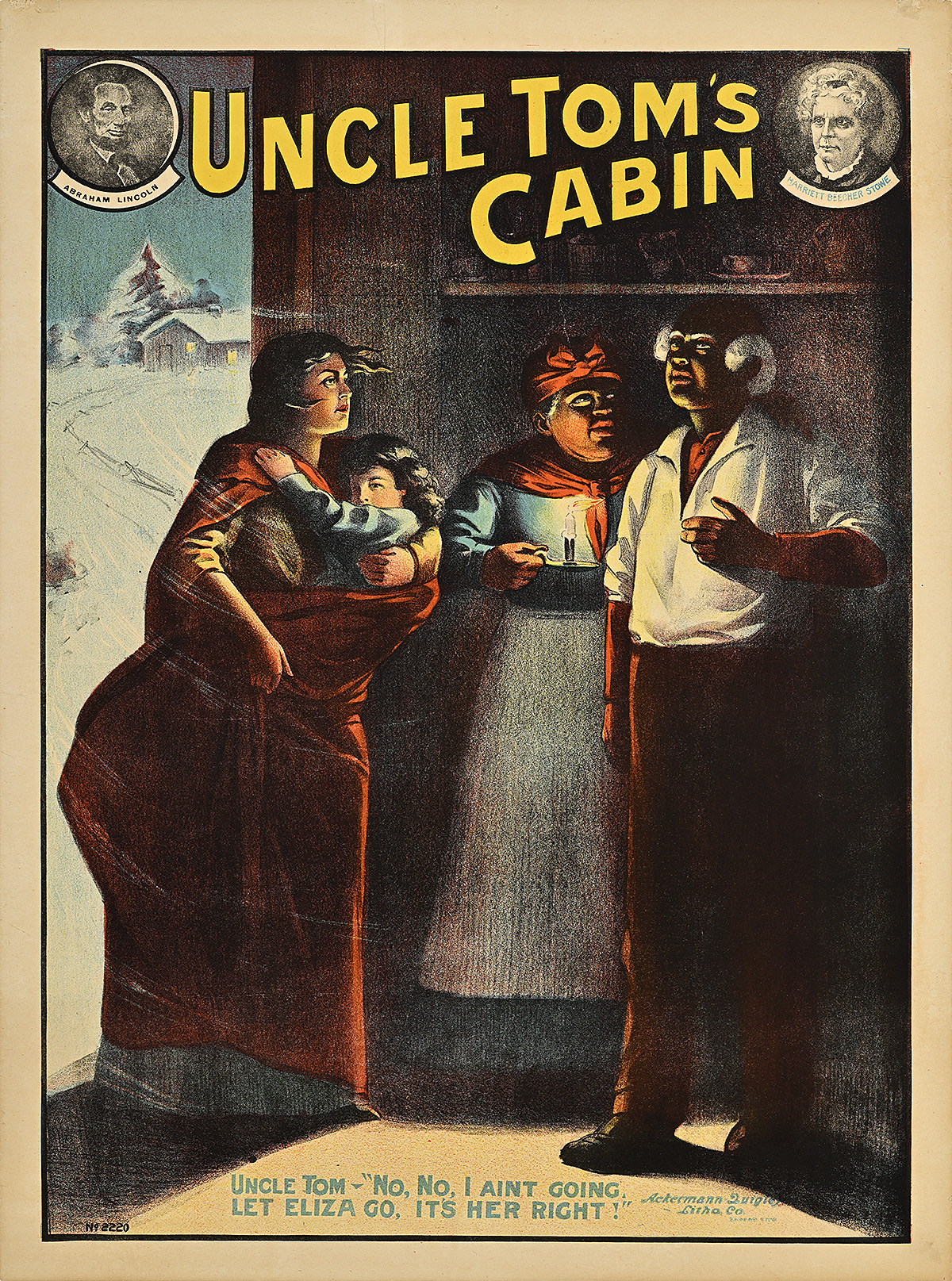
A poster of an older Black man and woman and a young woman holding a white child huddled inside during a snowstorm.

Uncle Tom’s Cabin, c. 1910

Designer Unknown

Poster House Permanent Collection

  • In 1852, Harriet Beecher Stowe published Uncle Tom’s Cabin as an abolitionist novel. It tells the story of Tom, an enslaved man who saves the life of Little Eva, the young white daughter of a Southern enslaver. Little Eva then encourages her father to purchase Tom for the family plantation. Uncle Tom’s Cabin became the best-selling novel of the 19th century and played a role in bringing complex Black characters to the attention of white readers, both those who empathized with and those who objected to its abolitionist messaging. 
  • While Stowe did not authorize any theatrical interpretations of Uncle Tom’s Cabin, the loose nature of 19th-century copyright laws allowed the book to be both formally and informally adapted for playhouses and traveling theater troupes, resulting in different versions of the story that became part of a broader American popular culture. Many of these adaptations dismissed the anti-slavery message and reframed the material as a minstrel show. Such racist depictions led to the development of the pejorative term “Uncle Tom,” alluding to a subservient Black man content with his condition of enslavement. Additionally, “Tom Shows” featuring minstrel buffoonery became especially popular after the Civil War.
  • Here, the character of Eliza, an enslaved woman, embraces her young son who is about to be sold to another enslaver. In this scene, Tom declares that he will remain on the plantation but encourages Eliza to run away—a moment in the story that is meant to appeal especially to white Northern women, who could empathize with the sacrifices of motherhood. In the poster, as in those for many adaptations, Eliza is comparatively lighter in complexion and thus positioned as both a sympathetic figure and an exceptional Christian because whiteness was seen as closer to godliness.

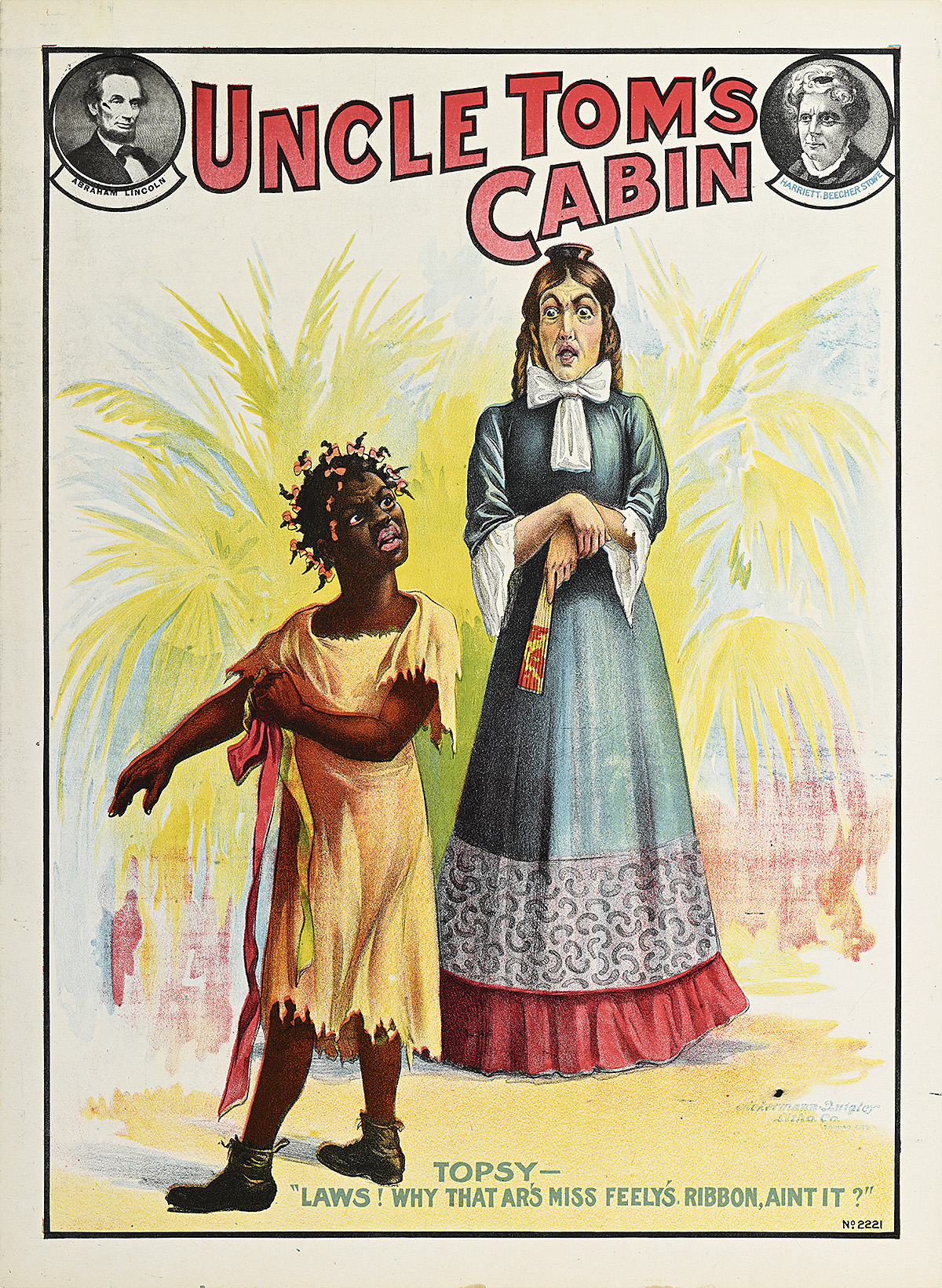
A poster of a small Black girl in ragged clothing holding a red ribbon looking at an angry white woman.

Uncle Tom’s Cabin/Topsy, c. 1910

Designer Unknown

Poster House Permanent Collection

  • Known as character posters, images like this one were commonly used to advertise theatrical productions and served to introduce or celebrate a given character through their most prominent personality trait or most famous scene. Here, Topsy, one of the best-known and most controversial figures in Uncle Tom’s Cabin, is shown interacting with Aunt Ophelia, a religious white woman; while outwardly an abolitionist, Ophelia retains certain prejudices against Black people. Her character is meant to satirize the de facto racism of white abolitionists in the Northern states, evidenced here by her agitated expression and apparent discomfort in the presence of Topsy.
  • Topsy is an enslaved child often viewed as a foil, or visual counterpoint, to the pristine innocence of Little Eva. She is almost always portrayed as a “pickaninny”—a disheveled Black child with unkempt hair and wide eyes, running wild and causing mischief. Though Topsy is described as naughty, Stowe used the character to comment on how the condition of enslavement strips children of their humanity and desensitizes them through neglect and abuse. 
  • In order to entice as wide an audience as possible, theatrical productions often created numerous advertising images for a single show, each highlighting a different facet of the work—some comic, others dramatic. Although Topsy is a minor character in the novel, she was frequently given top billing in posters for theatrical productions of Uncle Tom’s Cabin because of her popularity with audiences as comic relief. Actors portraying her (most often white women in blackface) typically leaned into slapstick humor and general buffoonery, creating an undignified image of Black youth that supported pro-slavery sentiments.
  • In this scene, Ophelia is attempting to teach Topsy religious doctrine and household skills but Topsy proves to be a difficult student. Ophelia gradually realizes that teaching children who have been subjected to the horrors of enslavement since birth is more challenging than she anticipated; rather than approach Topsy with empathy and patience, however, she becomes disgusted with her.

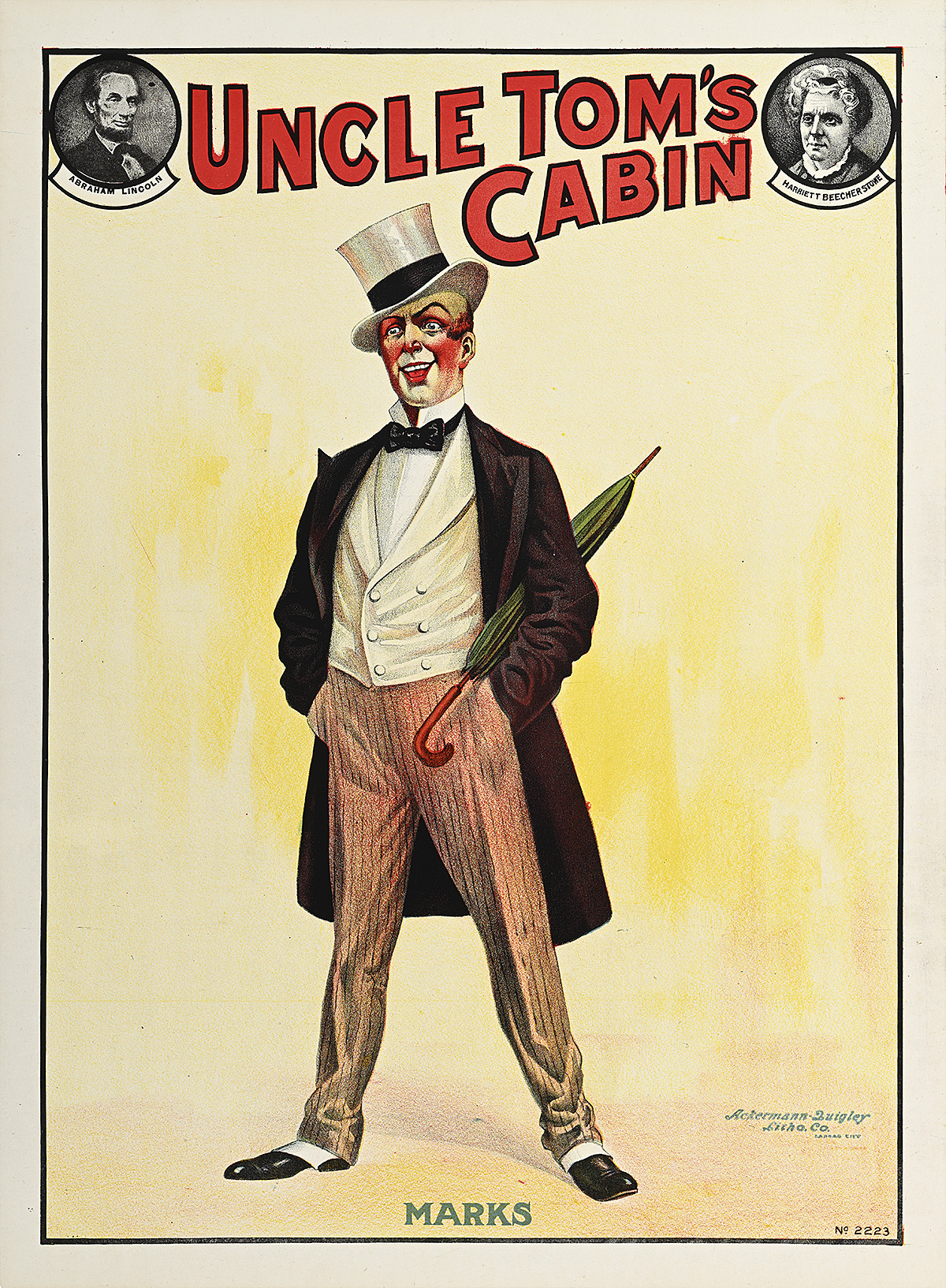
A poster of a white man in a suit and top hat with excessive makeup holding an umbrella.

Uncle Tom’s Cabin/Marks, c. 1910

Designer Unknown

Poster House Permanent Collection

  • This character poster introduces audiences to Marks, a lawyer and enslaver who hunts enslaved people who have escaped captivity. He was originally included in the novel to demonstrate the brutality of the system of enslavement in the American South. Though he is relentless and violent throughout the story, he is ultimately shown to be a coward when he flees a confrontation in which his business partner is shot by Eliza’s husband when he attempts to capture the enslaved man.
  • It is interesting that a separate character poster was made for Marks as he is not a prominently featured figure in the story and, unlike some of the others, he does not experience a dramatic shift in personality or opinion, remaining staunch in his support for the institution of enslavement.
  • The cameos at the upper left and right of the composition depict President Abraham Lincoln and Harriet Beecher Stowe, indicating that this is a performance linked to themes of enslavement and freedom. It also elevates Stowe, suggesting that her contributions to the liberation of Black Americans are on the same level as Lincoln’s Emancipation Proclamation of 1863. Cameos like this one were often included in posters for traveling circuses to indicate that a performance was official or otherwise authorized by those represented—which, in this case, was highly unlikely.
  • This poster advertises an unlicensed road show (a traveling theatrical performance) based on the novel. It was common for all characters in such stage adaptations to be performed by white actors in blackface so that the shows could be performed for exclusively white (mainly working-class) audiences.

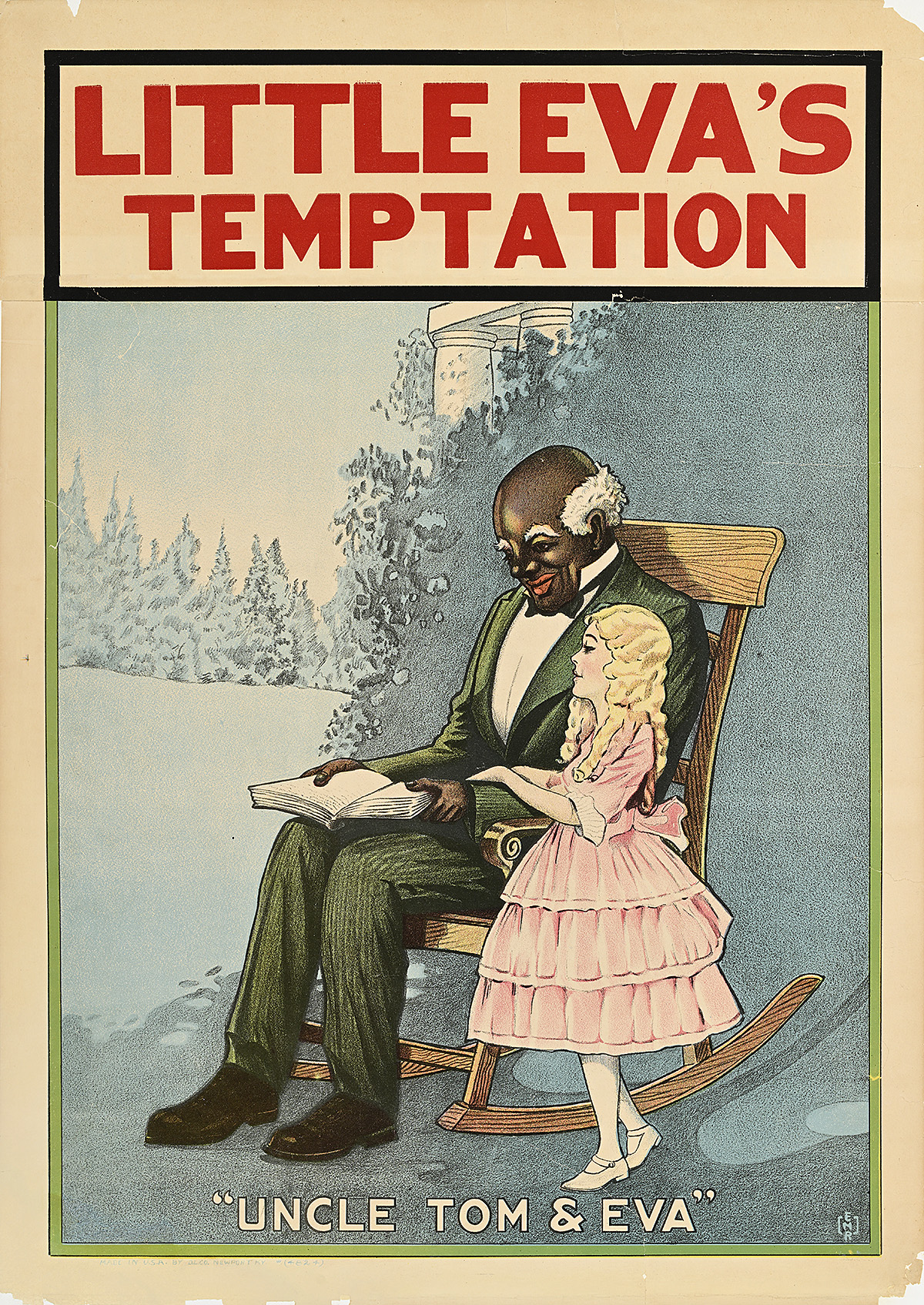
A poster of an older Black man and a small white girl reading a book together.

Little Eva’s Temptation, c. 1928

Emil Rothengatter (1848–1939)

Poster House Permanent Collection

  • As copyright laws were limited and difficult to enforce, many unlicensed spin-offs and parodies of Uncle Tom’s Cabin were performed throughout the late 19th and early 20th centuries in the United States. Written by Henrique Vivian Messetti in 1928, Little Eva’s Temptation was one of the productions advertised in newspapers as a “farce comedy” or “musical burlesque.”  
  • This is a stock poster. Printed in bulk, it would have been purchased from the printer by any theater company presenting a show inspired by Uncle Tom’s Cabin. The text banner (called a “tip-on” or “snipe”) was printed separately and pasted onto the image by the group that bought the poster. Other examples of this poster advertise different theater companies, including Harmount’s Uncle Tom’s Cabin Company. 
  • The poster presents a tender scene of Uncle Tom reading to Little Eva; however, it also displays the one-sided racial dynamics of the South during enslavement. Eva is shown as innocent and pure in her whiteness while Uncle Tom is a grandfatherly figure at the child’s emotional service. 
  • Stowe intended readers to perceive the relationship between Tom and Little Eva as one of empathy and understanding, especially when Eva falls ill and begs her father to free all the enslaved people on their plantation. In the end, Tom is whipped to death in a moment of self-sacrifice, one that evokes the fate of Jesus Christ. 
  • The depiction of Uncle Tom here underscores the historic practice of scripting Black people and using enslavement as the baseline for their identities. Both in the novel and in theatrical adaptations of it, the story’s principal Black characters are two-dimensional and only serve to uphold a white, optimistic narrative of potential interracial harmony. In all instances, the power imbalances between white and Black people persist, suggesting that the status quo would not be compromised even after emancipation. Narratives like this one, even when adapted as comedies, reinforce the idea of keeping Black people “in their place.”

Black Vaudeville

“We saw that the colored performer would have to get away from the ragtime limitations of the ‘darky’, and we decided to make the break, so as to save ourselves and others.”—George Walker, performer

In the period immediately following the Civil War, American vaudeville became increasingly popular among Black and white theatergoers. Its format of variety acts that combined comedy, dance, music, and drama could easily be adapted to the tastes of different regional audiences, most especially in the nation’s growing urban environments. In the 1880s, Black vaudeville emerged in response to segregation practices within circuits and touring companies that often limited revues to one “Black act” per show, meaning there was a limited amount of time allotted to Black performers on stage. In response to these restrictions, Black-only theaters opened and all-Black circuits (a network of venues that troupes would tour during a season) were born. The Chitlin’ Circuit, introduced in the 1930s, was the most notable of these, a network of entertainment venues that encompassed the southern, eastern, and midwestern United States and provided an organized and safe system for Black performers. This informal group worked around the social restrictions of the time to establish an audience and an economic base that would enable it to advance and sustain its creative work. 

Minstrelsy was a common form of entertainment during the 19th century; white and, eventually, Black people would perform in blackface—the practice of covering one’s face in black makeup with exaggerated lips to create characters that relied heavily on racist stereotypes to physically and linguistically portray Blackness. Though Black vaudeville incorporated blackface and borrowed cues from traditional vaudeville in the form of variety revues with singing, dancing, and comedy bits, it was also adapted to present stories that centered on race. 
Black performers and creators approached vaudeville in a variety of ways, with some playing into stereotypes and others subverting them through irony and humor. In both cases, Black vaudeville provided a path for performers to emerge as managers, songwriters, and celebrities as they reinterpreted minstrelsy—even though it sometimes compelled them to reinforce racist stereotypes in their performances that might be met with criticism from Black audiences. Posters and other printed material played an especially important role in centralizing images of Black people who both created and promoted theatrical productions.

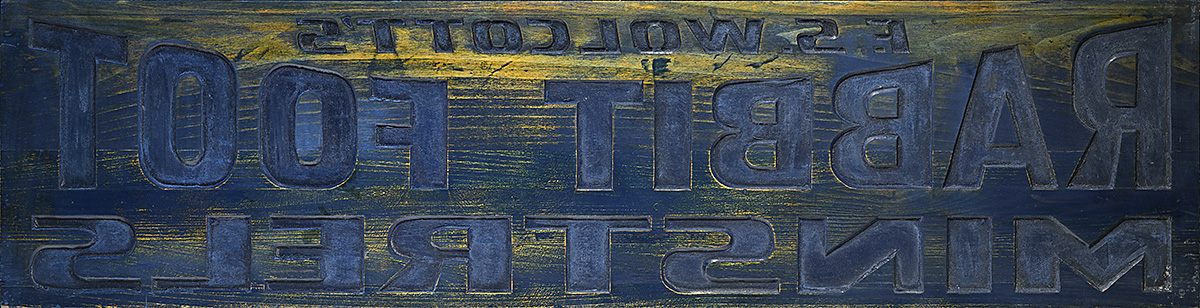
A wooden printing block with backward text.

Rabbit Foot Minstrels Printing Block, 1946

Collection of Hatch Show Print

  • Founded around the turn of the 20th century by Black entrepreneur Patrick Henry Chappelle, the Rabbit’s Foot Company was an all-Black tent show and revue. While Chappelle himself refrained from calling the production a minstrel show, after his unexpected death in 1911 it was purchased by white producer Fred Swift Wolcott, who renamed the troupe the Rabbit Foot Minstrels.
  • This carved printing block shows the name of the new proprietor and highlights the minstrel-show aspect of the production. Wolcott advertised it as the “Greatest Colored Show on Earth,” a riff on the tagline of the famous Barnum & Bailey’s Circus, and often promoted it as an “authentic” minstrel show since the entire cast was Black.

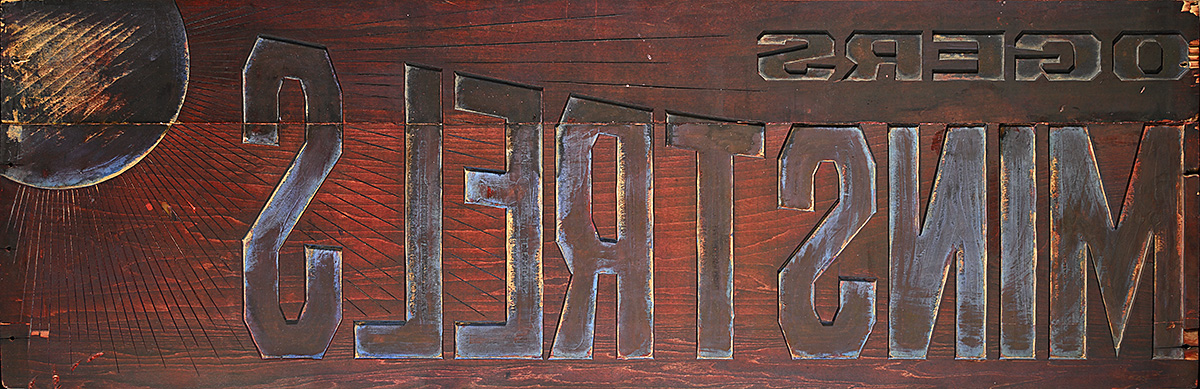
A red toned wooden printing block with backward text.

Rogers Minstrels Printing Block, c. 1925

Collection of Hatch Show Print

  • Woodblock printing was less expensive than lithography and therefore became a common technique for creating advertising material for productions with modest budgets. Blocks like this one could be combined with additional text and imagery to create a custom design, allowing traveling shows to adapt it to each venue. The letters and sun icon carved into this printing block of long-grain basswood formed part of a large, multipiece header for the Rogers Sunshine Minstrels.
  • Established in 1879 in Nashville, Tennessee, Hatch Show Print is a letterpress printer focusing on entertainment posters. Unlike many printers in the South that would only work with white businesses, Hatch also produced posters for those that served Black communities. Since it had a large print studio, Hatch was able to offer clients a variety of stock imagery that could be combined with title blocks like this one to create a semi-bespoke announcement. Smaller text for a poster would be hand-set using woodtype.

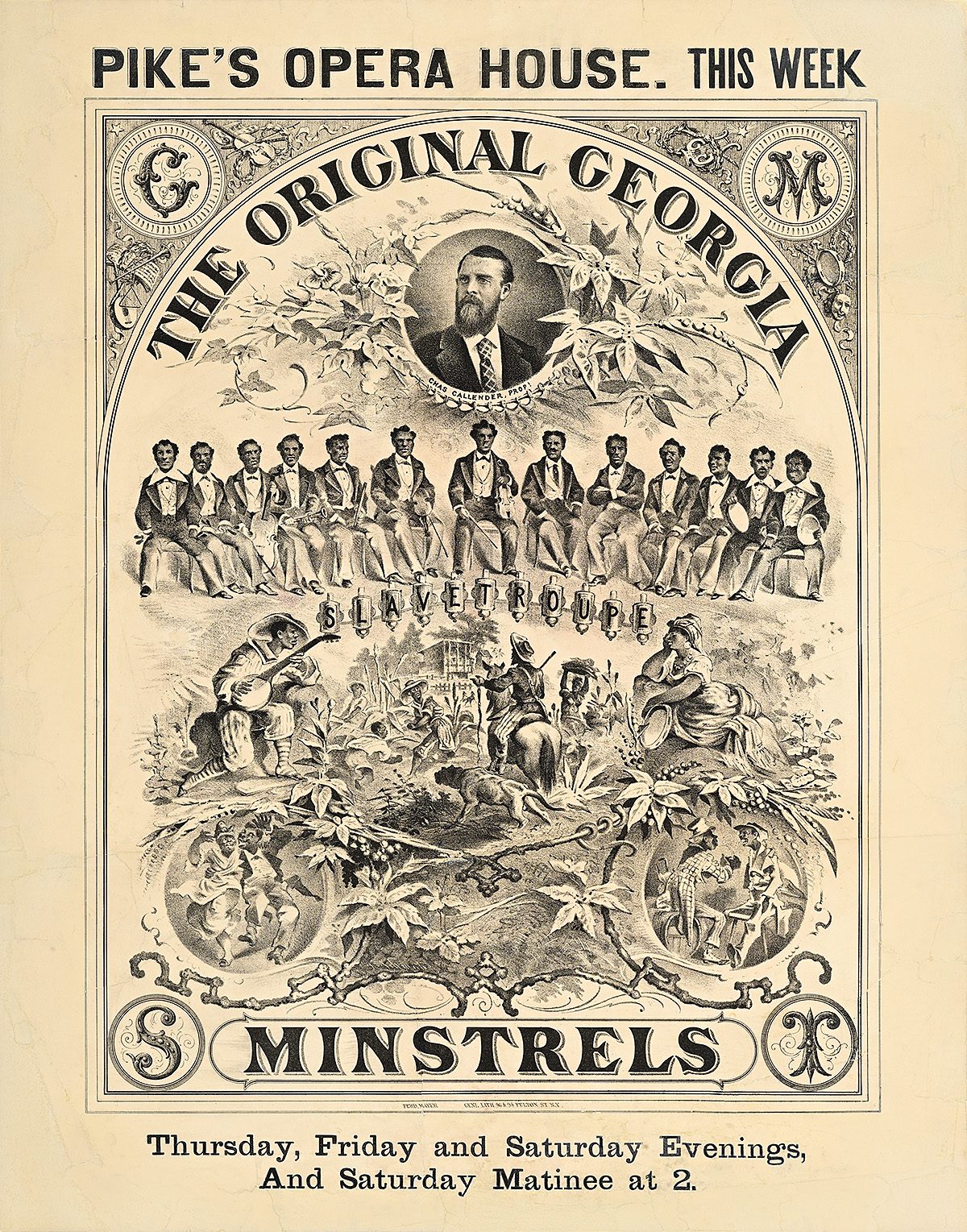
An elaborate poster of men with dark skin sitting in a line above vignettes of people playing instruments and dancing.

The Original Georgia Minstrels, c. 1872

Ferdinand Mayer (1817–79)

Poster House Permanent Collection

  • Formed by Black manager Charles B. Hicks in 1865, the Georgia Slave Troupe Minstrels (promoted under several similar names over the years) was the first popular all-Black minstrel troupe composed of formerly enslaved men. Hicks promoted his troupe as “authentic” minstrel performers, presenting plantation narratives with brown-skinned men in blackface. In 1872, Hicks sold his company to Charles Callender, a white man who had worked on the show as part of Hicks’s team. 
  • Following the Civil War, the words “Georgia” and “Dixie” became synonymous with blackface minstrelsy in theater, representing the South and a nostalgia for plantation life. As such, these words were often included in minstrel posters even if the troupes themselves were neither from Georgia nor the South. These images evoked the myth of the Lost Cause, an interpretation of the Civil War that portrays the fight of the Confederate States as honorable and just while rejecting or decentering the critical role of the institution of slavery. 
  • As in most circus and vaudeville advertising of the time, the proprietor’s portrait is featured in a cameo at the top of the poster. Below him, the 13 members of the original minstrel troupe are shown in matching formal costumes, their individual facial features barely distinguishable. This juxtaposition reinforces a sense of Callender’s control over the formerly enslaved performers. 
  • The tableau that dominates the lower half of the poster shows a violent plantation scene flanked by vignettes of carefree and happy-go-lucky Black figures. Such depictions are similar to the “Uncle Tom” trope and serve to uphold a disingenuous, white view of a Black lived experience.

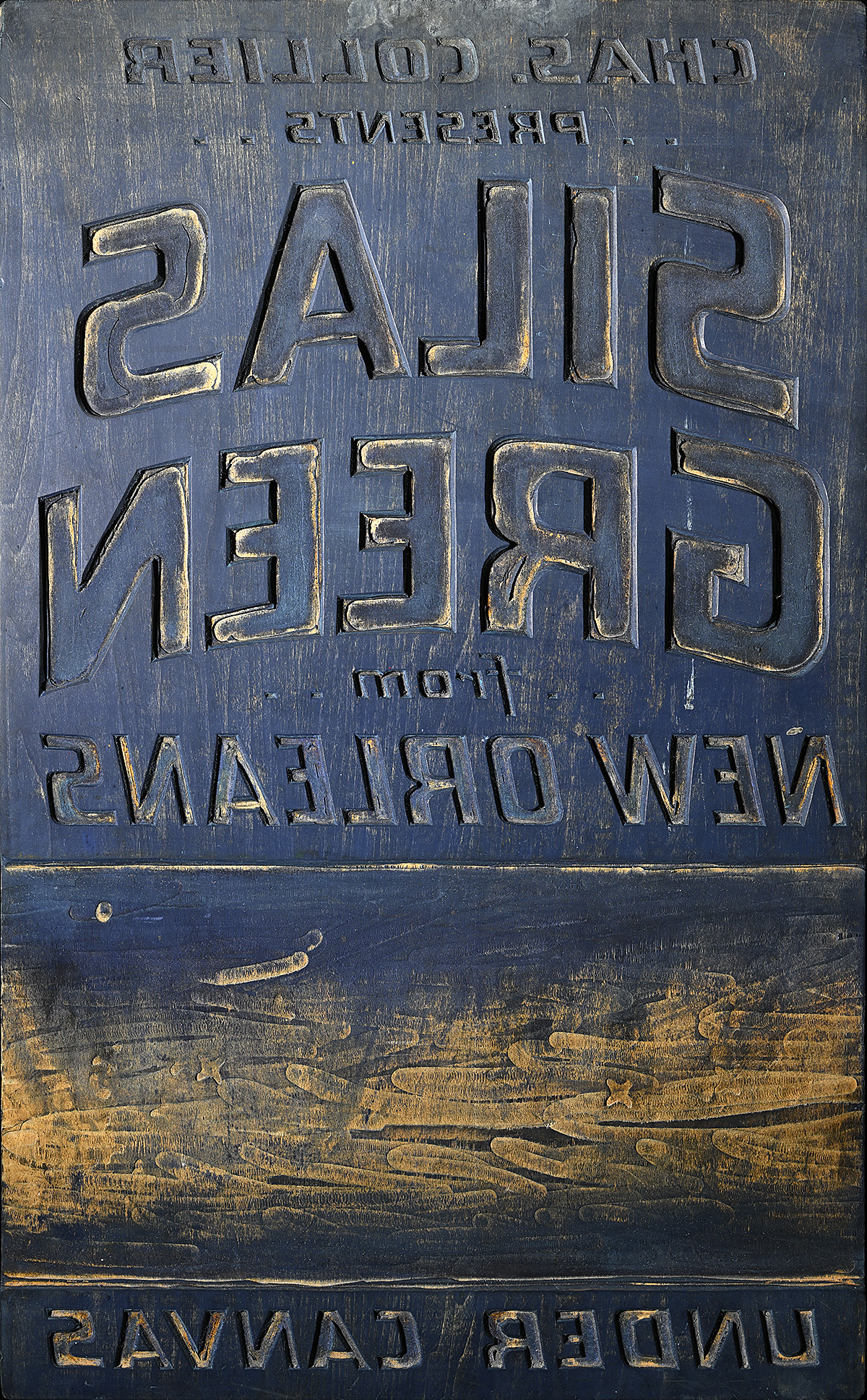
A wooden printing block with backward text.

Silas Green from New Orleans Printing Blocks, c. 1945

Collection of Hatch Show Print

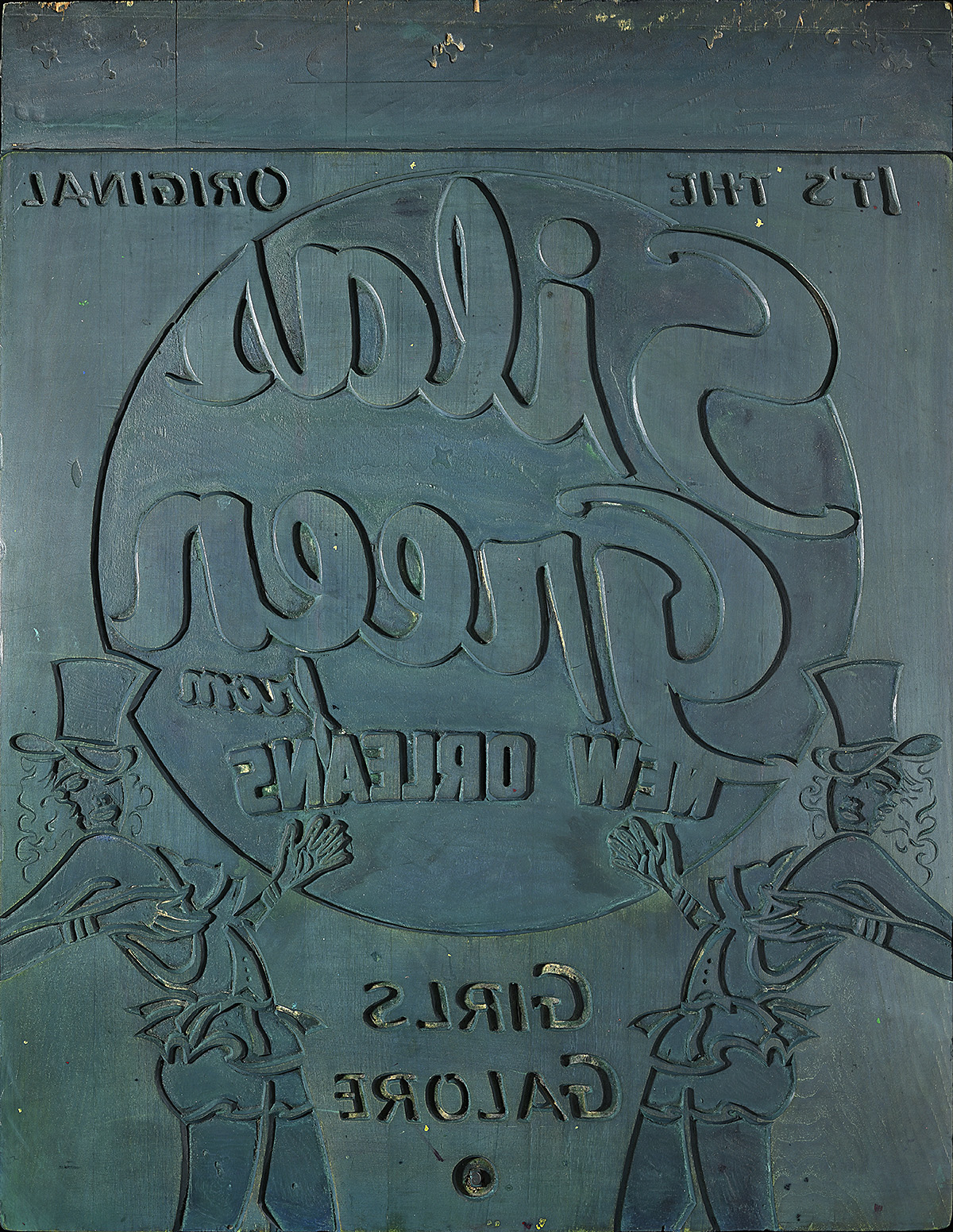
A green toned printing block with two dancing women and backward text.

Silas Green from New Orleans Printing Blocks, c. 1945

Collection of Hatch Show Print

  • In 1908, soprano Matilda Sissieretta Joyner Jones (nicknamed “The Black Patti” in reference to the famed Spanish-Italian opera singer Adelina Patti) introduced the song “Silas Green from New Orleans” in the musical revue Black Patti Troubadours. The vaudevillian brothers Salem Tutt Whitney and J. Homer Tutt were so inspired by the song that Whitney created the character of Silas Green and a variety show built around the misadventures of two Black men with contrasting outward appearances. 
  • In 1910, Ephraim “Eph” Williams—the only known Black American circus owner—bought the rights to the production and turned it into a traveling tent show that toured throughout the Southern United States between 1904 and 1957.
  • As a result of its tremendous popularity, the variety show Silas Green from New Orleans became one of Hatch Show Print’s largest clients during the first half of the 20th century. There is a large surviving archive of hand-carved blocks and metal photo plates that document the evolution of Williams’s promotion of the show over the decades.
  • The two accompanying prints are contemporary restrikes made from the original blocks. While original posters do not survive, heritage printers like Hatch frequently make use of vintage carved blocks like these to prevent them from drying out and cracking as well as to learn from and appreciate the artistry of the designs. These types of posters would have been printed and circulated as Silas Green from New Orleans traveled around the country.

Black Music

“The 1920’s were the years of Manhattan’s black Renaissance. It began with Shuffle Along, Running Wild, and the Charleston. Perhaps some people would say even with The Emperor Jones…”—Langston Hughes, poet

Minstrel performances often incorporated the obligatory “coon song” or “cabin song” that borrowed from the music traditions of enslavement but added offensive and degrading language to objectify the enslaved person’s condition. Starting in the 1880s, an informal collective of songwriters and music publishers who created sheet music in New York City formed what was colloquially known as Tin Pan Alley. Black songwriters, who made up a small but influential part of this group, wrote a variety of songs, including pieces that departed from stereotypical interpretations. 

Sheet music covers, printed in large editions and sold both nationally and internationally, provide some of the only surviving imagery that accompanied popular songs of the vaudeville era. More so than posters, sheet music entered theaters and homes, advancing popular musical entertainment and becoming essential to the monetization and promotion of the early music industry. These elaborately illustrated works are also often the only remaining printed materials that document Black performers, music producers, and songwriters from this period. As many Black performers began their careers as singers or dancers, music became the most prominent element of Black vaudeville that later translated into the new medium of film. Behind the scenes, producers and directors would write or be inspired by songs that communicated the diversity of Black people’s experiences into the 20th century.

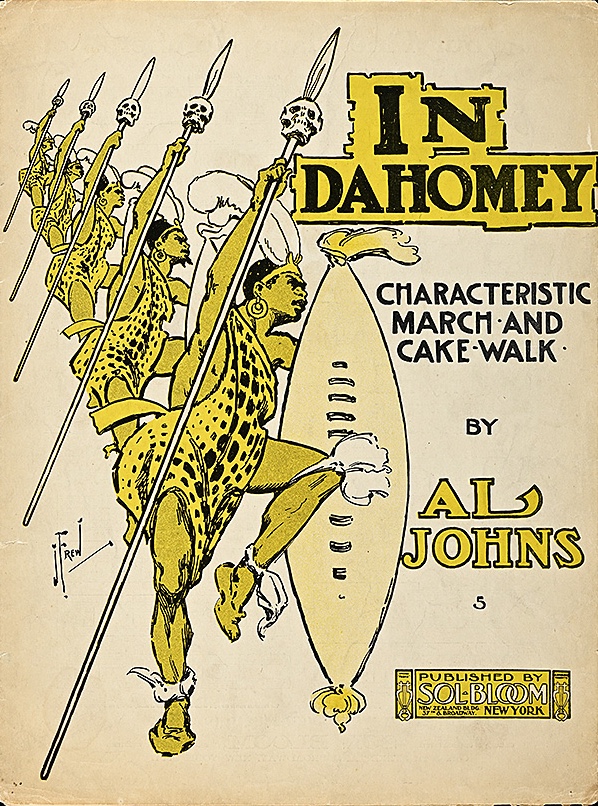
Five warriors in a receding line holding spears topped with skulls and wearing feathers on their heads.

In Dahomey, 1902

John Frew (1875–1955)

Collection of John T. Reddick

  • Bert Williams and George Walker decided to create a production that would combine African themes and Black American showmanship. In 1902, the men teamed up with Will Marion Cook and other notable composers, including Al Johns, who is mentioned on this sheet music cover, to produce the song “In Dahomey.” It would become the title song of a full-length musical that opened at the New York Theatre on Broadway in 1903. 
  • The musical follows two Black conmen from Boston who travel to Dahomey (then a French colony and today the Republic of Benin) with plans to colonize the country. In Dahomey was one of the first vaudeville shows to address the European colonization of the African continent.  
  • This sheet music cover shows the cakewalk, a processional dance that took root in enslaved communities of the South where they mocked the poised strut and exaggerated dance movements of white enslavers. Williams and Walker helped popularize this style of performance, often accompanied by fellow vaudeville singer, dancer, and choreographer Aida Overton Walker, known as “Queen of the Cakewalk.” She would elevate the dance into an international craze, the first to be associated with Black American culture.
  • Advertising for In Dahomey employed primitive stereotypes, often including generic shields and spears in reference to the African setting of some of the scenes in the play. This sheet music cover “Africanized” the cakewalk number in the musical, combining a traditional Black American performance with tribal motifs.

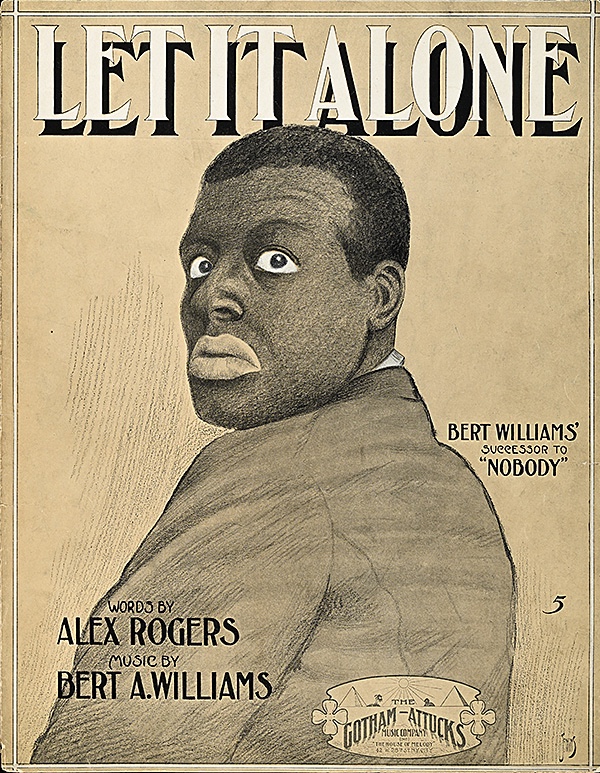
A drawing of a Black man with his head turned over his shoulder and a nervous expression on his face.

Let It Alone, 1906

Jenkins (Dates Unknown)

Collection of John T. Reddick

  • Written by and starring Black entertainers, Abyssinia is a one-act musical set in Abyssinia (present-day Ethiopia and Eritrea). It tells the story of two Black American men who win the lottery and use the money to travel abroad, where one is falsely accused of being a thief and brought to the court of the King of Abyssinia for judgment. 
  • Although it was a comedy, the themes in the musical were rooted in the First Italo-Ethiopian War of 1895–96, one of the first decisive victories by an African nation over European colonizers. This important narrative was frequently referenced within the history of Black self-determination.  
  • The song “Let It Alone” was one of the musical’s most popular numbers, and thousands of copies of the sheet music for the song were sold across the United States. The lyrics combine slice-of-life wisdom with humor, encouraging listeners to avoid conflict and accept that some things are unknown. This wry commentary on ordinary life brought humanity and pathos to otherwise marginalized minstrel characters. This particular edition of the sheet music also carried a deftly rendered portrait of a Black man making direct eye contact with the viewer into homes and entertainment venues all over the United States.

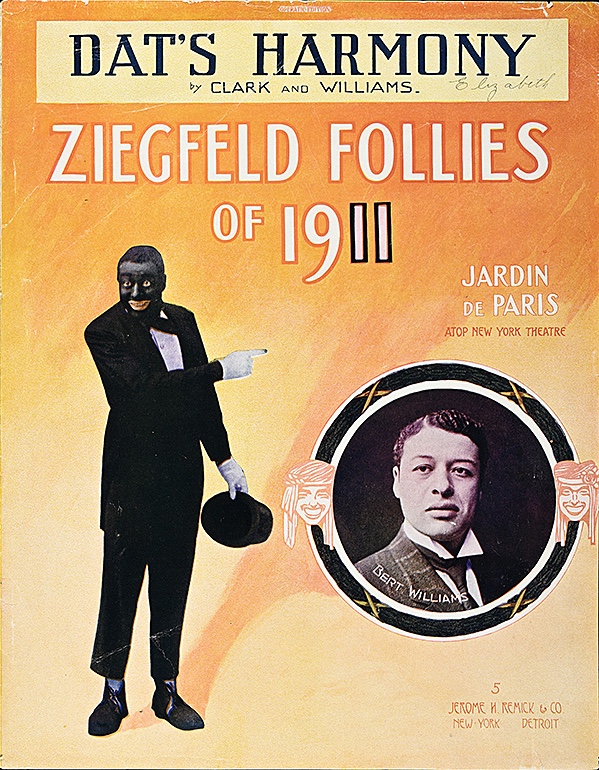
A Black man in a suit pointing to a circle enclosing a black and white photograph of a young man's face.

Ziegfeld Follies of 1911, 1911

Henry Mayer (1868–1954)

Collection of John T. Reddick

  • Inspired by the Folies Bergère cabaret in Paris, Broadway impresario Florenz Ziegfeld introduced his Ziegfeld Follies in 1907 as an elaborate vaudeville revue featuring beautiful, white chorus girls. The wildly successful show ran through 1931 and established an especially lavish style of American production that would influence other forms of entertainment throughout the 20th century. 
  • In 1910, Ziegfeld invited Bert Williams to appear in a segment in the Follies revue the following year. When the news was publicly announced that Williams would join the all-white production, the cast threatened to boycott the show and theatergoers protested this attempt at integration. Despite these negative reactions, Williams did perform in the Ziegfeld Follies of 1911. 
  • While Williams’s appearance on a Ziegfeld stage was a landmark event for Black visibility, he was not given the freedom to write his own material as he had done in previous shows. Instead, Ziegfeld’s writers scripted his routines to reflect their understanding of what was palatable to a white audience. Since what made Williams and Walker a revolutionary act was their control over the definition of “authentic” minstrelsy, this move put Black artistic expression back into the hands of white writers.
  • This sheet music cover for the song “Dat’s Harmony” shows Williams both in blackface and without it—an important distinction when considering audience reception and eventual acceptance of a Black man on stage with white actors. The photograph of Williams in costume was taken by New York photographer Samuel Lumiere but was colorized for the sheet music, removing the studio quality of his full body image and emphasizing caricature versus reality. Williams continued to perform with the Follies through 1919, by which time he was receiving equal billing on the marquee with the top white stars.

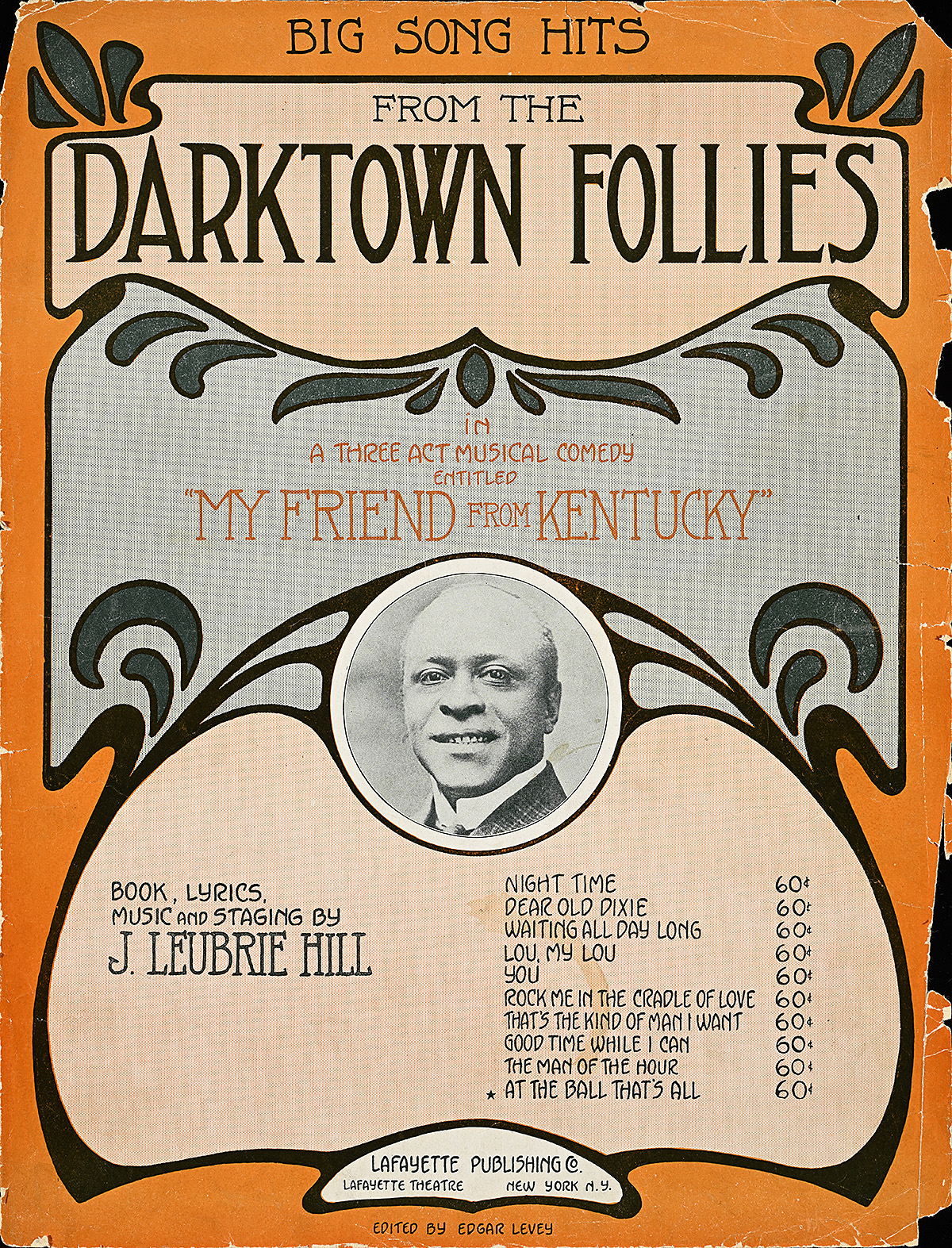
A small circular black and white photograph of a man's face in the center of an art nouveau design.

Darktown Follies, 1913

Designer Unknown

Collection of John T. Reddick

  • In 1912, the Lafayette Theatre opened in Harlem. It quickly became one of the first major theaters in the nation to desegregate; Black theatergoers were permitted to sit with white patrons throughout the venue rather than being restricted to the balcony. This souvenir program includes sheet music and was printed by the publishing branch of the theater. 
  • The Anita Bush Stock Company, a Black female-founded repertory troupe, often performed at the theater. One of its most popular musical revues was the Darktown Follies, with music by Black songwriter J. Leubrie Hill who also wrote songs for William and Walker musicals and, later, for the Ziegfeld Follies. Along with other Black entrepreneurs, Hill helped establish the Colored Consolidated Vaudeville Exchange, the first Black-operated vaudeville circuit established to protect performers and secure venues. 
  • Much of Darktown Follies consists of tap-dancing sequences and episodic numbers. It tells the story of a Black man who sells his father-in-law’s plantation, leaves his domineering wife, and travels to Washington DC in search of an elite social circle into which he can marry. The story was ideally suited to the songs and dances that communicated romantic plotlines between the characters, some of the earliest representations of love between Black people on a major stage. While depictions of Black romance were not explicitly prohibited in vaudeville, there was a general aversion to presenting such scenes to audiences; Black romance was believed to be obscene and lewd, meaning that Black characters were typically scripted as aromantic and emotionally unserious. 
  • Darktown Follies was one of many shows that lured white audiences to Harlem as cultural tourists. The particular success of the revue and others like it with white audiences eventually led white theater producers like Ziegfeld to mine Black shows for content and to purchase music from Black composers.

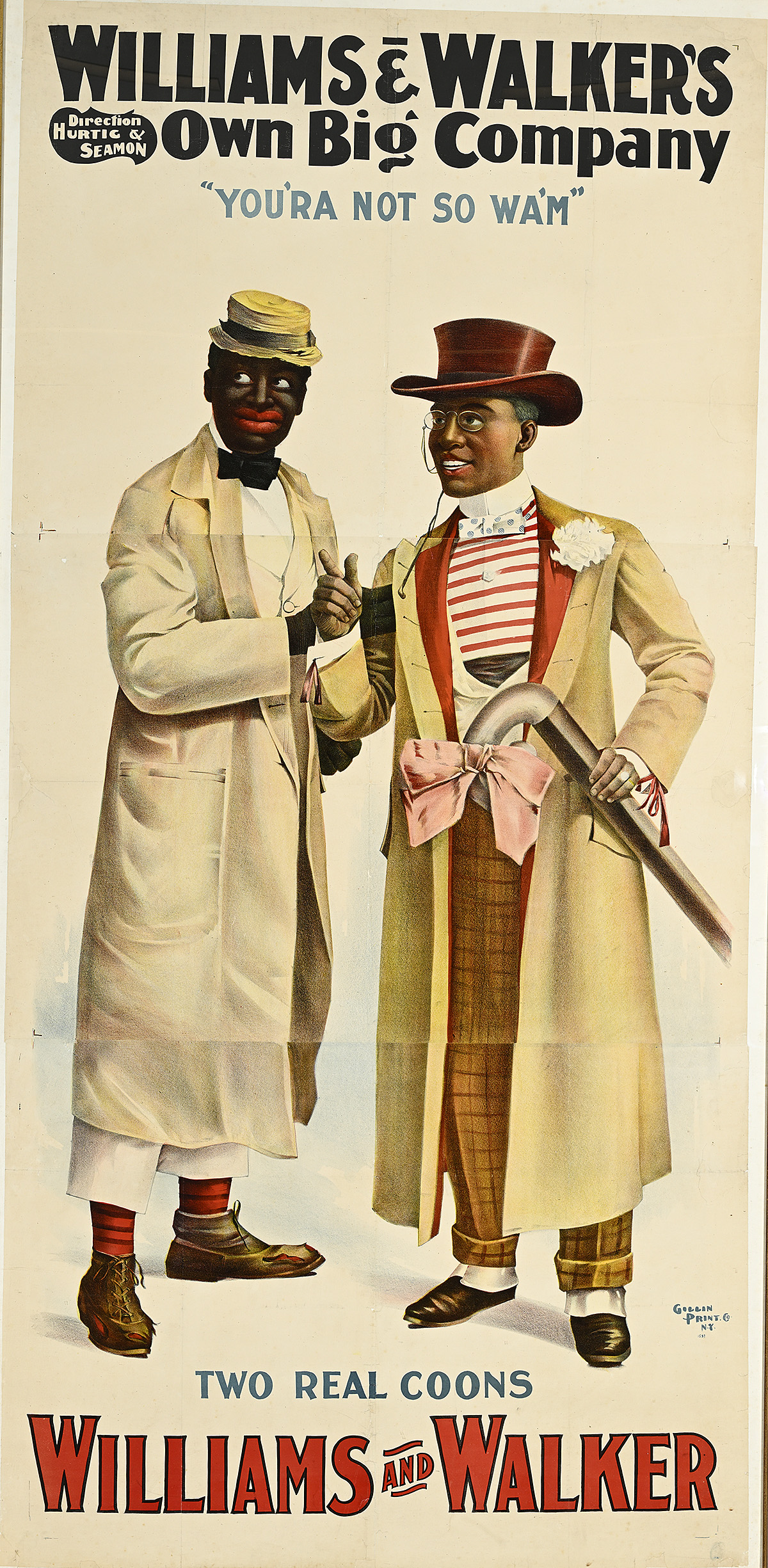
A narrow poster of two Black men in long coats and brimmed hats pointing and looking off into the distance.

Williams and Walker, 1903

Designer Unknown

Collection of Cynthia D. Stubbs-Hill and Hugh A. Hill

  • Born in the Bahamas, Bert Williams (born Egbert Austin Williams) was a pioneer in vaudeville and musical theater who performed in blackface and forged a new place for Black performers in the field. While performing in Martin and Selig’s Mastodon Minstrels in 1893, he met his future performance partner George Walker; the two men decided to create their own vaudeville show, maintaining ownership over their material and business from the start.
  • After observing white actors in blackface attempt caricatures of Blackness, Williams and Walker dubbed themselves “Two Real Coons” in order to emphasize the authenticity of their performance. To subvert the popular character of Jim Crow, typically characterized as an unintelligent and shabbily dressed trickster, their act featured well-dressed Black men performing minstrelsy. Rather than rely on standard reductive portrayals, their act offered emotional depth and irony—a unique and powerful take on the genre. 
  • This poster depicts the two men in their respective stage roles: Williams wears blackface in the comic role of the Zip Coon (a lazy urban or free Black man), while Walker (who has a darker complexion than Williams) is not in blackface and is dressed in more tailored, ostentatious attire in the role of the dandy straight man (an offshoot of the Zip Coon).
  • While the poster does not include the title of a specific play, it is possible that it served as an advertisement for In Dahomey, the first full-length musical entirely written and performed by Black people. Jules Hurtig and Harry Seamon, the show’s producers, owned a number of theaters in Harlem and in 1913, they became the original lease tenants for Hurtig and Seamon’s New (Burlesque) Theater (later renamed the Apollo Theater by its new owner). The poster also notes that Williams and Walker own the act, an important shift in control over the creative expression and lived experience of the stories told on stage.

An illustration of a Black young man in a suit looking adoringly at a seated young Black woman in an orange dress.

Shuffle Along, 1921 

William Austin Starmer (1872–1957) and Frederick Waite Starmer (1878–1962)

Collection of John T. Reddick

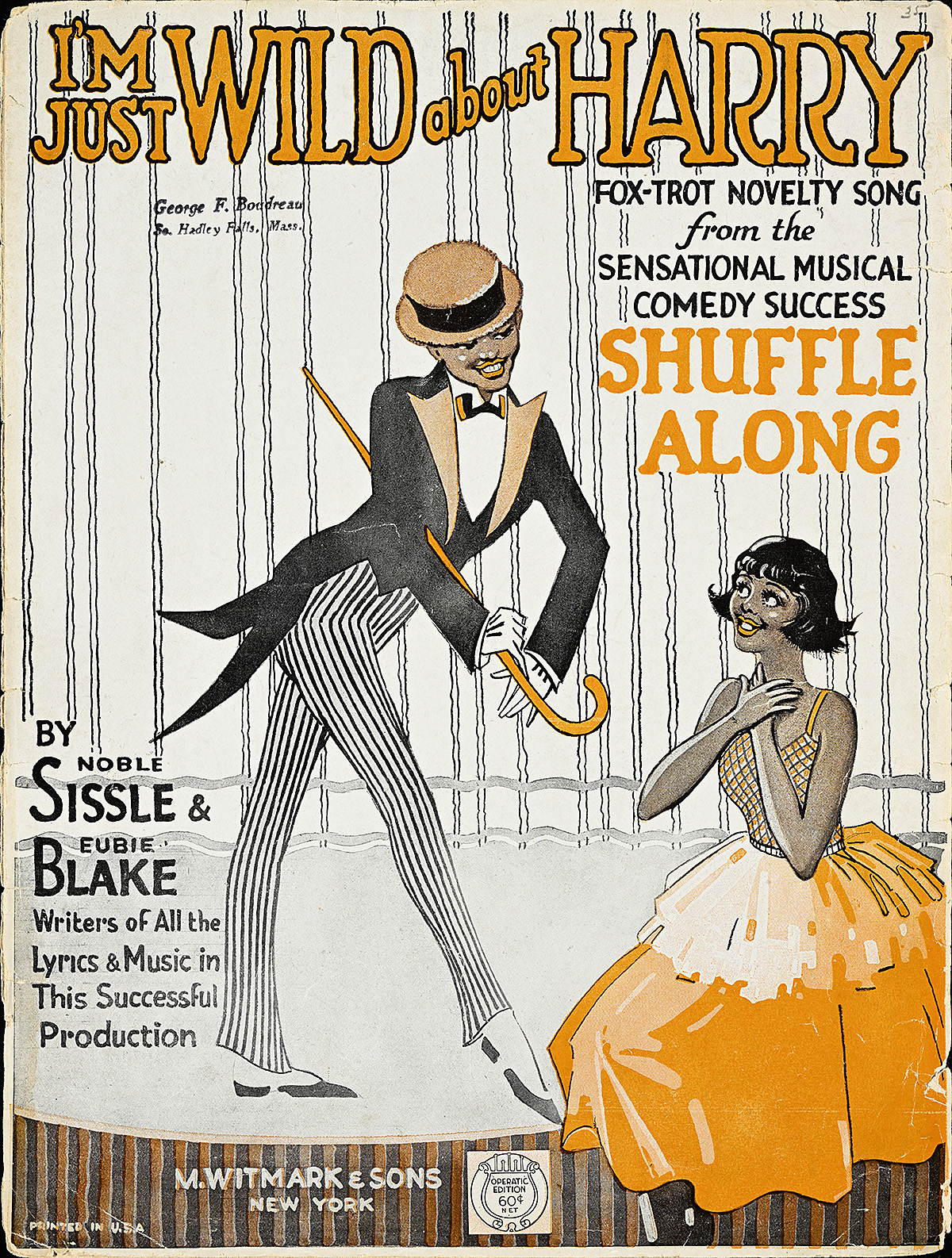
  • Often cited as one of the most important Black American cultural events that contributed to the emergence of the Harlem Renaissance, the musical Shuffle Along premiered on May 23, 1921, at Daly’s 63rd Street Music Hall (renamed Daly’s 63rd Street Theatre the following year). Produced by an all-Black team, it featured complex dance numbers, catchy songs, and a genuine romantic plot between Black lovers, represented in the song “Love Will Find a Way.” The jazz score composed by Eubie Blake and Noble Sissle also brought a distinctly Black style of music to Broadway.
  • Unlike those for other Broadway shows at the time, the audience for Shuffle Along was fully integrated, a moment in the slow evolution of efforts to center Black people within Black entertainment.
  • The extreme success of Shuffle Along meant that multiple printings of sheet music from the show were distributed across the country. This example came from a shop in Hadley Falls, Massachusetts. 
  • This cover of this early edition of one of the musical’s most popular songs, “I’m Just Wild About Harry,” shows an elegant Black couple; a finely dressed gentleman courts a sophisticated ingénue in a scene that was rare at a time when shallow and undignified depictions of Black life were still the norm. Such imagery reaffirms the importance of depth in Black storytelling and the humanity shaped by romance.

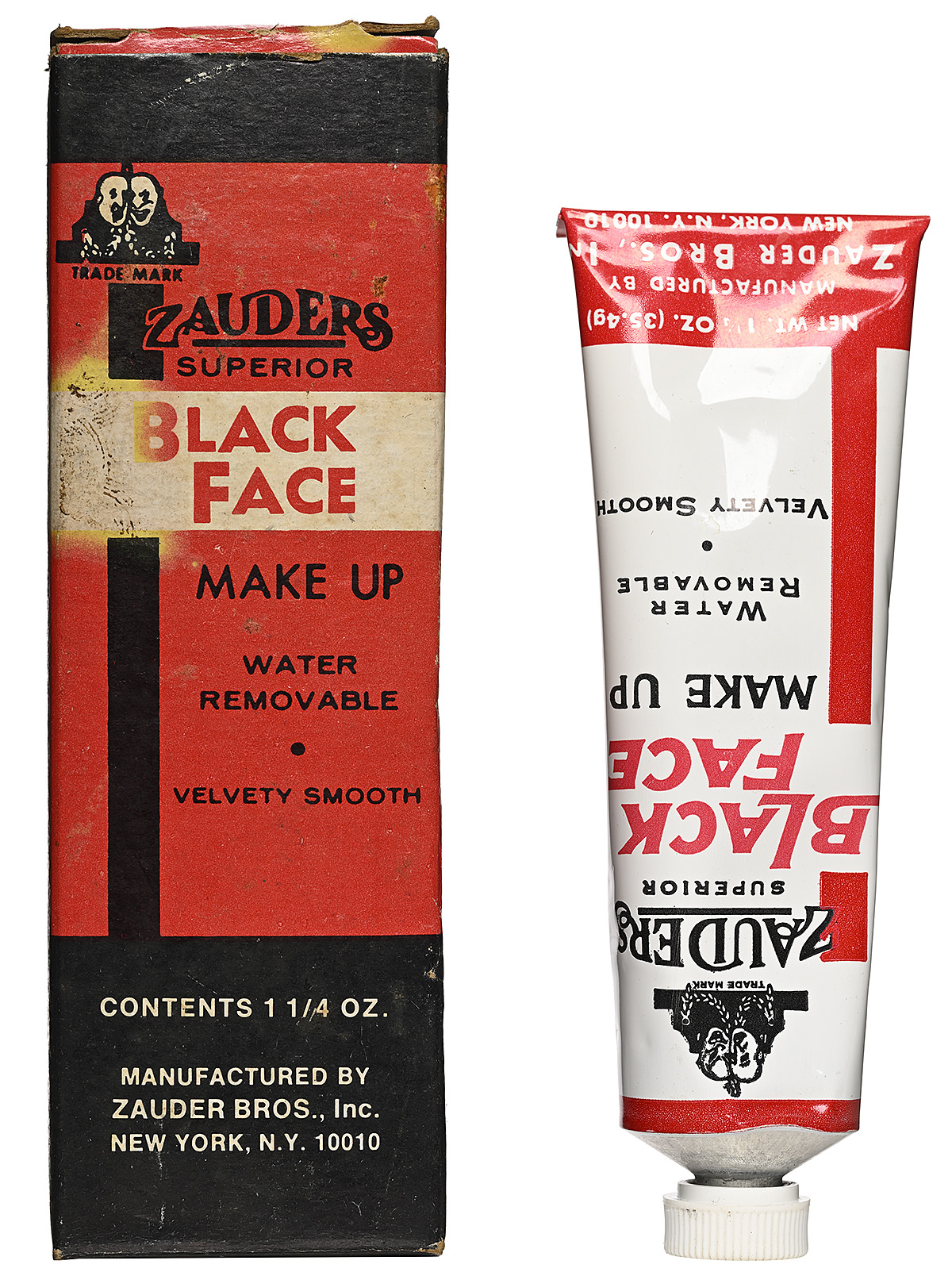
An orange rectangular box with black text next to a skinny tube both with small theater masks at the top.

Theater Makeup and Accessories, c. 1930

Private Collection, NYC

The top of a yellow circular tin with black text.

Theater Makeup and Accessories, c. 1930

Private Collection, NYC

A black wig on a thin metal stand.

Theater Makeup and Accessories, c. 1930

Private Collection, NYC

A red and black rectangular box next to an upside down red and white tube.

Theater Makeup and Accessories, c. 1930

Private Collection, NYC

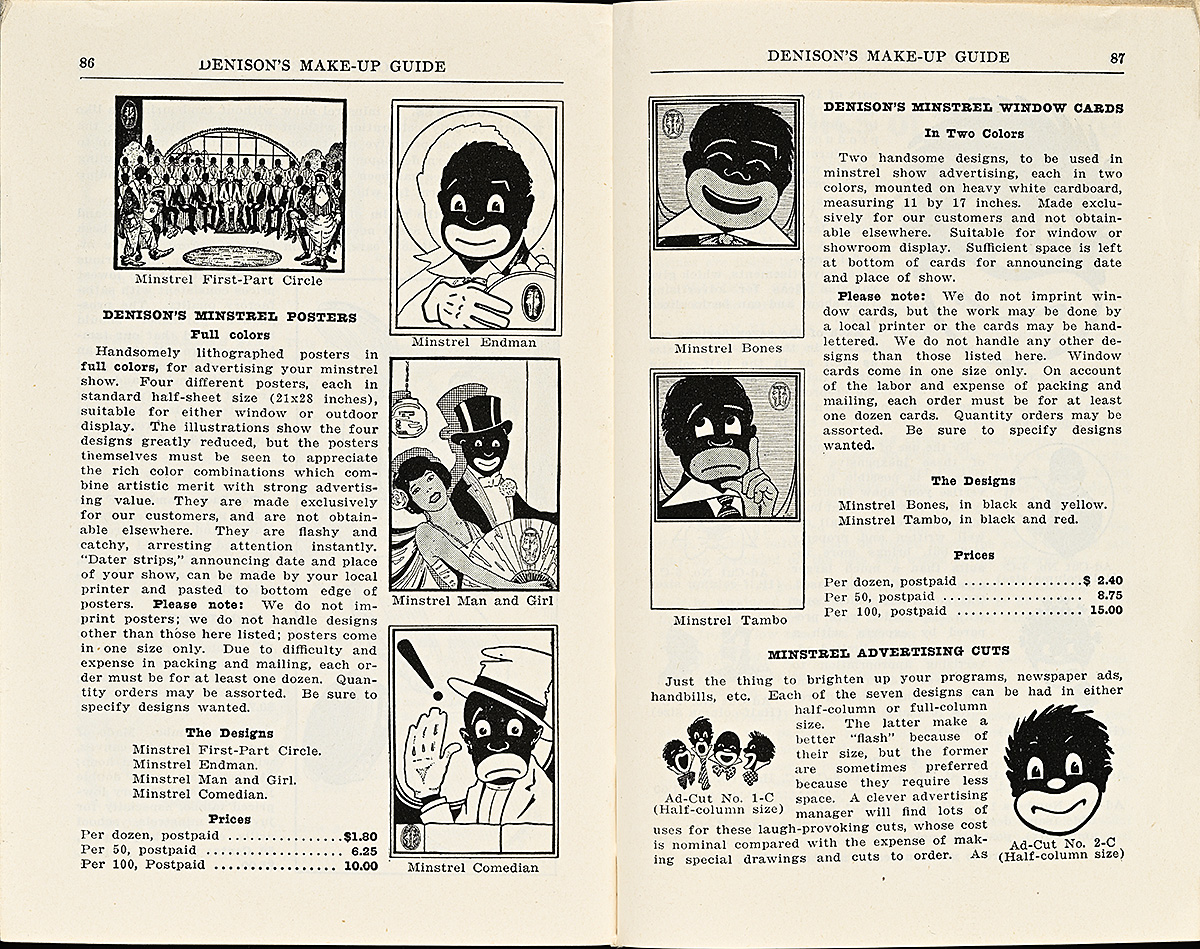
Two open book pages with black and white illustrations and text.

Theater Makeup and Accessories, c. 1930

Private Collection, NYC

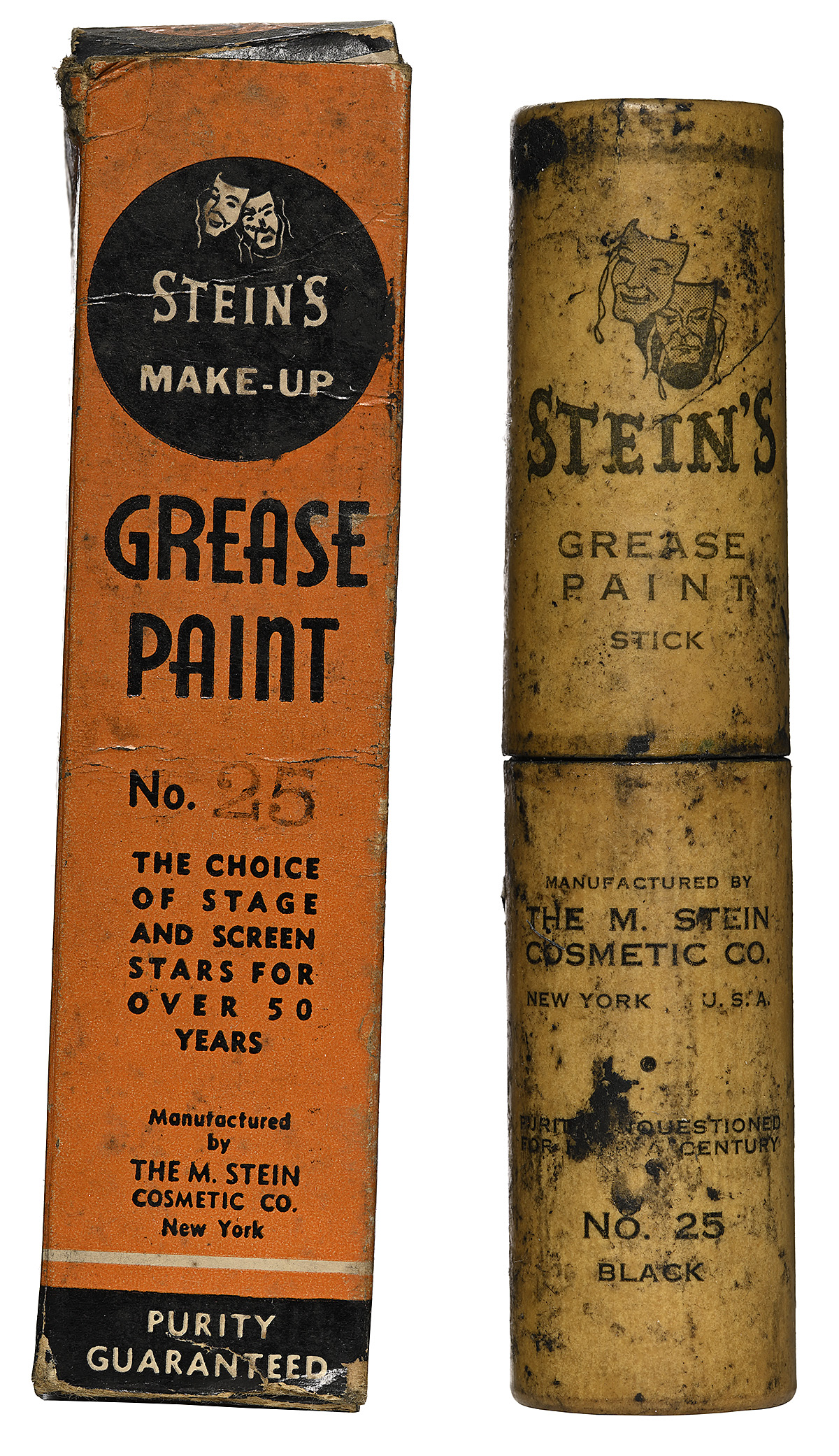
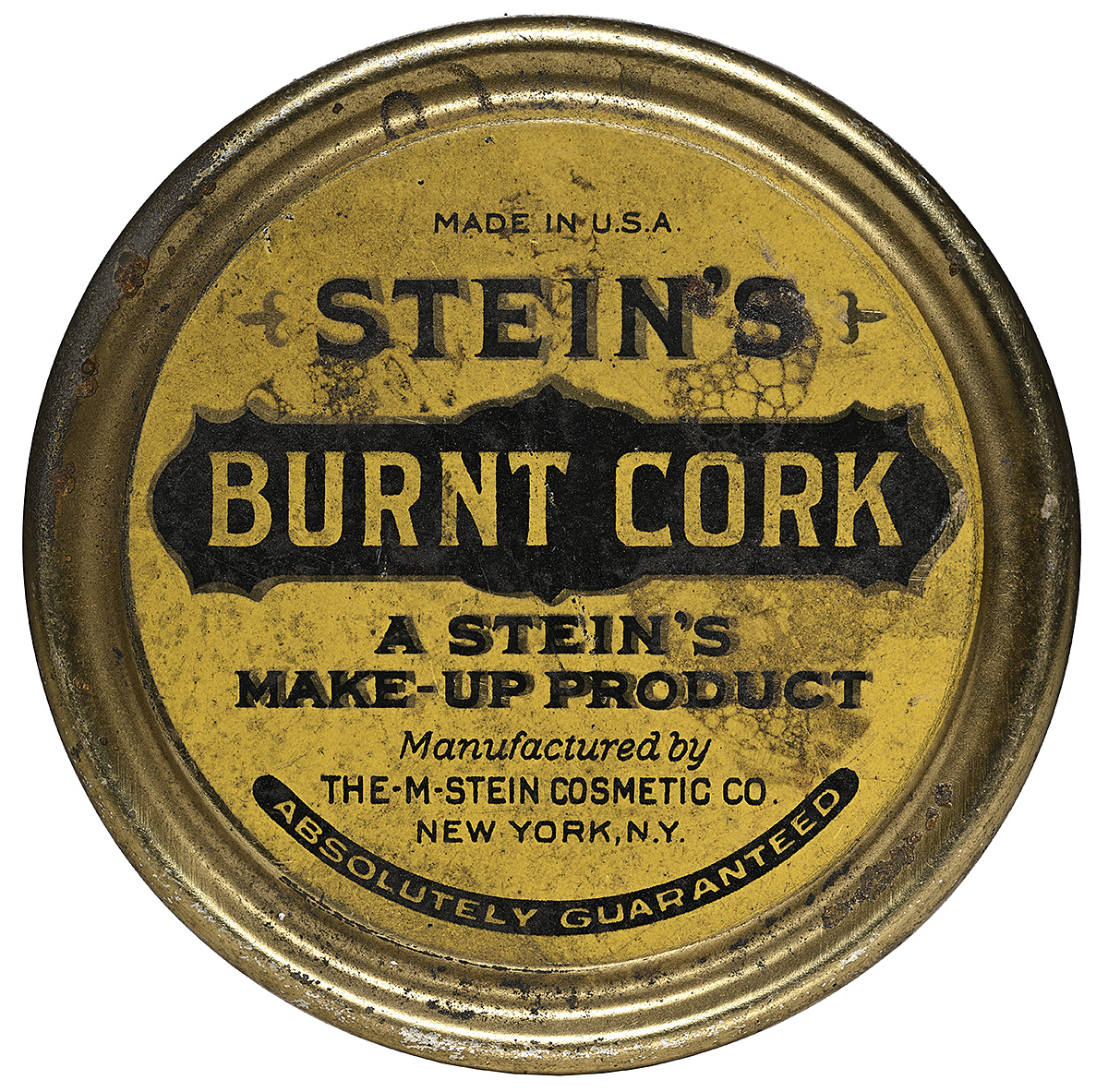
  • M. Stein Cosmetic Company was based in New York and specialized in theatrical makeup, offering a variety of grease paints that allowed actors to perform racist interpretations of non-white characters. Such products were often incorporated in basic theatrical makeup kits alongside makeup for clowns. While Stein was one of the best-known manufacturers of this type of product, other companies like Zauder Brothers, Inc. sold similar materials in addition to a wider cosmetics line. 
  • Dating back to the 1830s, burnt cork was the traditional and preferred method of applying blackface. When mixed with water, it produces a paste-like consistency that can cover an entire face in just 30 seconds. By the 1910s, grease paint had become more popular than cork for this purpose due to its staying power under the intense heat of stage lighting.
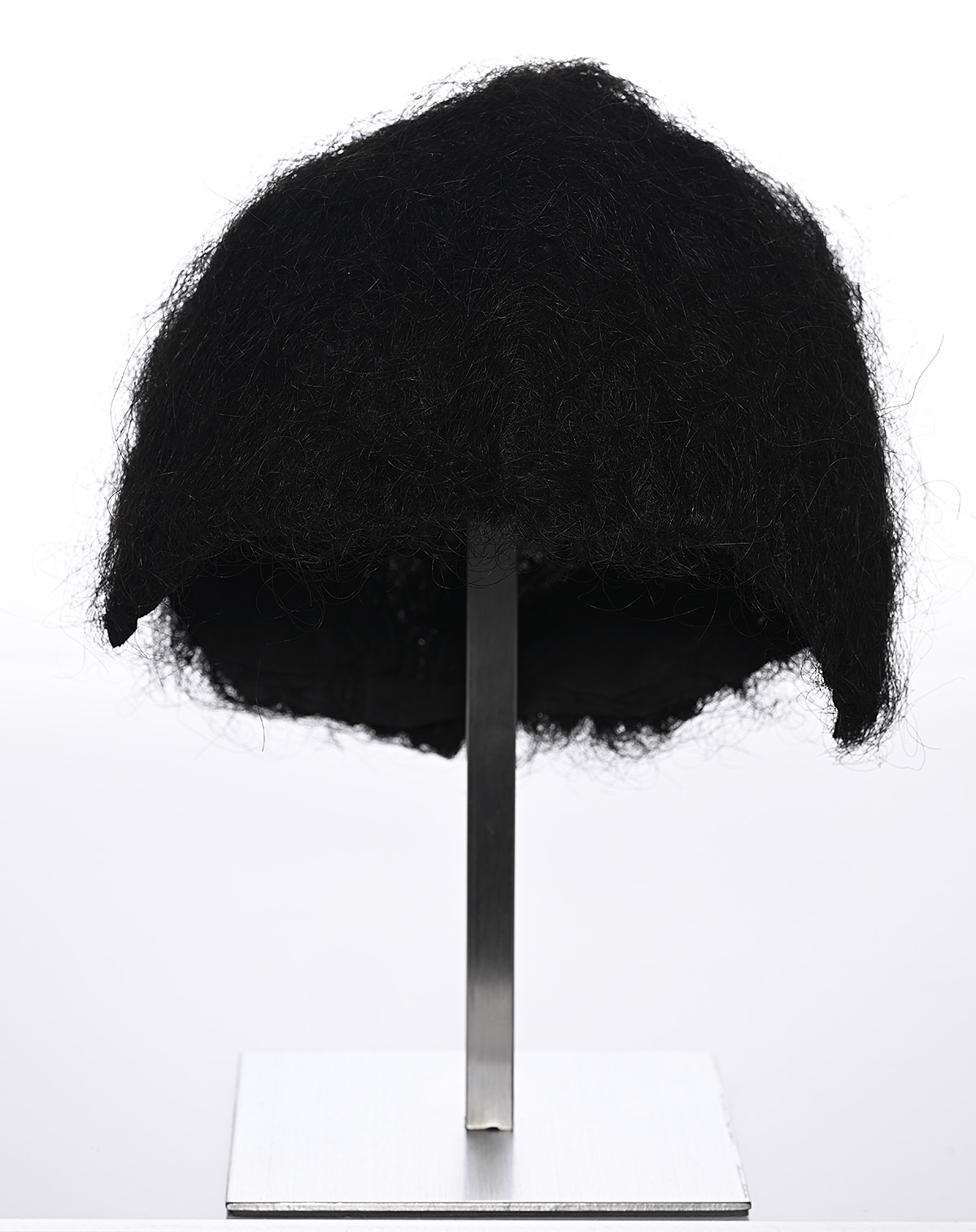
  • In order to help performers properly achieve more “realistic” blackface, companies also sold accessories like this minstrel wig that was meant to mimic the texture and color of some Black hair types. Makeup guides often sold such items, including a “Topsy Wig”  intended to represent the pickaninny stereotype popularized by Uncle Tom’s Cabin.
  • Guides like the one printed by Denison’s instructed both the “amateur and the professional” on how best to apply makeup, sculpt facial putty, and style their hair to achieve the most “convincing” racialized look. This particular guide even offered multiple stock posters and window cards that could be purchased to promote a minstrel show, a reminder of the pervasiveness of blackface and its culture of mockery.

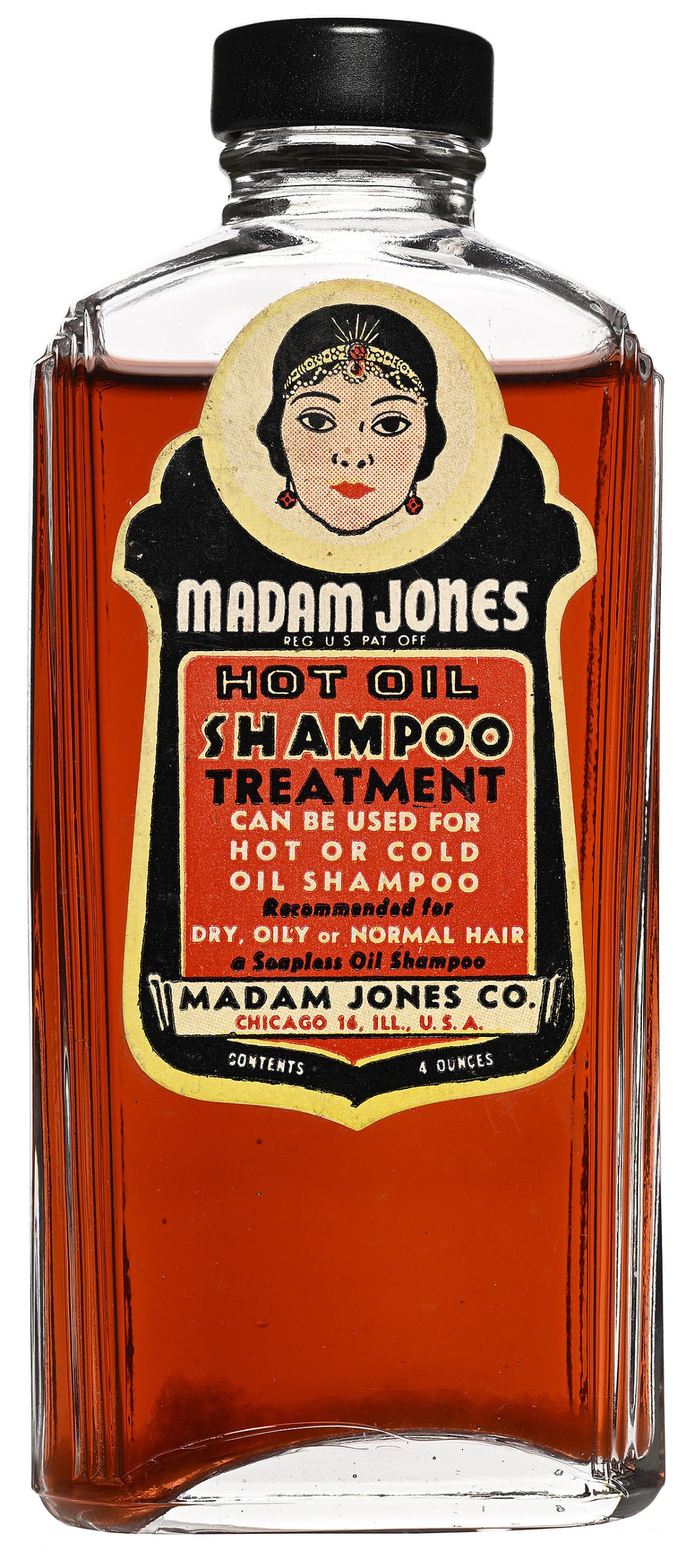
A glass bottle with a red liquid inside.

Pressing Oil and Shampoo, c. 1938

Private Collection, NYC

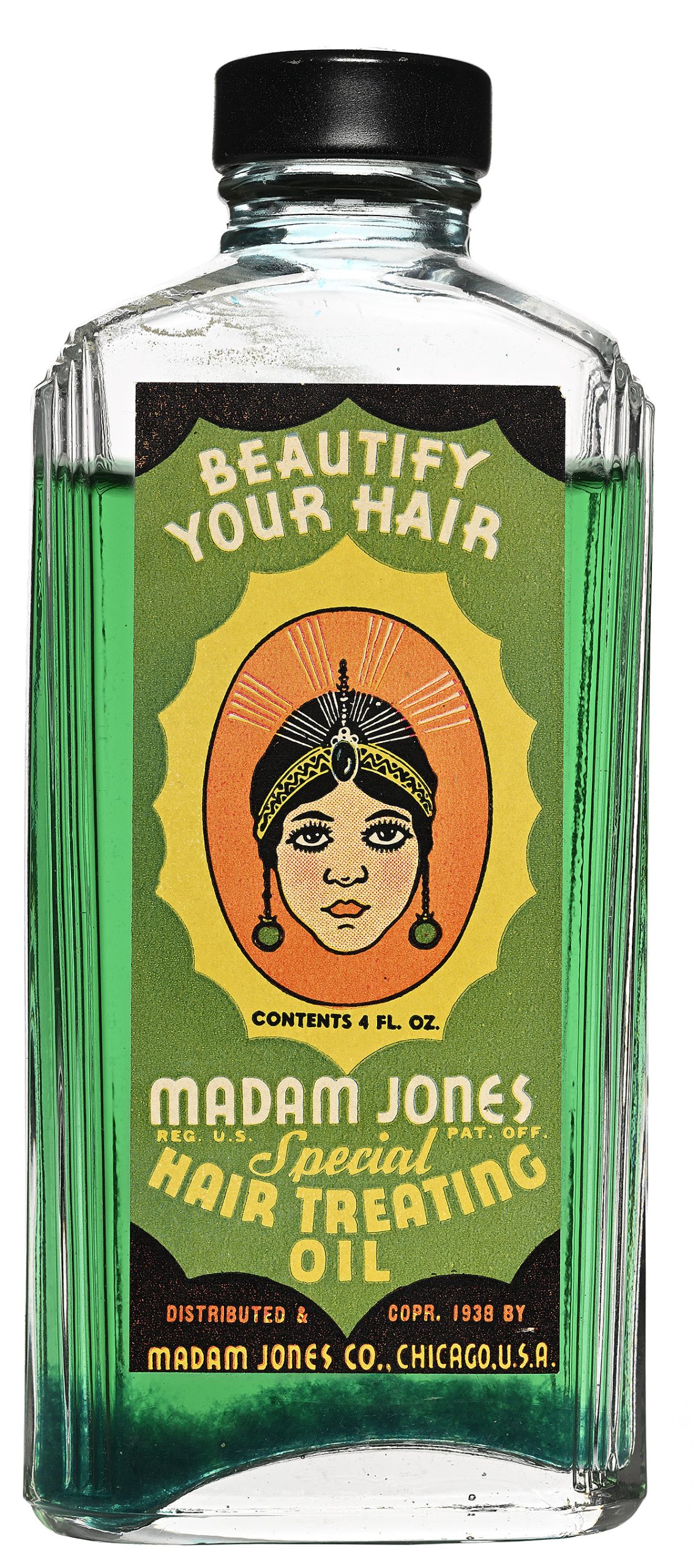
A glass bottle with a green liquid inside.

Pressing Oil and Shampoo, c. 1938

Private Collection, NYC

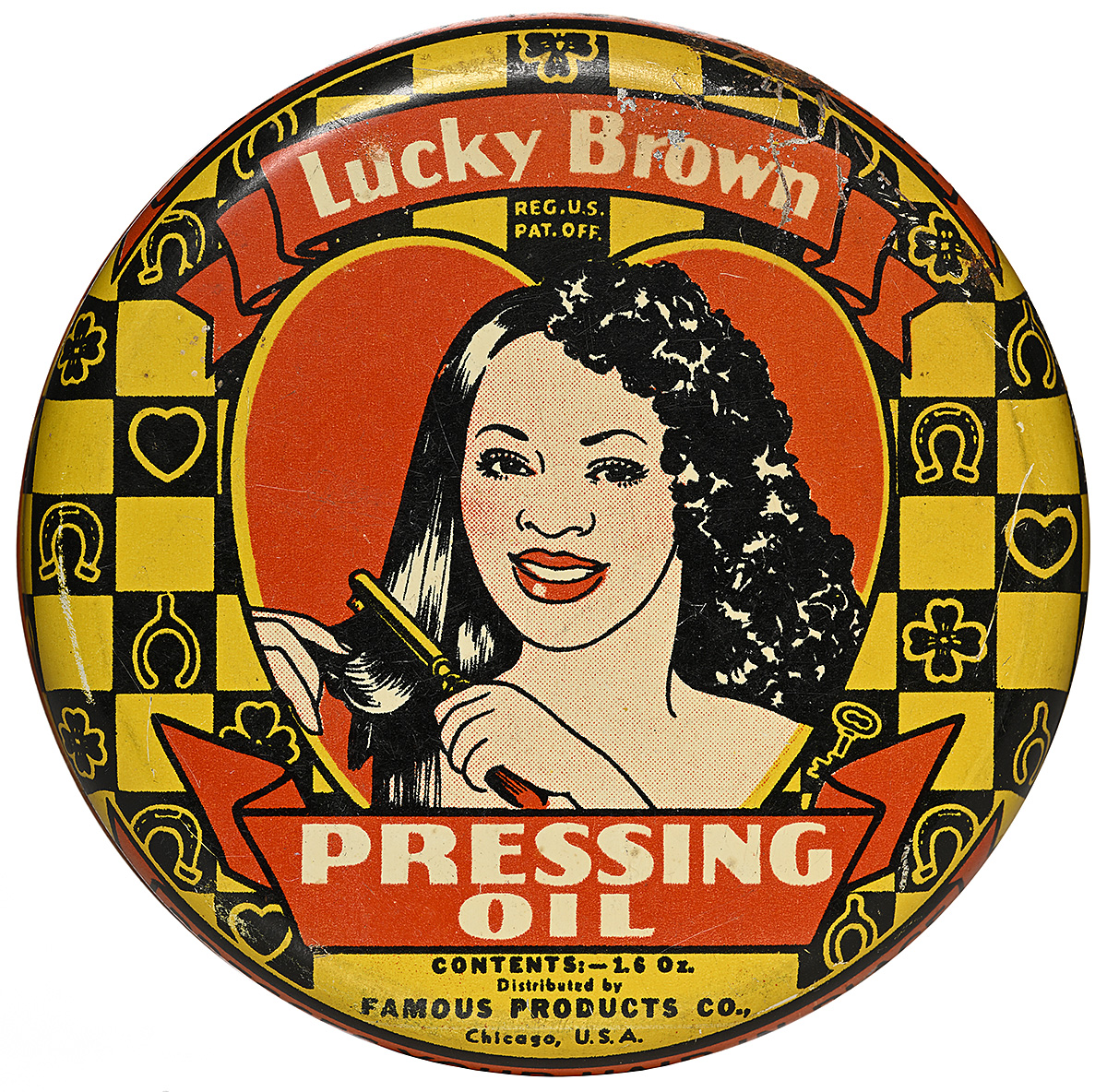
The top of a circular tin with an illustration of a young woman brushing her hair.

Pressing Oil and Shampoo, c. 1938

Private Collection, NYC

  • Valmor Products Company was founded in 1926 by chemist Morton Neumann who wanted to address the shortage of cosmetics for Black Americans. Lucky Brown and Madam Jones were among the company’s many sub-brands and their products were worn and promoted by Black models. The product labels were designed by Black American artists Charles C. Dawson and Jay Jackson who depicted refined and sometimes sensual-looking Black women.
  • Unlike their white counterparts, Black performers had access to few specialized cosmetic products with which to create glamorous stage looks. Pressing oils and shampoos like these were necessary to achieve the shiny bobbed hairstyle popularized by Black women like Josephine Baker.

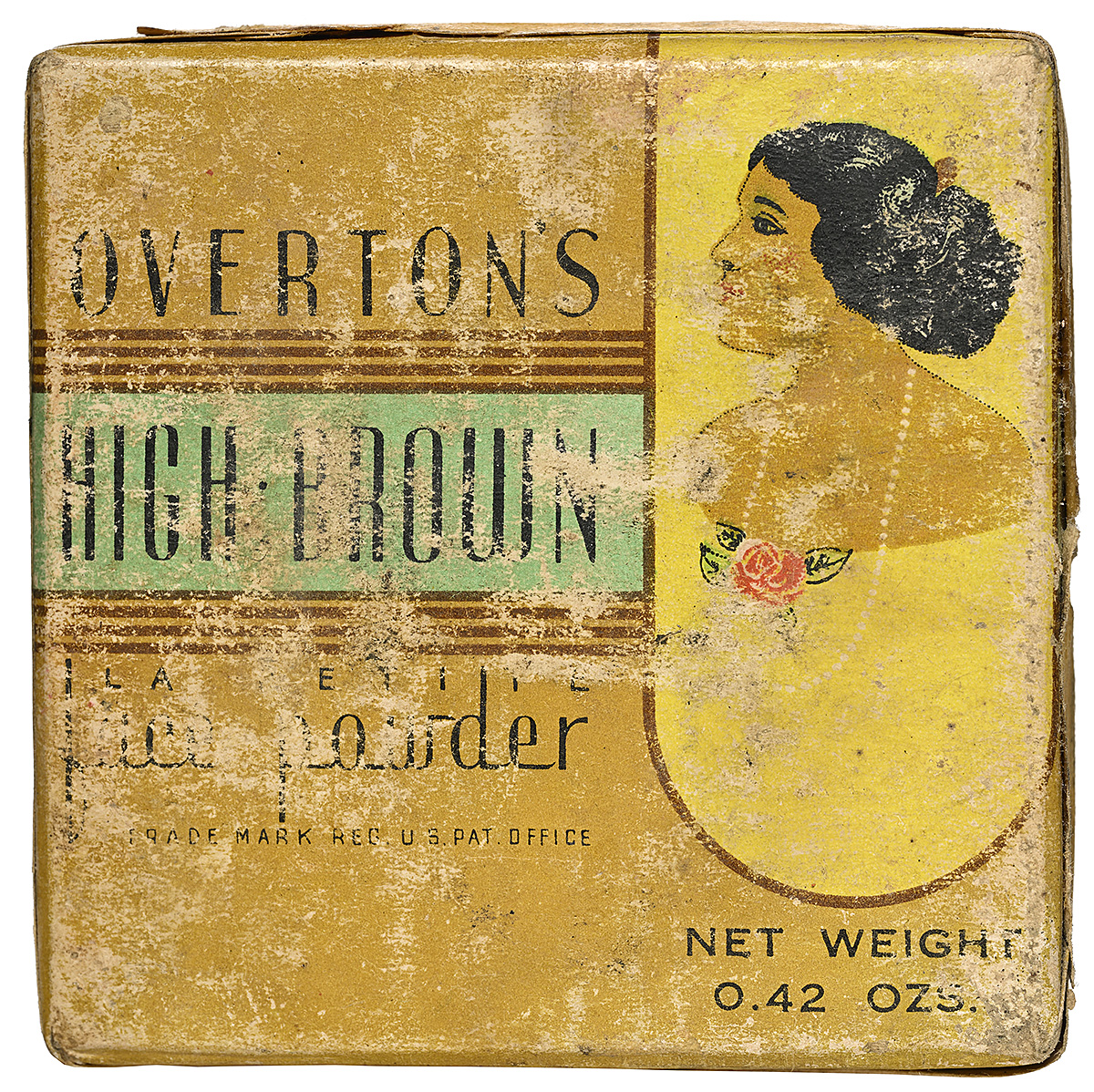
A faded illustration of a medium-skinned woman in side profile framed with black text on a brown background.

Makeup, c. 1935

Private Collection, NYC

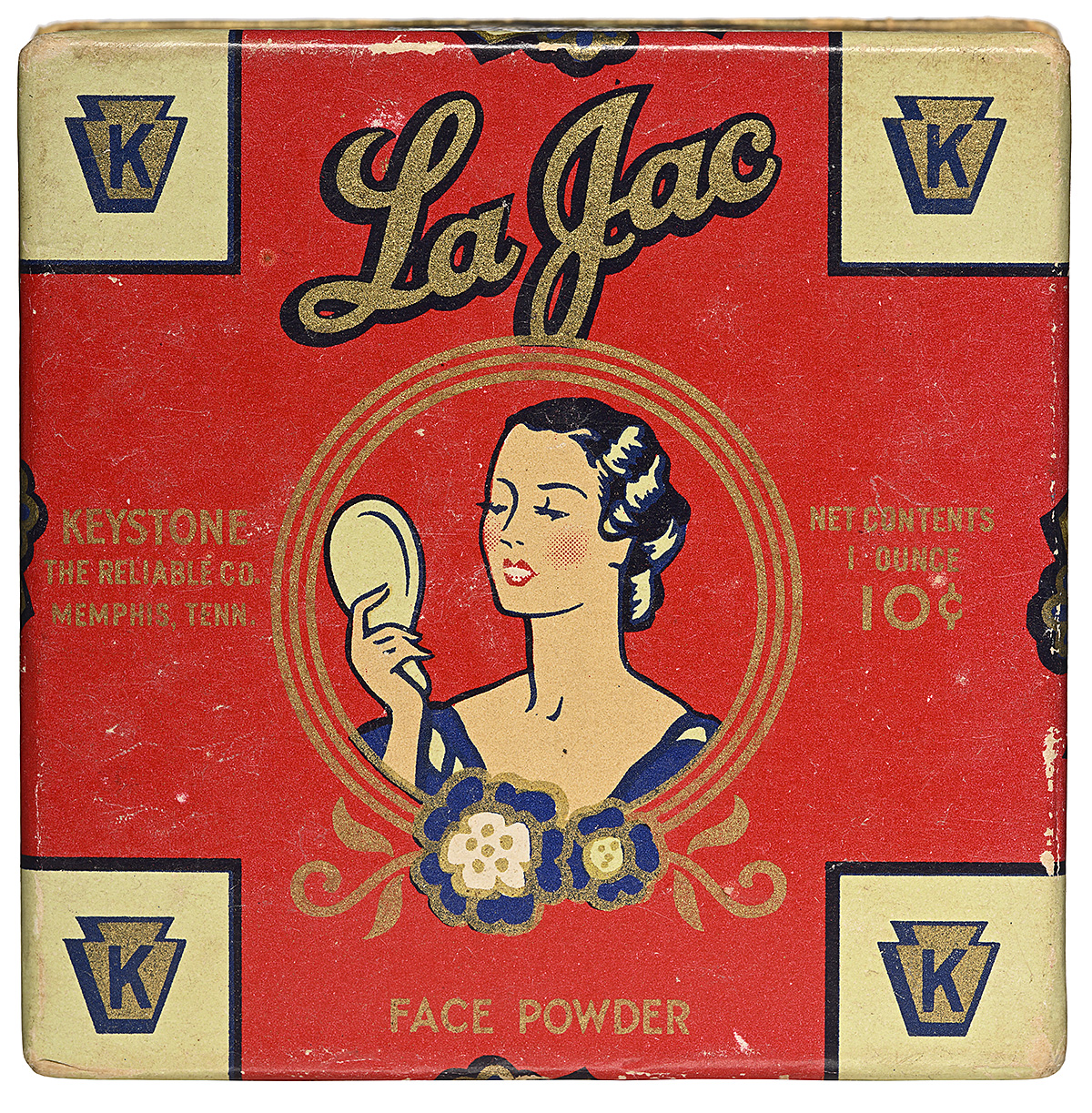
An illustration of a light-skinned woman holding a small mirror on a red background with gold and blue accents.

Makeup, c. 1935

Private Collection, NYC

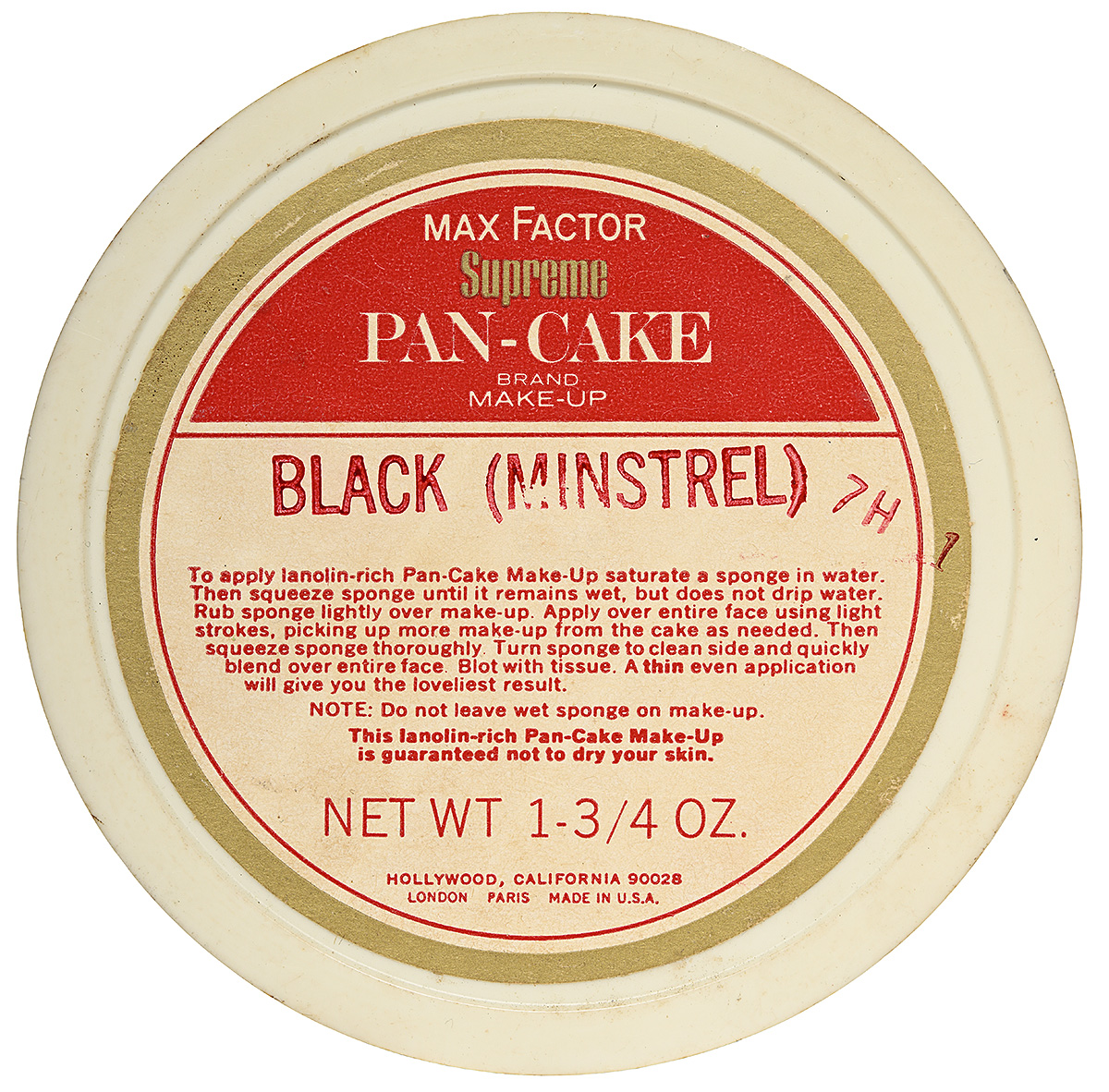
The top of a white circular container with a gold outline and red and white text.

Makeup, c. 1935

Private Collection, NYC

  • These are just some examples of the cosmetic products created for Black consumers in the early 20th century, offering a wider selection to Black performers and everyday customers. 
  • The son of enslaved parents, Anthony J. Overton was a lawyer and a chemist who founded Overton Hygienic Manufacturing Company in 1898, soon releasing Overton’s High Brown Face Powder as the first of many products for Black customers. Documentation from the time indicates that his wife, Clara Overton, played an essential role in the development of these cosmetics as well as in the business.
  • An early advertisement for Overton’s face powder declares that “[High Brown] is the first and only face powder that was ever made especially for the complexion of colored ladies.”
  • Actors in Technicolor films had to use pancake makeup that could withstand the intense heat of the lighting on set. Max Factor was one of the industry leaders and the favorite brand of leading man Herbert Jeffries, who often needed to darken his complexion to appear Black. Actress Fredi Washington was also instructed to darken her complexion with makeup for her appearance in Emperor Jones.
  • Keystone Laboratories, Inc. (originally the Keystone Chemical Company) was founded in Memphis, Tennessee, in around 1925 by chemists Morris Shapiro and Joseph Menke, who were aware of the lack of personal care and cosmetic products for Black Americans. The company both employed Black people and marketed its products to them, occupying a unique position at a time when most cosmetic companies were not targeting Black consumers.

Chorus Girls

Chorus girls played a unique role in theater, serving to move the plot forward and entertain audiences on stage while representing aspirational beauty standards. The Ziegfeld Follies established the ideal of the tall and lean young woman, elevating her to celebrity status and providing her with opportunities not often afforded to many female performers. 

Black theater productions were largely inspired by this chorus-girl model, employing their own line of talented beauties to entertain, titillate, and inspire the crowd. While incredibly important in increasing Black female visibility on the stage, these women also remained subject to white beauty standards and hypersexualization. Calls for Black chorus girls generally required that they have light or fair complexions, and advertising for these shows promoted their “Bronze,” “Honey,” or “Sepia” girls—all words that excluded darker skin tones. There was also a pay disparity for Black chorus girls who, despite their popularity, received less than their white female and Black male counterparts. By the 1930s, these women would strike for higher wages and improved working conditions, part of an ongoing effort to establish that the role was worthy of more than superficial attention. In spite of these restrictions, however, Black chorus girls provided an aspirational image for some Black women, expanding their career options and reinforcing their femininity, albeit a commodified version of it.

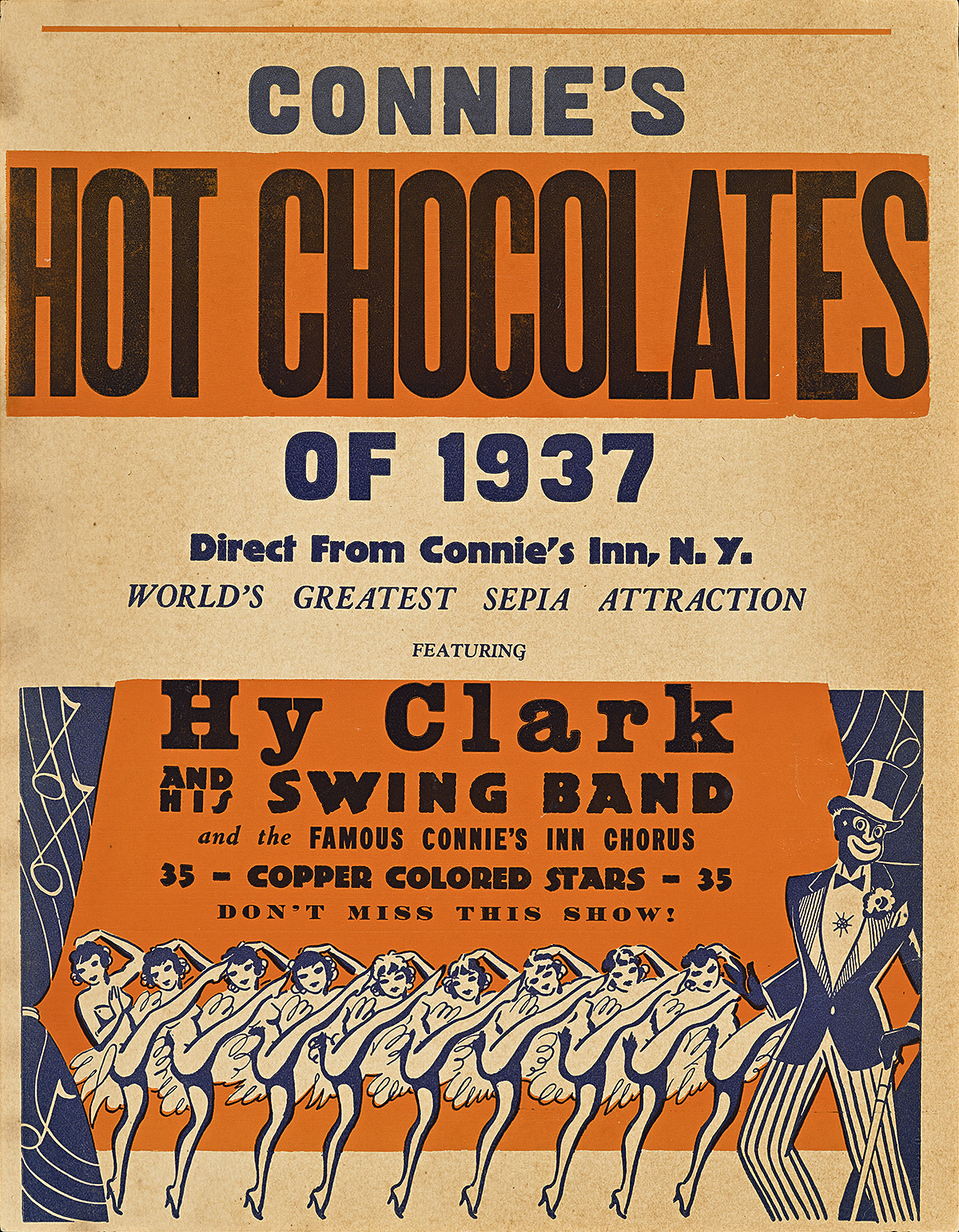
A poster of Black chorus dancers in a kickline on an orange background.

Connie’s Hot Chocolates, 1936

Designer Unknown

Poster House Permanent Collection

  • Connie’s Inn opened in 1923 as a sophisticated Harlem nightclub featuring such acclaimed jazz performers as Louis Armstrong, Thomas “Fats” Waller, and cabaret personality Ada “Bricktop” Smith. The all-Black musical revue Connie’s Hot Chocolates, with music by Fats Waller and Harry Brooks and lyrics by Andy Razaf, premiered at the venue in 1929. While the chorus line featured both men and women, advertisements in both the press and on handbills highlighted the female talent who were the real stars of the show. The revue would move to the Hudson Theatre on Broadway that same year under the name Hot Chocolates while the original one continued to be performed at Connie’s Inn. The New York Times review was headlined “The Best of Its Type Since ‘Blackbirds’” and praised the show’s quick pace and exciting musical segments.
  • When white mobster Dutch Schultz, one of the revue’s financiers, heard that Waller and Razaf were composing a show for the white clientele of Connie’s Inn, he allegedly threatened to shoot Razaf if he did not include a comic song for a Black woman with a darker complexion in which she laments her skin color and expresses her jealousy of women with lighter complexions. Though Razaf was opposed to the demand, he acquiesced but decided to write it as a commentary on the racial environment against Waller’s mournful melody. Edith Wilson, vaudevillian and blues singer, would go on to sing “(What Did I Do) To Be So Black and Blue,” moving the audience with its serious tone.
  • Like the 1925 poster for Brown Skin Models, an all-Black musical revue produced by Irvin C. Miller, this one promoting a 1936 revival of Connie’s Hot Chocolates features high-kicking chorus girls and the “World’s Greatest Sepia Attraction,” a reminder of the language typically used to market Black women. Though this kind of advertising reinforced the social reality of colorism, the light complexions and delicate features of the chorus girls stand in contrast to the minstrel figure positioned beside them. Connie’s Inn closed in 1933 or 1934 but the revue was so popular that it was revived frequently throughout the 1930s and ’40s.

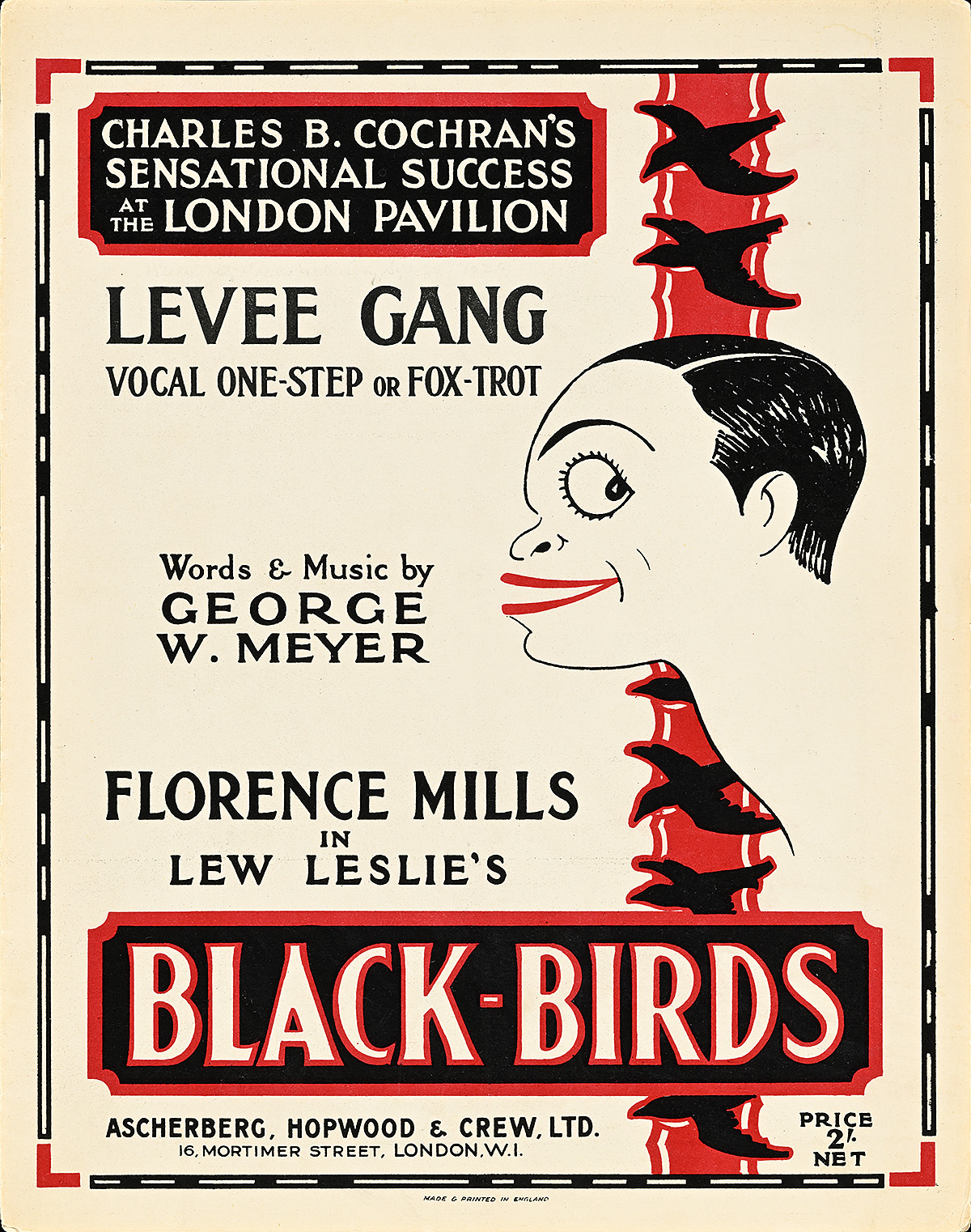
A black and red illustration of a woman's face in side profile with small black birds behind her.

Blackbirds of 1926, 1926 

Designer Unknown

Collection of John T. Reddick

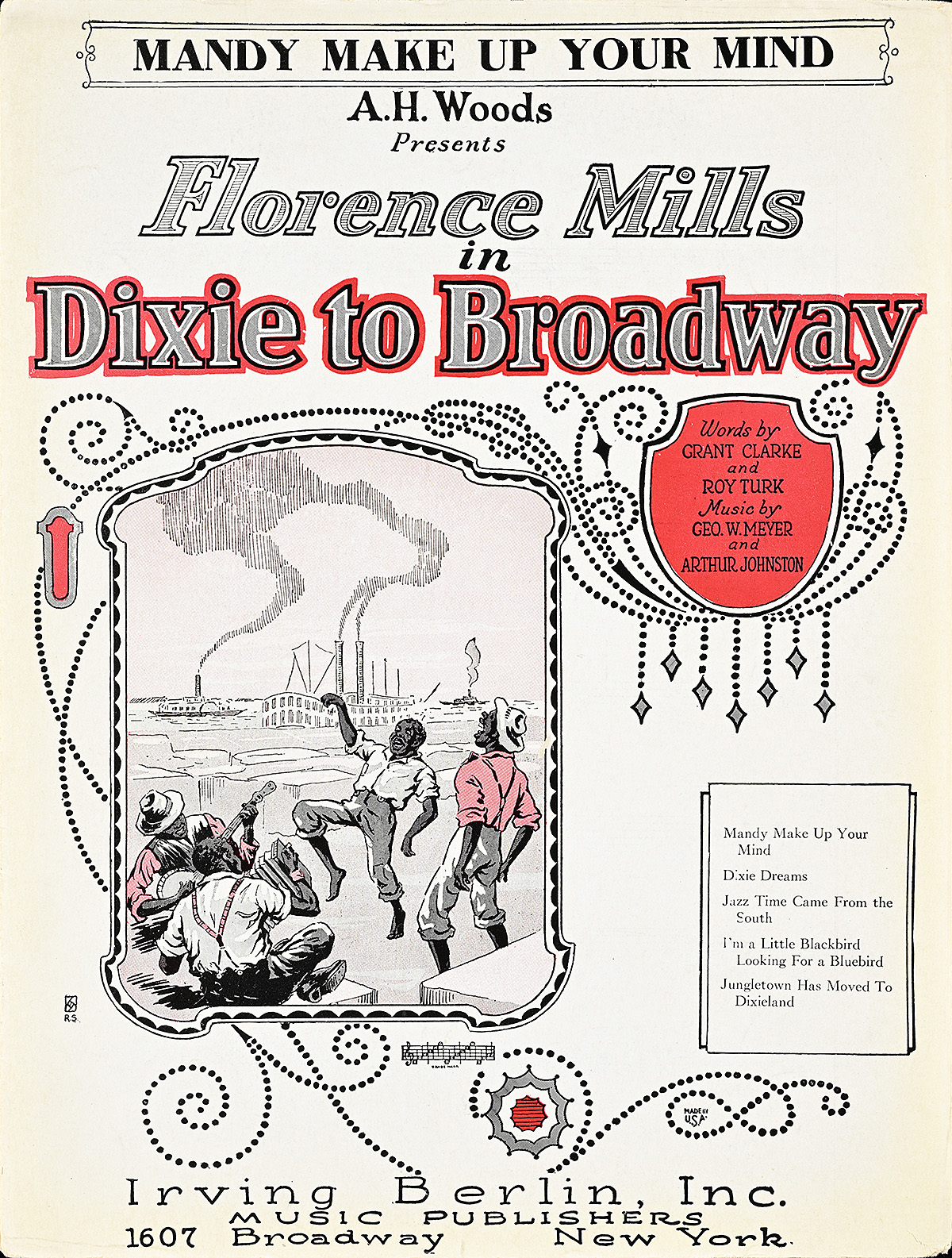
An illustration of a group of Black men playing music and dancing surrounded by decorative illustrations and black text.

Dixie to Broadway, 1924 

Morris Rosenbaum (1886–1953)

Collection of John T. Reddick

  • Producer Lew Leslie became famous in the world of vaudeville for his efforts to create an all-Black show in the style of the Ziegfeld Follies. In 1922, Leslie organized Plantation Revue with musical numbers and comedy acts featuring performers from Harlem. Then, in 1923, Plantation Revue moved to London, with members of the original company appearing in the second half of British impresario Charles B. Cochran’s revue From Dover Street to Dixie, with an all-white British cast featuring in the first half. When the show moved to New York in 1924, it was renamed Dixie to Broadway and was added as the second act featuring an all-Black cast who presented enslaved life as happy-go-lucky.
  • In the 1924 version of Plantation Revue, Leslie saw star potential in the actress Florence Mills. Mills’s career as a dancer had really taken off after her performance in the Shuffle Along chorus line but her performance in this revue inspired Leslie to develop a new project as a vehicle for her bird-like singing voice and delicate presence on the stage. After undergoing many revisions, the show became Blackbirds of 1926 and opened at the Alhambra Theatre in Harlem. It took its name from the song, “I’m a Little Blackbird Looking for a Bluebird,” made famous by Mills in the 1924 revue. The song itself was a subtle commentary on racial injustice.

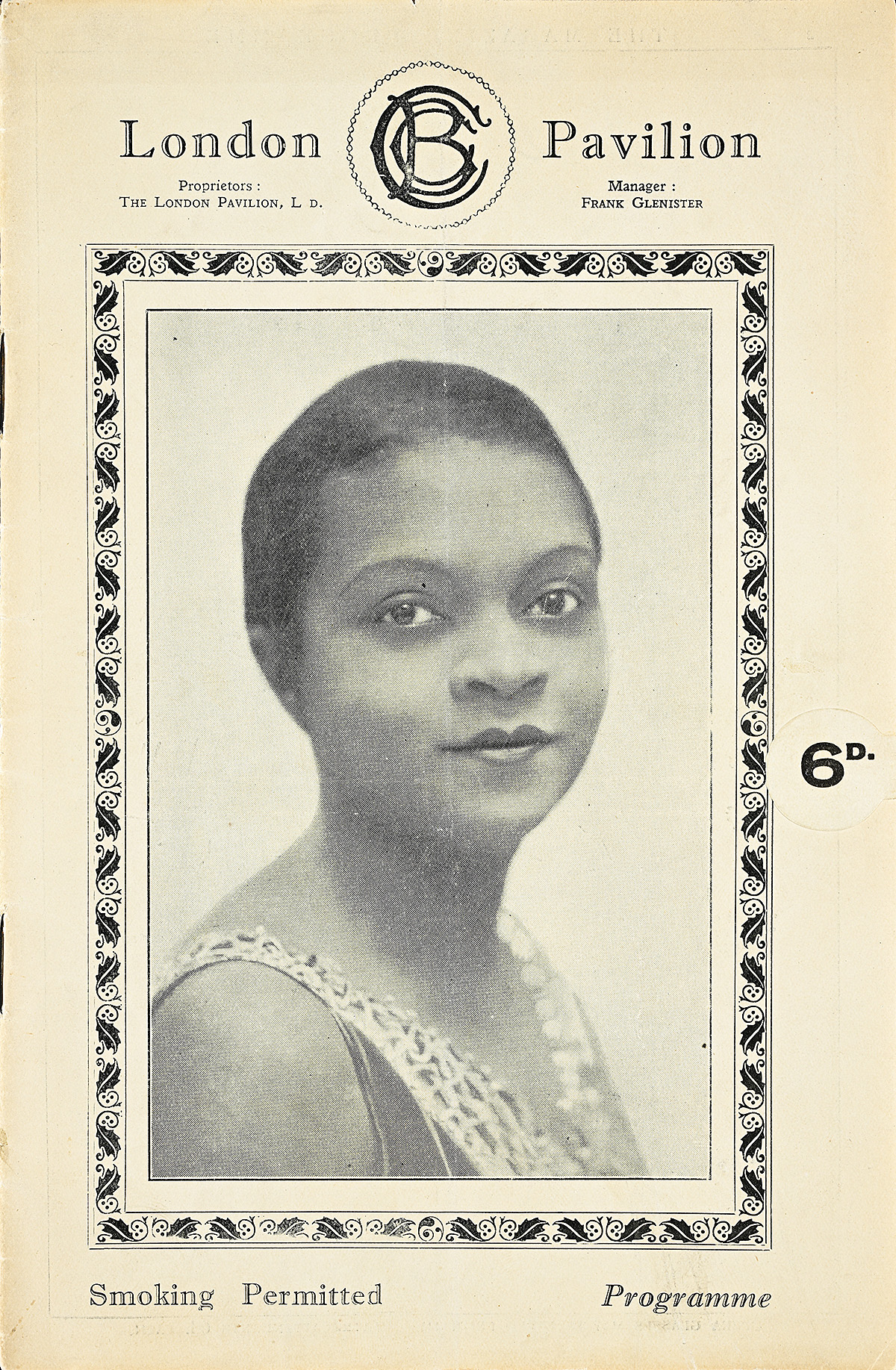
A black and white photograph of a young woman's face surrounded by a decorative rectangular border.

London Pavilion Program, 1927 

Collection of John T. Reddick

  • On September 11, 1926, Lew Leslie’s Blackbirds of 1926 opened in England at the London Pavilion and played for more than 250 performances to an integrated audience. This second edition of the program produced for performances in 1927 is unique; the photographic portrait of Florence Mills presents her as the main attraction. 
  • Despite her celebrity status, few photographs of Mills have survived. This program therefore joyously represents her stage legacy.

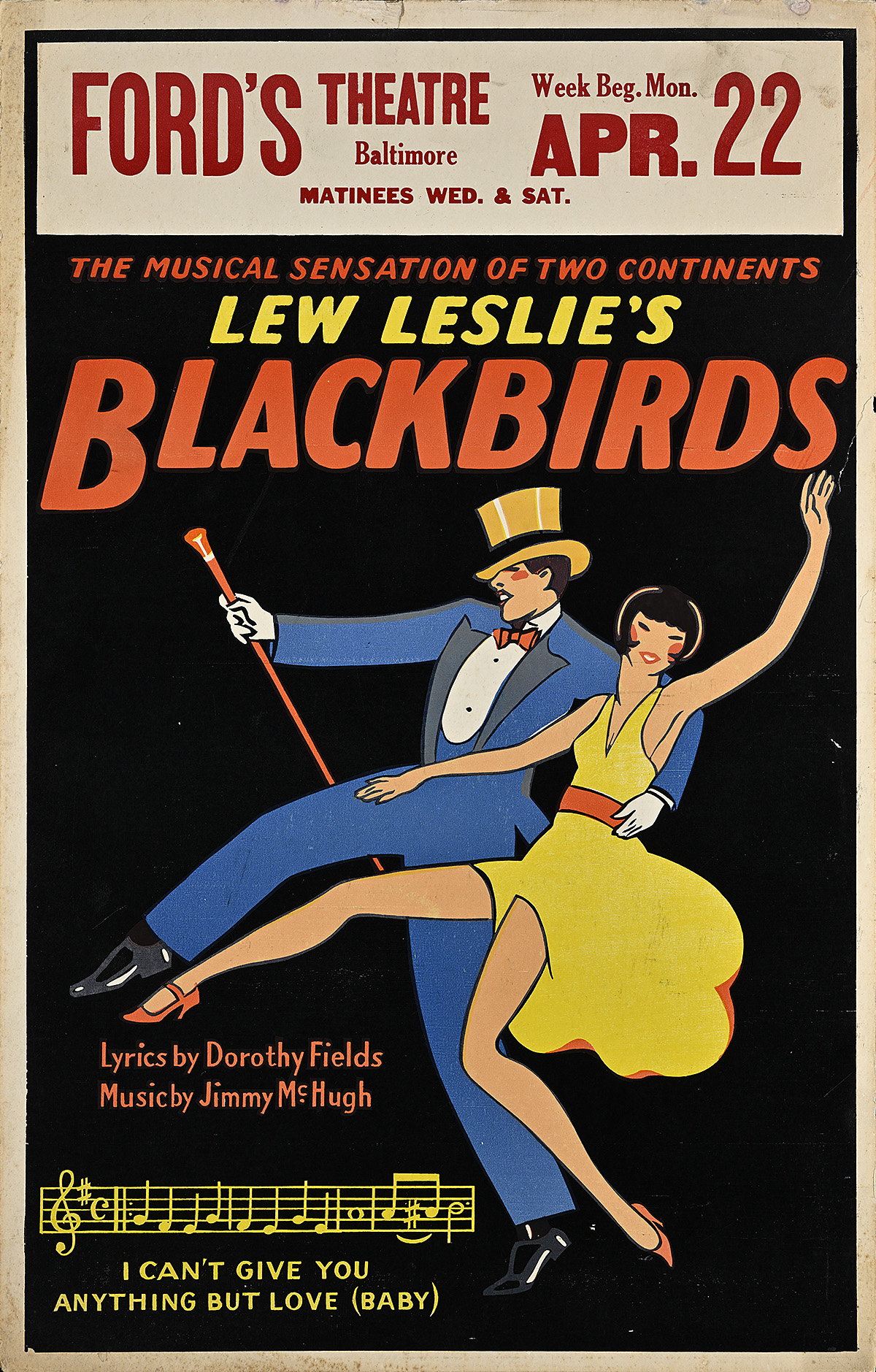
A poster of an illustrated man in a suit and hat and a woman in a yellow dress dancing together on a black background.

Lew Leslie’s Blackbirds, 1929

Designer Unknown

Private Collection

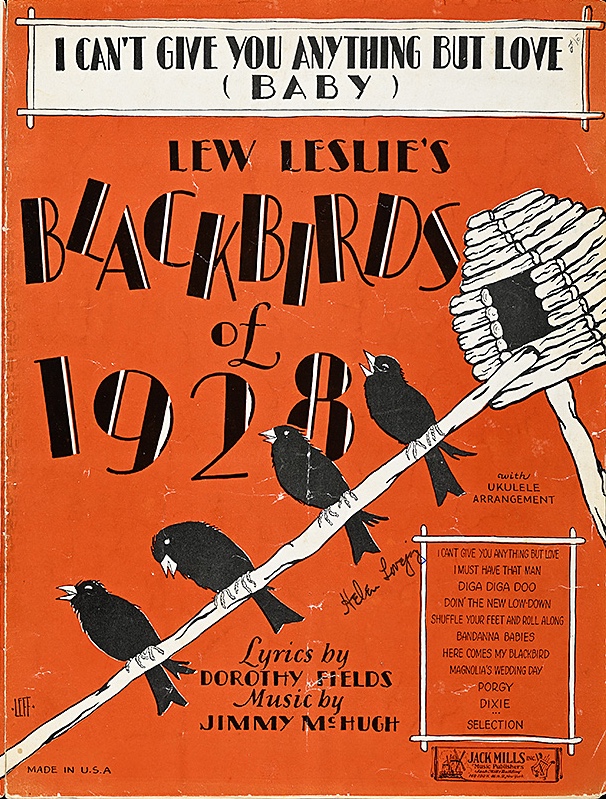
Four illustrated black birds sitting in a line on a twig with black text on an orange background.

Lew Leslie’s Blackbirds of 1928, 1928

Sydney Leff (1901–2005)

Collection of John T. Reddick

  • After the incredibly successful European tour of Blackbirds of 1926, Lew Leslie planned to open a new version of the show in New York City with its star Florence Mills. Tragically, Mills died from tuberculosis in 1927. Leslie then cast Brooklyn-born performer Adelaide Hall in the principal role, and Blackbirds of 1928 subsequently became the longest-running all-Black revue on Broadway. The following year, Blackbirds of 1928 toured the United States, performing to sold-out audiences around the country.
  • Reviews of Hall’s rendition of “I Can’t Give You Anything But Love” were so exceptional that it became the show’s most famous song, resulting in a national increase in sales of its sheet music. Although she quit the production after the national tour’s first stop in Chicago, Hall’s version made it one of the most recorded songs of the first half of the 20th century, with copies of sheet music like this one selling hundreds of thousands of copies worldwide.
  • While the popularity of Blackbirds of 1928 allowed it to tour nationally, audience experiences around the country were not equal. For the Baltimore production, seating at Ford’s Theatre was racially segregated, undermining the director’s original intention. In addition, the man and woman who appear on the window card are not distinctly Black, implying a hesitation in advertising Blackbirds too overtly as an all-Black revue.

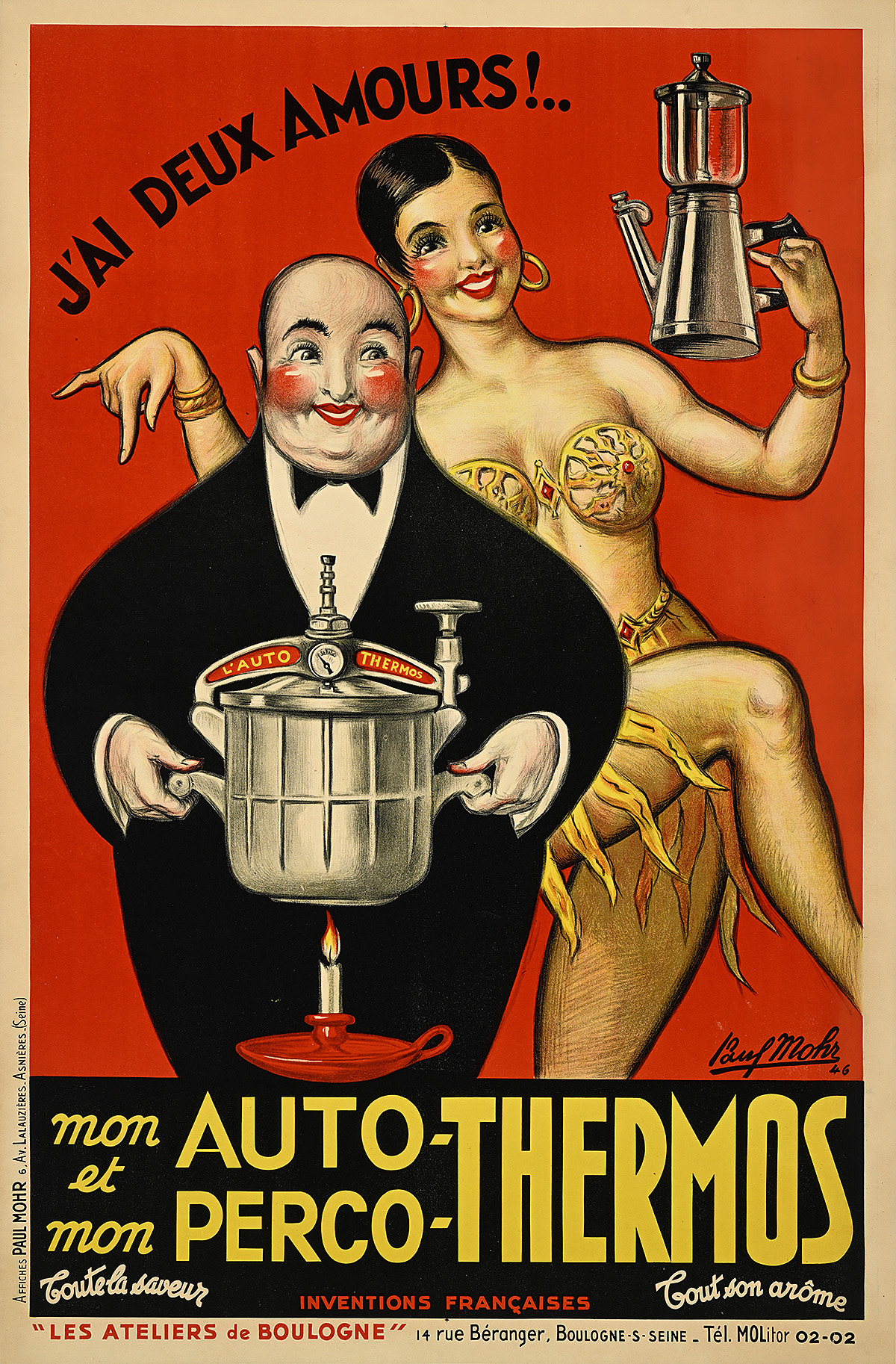
A poster of an illustrated Black woman dressed as a dancer holding a thermos behind a white man in a tuxedo.

Auto-Thermos/Perco-Thermos, 1946

Paul Mohr (1890–1959)

Poster House Permanent Collection

  • Josephine Baker first sang “J’ai deux amours” (I Have Two Loves) at the Casino de Paris in 1930. The lyrics include the line, “J’ai deux amours, mon pays et Paris” (I have two loves, my country and Paris), alluding to her devotion to both America, where she was born, and Paris, where she lived. It would become one of Baker’s signature songs as well as a favorite of expats—especially Black Americans—who had made Paris their home.
  • This poster advertising kitchen appliances plays on the words of the song, transforming Baker’s two loves into a pressure cooker and a coffee percolator. By the time Paul Mohr designed this poster in 1946, Baker was such a household name that she was paid to endorse a variety of products—and not just products for Black purchasers but for all consumers. This level of commercial influence marked a turning point; a Black woman could now be perceived internationally as a representative of Black American culture.

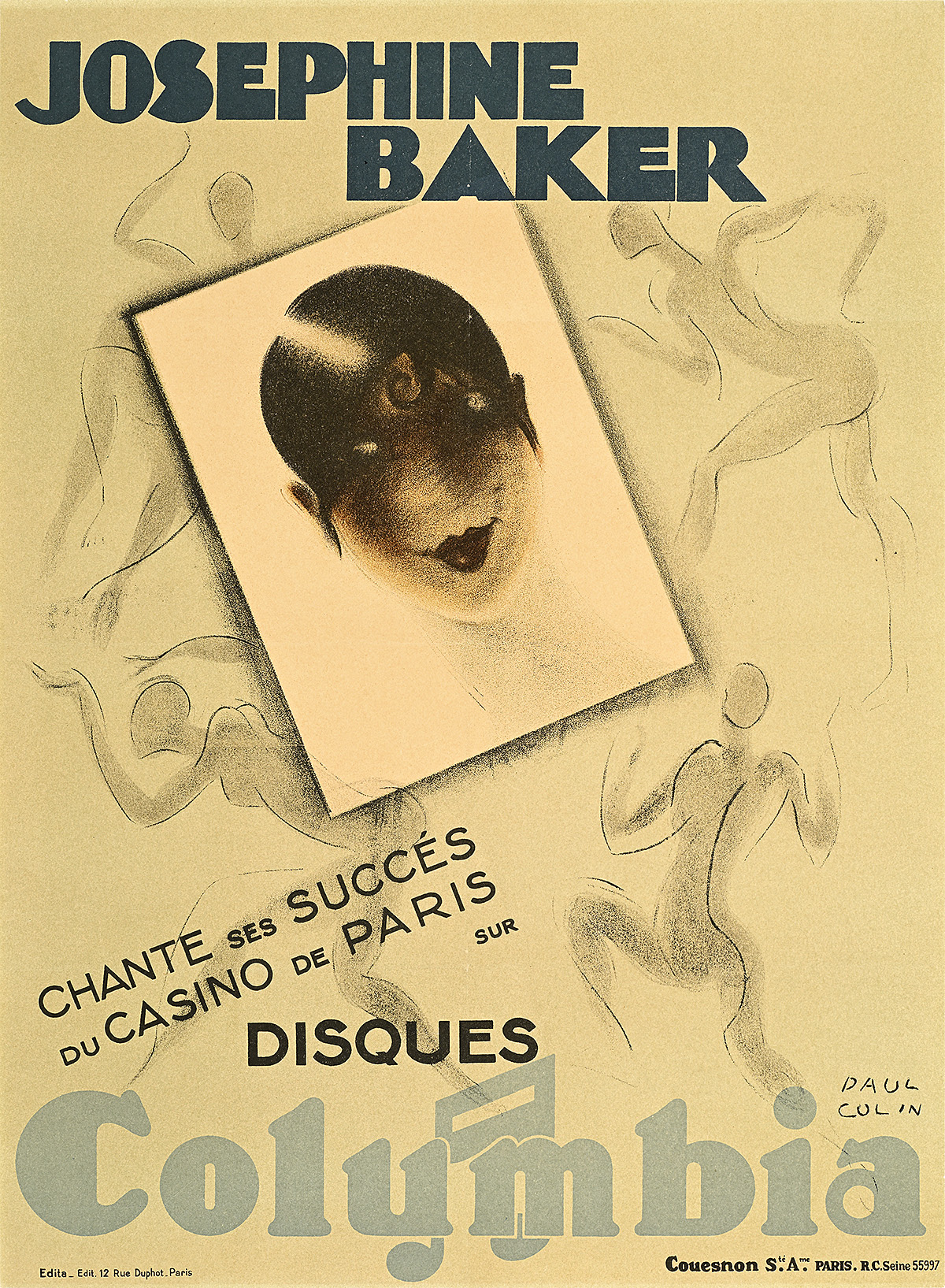
A poster of a painterly woman's face on a white card surrounded by illustrations of dancing figures.

Josephine Baker/Columbia, 1930

Paul Colin (1892–1985)

Courtesy of David and Lucinda Pollack

  • In September 1930, Josephine Baker opened Paris qui Remue (Swinging Paris) at the Casino de Paris, a revue that showcased both her vocal ability and her comedic range. The elaborate costumes and sets indicated a shift away from the exoticized performances that first made her famous, establishing Baker as a “proper” star in the Western mold. The show was so successful that Columbia Records produced a recording of its songs. This poster announces the French release of the album, adding Baker to the Columbia label that had included Bert Williams as a popular comic recording artist only a decade earlier. 
  • In addition to this poster, Paul Colin designed the costumes for Paris qui Remue, further emphasizing his role in crafting and marketing Josephine Baker’s image.
  • Baker remained a resident of France until her death in 1975. While racism was still a problem in Europe, cosmopolitan cities like Paris afforded Black American performers opportunities and a degree of social acceptance that would have been impossible in the United States. This was especially true for those with lighter complexions as the color-caste system linked complexion to a social hierarchy and elevated light-skinned performers like Baker.

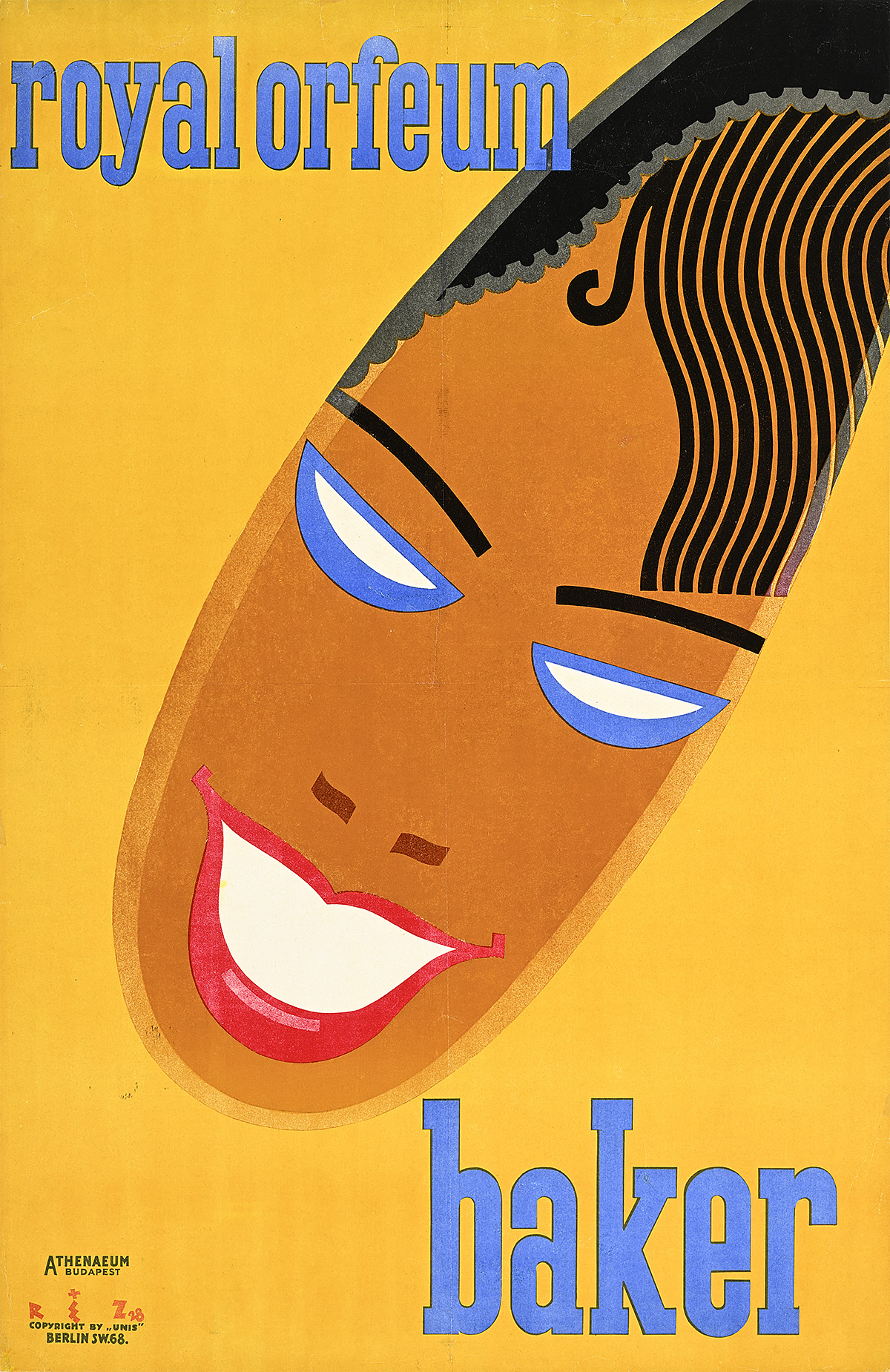
A poster of an illustrated Black woman's face with blue eyes and red lips floating at an angle on a yellow background.

Royal Orfeum/Baker, 1928

Tibor Réz-Diamont (1885–1960)

The Collection of William W. Crouse

  • In 1928, Josephine Baker embarked on a European tour, making a month-long stop in Budapest, Hungary, to perform at the Royal Orpheum Theater (now the Mádach Theater). In just three years, she had gone from being an unknown but talented chorus girl to an international superstar, solidifying her reputation as a powerful representative of the potential of Black women to achieve international acclaim.
  • Here, Hungarian designer Tibor Réz-Diamont depicts Baker in a minimalist Art Deco style, reducing her portrait to key geometric shapes. Even without fine detail, however, the slicked bob hairstyle and signature kiss curl were enough to announce her appearance on stage, indicating the exceptional level of her international stardom. 
  • While Baker’s popularity drew hundreds of fans to theaters throughout Europe, the presence of a Black woman performer also attracted protesters—a reminder of the less-than-harmonious reception of Black people outside the United States.

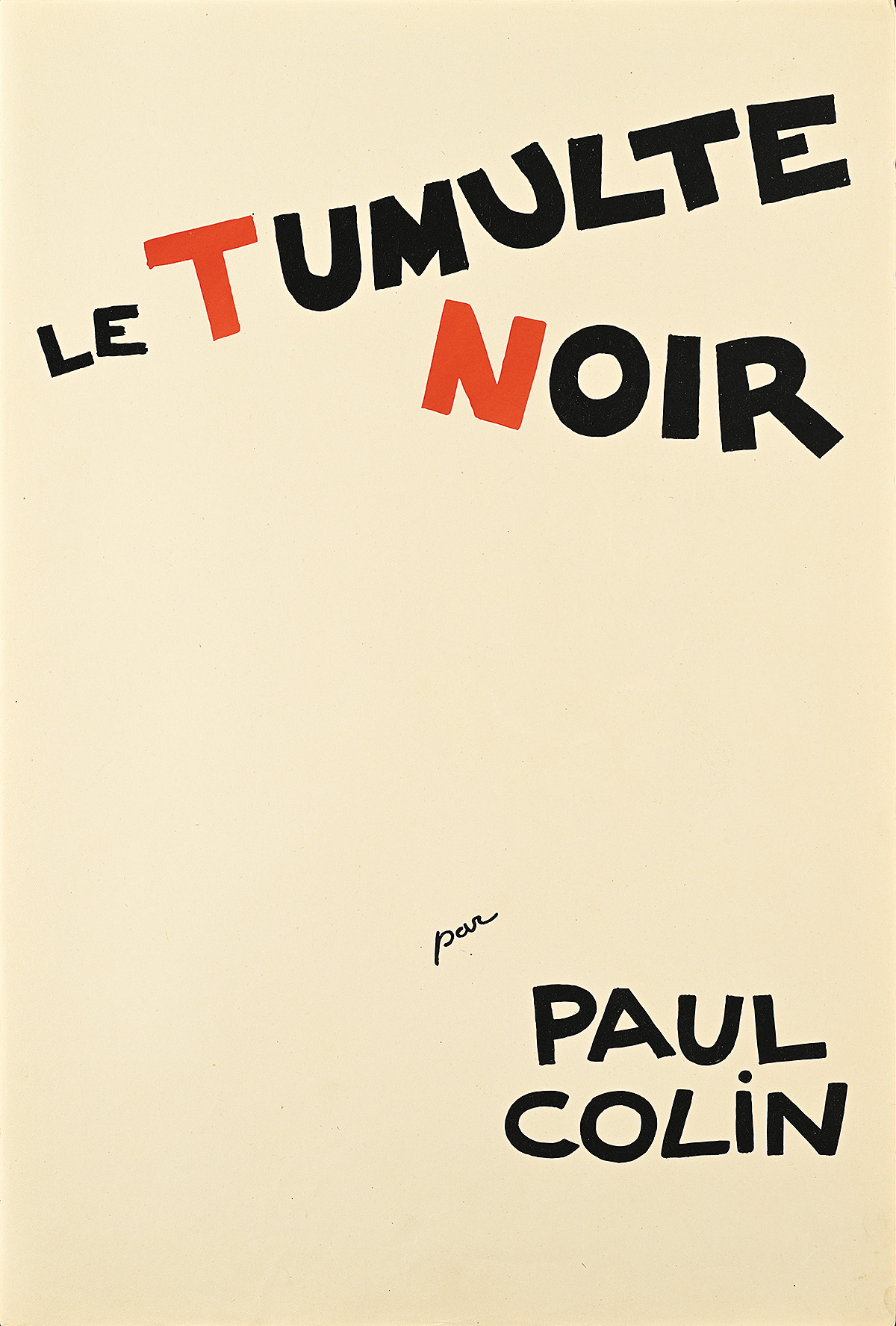
Black and red text on a cream background.

Le Tumulte Noir, 1927

Paul Colin (1892–1985)

The Collection of Merrill C. Berman

A drawing of a dark-skinned woman dancing and wearing a skirt made of bananas.

Le Tumulte Noir, 1927

Paul Colin (1892–1985)

The Collection of Merrill C. Berman

A drawing of a dark-skinned woman dancing and wearing a skirt made of green leaves.

Le Tumulte Noir, 1927

Paul Colin (1892–1985)

The Collection of Merrill C. Berman

A drawing of a dark-skinned man in a Black suit and white gloves dancing and smiling.

Le Tumulte Noir, 1927

Paul Colin (1892–1985)

The Collection of Merrill C. Berman

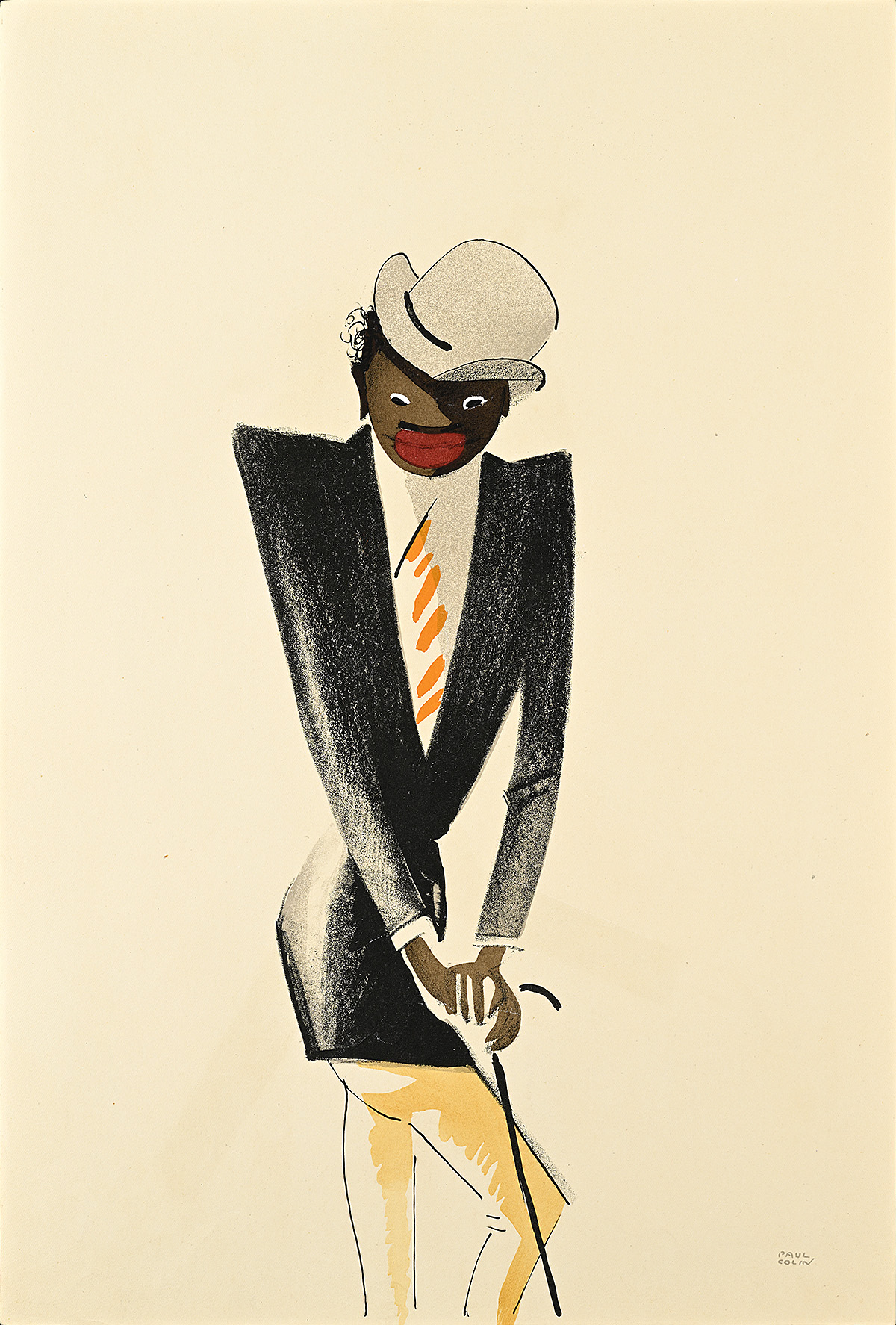
A drawing of a dark-skinned figure wearing a black jacket and white hat with both hands leaning on a thin black cane.

Le Tumulte Noir, 1927

Paul Colin (1892–1985)

The Collection of Merrill C. Berman

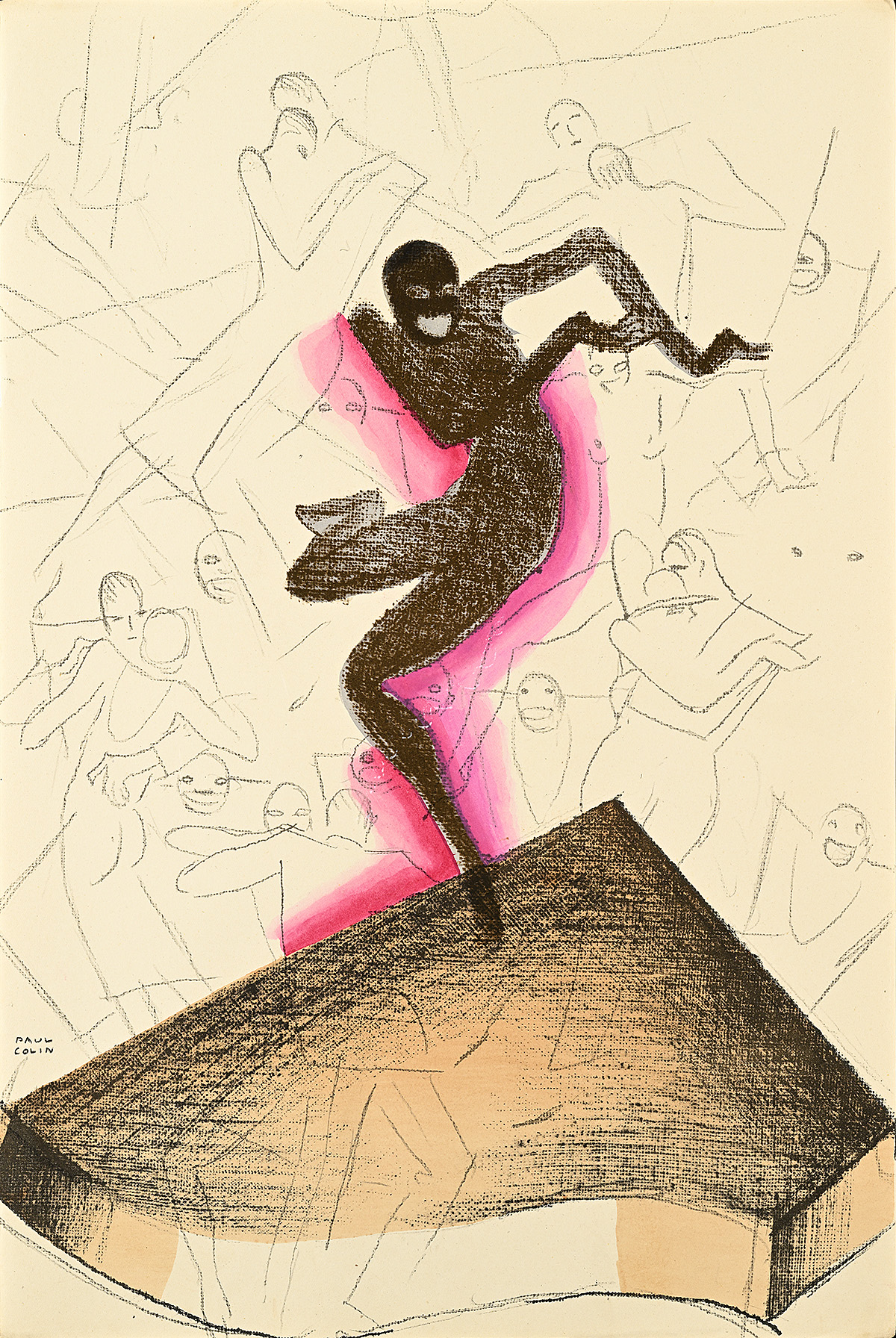
A drawing of a dark figure dancing on top of a piano with sketches of several figures dancing in the background.

Le Tumulte Noir, 1927

Paul Colin (1892–1985)

The Collection of Merrill C. Berman

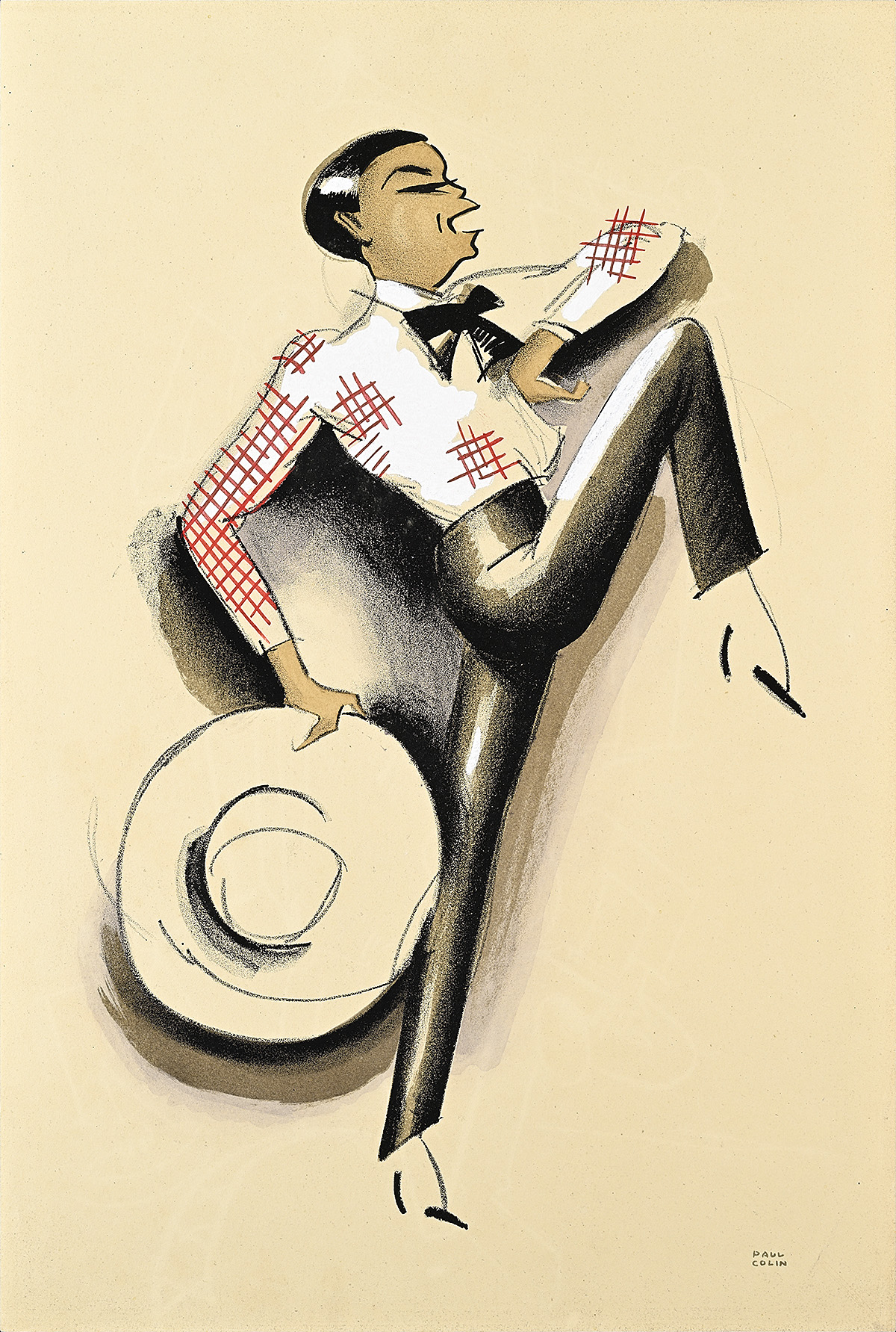
A drawing of a figure in a white shirt and black bow tie holding a wide brimmed hat and kicking their leg up very high.

Le Tumulte Noir, 1927

Paul Colin (1892–1985)

The Collection of Merrill C. Berman

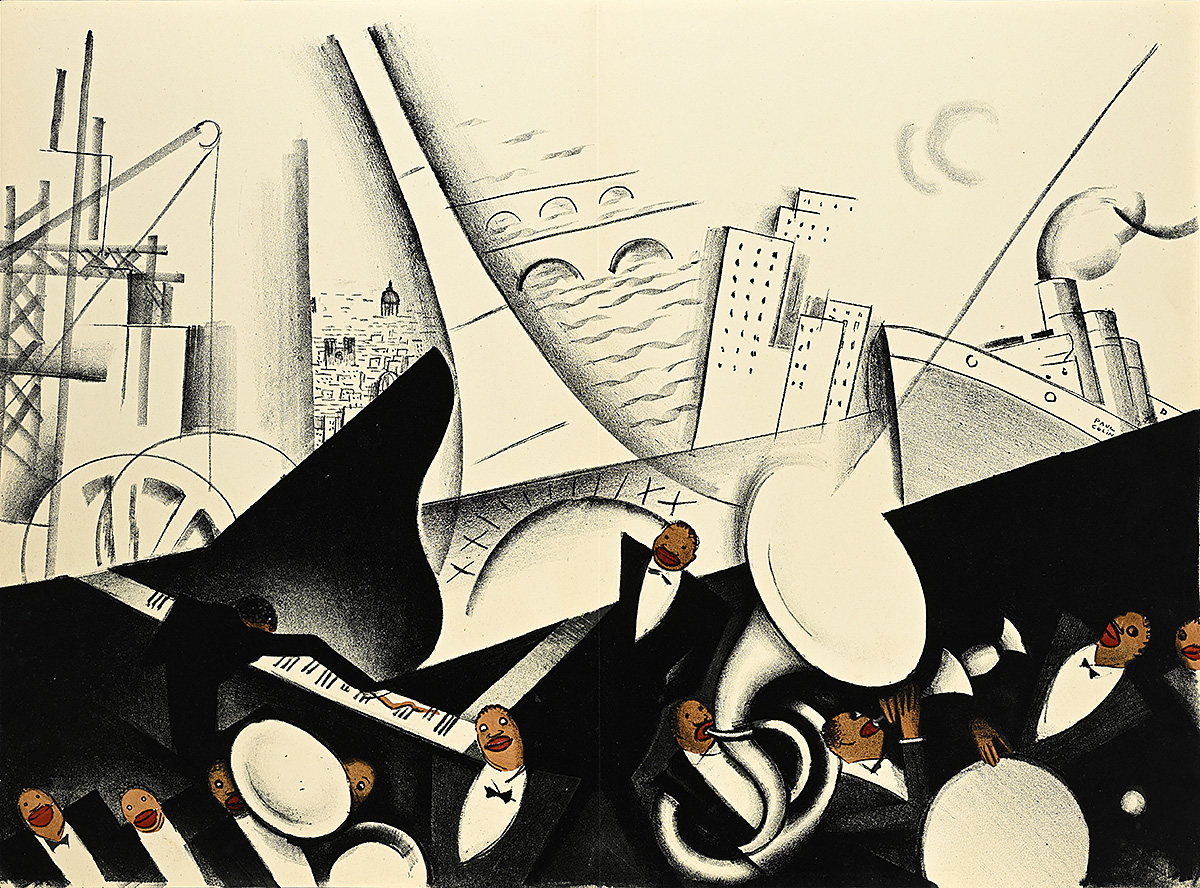
An abstracted illustration of men in black suits playing instruments with a cityscape in the background.

Le Tumulte Noir, 1927

Paul Colin (1892–1985)

The Collection of Merrill C. Berman

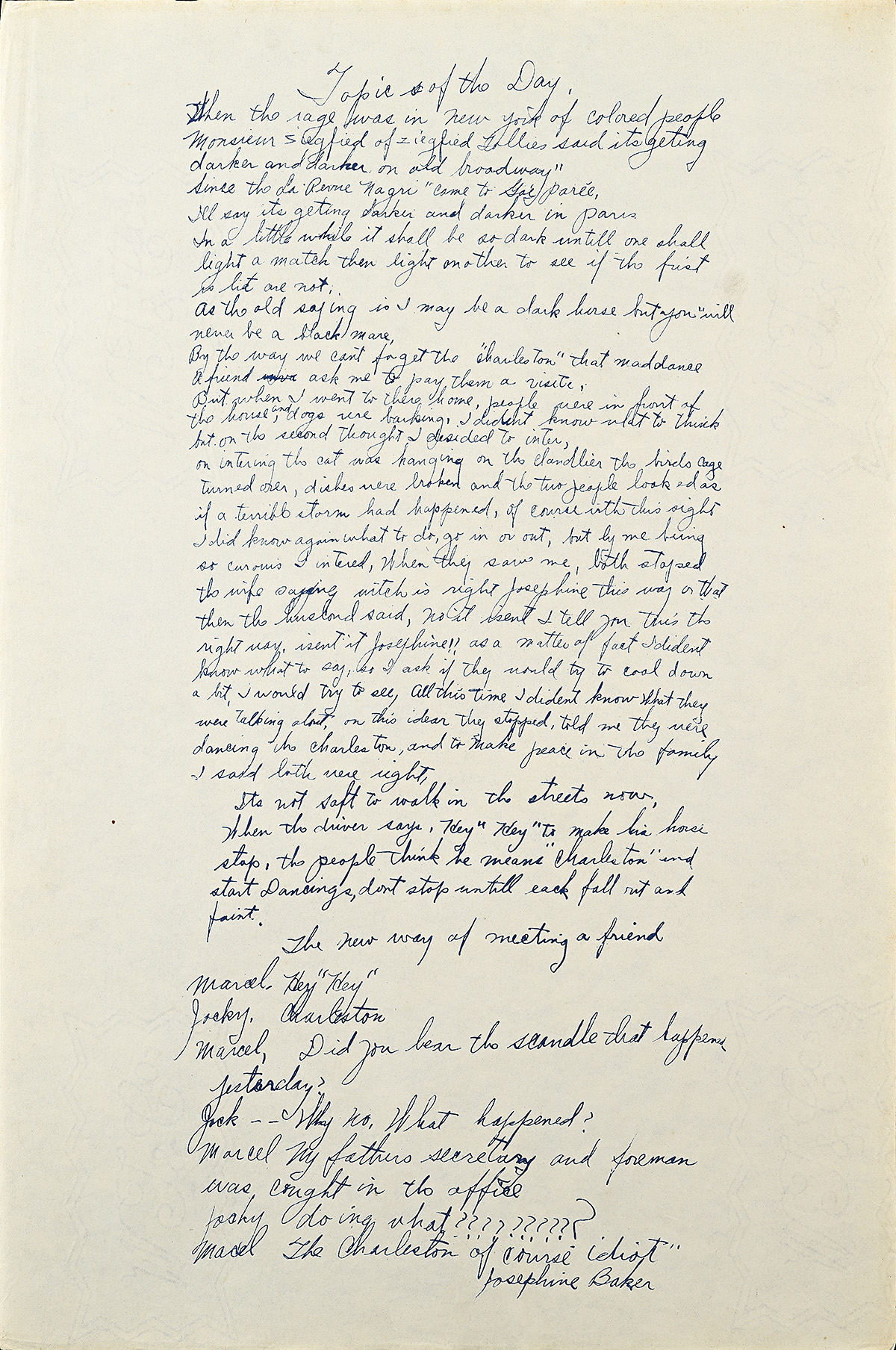
Cursive handwriting in blue ink on off-white paper.

Le Tumulte Noir, 1927

Paul Colin (1892–1985)

The Collection of Merrill C. Berman

  • While she is known today as one of the most important Black stars of all time, St. Louis-born Josephine Baker began her theatrical career as a chorus girl in Shuffle Along, eventually sailing to France in 1925 to star in La Revue Nègre, an all-Black revue that tapped into the Parisian obsession with Black American culture. This production introduced French audiences to the Charleston, a dance created by Black Americans and named after the city in South Carolina. 
  • When La Revue Nègre opened, neither the illustrator Paul Colin nor Josephine Baker were particularly well known; however, Colin’s elaborate and evocative poster for the show became as much of an overnight sensation as the star. The close, occasionally romantic, relationship between Baker and Colin lasted the rest of their lives, and Colin created numerous posters and lithographs depicting the great performer. 
  • Le Tumulte Noir (The Black Craze) is a portfolio of double-sided lithographs accented by pochoir (hand-coloring) that serves as a tribute to Black jazz performers and dancers and their impact on Paris throughout the 1920s. While faithfully reflecting the costumes in productions like La Revue Nègre, the images also incorporate many racist themes, including the suggestion of the hypersexualization and “primitivism” of Black women. The portfolio contains the facsimile of a note from Josephine Baker on her “Topic of the Day,” discussing the idea that Black people were “en vogue” in France.
  • One of Colin’s renditions of Baker shows her erotic banana skirt from the “Danse Sauvage” (savage dance), and suggests the wild and unfamiliar twisting movement of her body that captured the imaginations of white European audiences and helped fuel “the Black Craze.” He also depicts a high-stepping and confident Florence Mills in what was considered more boyish attire in Blackbirds of 1926 as well as a number of unnamed performers who also reflected the craze.

Broadway

In 1903, In Dahomey became the first all-Black musical to open on Broadway, paving the way for a number of shows in the subsequent decades. While it was a challenge to find theaters willing to promote productions with all-Black casts, some of these productions did appear on major stages in New York City, shining a spotlight on Black talent. Most notably, when the Federal Theatre Project was founded in 1935 as part of President Franklin D. Roosevelt’s plan to fund live arts performance under the New Deal, Negro Theatre Units were set up to establish theaters and train unknown artists. These programs employed a number of actors, dancers, and directors who would influence a new tradition of Black presence on the Broadway stage.

The promotion of these all-Black shows often required additional visual support to encourage audiences to attend. In the 1910s, window cards were introduced as supplemental advertising tools to promote films outside of movie theaters. They were so well received that they were soon used for theatrical productions too. Printed cheaply and quickly on inexpensive cardboard, these window cards lack much of the vibrancy and the elaborate designs of traditional posters advertising the same shows; however, they were durable enough to stand up in the windows of stores, barbershops, offices, and other community establishments. This, combined with their relatively small size, allowed them to reach an expanded audience in both rural and urban areas, creating a wider network of venues that could promote Black theater.

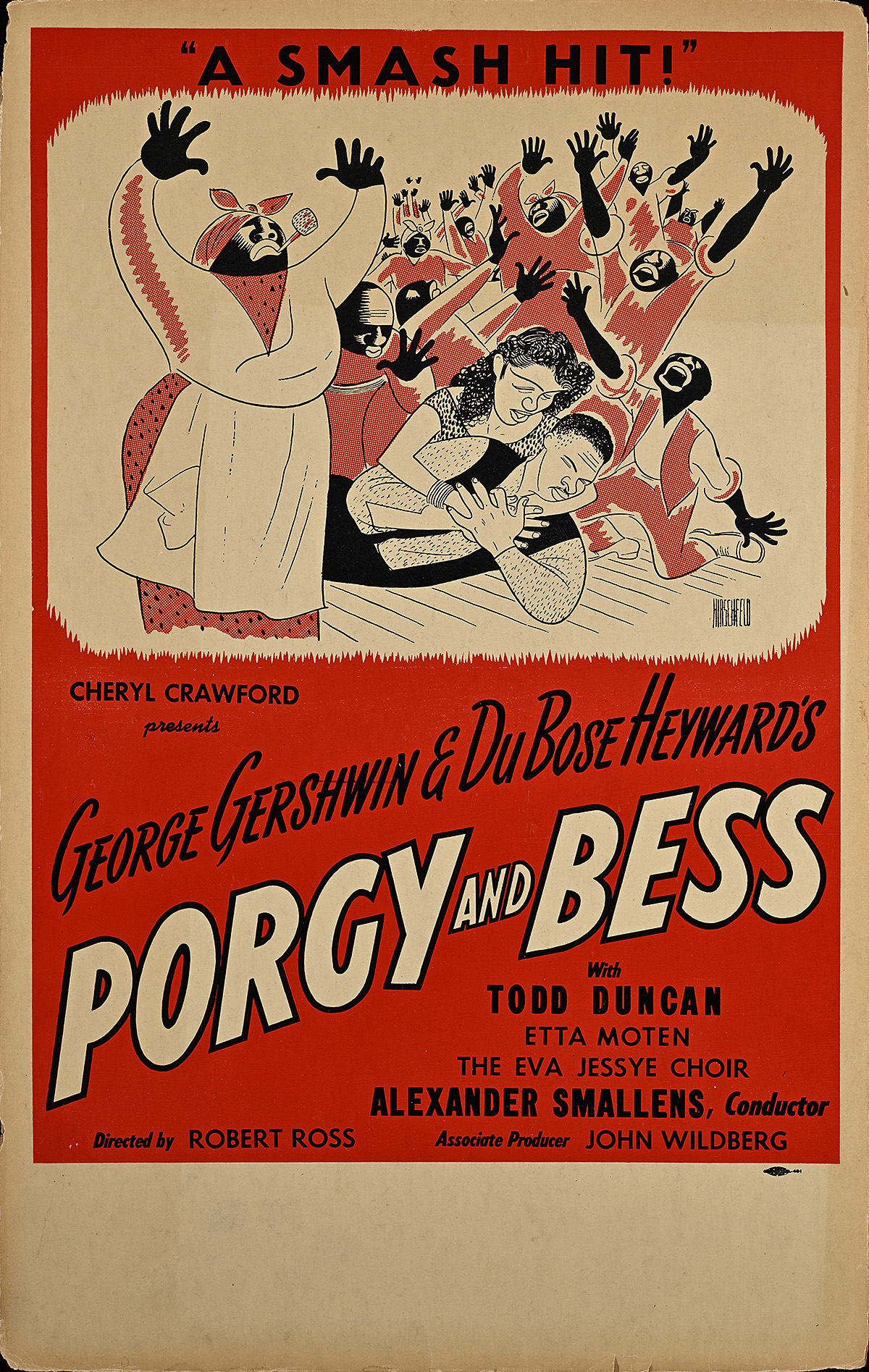
A poster with an illustration of a man and woman embracing on the ground surrounded by figures with their arms in the air.

Porgy and Bess, 1942

Al Hirschfeld (1903–2003)

Private Collection

  • Based on the novel Porgy (1925) by the white writer DuBose Heyward, Porgy and Bess is an opera by George and Ira Gershwin that tells the story of Porgy, a Black disabled beggar in Charleston, South Carolina, who attempts to rescue a woman, Bess, from her violent lover.
  • The opera opened at the Colonial Theatre in Boston in September 1935, before its Broadway run at the Alvin Theatre (now the Neil Simon Theatre) in New York, with Todd Duncan and Anne Brown in the title roles. Brown’s skillful performance allowed Bess to take on a more significant position in the narrative, transforming her from a two-dimensional figure into an emotionally complex character. 
  • Before performing at the National Theatre in Washington, DC, in March 1936, Brown insisted that she would not sing unless the theater was integrated so that her family and friends could enjoy the show alongside white theatergoers. The theater acquiesced to her demands and Porgy and Bess became the first production at the venue to be presented to an integrated audience.
  • The opera was revived in 1942, with Todd Duncan reprising his role of Porgy and Etta Moten as Bess at the Majestic Theatre on Broadway. Like Brown, Moten was adamant about the proper representation of Black Americans on stage and refused to sing the N-word. Her portrayal of Bess (and the 1942 production as a whole) was incredibly successful and encouraged further agency for Black actors.
  • The opera was controversial, however; many criticized its use of minstrel stereotypes, its representation of excessive violence, and its exaggerated Black dialect. This window card by famed cartoonist Al Hirschfeld furthers these issues, featuring an unflattering image of a mammy (a loyal and desexualized Black maternal figure) and other hallmarks of Black stereotyping. Here, Hirschfeld also gives the mammy figure a prime position in the image even though no character of that type actually appears in the opera. This kind of approach would dramatically change in subsequent decades as Porgy and Bess was reworked for modern audiences who supported desegregation and an aggressive shift away from minstrelsy.

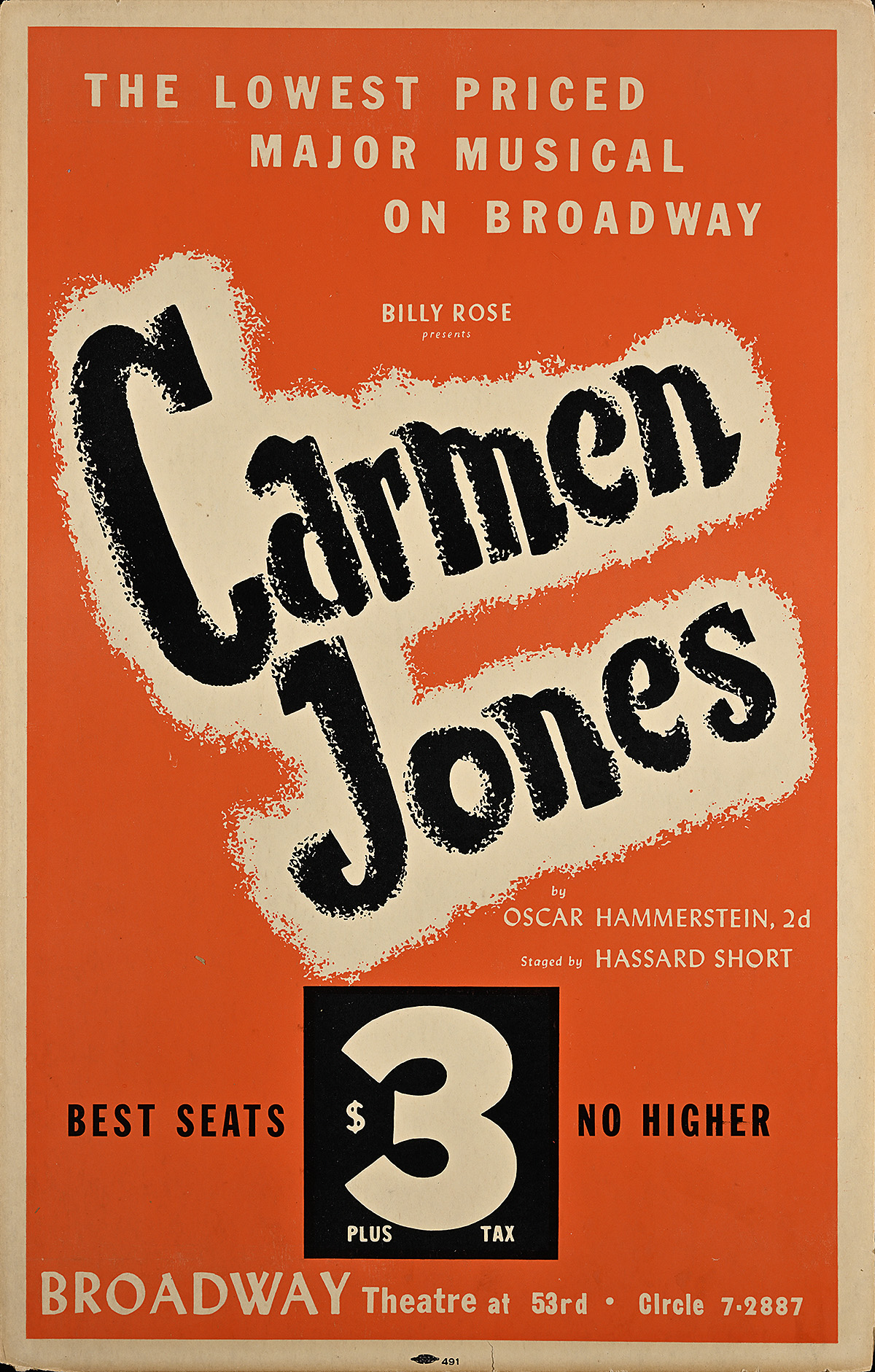
A poster with black and white text on an orange background.

Carmen Jones, 1943

Designer Unknown

Private Collection

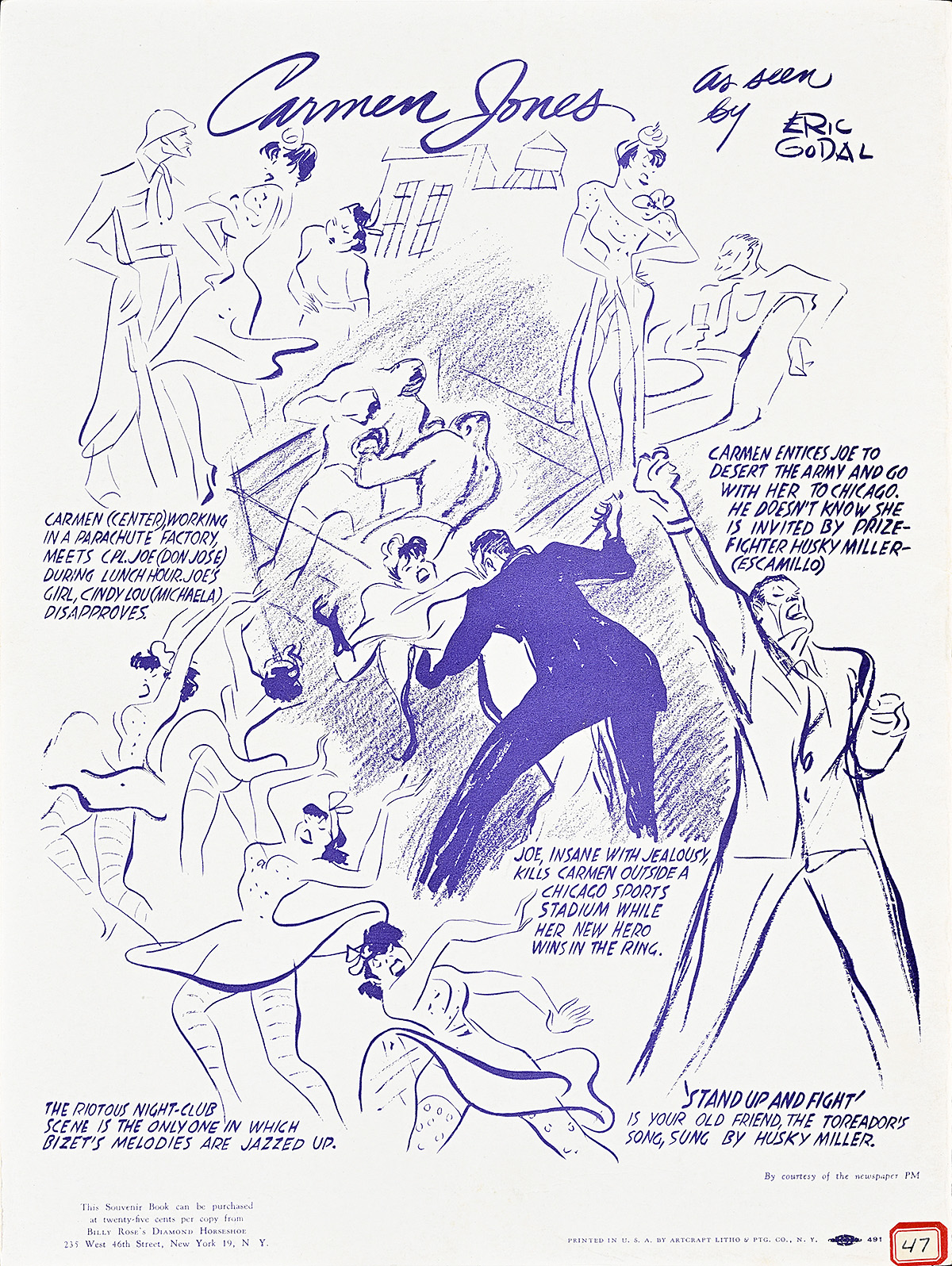
Multiple sketchy purple vignettes of men and women dancing and talking surrounding two boxers in the center.

Carmen Jones Program, 1943

Eric Godal (1898–1969)

Private Collection, NYC

  • The story of Carmen began as an 1845 novella by French writer Prosper Mérimée; in 1875, it was adapted into an opera by the composer Georges Bizet. The narrative follows a manipulative and troublemaking Spanish woman who seduces a hapless soldier so he will help her escape from jail, only to lead him on a path to ruin before leaving him for a more glamorous bullfighter. At the end of the story, the soldier murders Carmen in a jealous rage.
  • In 1943, celebrated Broadway lyricist Oscar Hammerstein borrowed Bizet’s original score and reimagined the production as Carmen Jones, a contemporary retelling of the story with an all-Black cast set against the backdrop of America during World War II.
  • Almost all the members of the original Broadway cast made their stage debuts in this high-status show, which offered a unique opportunity for performers, regardless of race. Despite this, the fact that the dialogue was written entirely by Hammerstein, a white man, led to criticism about its authenticity and portrayal of a Black American experience.   
  • As this musical opened during World War II when domestic budgets were tight, the poster emphasizes the low ticket prices. It is also notable that there is no mention of the production’s all-Black cast, suggesting that such integral information may have been seen as a deterrent to white audiences. By contrast, the stylized, illustrated program depicts scenes from the play with Black cast members and includes a spoiler for the ending.

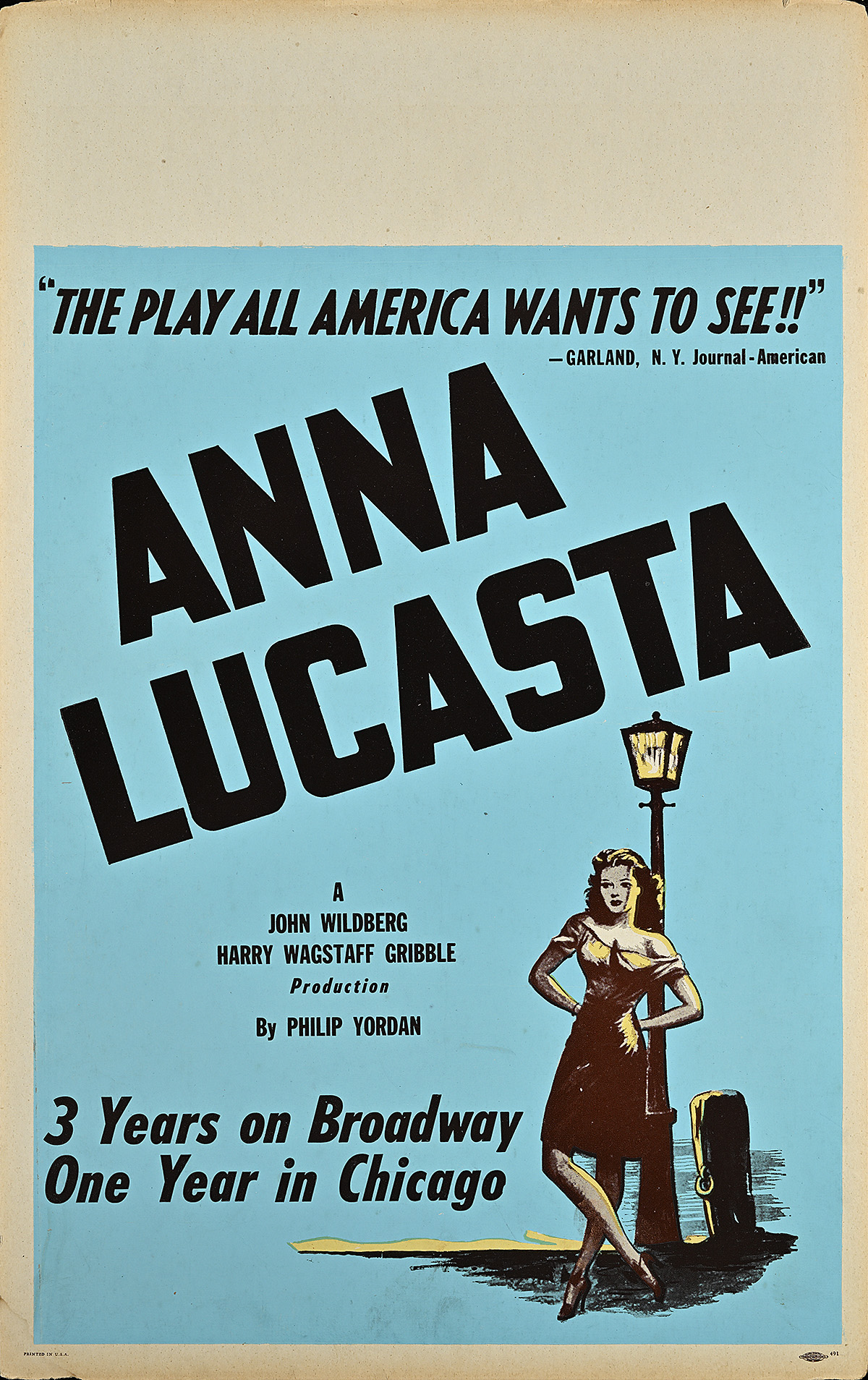
A poster with an illustrated woman in a dress leaning against a lamp post with bold black text on a blue background.

Anna Lucasta, c. 1947

Designer Unknown

Private Collection

  • In 1944, the directors of the American Negro Theatre, Abram Hill and Harry Wagstaff Gribble, purchased the rights to Anna Lucasta, a play by Philip Yorden inspired by Eugene O’Neill’s 1921 Pulitzer Prize-winning play Anna Christie about a young Polish sex worker. They updated it as an all-Black production, and it opened in June 1944 at the Little Library Theatre (now the Schomburg Center for Research in Black Culture) in Harlem before transferring to the Mansfield Theatre on Broadway.
  • Anna Lucasta was the first all-Black play that did not focus primarily on racial issues. Gribble told the Chicago Defender, the Black American weekly newspaper, that a play in which Black people were seen as individuals and not reduced to racialized topics might represent the future of Black theater. 
  • The design on this window card was reprinted for several years and used nationally, with only slight alterations to the text. This particular print indicates that the play has already run for three years on Broadway and one in Chicago—a notable achievement during the cash-strapped wartime era. The blank space at the top of the poster would have been filled in by the theater presenting the show, indicating that this card was most likely printed for a national tour.

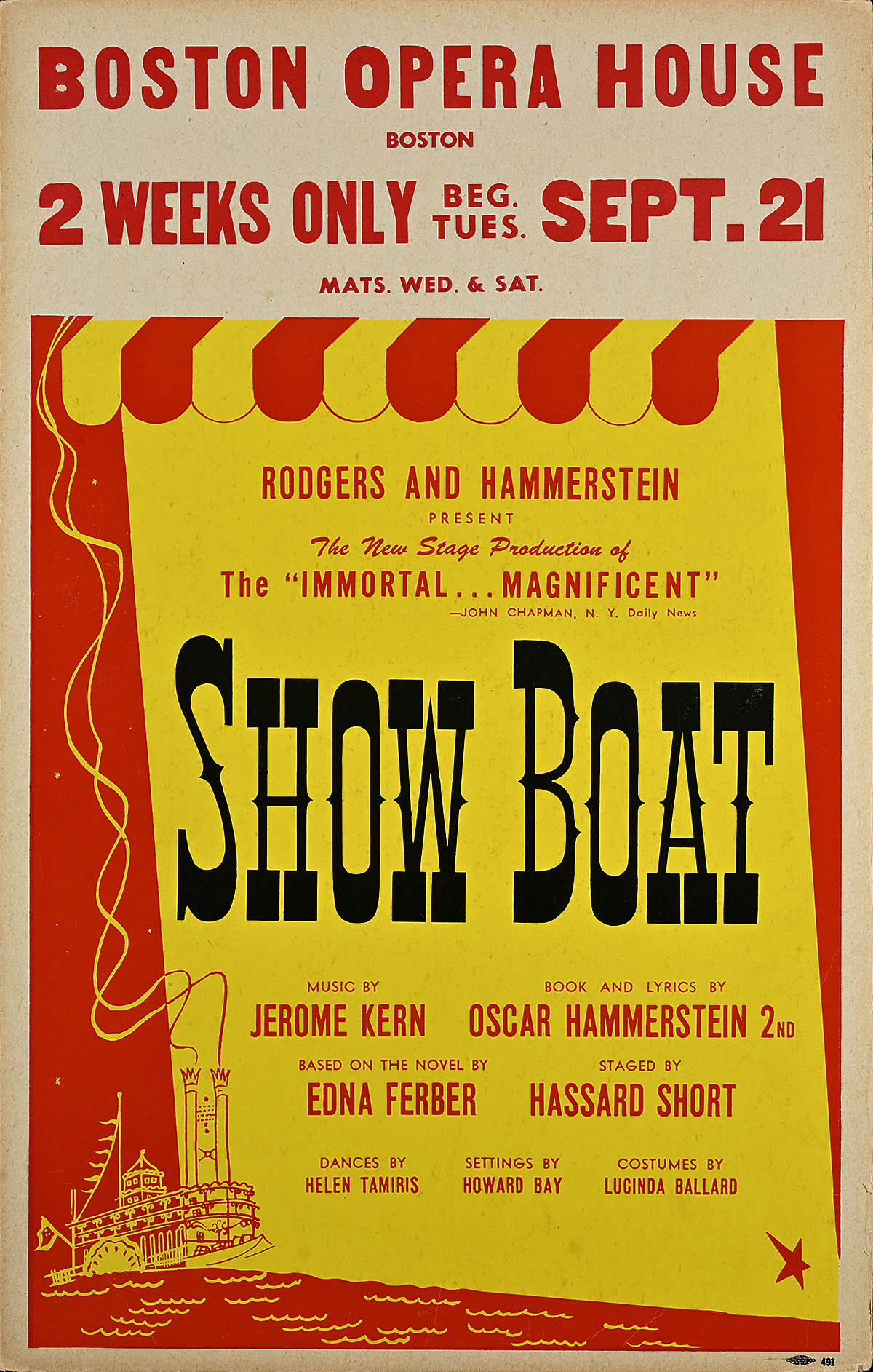
A poster with a yellow rectangle with black and red text surrounded by a red frame and a drawing of a boat.

Show Boat, c. 1948

Designer Unknown

Private Collection

  • Based on the 1926 novel by Edith Ferber, Show Boat was adapted to a play with music by Jerome Kern and lyrics by Oscar Hammerstein. The show follows a family of theatrical performers and their staff on a Mississippi riverboat over the course of four decades. It remains significant to the history of Black narratives in theater since it addresses serious themes of miscegenation (mixed-race romance) and racial prejudice. It also incorporates traditional Black music styles, including gospel and jazz, most notably in the show’s famous ballad “Ol’ Man River.”
  • The cast of the original 1927 production included several vaudeville performers as well as the Princeton-born Paul Robeson who would reprise the role of Joe in the 1936 film. It was also the first integrated musical, with Black and white performers singing together. Notably, the mixed-race character Julie LaVerne was always played by a white actress to ensure that there was no interracial romance between the actors since this was illegal. Despite these advances, the writing in Show Boat, like that in Carmen Jones, was criticized for not reflecting real Southern Black vernacular. The liberal use of the N-word in the script was substituted or omitted in later productions.
  • The play originally included a scene in which the characters visit Dahomey Village at the 1893 Chicago World’s Fair where “native Africans” are on display. They begin chanting as they perform the song “In Dahomey” (no relation to the show of the same name but full of historic similarities in themes and musical compositions), scaring off the white fairgoers. Once the audience in the play leaves, it is revealed that the “Africans” are really Black Americans in costume. The scene was reworked after the 1946 production due to its perpetuation of the exotification of Black people and its use of nonsensical gibberish as a stand-in for an African language or dialect.

The Screen

In the early 20th century, motion pictures quickly became the most popular form of mass entertainment, providing a fresh space for writers and directors to craft stories for Black audiences. This new narrative medium also presented an opportunity for a generation of Black performers who excelled on the vaudeville circuit to reach an even broader audience and present both realistic and mythical Black stories. At the same time, however, negative racial imagery and stock characters that were part of the American theatrical tradition migrated from the stage to the screen.

Filmmakers explored various ways of depicting aspects of Black culture across a variety of genres, like Westerns, crime, romance, comedy, and musicals, borrowing the musical style, chorus-girl extravagance, and revue format of theater to expand the diversity of stories presented on camera. The new movie studios used the power of the poster to lure audiences just as circuses and theaters had done, experimenting with bright and compelling compositions in a search for the most effective advertising methods. The screen became a powerful tool in the gradual promotion of a heterogeneous representation of Blackness, countering the reductive stereotypes of the stage while developing and offering a more diverse display of the artistry of Black Americans.

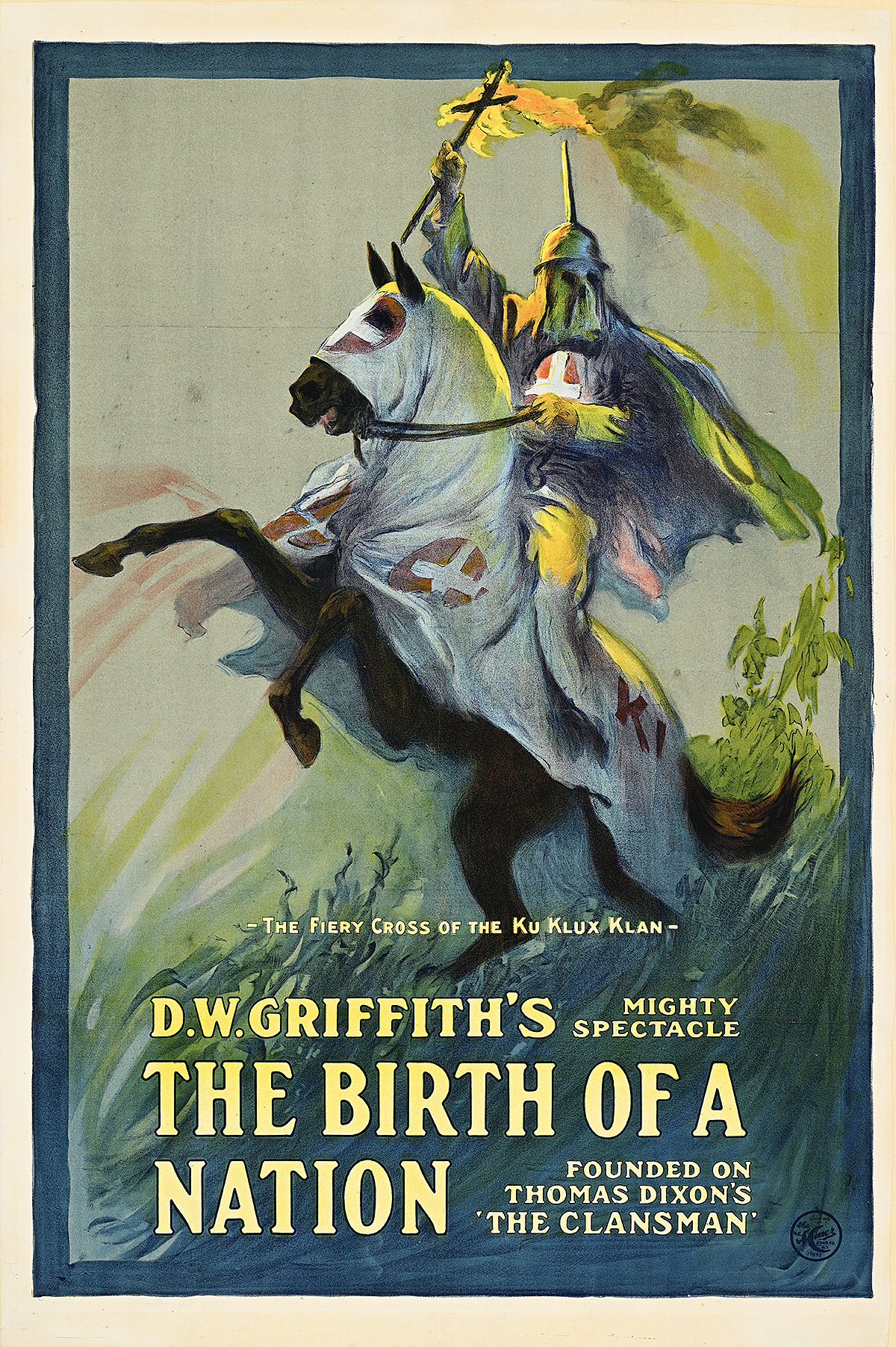
A poster of an illustrated person holding a cross and riding a bucking horse wearing a white sheet.

The Birth of a Nation, 1915

Designer Unknown

The Ralph DeLuca Collection

  • In 1915, director D.W. Griffith adapted The Clansman, the second of three novels in Thomas Dixon’s epic trilogy about the American Civil War and the period of Reconstruction that followed, renaming it The Birth of a Nation. The film was a huge commercial success with white audiences around the country, becoming the most profitable movie of its time. President Woodrow Wilson even screened it at the White House, effectively establishing it as a national cultural artifact. In spite of its overtly racist message and its championing of the Ku Klux Klan (KKK), it was an ambitious film, one still acknowledged for both its technical advances and its innovations in film narrative.
  • The Birth of a Nation presents the South as a paradise for the white race that is  threatened by the emancipation of Black people as well as by Black freemen from the North. The KKK, a white Christian extremist organization, is positioned as a protector of the traditional, white community against the supposed aggression and savagery of Black people. Many of the major Black characters in the movie are played by white actors in blackface and are subjected to horrific acts of violence, including torture and lynching.
  • Civil rights organizations like the National Association for the Advancement of Colored People (NAACP) spoke out and organized protests across the country against screenings of the film, asserting that a narrative that supports fear and hatred of Black people would naturally encourage violence against them and further perpetuate harmful stereotypes that degraded the entire race. The Black press and community leaders also called for a targeted response to the dangerous messaging of the film, insisting on a more honest depiction of Black people on screen. This included a demand for more films made by Black people, featuring Black characters (not in blackface), and written for Black audiences.
  • The hooded clansman on horseback in this poster is positioned as a heroic figure, reaffirming the KKK’s message of white supremacy. Pressbook promotions for the film matched the celebratory tone of this poster, claiming that it was one of the “mightiest spectacle(s) ever produced” and the “8th Wonder of the World.” As one of the earliest equivalents of a blockbuster, this film sent a loud message to the American public about how Black Americans were to be viewed and presented on screen.

Race Films

The first all-Black films appeared as early as the 1890s but by 1915, almost immediately after the release of The Birth of a Nation, Black filmmakers began working to create more representations of Black narratives for Black audiences. Colloquially dubbed “race films,” such movies did not necessarily present race-focused stories but reimagined the ways in which Black people were portrayed, adding depth to Black characters and range to racially driven plots. The main message of these films centered on quintessentially Northern ideas about advancement through education, industry, and urbanization. 

Race films were often financed and led by white production teams; in the few instances when this was not the case, the movies spoke to cultural and communal interactions and lived experiences. These films were not without flaws, however, and were occasionally criticized for stereotypical and offensive depictions of Black people, much like those found in vaudeville. 

Not all films with Black actors were considered race films. Many of them, though, were essential to establishing the ways in which Black stories were presented on screen since they were produced by an industry that often pigeonholed Black Americans and created barriers to their success.
Whether or not a movie was classified as a race film, those with all or mostly Black casts were screened in Black-operated or segregated theaters, churches, and schools throughout Black neighborhoods across the country, and especially in Southern states. To encourage all audiences to see these films, posters and other forms of advertising promoted the brilliance of their talented Black actors and their innovative or elaborate set designs.

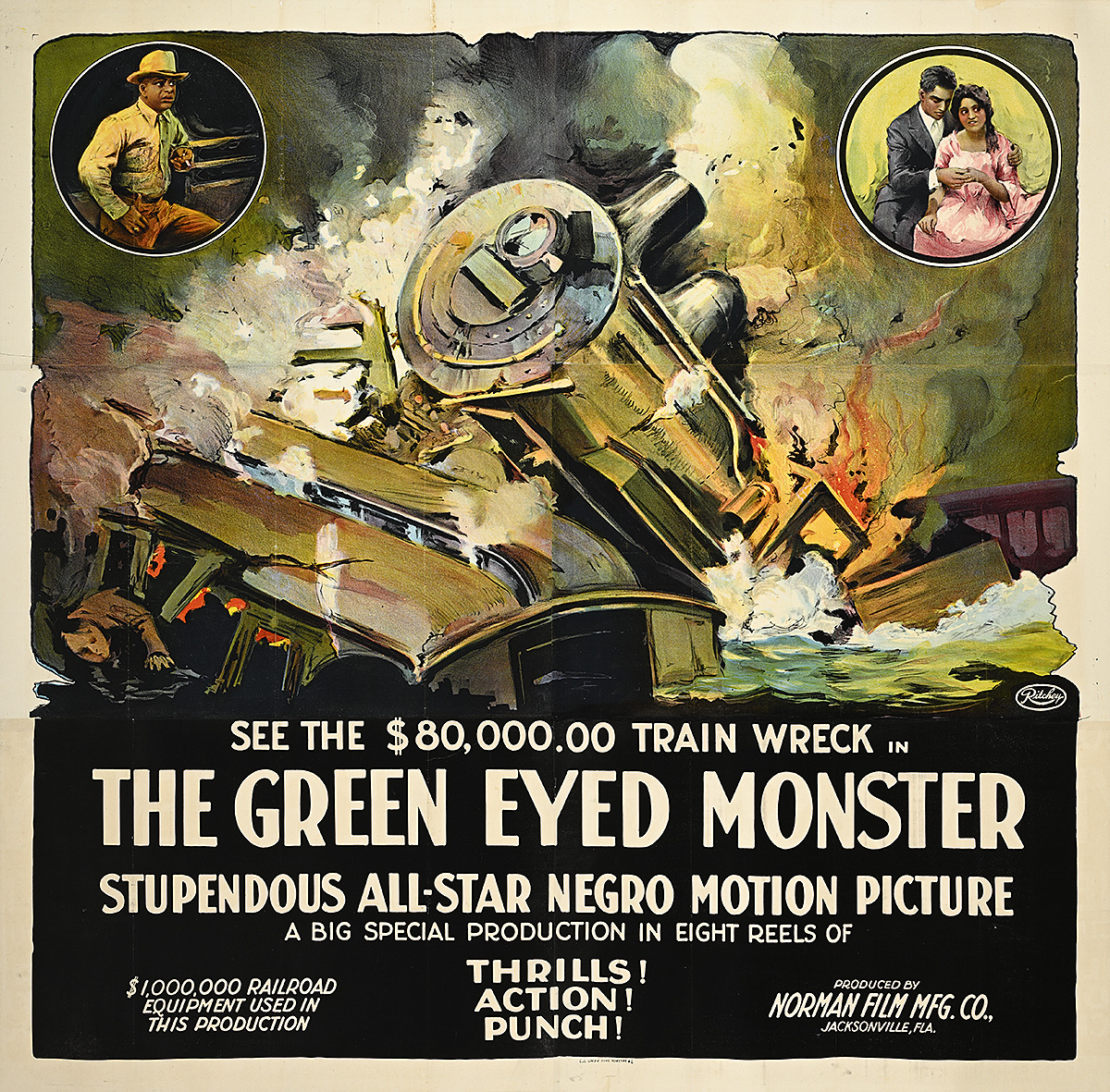
A poster of a painterly train crash with vignettes of Black men and women embracing.

The Green Eyed Monster, 1919

Designer Unknown

Poster House Permanent Collection

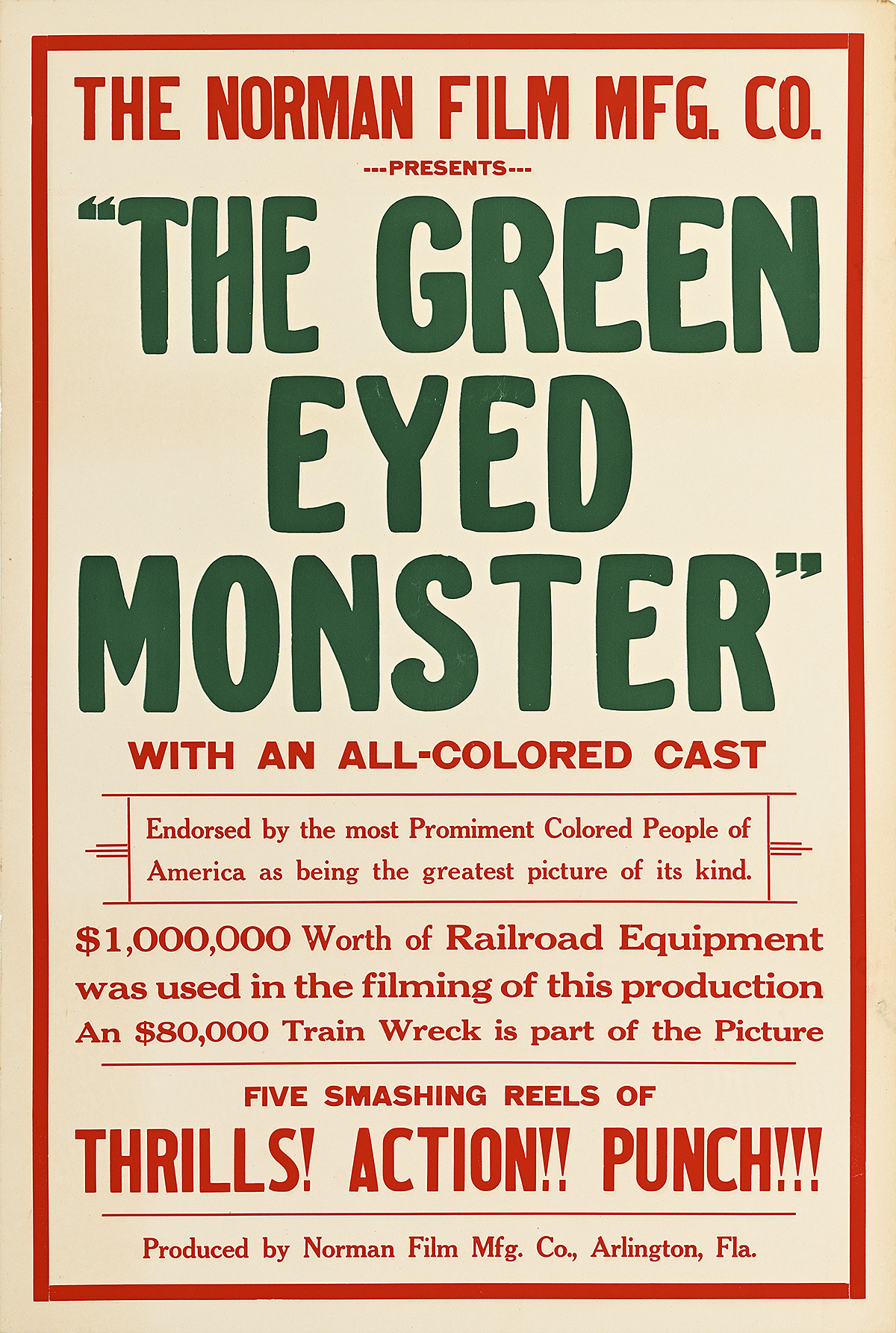
A poster of red and green text on a white background.

The Green Eyed Monster, 1919

Designer Unknown

Poster House Permanent Collection

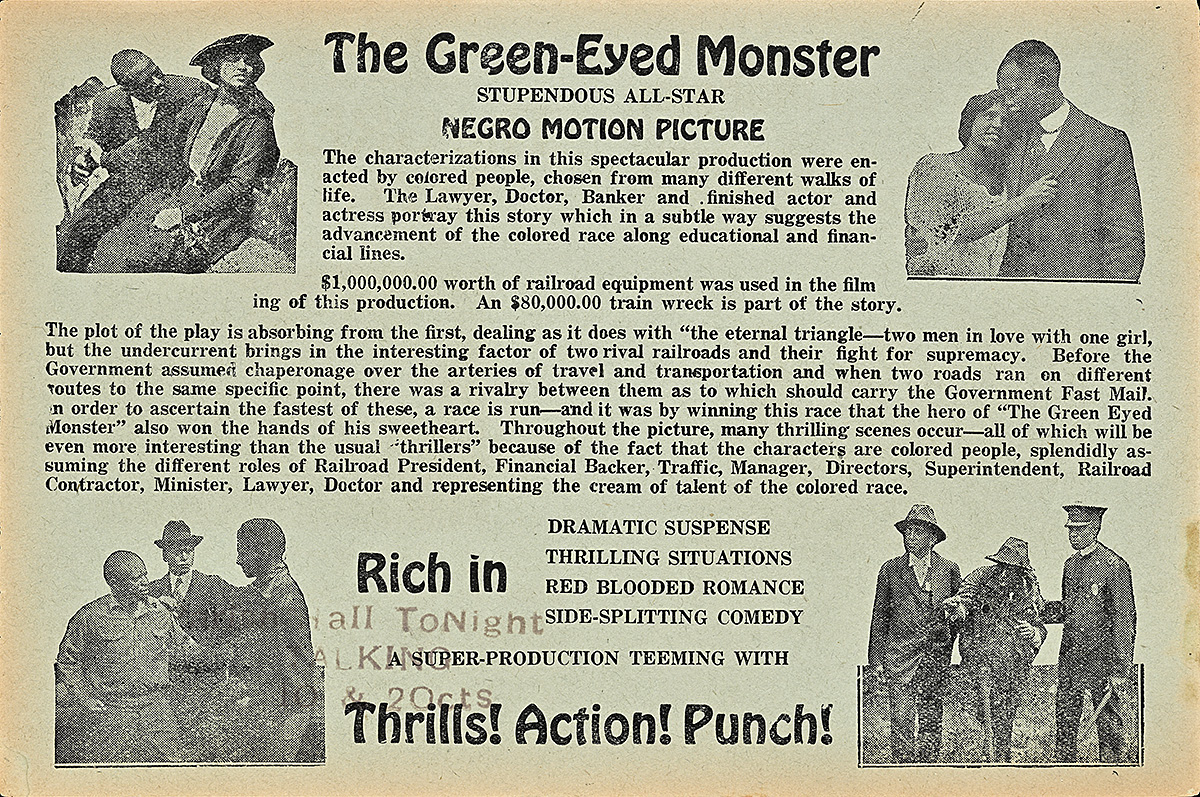
  • In 1912, Richard Norman, a white film producer, launched his career in the Midwest by creating “home talent” films, a format that featured local actors and crews. In the years that followed, he gradually stopped making films specifically for white audiences. In 1920, Norman officially moved to Jacksonville, Florida, where he founded Norman Film Manufacturing Company (eventually shortened to Norman Studios) and turned his attention to producing silent race films with all-Black casts specifically for Black audiences. He recognized both a business opportunity and a cultural need: there was a growing demand for films that showcased Black talent and offered what he considered to be a more accurate and more respectful representation of Black people. Motivated to combat the negative stereotypes perpetuated by films like The Birth of a Nation, Norman aimed to portray Black characters in a positive light while providing well-paying jobs for Black actors in the film industry. 
  • The Green Eyed Monster was Norman’s first race film. While it is considered a lost film, surviving material indicates that it was a comic drama about greed in the railroad industry and also featured a love triangle.
  • Both posters highlight the exceptional cost to the production company of making the film, including an $80,000 trainwreck (approximately $1 million today) and a million dollars worth of railroad equipment (approximately $18.5 million today). These figures may not be entirely accurate, however, as such numbers were often exaggerated and sensationalized on advertising materials by silent film companies of the day as they sought to compete with the growing film industries in Florida, New Jersey, and Hollywood. Current research indicates that Norman actually used old stock footage for the train wreck rather than paying a fortune to stage a new one.
  • It is also interesting that the length of the film is described differently in each poster. This inconsistency is most likely due to selective editing for later screenings in which certain comedy bits that had not been well received by early audiences were cut. Those scenes were later repurposed for The Love Bug, another feature released by Norman that year and described as a sequel to The Green Eyed Monster.

Four black and white photographs of Black men and women surrounding black text.

The Green Eyed Monster Herald, 1919

Private Collection, NYC

  • Norman Film Manufacturing Company emphasized the importance of racial representation in its race films, highlighting the talent of the individual actors; it also attributed the quality of its films to their high production values—a particularly important point since films produced by white production companies with white actors often had higher budgets and access to more screening venues. Despite these efforts, some critics still commented on the offensive comic stereotypes in The Green Eyed Monster
  • Heralds were small flyers that typically featured dramatic stills from a movie and could be handed out on the street to entice viewers. As noted in this herald, Norman cast many local Jacksonville residents in his films; in this case, they included S. D. McGill, an established Florida lawyer who played a wealthy railroad executive, and R. L. Brown, a doctor who portrayed the father of Louise Dunbar, the film’s main female character. One of the most prominent roles, however, was given to Buddy Austin, the manager of Jacksonville’s Strand Theatre, a motion picture theater that had originally served as a vaudeville house for Black acts and performances.
  • Jacksonville, Florida, offered an ideal climate for year-round film production. A year after the premier of The Green Eyed Monster, Norman purchased Eagle Studios in the city, creating a permanent home for his studio.

1920s

The film industry of the 1920s did not have formal regulations that dictated how Black people should appear in movies or how their stories should be told. Filmmakers during this decade generally had the freedom to present narratives that countered the horrific stereotypes and sentiment on display in films like The Birth of a Nation, often focusing on familial and aspirational Black storylines in which Black people were positioned as the heroes and heroines. 

To promote these movies, poster artists used the same sensational and eye-catching tactics as those deployed for early Hollywood features, frequently translating the most exciting or integral scenes from a film into full color. The addition of the phrase “All Colored Cast” and its variations in advertising was especially important, as many of the films were shown in Black-only theaters, churches, and schools. Mixed or predominantly white theaters that also screened race films on specific days of the week or during their late-night hours, referring to them as “midnight rambles,” could opt in (or out) based on this marketing language.

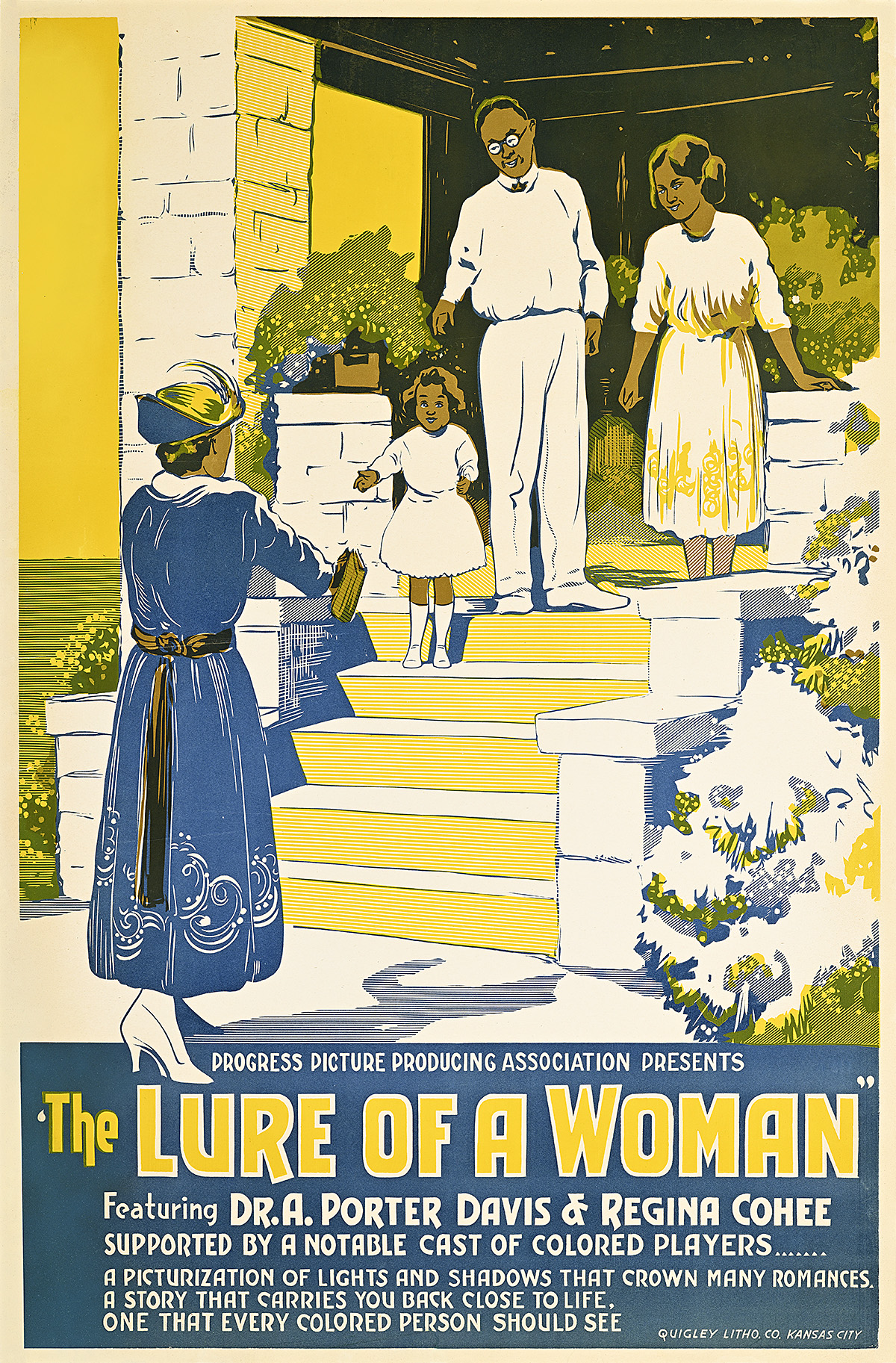
A poster of a Black woman walking up towards a house with a Black family with a child waiting at the top of the steps.

The Lure of a Woman, 1921

Designer Unknown

Poster House Permanent Collection

  • Early Black filmmakers aimed to represent traditional Black families in an effort to counter the cruel reality of family separation that was a cornerstone of enslavement. Though The Lure of a Woman is considered lost and little is known about the plot, the poster highlights a middle-class, Black suburban family and emphasizes the romance within the narrative.
  • The Lure of a Woman was the first race film made in Kansas City, Missouri, and featured a cast of local residents. One of the lead actors listed on the poster is Dr. A. Porter, an actual local physician who established a maternity sanitarium for Black mothers that provided services and guaranteed privacy. His position in the community as a medical professional who offered a safe haven for Black women underscores the wholesome nature of the film.
  • When the Lincoln Motion Picture Company moved its headquarters from Omaha, Nebraska, to Los Angeles, California, in 1917, the Midwest lost its only Black-owned film company; however, in 1921, the Progress Picture Producing Association took its place, promising that it would continue to provide opportunities for local people to feature in Black-focused films.
  • According to a newspaper article from 1922, a print of The Lure of a Woman caught fire and was partially destroyed during a screening at Western University, a historically Black college. Only one reel of the film is known to have survived.

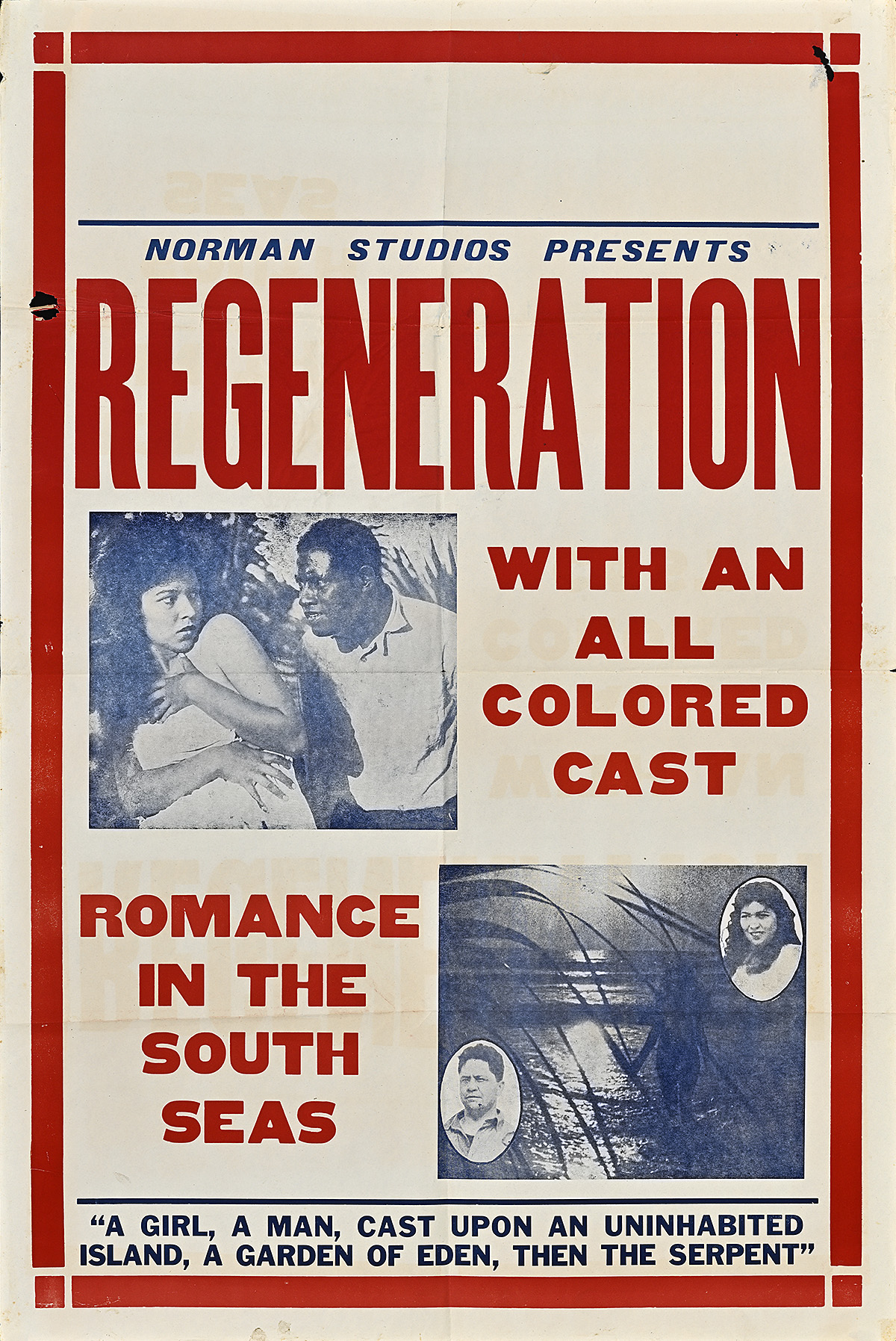
A poster of a Black man leaning towards a nervous looking Black woman printed next to bold red text.

Regeneration, 1923

Designer Unknown

Gift of Posteritati, Poster House Permanent Collection

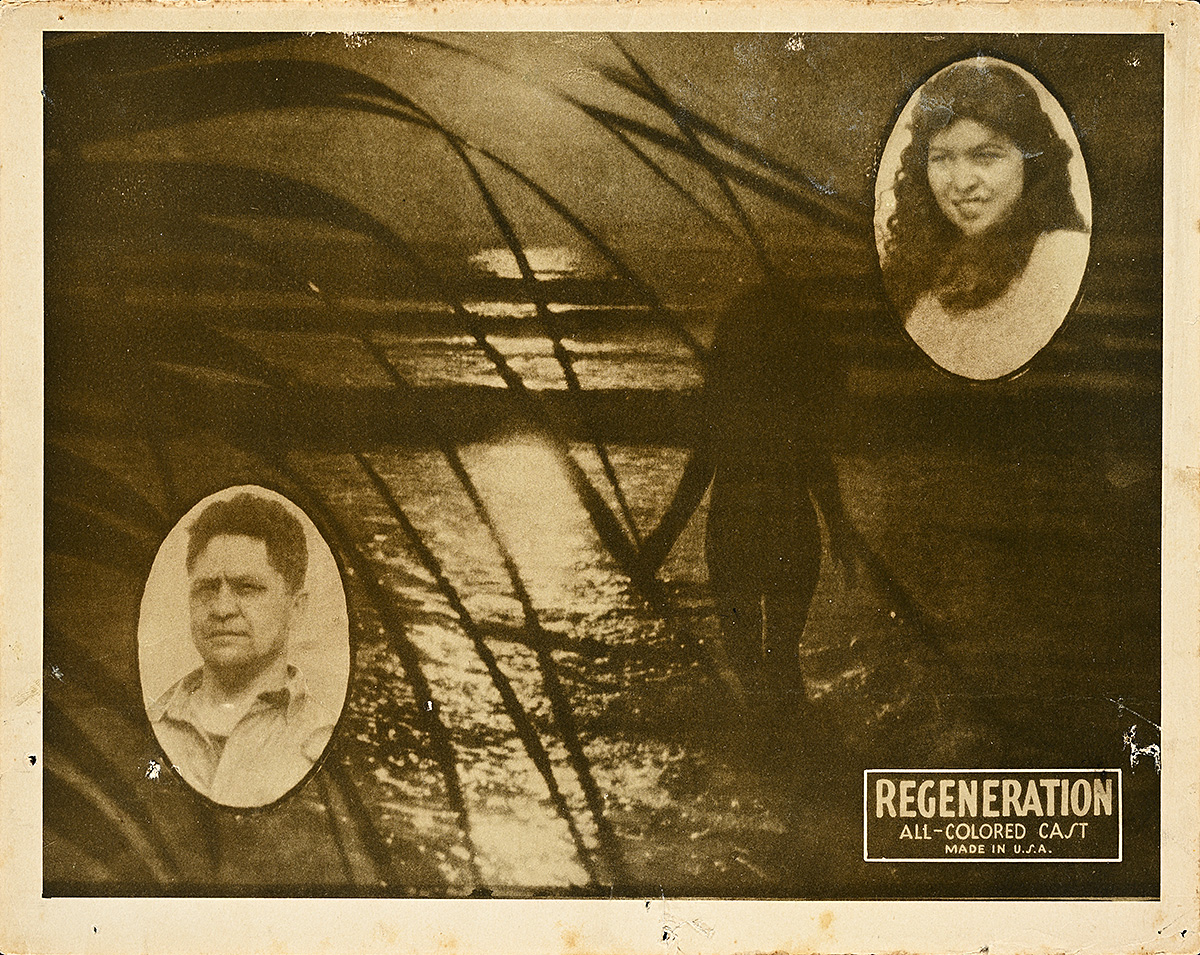
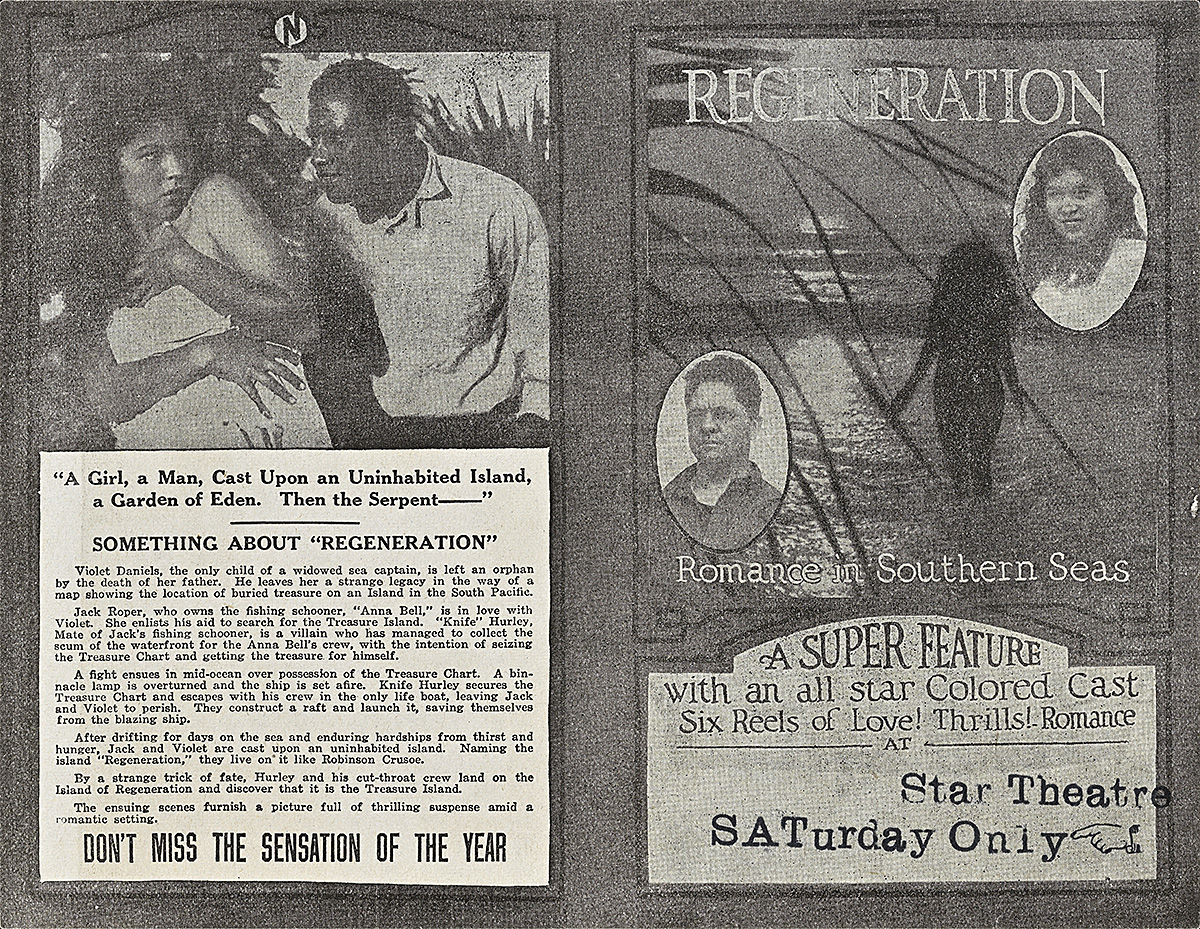
  • Filmed in the small seaside village of Mayport outside Jacksonville, Regeneration was one of Norman’s most daring projects. It tells the story of a woman and two men shipwrecked on an island they have named Regeneration. When other survivors appear, a hunt for buried treasure ensues and two of the main characters fall in love.
  • Eager to entice audiences, Norman featured a scene showing the lead female actor bathing nude in the film’s promotional material. Aware of state censorship laws outside Florida, he informed theaters that he could cut the scene if necessary.
  • In addition to titillating posters, Norman encouraged movie houses to fill their lobbies with palm leaves, moss, and white sand to emulate the film’s exotic location. This creative approach to advertising ultimately made the film a huge success with both Black and white audiences.
  • Like many of Norman’s films, Regeneration was a six-reel feature. At this time, reels were typically 10 to 11 minutes long. In corresponding advertisements, fight scenes were described as appearing in the second, third, fourth, and sixth reels, leading to some claims that the film was too violent and might incite riots. This type of subjective censorship was common throughout the 1920s and varied from state to state.

A photograph of a figure from behind standing in water and two ovals in the corner each with a person's face inside.

Regeneration Scene Cards, 1923

Private Collection, NYC

A black and white photograph of a young man and woman with text on the left and an ocean scene on the right.

Regeneration Herald, 1923

Private Collection, NYC

  • This herald and scene cards for Regeneration, Norman’s fourth feature film, also show the most sensual and supposedly violent scenes in the movie, further reflecting his daring approach to publicity.
  • The Reconstruction era that followed the Civil War was defined by the government’s attempt to rebuild and reintegrate the former Confederate States in the South. It also revealed the challenges faced by formerly enslaved persons (also known as freedmen) who faced violent social and political aggression as racial hierarchies reinforced a system of white supremacy with both de facto and de jure racism.  
  • The herald is stamped to post a showing at the Star Theatre. This might refer to a theater once located in Goldsboro, Florida, a town established by the Freedmen’s Bureau, an agency established by the federal government to provide relief and education for refugees and freedmen during Reconstruction. The Star Theatre opened sometime in the early 20th century and served only Black audiences. As race films were often screened in Black-owned theaters, this stamp indicates that films like Regeneration were screened for the communities they represented.
  • Of the six reels that comprise Regeneration, only the second survives—though much of the footage is damaged due to nitrate decomposition within the cellulose filmstrips.

A poster of a smiling Black woman's face under a spotlight with musical notes and people dancing.

St. Louis Blues, 1929

Designer Unknown

The Ralph DeLuca Collection

  • In 1922, New York City-based Okeh Records coined the term “race records” to help market Black music (blues and jazz) to predominantly Black audiences. Other recording companies quickly latched on to the phrase, and race records developed their own specific market. 
  • One year later, blues singer Bessie Smith signed with Columbia Records. Due to her popularity she eventually headlined for the Theater Owners Booking Association, a Black vaudeville circuit responsible for booking singers, comedians, and other performers.
  • As vaudeville declined in popularity, Smith looked for other opportunities, going on to star in her first and only film, St. Louis Blues. The movie takes its name from a 1914 song performed by Smith in 1925 with Louis Armstrong on cornet; it tells the story of a woman whose boyfriend has left her for someone else. The film ends with Smith singing the title song in a powerful display of her talent.
  • While they are not named on the poster, other members of the all-Black cast who went on to become important figures in Black history include Isabel Washington (sister of Fredi Washington and first wife of U.S. House Representative Adam Clayton Powell, Jr.) and Jimmy Mordecai (who performed in a minor role in the film adaptation of Eugene O’Neill’s The Emperor Jones in 1933).
  • Although the song itself is full of longing and desperation, the poster shows a jubilant Smith and an upbeat bar scene. At the time of its release, Smith was known as the “Queen of the Blues” and her presence alone compelled audiences to buy a ticket to hear one of America’s most beloved singers.

A narrow poster of four vignettes of Black men and women dressed as cowboys with concerned facial expressions.

The Bull-Dogger, 1922 

Designer Unknown

Poster House Permanent Collection

  • The Bull-Dogger was the first Western film produced by Norman Film Manufacturing Company. It featured Bill Pickett, a Black-Cherokee cowboy and actor who is credited with inventing bulldogging (biting the lip of a steer to wrestle it to the ground). 
  • The movie was filmed in and around Boley, Oklahoma, a thriving Black pioneer town incorporated in 1905 that was often advertised as a place where Black Americans could escape discrimination. While frequently represented as an expression of white manifest destiny, the Western United States (colloquially referred to as “The West”) also represented an opportunity for Black Americans to flee segregation laws present in the rest of the country in search of greater opportunities. Western films like this one therefore played an especially important role in Black representation on screen. 
  • The film largely comprised a series of action shots featuring Black cowboys. To further promote these exciting scenes, this three-sheet poster includes a depiction of one of the only surviving fragments of the film reel in which Bill Pickett wrestles a calf to the ground. 
  • Both the herald and the pressbook for the film emphasize the importance of race in the movie, stating that “this is the first feature picture of its kind, and proves conclusively that the Black cowboy is capable of doing anything the white cowboy does”—a powerful counterpoint to the dominant Hollywood narrative that mythologized the Western as an essentially white genre.

Two black and white film advertisements next to each other on a page with black text.

Norman Film Manufacturing Company Pamphlet, 1922

Private Collection, NYC

  • Printed by Norman Film Manufacturing Company to help sell its four available offerings to movie theaters around the country, this pamphlet uses enticing marketing language and statistics to highlight each production. 
  • Here, two posters for The Bull-Dogger are accompanied by text that asks theater managers to “give [their] colored patrons a treat [and] book a picture that’s different,” suggesting that there was a specific market for movies featuring Black storylines and stars.
  • Other pages spotlight reviews for The Green Eyed Monster from theater managers around the country. The Palace Theater in Dallas, Texas, for example, noted that “We Believe that you have made the best colored picture yet produced in your Green Eyed Monster.” Such endorsements indicate that movie houses were expected to promote the film to Black audiences and demonstrate Norman Film Manufacturing Company’s commitment to foregrounding race in its advertising in spite of the challenges it faced in selling race films to theaters.

A poster of a Black man and woman looking at each other while standing on either side of a white horse's head.

The Crimson Skull, 1922 

Designer Unknown

Collection of Sam Sarowitz

A poster of a trio of men with masks on around a tied up woman with a skeleton and a Black man look on.

The Crimson Skull, 1922 

Designer Unknown

Poster House Permanent Collection 

  • Filmed at the same time as The Bull-Dogger, The Crimson Skull was Norman Film Manufacturing Company’s second Western and featured the same cast. In it, a town is tormented by a band of outlaws led by a skeleton bandit named “Skull” (played by Bill Pickett). The film’s hero must join the gang as an undercover outlaw to end its tyranny. When accused of being a traitor, he is put to the “Crimson Skull” test in which, as the film’s pressbook describes, “one drop of blood decides his fate…”
  • Both of the film’s leading actors began their careers in vaudeville. After seeing Bert Williams’s and George Walker’s performances in In Dahomey, Anita Bush joined their company and later founded the successful Anita Bush Stock Company (eventually called The Lafayette Players), becoming celebrated as “The Little Mother of Colored Drama.” The Crimson Skull was Bush’s second and final film before she returned briefly to theater and eventually worked with the Negro Actors Guild (NAG).
  • The six-sheet poster exaggerates the extent of the special effects around the villain’s skeleton-like appearance. In the actual film, he is clearly wearing a black unitard painted with white bones. 
  • The six-sheet poster also highlights the “one-legged” actor Steve “Peg” Reynolds. Despite having a visible disability, his work as a stuntman featured prominently in the studio’s advertising and he appeared in all of Richard Norman’s films.

Two open pages with small black text on the left and several black and white film advertisements on the right.

The Crimson Skull Pressbook, 1922

Collection of Sam Sarowitz

  • Film studios often issued pressbooks to theaters to guide them in publicizing a given film. Methods often included marketing-campaign strategies and incorporated flyers that theaters could have printed and delivered to local residences as well as a selection of what would now be considered “clip art.” They also suggested advertising language that proprietors could have printed in local newspapers. 
  • This pressbook displays Norman’s ambitious advertising for both The Crimson Skull and its performers, most importantly Anita Bush who, in her own words here, explains the importance of leading her own company and its significance to her identity. It also emphasizes a departure from plantation themes in entertainment and shows what the pressbook describes as “a more serious side” of Black dramatic stories.
  • In 1911, Pennsylvania was the first state to pass a statewide film-censorship law. It banned The Crimson Skull not because of its depiction of race or race related topics but because it deemed immoral the film’s presentation of “lawlessness” and defiance.

A poster of Black male and female pilots, two inside of a red heart and one with a parachute falling from a burning plane.

The Flying Ace, 1926

Designer Unknown

The Black Canon Collection

  • The only Norman Studios film to survive in its entirety, The Flying Ace follows a World War I pilot who has returned to his job as a railroad detective. When $25,000 goes missing from the payroll of the local railroad company, he sets out to solve the case. Along the way, he falls in love with the railroad operator’s daughter who is interested in aviation.
  • All of the posters promoting the film use action-packed language that emphasizes the daring stunts of the performers. In reality, the flight scenes were simulated on land using a model plane that was most likely constructed by Norman himself. To suggest dynamic movement during these scenes, Norman simply turned his camera 360 degrees and shot from below so the actors appeared to be positioned against the sky. Other scenes drew from previously shot footage featured in other Norman Studios films. 
  • The plane in both posters is meant to be a Curtiss JN Jenny biplane—the aircraft Coleman was flying at the time of her tragic death. 

A pamphlet with photographs of a Black pilot next to images of a plane, a Black couple, and parachuters.

The Flying Ace Pressbook, 1926

Gift of Willis & Claudia Allen, Allen Airways Flying Museum

  • This pressbook for The Flying Ace uses exaggerated marketing language to indicate the limited number of Black theaters that will screen the film as well as the incredible amount of money Norman has spent to produce it. This information is meant to encourage the confidence of potential exhibitors in the profitability of the movie. Norman was a masterful marketer and often incorporated sensational language like this to convince people to screen his race films; it was accompanied by various promotional tips that could be used to attract audiences. Here, he even encourages the display of beautifully lithographed posters to increase attendance.
  • The names of the members of the star-studded cast are accompanied by references to their extensive careers in theater and vaudeville. These accomplishments, however, were marred by persistent racist typecasting, including many stereotypes like the “pickaninny” roles that Black actors typically had to endure to remain employed.

A narrow poster with three men standing next to a woman sitting in a grounded airplane and two damaged airplanes in the sky.

The Flying Ace, 1926

Designer Unknown

Collection of Allen Airways Flying Museum

  • In 1921, Bessie Coleman became a media sensation as the first Black and Native American woman to receive an aviation pilot’s license from the Fédération Aéronautique Internationale in France. At that time, Black people could not attend aviation school or be trained as pilots in the United States. 
  • Much of Coleman’s career revolved around stunt flying in air shows and other spectacles. Her ultimate aspiration, though, was to open an aviation school for Black Americans, providing space and training to those who were otherwise denied the opportunity.
  • On February 3, 1926, Coleman wrote to Norman Film Studios (formerly known as Norman Film Manufacturing Company) to sell the idea of producing a film using footage of her flights. She felt that she was “the most known Colored person…alive” at the time. On April 30, 1926, Coleman was in Jacksonville, Florida, preparing for an upcoming air show when she fell to her death from her newly purchased biplane.
  • It is not clear if Norman and Coleman met in person or exchanged further correspondence after her original letter; however, the female lead of The Flying Ace is loosely based on Coleman. This representation of a female flying ace was especially symbolic: flying represented modernity and limitless horizons, and the film allowed Black women to participate in an empowering adventure that went beyond typical movie fare. 
  • This poster highlights a moment in the film when the female lead lies unconscious in the plane as the villain prepares to attack the leading man. The addition of the three Black characters in the foreground of the design offers a powerful display of Black competence and ability in a professional field to which Black people in America did not yet have access.
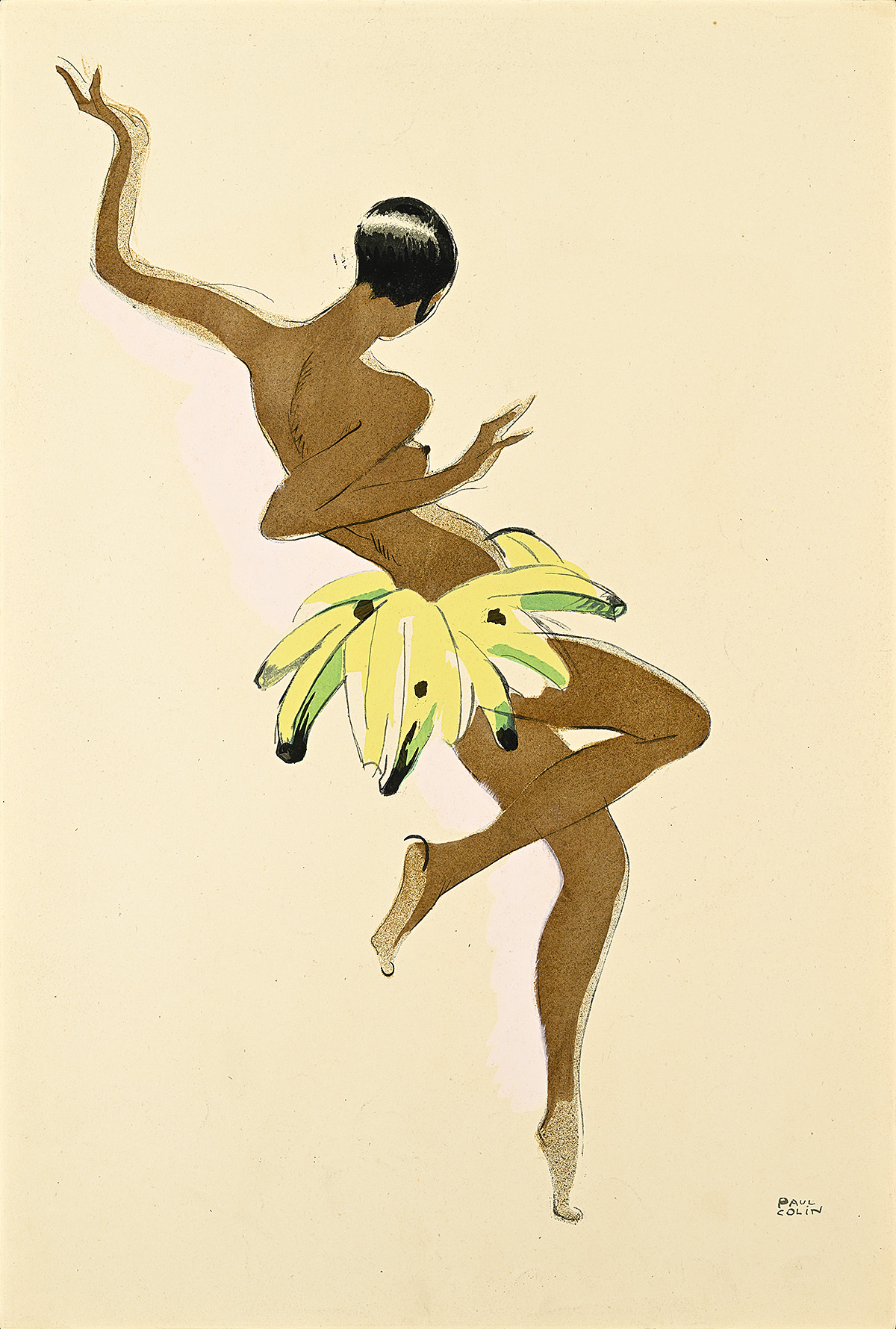
A poster of an oil rig with billowing smoke, a couple kissing inside of a red heart, and a woman helping an injured man.

Black Gold, 1928

Designer Unknown

The Black Canon Collection

A close up of a man looking through a prison cell behind a smaller image of men arguing.

Black Gold Scene Cards, 1928

Private Collection, NYC

Two images of a man and woman embracing, a horse, and two men talking while looking out into the distance.

Black Gold Scene Cards, 1928

Private Collection, NYC

  • Featuring the same stars as The Flying Ace, Black Gold was Norman Studios’s last feature film. It tells the story of a rancher who invests in the development of oil wells on his property but a local driller conspires to take over the oil supply. When the rancher retaliates, he is thrown in jail but is eventually exonerated through the efforts of his friend and a banker’s daughter.
  • The film was shot and set in the all-Black freedmen’s town of Tatums, Oklahoma, which had benefited from the oil industry in the 1920s. The narrative was further inspired by a resident of the town who discovered oil but struggled with a predatory drilling contractor. 
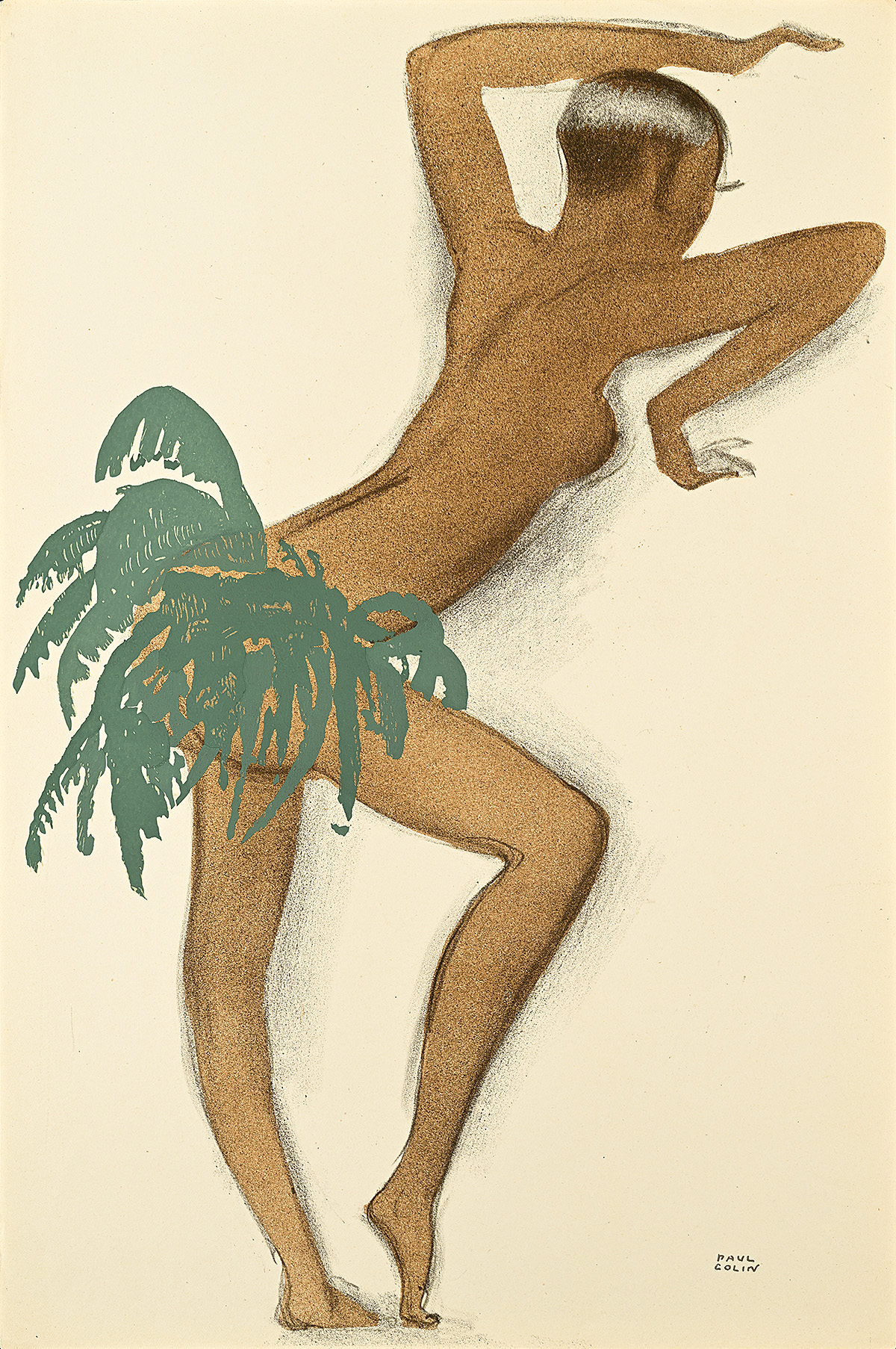
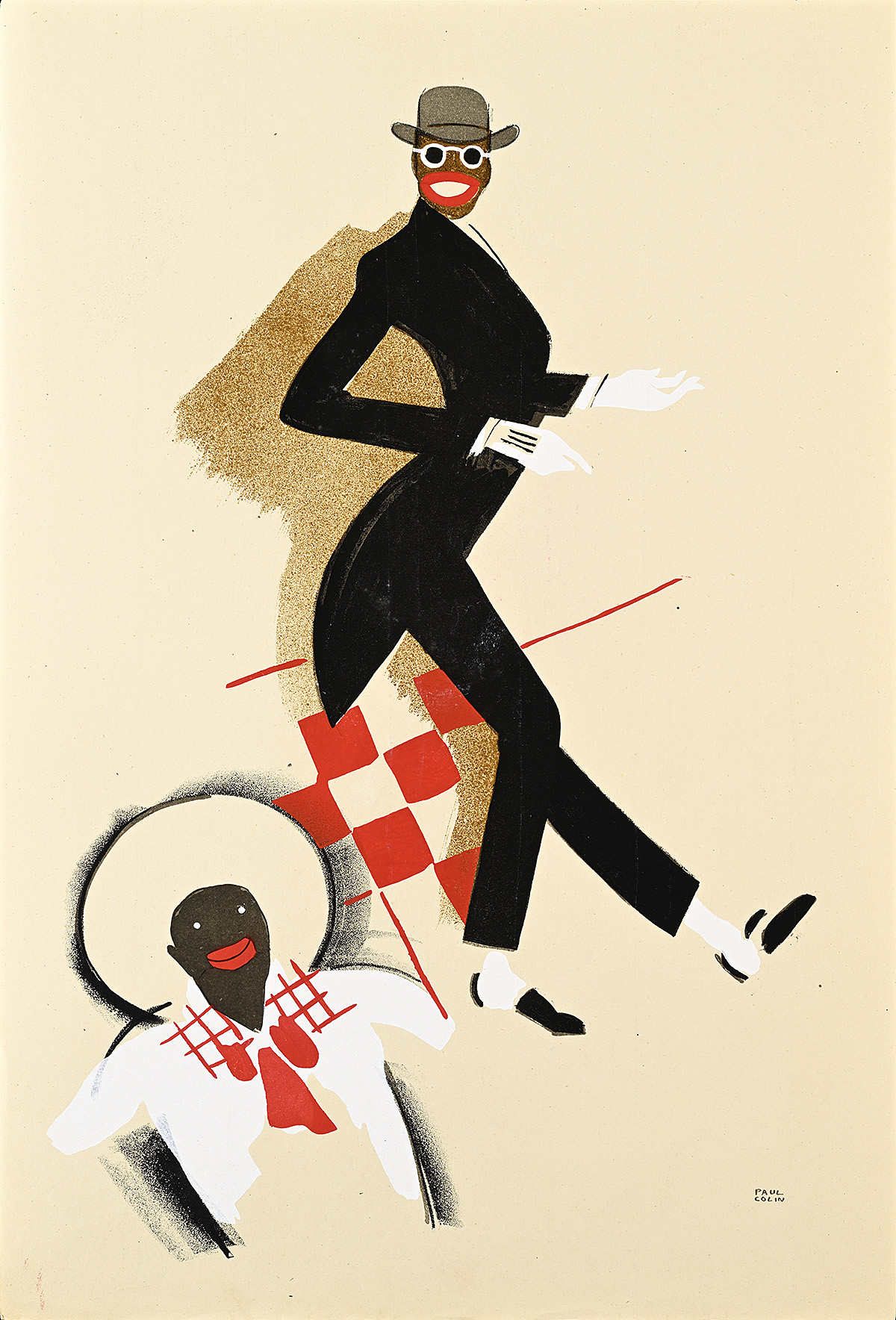
  • As in many of his films, Norman hired locals as extras, including the town’s founder, L. B. Tatums (a U.S. Marshal). By using local people and tapping into real stories, Norman highlighted aspirational narratives of Black success, adapting them for a national audience. 
  • Advertising for Black Gold mentioned captured footage of “real drilling” and an “accidental” explosion that occurred on set. This might have been a marketing tactic; the poster nonetheless presents these thrilling scenes to attract audiences.
  • Norman Film Studios stopped making movies after Black Gold due to the development of talking-picture technology and the consolidation of the film industry in California. Although the studio was in operation for less than a decade, its focus on race films set the tone for Black representation on the silver screen during the subsequent years.

A poster of a ghost visiting a Black man in bed in a jail cell.

The Flaming Crisis, 1924

Designer Unknown

Poster House Permanent Collection

A poster of a smiling Black man and woman holding the reins of a brown horse surrounded by a large horseshoe.

The Flaming Crisis, 1924

Designer Unknown

Poster House Permanent Collection 

  • The Flaming Crisis is a short Western film about a news reporter who is wrongly imprisoned for murder. After several years in jail, he escapes to an unnamed city in the West and falls in love with a local cowgirl. In order to help his new community, he agrees to hunt down a gang of outlaws that is terrorizing the town (and chasing his girl); however, after this heroic act, he feels compelled to turn himself in to the police. In the end, the real murderer confesses and the reporter is free to marry the cowgirl.
  • These two posters highlight the different advertising tactics used to promote the film. While one focuses on the reporter’s supernatural encounter with a ghost in prison, the other suggests a charming Western-themed romance complete with an endearing steed and a lucky horseshoe framing the couple. 
  • While during the subsequent decades more films were produced with wrongful convictions as key plot points within broader Black narratives, early race films did not present crime or criminality as uniquely Black experiences. Instead, they showed Black characters from all economic backgrounds, centering an equitable Black society as the norm. Here, the ghost visiting the protagonist in prison appears as a well-dressed aristocrat, implying that Black people in America could be of high social status.

1930s

“I will not act in another Hollywood picture until the prejudice is removed against colored actors in dramatic roles. Personally, I will not accept any maid parts. I am not a maid and will not act one.”—Nina Mae McKinney, actor

The 1930s saw filmmakers embracing talking pictures (commonly known as “talkies”) with confidence as actors developed new verbal performance styles, filmmakers balanced dialogue with action in their scripts, and apprehension around complex audio systems waned. Such advances allowed for the integration of song-and-dance sequences in movies that capitalized on the talent of the performers. More specifically, Black talkies incorporated Black voices, reflecting the actors’ focus on elocution and vocal training, as well as traditional forms of Black music such as blues and folk, taking their cues directly from both vaudeville and straight theater. The advent of talkies also gave Black filmmakers an opportunity to present Black lived experience, culture, and language (African American Vernacular English) through plots that were driven by dialogue rather than the action and gesture of the silent-film era.  

In the years following the 1915 Supreme Court ruling that free speech did not extend to motion pictures, individual states introduced film-censorship laws. The film industry was also riddled with scandals and morally questionable plots during this era, prompting the gradual development of enforceable censorship guidelines across the country. As the film industry grew, the federal government demanded regulation. Introduced in 1930 by William H. Hays, the president of the Motion Picture Producers and Distributors of America, the Motion Picture Production Code (colloquially known as the Hays Code) produced a series of national guidelines for Hollywood movies; while the code was not rigidly enforced until 1934, among its other provisions were those restricting the ways in which Black people could be represented in relation to white people on screen. States also continued to maintain their own film-censorship guidelines; while many race films operated outside of the Hollywood system because they were not made there, some adhered to these state-by-state guidelines in order to maximize the number of theaters that could screen their movies.

Posters from this decade feature less sensational language and imagery than those of the 1920s, attracting audiences mainly through the power of celebrity. Stars’ names were displayed prominently in these advertisements and were often accompanied by giant floating portraits rather than images of key scenes from a film. In addition, the posters of this decade emphasize both the appeal and fear of the “big city” as a place of opportunity and racial liberation, reflecting the reality of the Great Migration of Black Americans from the South into urban areas.

A poster of a Black man and woman in sleeping robes with fearful expressions behind a railing and holding a gun.

The Girl from Chicago, 1932

Designer Unknown

The Black Canon Collection

  • After failed negotiations with the Black-owned Lincoln Motion Picture Company, Oscar Micheaux founded the Micheaux Film and Book Company (later the Micheaux Film Corporation) in around 1919 to produce a movie based on his own novel The Homesteader. The film was intended as a commentary on contemporary racial topics, including miscegenation, crime, and the importance of Black leadership.
  • Micheaux frequently revisited and reworked his earlier films. The Girl from Chicago was a remake of his now-lost silent film The Spider’s Web (1926) about a Black teenage girl from Harlem who is almost raped by a white plantation owner while visiting her aunt in Mississippi. A Black investigator eventually arrests the white man and also proves the innocence of the girl’s aunt who has been framed for a gambling-related murder. The Girl from Chicago delves deeper into the theme of urban versus rural life for Black people, altering the plot to focus on a Mississippi girl fleeing to Harlem with her federal-agent boyfriend to escape gang violence, only to become involved in the assassination of a Cuban racketeer. 
  • Oscar Micheaux frequently used light-skinned Black actors in aspirational roles. This is most evident in the posters for his films that show fair-skinned, well-dressed actors who are intended to supply a specific, idealized image of racial uplift and success. Despite the mention of an “All Star Colored Cast,” most of the actors in the film were not famous even in the world of Black entertainment.

A poster with a small photo of a Black male tapdancer with bold yellow and brown letters.

Harlem is Heaven, 1932 

Designer Unknown

The Black Canon Collection

  • Harlem is Heaven is a musical drama about a Southern girl who comes to Harlem in search of work. She and her soon-to-be lover are troubled by her employer, a racketeering boss. He is ultimately indicted on fraud charges.
  • As the most famous performer in the movie, Bill “Bojangles” Robinson is heavily featured in the advertising. Before he worked in films, Robinson was one of the first Black performers to sidestep vaudeville’s unspoken “two-race rule” determining that Black tap dancers could not perform solo on stage and could only dance in pairs or in a group. 
  • In Robinson’s most notable scene in Harlem is Heaven, he tap dances up and down an Art Deco staircase. He echoed this performance three years later in the film The Little Colonel in which he appeared with child star Shirley Temple in the first interracial dance performance in a Hollywood film.
  • This poster presents Robinson as the “World’s Greatest Tap Dancer.” Advertisements for the movie also referred to specific Harlem locations like the Cotton Club that would have been familiar to some Black audiences. Notoriously, that nightclub only served white patrons (with few exceptions) but relied on Black performers to provide entertainment. 
  • One of the main plot points in the film centers on the racketeering boss’s scheme to create a machine that will take the “kinks” out of Black hair to align it with culturally dominant white beauty standards. The presence of such a device speaks directly to a Black audience who would understand the pressures of assimilation and conformity in ways that white viewers would not.

A poster with black and white photographs of dance scenes featuring a Black woman with short hair.

Zouzou, 1934 

Designer Unknown 

Poster House Permanent Collection

  • Zouzou was the first movie in which audiences could hear Josephine Baker’s voice, and Columbia Records was eager to capitalize on it and share it with the world. This poster promotes a special recording of two songs from the film, “C’est lui (Pour moi, y’a qu’un homme dans Paris)” (It’s him [For me, there’s only one man in Paris]) and “Haiti.” 
  • This rare photocollage poster features Baker starring in numerous scenes from the movie. The composition is reminiscent of earlier revue-style advertising, highlighting major moments of show-business glamour.

A poster of an illustrated sailor and a Black woman looking at each other and smiling.

Zouzou, 1934

Marcel (Dates Unknown)

Poster House Permanent Collection

  • In addition to her theatrical career, Josephine Baker starred in four French films. Zouzou was her first talkie. She plays the film’s titular character, a laundress who becomes a star performer and pines for her adopted brother who loves her best friend.
  • While the story neither centralizes Baker’s Blackness as part of her character’s identity nor offers any overt commentary on the racial issues of the time, it does not ultimately permit her to become the love interest of a white man, reinforcing anti-Black prejudices and social norms. While Baker was allowed more social and economic freedom in her adopted country of France than she had experienced in the United States, she was rarely presented in similar ways to her white counterparts. In this film and its corresponding advertisements, her character is othered as “exotic” or generally childlike and innocent rather than as a typically glamorous leading lady. In her innocence, she could be sought after and entrapped but not the other way around. 
  • Josephine Baker’s presence in all her films had a powerful international impact, bringing Black American culture as well as a multifaceted and sometimes contradictory version of Black womanhood to the screen. Despite her exotification in Zouzou, her role as a sensual yet innocent and playful character suggested a complexity that stood in sharp contrast to the stereotypical roles available to Black actors in America.

A poster of a Black man holding up a stack of money in front of a Black woman.

Temptation, 1935

Designer Unknown

The Black Canon Collection

Temptation, 1935

Designer Unknown

The Black Canon Collection

A poster of a man and woman sitting on a couch holding hands while the man looks adoringly at her.

Temptation, 1935

Designer Unknown

The Black Canon Collection

  • Another lost film, Temptation is one of Micheaux’s most explicit crime dramas. It tells the story of an artist’s model who desperately attempts to ward off lustful men, eventually finding herself drawn into a world of gangsters and underground crime. 
  • After an early career as a chorus girl and as a dancer at the Cotton Club, Ethel Moses made her film debut in Temptation. The movie propelled her to stardom—she was even dubbed the “Negro Harlow,” likening her to actress Jean Harlow. Micheaux often used such comparisons to Hollywood figures to indicate that his work was equal to theirs in value and quality.
  • As in all of his films, Micheaux used the plot of Temptation to comment on contemporary Black social issues and topics that affected interracial and intraracial relationships; its ambitious storyline highlighted urban problems of sexual coercion and prostitution. 
  • Despite the film’s exploitative content, Micheaux’s posters use the same visual language and advertising tactics of those for major Hollywood pictures, focusing on bright colors, beautiful costumes, and glamorous characters. A true virtuoso, Micheaux not only wrote, directed, and produced his films but also art directed these one-sheet lithographic posters and lobby cards, delivering them himself to local theaters and meeting with managers to speak about promotion methods.

A poster of female dancers standing in a line above large text and a group of people talking.

Harlem After Midnight, 1934

Designer Unknown

The Black Canon Collection

  • Directed by Oscar Micheaux, Harlem After Midnight is an all-Black silent film that follows a young woman as she navigates divorce, love, and crime against the backdrop of the Harlem underworld. Though no copies of the film have survived, some records indicate that Micheaux himself appeared in it as a detective who exposes a criminal racket. While none of the other actors are billed on the official poster, some lobby cards and heralds note that Micheaux’s wife, Alice B. Russell, had a cameo in a “mother role.”
  • The film highlights a number of themes specific to a Black lived experience that Micheaux often explored in his work. Here, he focuses on gang-related violence, emphasizing the horrors of crime in major American cities such as New York and Chicago where Black people often migrated. 
  • In order to establish the film as an “authentic” or “real” representation of Black American culture, Micheaux incorporated phrasing on the poster describing it as “straight from Harlem.” It also incorporates slang terms from African American Vernacular English like “High Yallers” and “Sugar-Cured Browns” (both referring to the light-skinned performers). Black audiences might have found this type of advertising copy problematic since it reflected the higher social value placed on those with fair skin.

A poster of a Black man in royal clothing sitting on a chair surrounded by other male characters.

Emperor Jones, 1933 

Designer Unknown

The Ralph DeLuca Collection 

  • Adapted from Eugene O’Neill’s 1920 play, The Emperor Jones is a white-produced film starring Paul Robeson in his first major cinematic role. The narrative serves as a commentary on the occupation of Haiti by the United States; this began in 1915 and would not end until 1934.
  • Robeson plays Brutus Jones, a porter for the Pullman Company, who ends up in the big city where he engages in various vices and crimes, including the accidental stabbing of an acquaintance during a craps game. After being condemned to hard labor on a chain gang, he escapes by hitting a white prison guard and flees to a remote island run by a colonial merchant. Brutus cleverly overthrows the merchant but becomes an oppressive leader to the island’s native people. The film ends with his descent into madness as he accepts his fate at the hands of those he has wronged.
  • While The Emperor Jones is not a race film with an all-Black cast, its themes address domestic and international racial tensions. In order to avoid Hollywood’s early pre-Code censorship rules prohibiting Black-on-white violence, the depiction of white women (or women who appeared white) as prostitutes, and women smoking, the film’s director pushed to shoot it in New York where some of these rules did not apply.

A collage of photographs of men and women talking and dancing.

Emperor Jones Pressbook, 1933 

Designer Unknown

The Black Canon Collection 

  • Eugene O’Neill agreed to a film adaptation of his play with the stipulation that Robeson received proper top billing. Posters for the movie show Robeson in multiple scenes that demonstrate his character’s evolution. Interestingly, advertising for the film often focuses on Brutus as the “emperor” in one of its most striking scenes; it is also one that subverts the racial dynamics of the time by positioning a Black man as the oppressor of native people. 
  • Since films with recorded sound were relatively new in the early 1930s, movies featuring music typically highlighted that fact in their advertising. Oddly, neither the poster nor the pressbook cover for The Emperor Jones mentions its various song-and-dance sequences. 
  • The movie was shot before the full enforcement of the Hays Code, allowing the display of Robeson’s bare chest on the film’s posters and lobby cards. By 1934, the code strictly regulated the representation of Black male nudity.  

A poster of a woman with a stunned look on her face in front of a man and woman looking at each other seriously.

Murder in Harlem, 1935

Designer Unknown 

The Black Canon Collection

A poster of a Black woman and child crouched down with their heads leaning against a door.

Lem Hawkins Confession, 1935

Designer Unknown

The Black Canon Collection

  • In 1921, Oscar Micheaux directed and produced The Gunsaulus Mystery, a silent film based on the actual 1913 murder of 13-year-old Mary Phagan at a pencil factory in Atlanta, Georgia. Jewish-American factory employee Leo Frank was tried and convicted of the murder; after many appeals, his sentence was reduced to life in prison due to questionable evidence. A local mob, believing that justice had not been served, abducted him from prison and lynched him. In his version, Micheaux cast the young girl and the accused murderer as Black and the real murderer as a white man. 
  • In 1935, Micheaux remade this film as a talking picture in which he added a layer to the narrative by incorporating the different perspectives of multiple witnesses. He originally released this remake as Lem Hawkins’ Confession and then Brand of Cain but eventually settled on the title Murder in Harlem.
  • Both the poster and the lobby card note that the film is based on the Stanfield murder case, probably a made-up reference. In 1946, more than a decade after this film was released, Micheaux published The Story of Dorothy Stanfield, a novel chronicling the difficulties of a Black woman trying to make her way in the world; however, there is no murder in that story and he might just have chosen to reuse the name.

A poster of illustrated vignettes of male and female cowboys surrounded by musical notes.

Harlem on the Prairie, 1937 

Designer Unknown

The Black Canon Collection

  • Billed as the first all-Black Western musical, Harlem on the Prairie, starring Herbert Jeffries, premiered at Paramount Theatre in Los Angeles and then at the Rialto Theatre in New York to great acclaim. Filmed at the Black-owned Murray’s Dude Ranch in Apple Valley, California, it helped establish the presence of Black cowboys within the Western genre. 
  • Born Umberto Alejandro Balentino, Herbert Jeffries was most likely of Sicilian and Irish descent. Encouraged by the opportunity to perform, he changed his name and began publicly identifying as Creole during the early part of his career but sometimes claimed Black identity in order to star in race films and perform in jazz troupes. On camera, he would often darken his skin tone with Max Factor blackface makeup—evidenced in many of the posters in which his complexion has a deeper brown tone. This choice helped him appeal to both Black and white audiences, especially those in the segregated South. More importantly, it allowed him to navigate the constantly shifting censorship rules that did not allow a white man (or a Black man who appeared to be white) to be shown in a romantic relationship with a Black woman.
  • The film follows a romance between a cowboy and the daughter of an outlaw as they attempt to find her father’s hidden gold. It was initially intended only for release in segregated theaters in the South—something that Herbert Jeffries supported as he wanted to show young Black boys that heroic Western cowboys could also be Black. With the help of white actor and fellow onscreen cowboy Gene Autry, who quietly supported civil rights, the film ultimately gained national distribution.

A poster of a man and woman in formal dress pointing a gun at the back of a Black man in a suit.

Underworld, 1937

Designer Unknown

The Black Canon Collection

  • Directed and written by Oscar Micheaux, Underworld follows a male graduate from a Southern Black college who becomes involved in Chicago’s criminal underworld and falls for a gangster’s girlfriend.
  • Although race films were directed at a decidedly different audience than standard Hollywood productions, they still had to be profitable for both investors and theaters. A master salesman and filmmaker, Micheaux often experimented with different methods of selling his films. Here, he tapped into the popularity of the Prohibition-era gangster story. 
  • In Underworld, as in many of his other films, Micheaux contrasts city and country life to dramatize scenes of urban nightlife. While the narrative highlights middle-class upward mobility, it simultaneously glamorizes urban debauchery. Ultimately, Micheaux presents his heroic Black characters (especially those with lighter complexions) as closer to a bourgeois ideal.

A poster of an illustrated man and woman's face both smiling and wearing cowboy hats.

Harlem on the Prairie, 1943

Designer Unknown

The Black Canon Collection

  • Founded in 1941, the Toddy Pictures Company specialized in musicals and all-Black films, often promoting rereleases with illustrated posters featuring caricatures of the actors and highlighting musical numbers. This poster for its 1943 rerelease of Harlem on the Prairie advertises the film’s “six great songs [and] two radio hits,” marking its place in the popular “singing cowboy” subgenre of the Western.  
  • Films were often rereleased after their initial theatrical run, sometimes with a new title, poster design, and/or actor billing. In the case of race films, such rereleases were sometimes produced in response to changing perceptions and attitudes about racial representations. 
  • Sometime in the early 1940s, a typo led Herbert Jeffrey to be renamed Herbert Jeffries or Herb Jeffries in advertising. Scholarship has connected this change in the actor’s name to the 1940 record “Flamingo” that Jeffries recorded with Duke Ellington and His Orchestra.

A poster of a dancing Black woman in a red dress behind two Black woman talking facing each other.

Birthright, 1938

Designer Unknown

The Black Canon Collection

  • Based on the 1922 novel by T. S. Stribling, Birthright is Micheaux’s remake of his 1924 silent film of the same name. The story follows a mixed-race Harvard University graduate who returns to his hometown in Tennessee hoping to open a Black technical college. He faces opposition from both Black and white community members.
  • The film again reflects Micheaux’s interest in representing modern Black life, offering a story that criticizes segregation and contemporary perceptions of race. The Tutt Brothers, who had appeared in Silas Green from New Orleans, contributed an element of Black vaudeville to the musical scenes.
  • This poster credits A. Burton Russell, Micheaux’s second wife, as the producer of the film; this was unique at a time when Black women were rarely acknowledged for their leadership roles in any industry. Russell was often involved in Micheaux’s work, both on and off camera. In addition, Carman Newsome, the lead actor, had been hired the previous year to sell and distribute Micheaux’s films.
  • The poster does not focus on the film’s serious plot but rather on its more upbeat and traditionally entertaining aspects, most especially the performance of Ethel Moses.
  • Though Birthright was considered a race film, Micheaux ensured that the poster noted its “White and Colored Cast”—a departure from his typical emphasis on a Black cast for Black audiences. This choice perhaps reflects the intentionally provocative nature of his work. In spite of his ongoing efforts to create narratives focusing on Black experience, Black audiences in California boycotted both Temptation and Birthright in response to what they saw as the stereotyping of the Black characters.

A sepia toned image with a photograph of cowboys dancing and hiding in a saloon.

The Bronze Buckaroo, 1939

Designer Unknown

The Black Canon Collection

A sepia toned image with a photograph of cowboys dancing and hiding in a saloon.

The Bronze Buckaroo, 1939

Designer Unknown

The Black Canon Collection

  • The Bronze Buckaroo is the second film in the Bob Blake Western trilogy and tells the story of Blake and a group of four cowboys who investigate a cowgirl’s missing brother. In the process, they learn of a stash of hidden gold.
  • Herbert Jeffries, who became known as “The Bronze Buckaroo” after this film, starred in Black Westerns through the late 1930s, showing off both his acting ability and his velvety baritone voice in the musical numbers. The most important aspect of this film, however, was the appearance of the Four Tones, a quartet formed at Lane College (a historically Black college) in Jackson, Tennessee, who sing here in the call-and-response style found in jazz and some vaudeville musical numbers. While such traditionally Black musical styles were not new to film, the inclusion of jazz made way for a subgenre known as Western Swing that further embedded Black artistry in the broader archetype of the singing cowboy.
  • Rather than relying on an image of the film’s star, these lobby cards highlight hallmarks of the Western genre, including gun-toting cowboys, galloping horses, and an action-packed shootout in a saloon. 
  • With the onset of World War II, many films were rereleased to provide cheap entertainment during a time of financial austerity. Westerns proved especially popular as they promoted a uniquely American sensibility.

A poster with photographs of a group of young Black men, a Black officer holding a gun and a judgmental woman's face.

Reform School, 1939 

Designer Unknown

The Black Canon Collection

A poster with photographs of a group of young Black men, a Black officer holding a gun and a judgmental woman's face.

Prison Bait, 1944

Designer Unknown

Poster House Permanent Collection

  • While race films often attempted to counter the racist narratives perpetuated by the mainstream film industry, some (like the vaudeville producers before them) leaned into these tropes in order to make money. Black actors often had to choose between a paycheck and playing parts that would now be deemed as stereotyped. 
  • Louise Beavers, one of the best-known Black actors of her generation, was generally typecast as a maid or a nanny in theater and film. These roles went against her vocal stance on negative portrayals of Black people in the media. Even so, the depth and emotional complexity that she brought to every performance confirmed her legacy as an actor who advanced the work of Black people both on and off screen.  
  • Originally released in 1939 as Reform School, Prison Bait features Beavers as a progressive probation officer who becomes the superintendent of a reform school and defends a group of boys who are harassed by the institution’s staff. The film explores the corruption of the criminal justice system and the importance of a compassionate approach to education.
  • The renaming of the film was most likely based on the marketing value of sensationalism; a prison offers more dramatic potential than a mere reform school. Rather than reprinting the poster, however, theaters were instructed to paste over the original title with a snipe or tip-on of the new one, as shown in this poster.
  • The Harlem Tuff Kids were modeled after the all-white Dead End Kids, a group of young actors who had appeared in Crime School, a film with a similar plot, in 1938. The Harlem Tuff Kids was a theater troupe of young Black actors who featured in other films by Harry M. Popkin, often adding a comic touch to an otherwise dramatic plot.

A poster of a Black woman in a fur coat looking directly at the camera on an orange background.

Gang Smashers, 1938

Designer Unknown

Poster House Permanent Collection

  • Gang Smashers follows an undercover female agent who poses as a cabaret singer to expose a racketeering Harlem nightclub owner. It features the actor Lawrence Criner who also starred in The Flying Ace and Black Gold
  • Nina Mae McKinney (born Nannie Mayme McKinney) began her career as a chorus girl in Lew Leslie’s Blackbirds of 1928. She made her first film appearance in MGM’s musical Hallelujah (1929), becoming the first Black actress in an all-Black cast to hold a principal role at a major studio. She received top billing on the poster and was dubbed “The Black Garbo” in a comparison to the famously beautiful Swedish-American actress Greta Garbo.
  • Whether a Hollywood production or a low-budget film, the gangster genre was often used to comment on moral decay and economic crisis in the aftermath of Prohibition and the Great Depression. These films were also a means of exploring ethnicity and “otherness.” Race films were especially well placed to confront intraracial conflict.
  • This poster incorporates many of the quintessential tropes of 1930s gangster movies, including a character with a fixed, stony expression; a fur coat; a reference to gun violence or other action (as suggested by the miniature figures surrounding McKinney’s name); and a gun aimed at the viewer. The film was also released the same year under the title Gun Moll.

A poster with a photo of a Black woman looking at the camera above bold red and black text.

Straight to Heaven, 1939

Designer Unknown

Poster House Permanent Collection

  • Straight to Heaven tells the story of singer Jimmy Williams whose father, Joe, loses his business and starts investigating the corrupt owners of a Harlem canned-food brand. Racketeers force local store owners to sell the rotten food, and when Joe is framed for murder, his wife (played by Nina Mae McKinney) is forced to find work.
  • This poster, a cheaply printed window card similar to those used to advertise boxing matches, presents McKinney as the star of the film. She was one of a few major Black actresses in the film industry of this time who played into the role of the beautiful temptress; this kind of character stood in stark contrast to the Sapphire stereotype of the overbearing and loud Black woman.
  • In a continuing effort to legitimize race films, producers frequently compared Black actors to white ones with similar performing styles. Advertising for Straight to Heaven positions 12-year-old actor Jackie Ward as “The Colored Bobby Breen,” referring to a white child star contracted to RKO Pictures.

A poster with a photograph of a Black boxer in a fighting stance surrounded by musical notes and bold brown text.

Keep Punching, 1939

Designer Unknown

The Black Canon Collection

A lobby card of a Black woman in a white dress posing next to a photograph of Black men and women standing in a line.

Jittering Jitterbugs, 1943

Designer Unknown

Poster House Permanent Collection

  • Keep Punching is an all-Black boxing movie starring real-life boxing champion Henry Armstrong who is sabotaged by both his childhood friend and his lover before a major fight. The film includes a scene of a dance competition featuring the famous Whitey’s Lindy Hoppers (billed here as Arthur White’s Lindy Hoppers). The scene was so well received that it was rereleased in 1943 as a stand-alone short under the title Jittering Jitterbugs
  • Whitey’s Lindy Hoppers were well known and widely loved; they had performed in a handful of movies as well as at the 1939 New York World’s Fair. A year before the release of this dance-centered short, however, the group disbanded and many of the young men were drafted into World War II. 
  • The Lindy Hop was a dance created by Black Americans in “juke joints” (a Black American term for a small, informal club featuring music and dancing) in the late 1920s and further popularized in venues like the Savoy Ballroom, a renowned nightclub in Harlem. The term “Jitterbug” was originally used as a pejorative to describe the rapid movement of white people as they performed the dance but soon evolved to cover swing dancing in general and lost its negative connotation. 
  • Films of the 1940s often included dance-and-music sequences performed by Black artists. These numbers attracted audiences to films because they not only introduced a type of entertainment that was separate from the film’s plot (most especially popular jazz performances) but also showed off the developments in sound technology.   
  • While audiences typically loved these performances, they had to be shot so that they could be removed easily from the reel if necessary in order to comply with the Hays Code (prohibiting dances that suggested indecency) and to allow them to be released in Southern states. The lobby card is an example of this type of censorship, promoting a short film comprising a dance-and-music sequence that could be cut from the movie.

A poster of Black cowboys fighting while on horseback.

Harlem Rides the Range, 1939

Designer Unknown

The Black Canon Collection

  • A sequel to The Bronze Buckaroo, Harlem Rides the Range follows Bob Blake and his sidekick as they help a rancher from being cheated out of his property. Blake is eventually framed for murder but escapes from jail to save the property and falls in love with the rancher’s daughter.
  • The film introduced the serialized format to Westerns with Black casts. Herb Jeffries sometimes acted in these films with his trusty horse companion Stardusk, though the name was sometimes misspelled, much like that of Jeffries (shown on this and other posters as Jeffrey), appearing in press materials as Stardust.
  • Harlem Rides the Range was released within days of Stagecoach starring John Wayne, indicating that the popularity of the Western genre transcended race. While Black audiences could have gone to see the big-budget film Stagecoach, they flocked instead to see Jeffries and his supporting cast of Black cowboys in all their glory in this relatively modest production that had a fraction of Stagecoach’s budget. Harlem Rides the Range was Jeffries’s last Western, and his last feature film until 1951.

A poster with illustrated vignettes of women in fancy dresses surrounded by a painter, a cameraman, and an orchestra.

Gone Harlem, 1938

Designer Unknown 

The Black Canon Collection

A printed card with a black and white photograph of a Black man painting a nude Black woman.

Gone Harlem, 1938

Designer Unknown

Poster House Permanent Collection

A printed card with a black and white photograph of a Black man and woman kissing.

Gone Harlem, 1938

Designer Unknown

Poster House Permanent Collection

A printed card with a black and white photograph of a Black man embracing a woman in a nightgown.

Gone Harlem, 1938

Designer Unknown

Poster House Permanent Collection

  • By the late 1930s, Ethel Moses was a celebrity in the Black movie world and received top billing in all her films. The movie industry was in its golden age, and many studios wanted to give audiences a glimpse of its legendary glamour—even if it came at the expense of sexually exploiting its leading ladies. 
  • Because it is a lost film, little is known about Gone Harlem beyond a brief description of its story of an artist’s model who becomes a movie star. The lobby cards feature actual stills from the film, offering viewers the only glimpse of key scenes, some of which were incorporated by the poster designer into the main composition. 
  • Director Irwin Franklyn decided to use the language of the Hollywood star system on the poster, reflecting the efforts of film studios to develop the public images of young actors, giving them glamorous new personas to sell the idea of celebrity. Directors like Franklyn and Micheaux situated Black actors and actresses within this context.
  • In one of the most titillating scenes in the film, Ethel Moses poses nude for an artist. In the poster, her body is tastefully draped with a white cloth—probably due to censorship guidelines. But on the film’s lobby card, she is almost completely nude, highlighting the exploitative nature of an industry that physically exposed Black women for male pleasure and often portrayed Black actors as sexually perverse.

1940s

“I’m proud of the movies I made because they constituted the new cycle of black in modern-day portrayals.”—Ralph Cooper, actor

The 1940s was a pivotal decade for the film industry and one of the high points in Hollywood’s golden age. Once the United States entered World War II at the end of 1941, the studios began producing patriotic films that offered Americans a shared sense of purpose, often highlighting individual sacrifice for the collective good. Filmmakers also introduced new narrative structures in scripts and visual techniques on camera that expanded the popularity of genres like American film noir in particular. The themes of deceit, corruption, alienation, and murder that defined the genre gave voice to a victorious but uncertain nation during the war and in the years that immediately followed.

Race films of the period were not exempt from these trends but they also included narratives that highlighted the continuing impact of racism and segregation within the United States. Though these films had often focused on community, such stories now expanded to further address religion, education, and the perspective of the Black soldier. There were also efforts to match the big-budget films of Hollywood, and the posters of this period feature bolder colors, cartoon-style illustrations, and the actors’ names in large text to emphasize their stardom. While race films began to diversify their casts to include other ethnicities, they were still predominantly Black since roles for Black actors remained limited. Technicolor entered mainstream feature-film production after 1935, allowing Black actors to be seen in a more true-to-life way on the screen. A full spectrum of skin tones replaced the shades of gray that had previously described them, providing a complex, often colorist, representation of Black performers in the movies.

A poster of a woman lying on the ground with a knife in her chest next to a building with onlookers in the windows.

Murder on Lenox Avenue, 1941

Designer Unknown

The Ralph DeLuca Collection

  • Murder on Lenox Avenue features the cast that had appeared in another race film, Sunday Sinners (1940) and presents the story of an upstanding local businessman who becomes the manager of a building after its landlord is forced out. The film follows a series of dramatic events in the Harlem apartment complex and includes a subplot with a love triangle.
  • The poster plays up the drama of the story, showing a bloodied female body with a knife stabbed in her chest in the foreground as neighbors observe the horrendous crime from their apartment windows. The film was not, in fact, a murder mystery or a whodunit but the poster relied on some of the visual signifiers of the genre—a stabbed body and dripping blood-red lettering—to attract audiences. 
  • While it was cheaper for advertisers to use illustration in a film poster rather than incorporating photographic stills, it also made it more likely that questionable content (like a female corpse) would pass the censors.

A poster of cartoon men fighting on a ladder above cowboys riding on horseback.

Two-Gun Man from Harlem, 1942

Designer Unknown

Poster House Permanent Collection

  • Originally released in 1938, Two-Gun Man From Harlem is the first film in the Bob Blake trilogy of musical Westerns and tells the story of a man wrongly accused of murder who flees to Harlem and adopts the identity of a dead gangster. He then returns out West in disguise to find the real killer.  
  • This three-sheet poster for the 1942 rerelease combines Western cowboy motifs with a choking scene of a kind that also appears in posters for crime films. The term “two-gun man” refers to a gunslinger of the Old West who carried two pistols, one on each side of his body.

A poster with a close up photo of a man's face next to a photo of a surgical procedure above a group of men fighting.

Am I Guilty?, 1940

Designer Unknown 

The Black Canon Collection

  • In 1937, Ralph Cooper, an actor, dancer, choreographer, and the original master of ceremonies at the Apollo Theater, joined forces with brothers Leo C. and Harry M. Popkin to establish Million Dollar Productions, a company dedicated to films mostly featuring Black actors. It became well known for its low-budget productions and condensed shooting schedules of only seven days. 
  • Cooper often wrote and starred in these movies, deliberately avoiding stereotypical roles for his Black characters. In Am I Guilty?, he plays a doctor who opens a free health clinic in Harlem, asserting the importance of Black doctors and community healthcare in Black neighborhoods. It marked a shift in the tone of contemporary race films, presenting a more serious and thoughtful theme that reflected everyday concerns.
  • The film was rereleased by Toddy Pictures in around 1945 under the title Racket Doctor, one that capitalized on the sensational gangster subplot. While the original poster highlights the doctor and his service in the Black community, the poster for Racket Doctor shows a violent scene, complete with a gun, below the tagline “To save the poor he became a criminal!”

A poster with four black and white photographs of Black men and women dancing, in a bar, looking afraid, and in a courtroom.

Sunday Sinners, 1940

Designer Unknown

The Black Canon Collection

  • Set in a Harlem club, Sunday Sinners brings together crime, music, and drama in a religious setting. The plot centers on a debate about whether or not the club should be open on Sundays, traditionally a day of rest and religious observance. One of the subplots involves a pair of con men who try to cheat a Chinese laundryman of his property.
  • Headliner Mamie Smith began her career as a singer and dancer in a group created by the Tutt Brothers. In 1920, she recorded “Crazy Blues,” becoming the first Black artist to record a blues song. This was a significant moment in the history of Black music intended for a Black audience; it also marked the emergence of Black female singers in the culture of American popular music. Smith’s commercial success as a singer propelled her into roles in musical films. Productions like Sunday Sinners relied on her celebrity status in the Black community to draw large audiences.
  • Chin Lee, the Chinese laundryman, is represented by an offensive stereotype common in films of the time (and for decades afterward). This characterization demonstrates that even in race films, true character development could be sacrificed in favor of discrimination against people of different ethnicities and backgrounds.
  • The film is of exceptionally high quality given its low budget, as is all of its advertising. This poster incorporates photographs of many of the musical moments in the plot and mentions the chorus girls by name. These girls are also referred to as “A Brown Skin Chorus of Beauties,” pointing to the film’s colorist undertones, even as they promote an ideal of beauty for Black women.

A poster of a Black woman standing with her hands around the neck of a second Black woman lying on a couch.

The Notorious Elinor Lee, 1940

Designer Unknown

The Black Canon Collection

  • Based loosely on the real-life rivalry between heavyweight boxers Max Schmeling and Joe Louis, Oscar Micheaux’s penultimate film, The Notorious Elinor Lee, focuses on the title character as she attempts to rig boxing matches by promoting a champion destined to fail. When he wins, she and her scheming business partners lose all the money they have bet against him.
  • The athletic rivalry between German boxer Schmeling and Black American boxer Louis came to symbolize the existential struggle of the era as tensions with Germany mounted in the years leading up to World War II. Schmeling won the first of their two famous matches in 1936 and Louis the second in 1938. Although he was a Black man, Louis represented American exceptionalism and perseverance and any win against his German counterpart (who was also accused of being a Nazi) thus represented a victory for the United States. Nevertheless, racism often outweighed Louis’s achievements for his country, and he continued to face prejudice and segregation within the sport.
  • The pioneering Trinidadian-American aviator Hubert Julian was the associate producer on the film, also serving as the master of ceremonies at its lavish Harlem premiere where he demurely stated that the audience should know they did their best without expecting a Hollywood-quality film. 
  • The poster is based on a still photograph from the film in which two women are engaged in a physical altercation. The use of this image to promote a film about male boxers suggests that a catfight was considered more likely to attract an audience than one actually showing the boxers.
  • The film’s pressbook emphasized that “it is NOT an ‘imitation’ story of white people’s lives and events, made to flatter the Negro by showing him in roles he has no relation to in every day life. A photoplay with a colored cast is more interesting when the audiences can associate it with every day Negro life when they can tie it up with…events that have already happened.” While these sentiments were not always represented in other advertising materials for The Notorious Elinor Lee, they do reflect some of Micheaux’s ambitions for his Black stories on screen.

A poster of an illustration of a frightened woman in a dress behind a skeleton next to a floating man's head.

Lucky Ghost, 1942

Designer Unknown

The Black Canon Collection

  • Lucky Ghost is a comedy-horror film in which two friends win a country club and casino that turns out to be haunted by the ghosts of its former owners. The movie’s humor provides an alternative take on Black aspiration, poking fun at the upper classes and suggesting that Black people can become members of the elite just by chance. 
  • The film features former vaudeville star and comedian Mantan Moreland who had appeared in the revue, Blackbirds of 1928. In the 1930s, he teamed up with Flournoy Eakin Miller (sometimes credited as F. E. Miller) in comedy shorts and low-budget race movies, among them Mr. Washington Goes to Town (1941), the prequel to Lucky Ghost
  • Ironically, Lucky Ghost was directed by William Beaudine who had been assistant director on the white supremacist film Birth of a Nation. At the height of his career, Beaudine often used the pseudonym William Crowley when working on low-budget comedies so that his real name remained associated only with A-list movies. In the 1940s, he added the middle initial “X” to this name when he directed race films.  
  • This poster incorporates a handful of slang terms of the period that were often used in advertising. “Thriller-diller” typically signified any type of film that was especially nerve-racking or exciting, while “laff” was an intentional misspelling of “laugh,” indicating a comedy.

A poster of an illustrated Black man and woman dancing with a devil and flames in the background.

Cabin in the Sky, 1943

Al Hirschfeld (1903–2003)

The Ralph DeLuca Collection

  • Illustrated by famed cartoonist Al Hirschfeld, this poster reflects some of the shifts in attitudes toward race in the film industry of the time, relying less on degrading Black figures and more on stylized versions of Southern Black folklore and religious piety. 
  • The central image features a male character in a zoot suit, a wide-legged suit with a long jacket commonly worn by Black American scenesters and male comedians (including Stepin Fetchit and Pigmeat Markham) in the late 1920s and 1930s. The loose fit was also ideal for dancing to jazz music and was generally considered a truly American sartorial style; its appearance in the poster is perhaps intended as a larger statement about national identity.
  • Some lobby cards promoting the film also incorporated dated references to Black culture and such negative stereotypes as a mammy-like figure (representing Ethel Waters’s pious character) raising her hands in a typical gesture of religious praise as she is bumped by a stylish, young Black woman (symbolizing Lena Horne’s sensual character). Hirschfeld’s characteristically expressive caricatures nonetheless give both a joyous tone and a touch of Hollywood glamour to the composition.
  • The sheer variety of the posters and lobby cards produced for the movie reflect its generous budget, a rarity within the race-film market. In spite of this ambitious promotion, however, cities in many Southern states refused to screen Cabin in the Sky and other films with all-Black casts.

A young Black woman sitting with her legs crossed on a yellow background surrounded by musical notes.

Cabin in the Sky, 1943

Designer Unknown

The Black Canon Collection

A printed card featuring a Black man and woman embracing next to a cartoon scene of Black figures dancing.

Cabin in the Sky, 1943

Al Hirschfeld (1903–2003)

Poster House Permanent Collection

Two open pages with a black and white photograph of a woman's face on the left and small black text on the right.

Cabin in the Sky Program, 1943

Private Collection, NYC

  • In 1943, Cabin in the Sky made history as the first major studio film with an all-Black cast since the release of The Green Pastures in 1936. The movie is based on the 1940 Broadway musical of the same name and tells the story of a gambler who is killed in a fight but resurrected by an angel and returned to Earth where he is given six months to redeem his soul and be sent to Heaven.
  • Cabin in the Sky features some of the most notable Black musicians and actors of the era, including Louis Armstrong, Ethel Waters, and Lena Horne. Both Waters and Horne had performed in Blackbirds revues during the 1930s; in them, as Lew Leslie stated in The New York World-Telegram Horne, “comes closest to the talented Florence Mills.” Her talent translated well to the camera and she was therefore given the same prominence in promotional materials for the film as the leads although her role was essentially that of a cameo or specialty act. Here Waters reprised her character from the original Broadway musical, where she had been described in the program as “One of the Great Women of the American Stage.”
  • Cabin in the Sky was the first race film by white director Vincent Minnelli; significantly, he submitted its script in advance to the NAACP in order to ensure that the dialogue and story would not be deemed offensive. The NAACP praised the film, stating that it did not rely on racial stereotypes; however, critics would later point out the presence of minstrel stock figures like the Jezebel (Horne’s character), a hypersexualized Black woman. The film also incorporated other elements of Black vaudeville that had largely fallen out of favor by this time.

A poster with a close up of a man and woman looking into each other's eyes.

The Bronze Venus, 1943

Designer Unknown

The Black Canon Collection

A poster with dancing girls in colorful outfits.

The Bronze Venus, 1943

Designer Unknown

The Black Canon Collection

A poster of a light-skinned woman in a white dress in front of three chorus girls.

The Bronze Venus, 1943

Designer Unknown

Poster House Permanent Collection

  • Originally released as The Duke is Tops in 1938, this film tells the story of Duke Davis, played by Ralph Cooper, who manages and promotes the career of his love interest Ethel Andrews, a singer in his company played by Lena Horne. When she is offered an opportunity to perform on Broadway in New York City, he selflessly encourages her to leave his show and embrace the opportunity.
  • Lena Horne performed on the chorus line at the Cotton Club starting in 1933 and made her broadway debut in 1934. The Duke is Tops was her film debut and she did not receive the top billing given to Ralph Cooper; however, during the 1940s Horne would become one of the most famous Black women in Hollywood and the film was rereleased in 1943 under the name The Bronze Venus (her character’s nickname) with the original title in parentheses.   
  • For this poster, Toddy Pictures purchased Horne’s image rights from Metro-Goldwyn-Mayer (MGM) and based the composition on a photograph of her from the 1943 film Thousands Cheer, altering the style of the dress. The pink color of Horne’s dress in the lobby card was changed to bright white in the poster design to give it extra vibrancy.

A poster of illustrated Black men and women dancing and singing surrounded by instruments and musical notes.

Stormy Weather, 1943

Designer Unknown

Poster House Permanent Collection

  • In the classic 1933 song “Stormy Weather,” the bad weather serves as a metaphor for a woman’s emotional state as she pines for her boyfriend. It was first sung by Ethel Waters at the Cotton Club in Harlem, and would later inspire the 1943 musical film of the same name starring Lena Horne.
  • Loosely based on the life and career of Bill “Bojangles” Robinson, Stormy Weather recounts the story of a musician’s rise to fame and the relationships he cultivates along the way. The film is only 77 minutes long but it features 20 musical numbers. Among the most notable of these is the performance of the Nicholas Brothers who tap-dance to “Jumpin’ Jive” by Cab Calloway and His Orchestra, contributing a Black vernacular to the tradition of dance as expression on screen. Their spectacular routine here proved that high-energy dance could be exploratory and elegant in keeping with evolving Black music genres in film.
  • The poster showcases Lena Horne, evidence of her growing success and her performance of the title song. Distributed by 20th Century Fox, Stormy Weather was the second film with an all-Black cast released by a major Hollywood studio that year (the other one was Cabin in the Sky, also starring Horne).

A poster of a Black man holding the lapels of a white man's jacket through jail bars.

Take My Life, 1942

Designer Unknown

Poster House Permanent Collection

  • Take My Life is another prison-themed drama featuring The Harlem Tuff Kids (billed here as The Harlem Dead End Kids in reference to the all-white actors) as they enlist in the U.S. Army. The roughneck group has the opportunity to demonstrate their heroism in this now-lost film.
  • The movie opened at the famous Apollo Theater in Harlem and the poster promises to show that “Harlem Goes to War!” This was especially significant as the film was released at a time when the U.S. Army was still segregated and many Black soldiers faced racism, harassment, and threats of violence. 
  • Harlem often served as a stand-in for “Black” in movie advertising and situated Black people outside the agrarian and antiquated traditions of the South. This generic signifier was even more pervasive in the 1930s when Hollywood studios began to produce and profit from films like this one.
  • In the same year, Toddy Pictures rereleased the film as Murder Rap in yet another attempt to attract audiences with a more sensational title.

A poster of two worried looking Black men above a group of dancing people and a smiling woman in a dress.

House-Rent Party, 1946

Designer Unknown

The Black Canon Collection

  • Before World War I, Black Southerners moved en masse to urban areas in the North to escape some of the brutality of Jim Crow segregation and in pursuit of economic opportunities. Those who made the journey known as the Great Migration faced wage inequality and other forms of discrimination once they found factory work in their new towns. 
  • Many newcomers to Northern urban life found community in small apartment buildings where they were often forced to pay higher rents than their white neighbors. In order to raise funds for rent, some individuals began inviting guests to pay to attend “rent parties,” often featuring music and alcohol, in their apartments. 
  • While they originated in Harlem, rent parties became symbolic of Black communal culture in cities across the United States. The title of the movie references a uniquely Black experience, pointing to the evolution of storytelling about Black life in the 1940s. 
  • The film House-Rent Party follows a detective-novel enthusiast whose boss refuses to pay his wages. When attempts to negotiate his salary prove futile, the man convinces his boss to help him apprehend a local jewel thief who will definitely be attending that evening’s rent party, thus giving them both a chance to claim the reward money and become famous detectives. 
  • Dewey “Pigmeat” Markham (sometimes credited as Pigmeat Alamo Markham, as on this poster) was a popular comedian with professional roots in burlesque revues; he features in several posters in this exhibition. He was also known to perform in blackface minstrel vaudeville at the Apollo Theater.

A poster with illustrated soldiers, a couple embracing, and a black and white photograph of two women sitting together.

Marching On!, 1943

Designer Unknown

The Black Canon Collection

  • When the United States entered World War II in 1941, Black American soldiers proudly fought for their country, emerging as transformative symbols for Black communities at home. While Hollywood war films typically presented patriotic and heroic themes, race films of the period often reflected the racial tensions faced by Black soldiers both at home and abroad.
  • Marching On! is a race film about a reluctant Black soldier who is drafted into a segregated unit. After he deserts his base in Arizona, he and his grandfather discover Japanese saboteurs and he is redeemed as a hero. As Black soldiers could not be considered for the Medal of Honor during the war, this narrative establishing the valuable contributions of Black servicemen in wartime was especially powerful for Black audiences. The film also repeatedly emphasizes that Black Americans are just as American as anyone else—a distorted message in the context of the racism experienced by those who served and the Black communities they represented.
  • The film’s writer and director, Spencer Williams, had been mentored by the vaudeville star Bert Williams. He later worked as an actor in such Black Westerns as The Bronze Buckaroo and Two-Gun Man From Harlem. In the early 1940s, Alfred Sack (of the film distribution company Sack Amusement Enterprises) gave Williams the opportunity to direct, resulting in a lengthy career as a director.
  • This film was rereleased in 1943 under the title Where’s My Man To-Nite? and incorporated additional musical sequences as well as an appearance by Miller’s famous “Brown Skin Models.” Such gimmicks attracted a larger audience with more diverse tastes while allowing studios to make money from existing material.

A poster with a black and white photograph of a Black man's face on top of a cartoon body and holding a large sign.

Big Timers, 1945

Designer Unknown

The Ralph DeLuca Collection

  • Vaudeville actor Lincoln Theodore Monroe Andrew Perry adopted the stage name Stepin Fetchit early in his career after he and his performance partner had placed a winning bet on a racehorse named “Step and Fetch It.” In the persona of Fetchit, a slow-talking, lazy character, he rocketed to stardom and by the 1930s he was the most famous Black actor in the United States, both on stage and screen. He was also the first Black actor to become a millionaire. In 1940, he took a five-year break from Hollywood, frustrated by his efforts to get billing and pay equal to that of his white costars but returned in 1945 to appear in the musical-comedy short Big Timers.
  • Big Timers tells the story of a wealthy young man who dates a woman he believes is also rich only to discover that she is the daughter of a hotel maid. The film is one of a handful of movies from the period that showcase aspirational Black wealth, positioning a Black storyline in the “haves and have-nots” genre frequently presented in white Hollywood narratives.
  • Perry accepted the role partly in response to the NAACP’s criticism of his “Uncle Tom” persona on stage; in this film he plays a character that does not reflect overtly racist stereotypes. He was given prime billing in this poster despite the fact that he has a rather small part in the film as a hotel porter, scatting (a form of vocal improvisation in jazz music) during a single musical sequence.

A poster of an illustrated Black woman in a long red dress lying on top of a cross shaped tombstone under a blue night sky.

Midnight Menace, 1946

Designer Unknown

The Black Canon Collection

  • Midnight Menace is equal parts comedy, musical, and horror film and features vaudeville star Onnie “Lollypop” Jones as a performer who discovers the seemingly dead body of the wife of the former occupant of his dressing room.
  • All-American News was a film-production company that brought newsreels and films to Black Americans starting in 1942. Funded by the U.S. government, its newsreels were shown weekly in 150 Black theaters across the United States, sharing stories particular to Black life and encouraging Black Americans to join the war effort. The company’s films, like this one, were promoted as “All-American Streamlined Features” to distinguish between the two formats.
  • Like many posters produced by All-American Streamlined, this one focuses on a glamorous, buxom woman—albeit one who is presumably deceased. The design cleverly combines lettering and illustration to suggest both intrigue and spatial depth; the woman’s body is draped over a headstone, her hair and one leg touching the lead actor’s name as her bust grazes a letter in the film’s title. Eye-catching details like these allowed the company to produce a compelling design that was much less expensive than one including stills from the film that would have required payment for image rights. 
  • The phrase “voodoo that is hoodoo” in the poster conflates two different African-derived spiritual practices; voodoo is a form of organized religion while hoodoo represents a looser spiritual framework that operated as a faith-based survival system for enslaved people and their descendants. Here, the terms serve both to exotify Black spiritual culture and add a level of supernatural excitement to the promotion.

A poster of a person with their arms outstretched and a saxophone surrounded by music notes and posed women.

Caldonia, 1945

Designer Unknown

The Ralph DeLuca Collection

  • In 1945, saxophonist Louis Jordan (“the King of the Jukebox”) released the jump-blues (an uptempo style of music that blends jazz, blues, and boogie-woogie) song “Caldonia.” Its humorous lyrics and catchy tone anticipated rock ‘n’ roll. 
  • That year, Astor Pictures capitalized on the success of the song by releasing a musical short with the same name and featuring four numbers performed by Louis Jordan and His Tympany Five. The loose plot follows Jordan, his group, and his girlfriend as they move to Harlem in an attempt to achieve Hollywood-level success. In the end, Jordan returns home where he loses his girl but continues on his ambitious career path.
  • Musical shorts like this one gave theaters an additional source of revenue; they could be used to advertise or tease the longer picture with individual musical clips or be screened as the main feature. Jordan’s musical shorts are considered predecessors to music videos.
  • The poster describes Louis Jordan as the “King of the Bobby Sox Brigade,” a reference to the “bobby-soxers.” Named after teenage girls of the 1940s, bobby-soxers wore white ankle-length bobby socks with saddle shoes, defining a new youth culture in America as they danced to swing music, openly discussed dating, and used fashion as a form of rebellion and self-expression. Though bobby-soxers worshipped the young white crooner Frank Sinatra, Jordan was given the name because he was popular with the same young, white women, indicating his crossover appeal. He is shown here in a costume reminiscent of those worn by the stage characters created by Williams and Walker.

A poster of a smiling cartoon Black woman surrounded in a large red ribbon with a photograph of a floating man's head.

Hi-De-Ho, 1947

Designer Unknown

The Black Canon Collection

  • Hi-De-Ho is a musical film starring Cab Calloway, one of the most famous Black performers of the era. While his band is auditioning to perform at a new club, Calloway’s girlfriend becomes jealous of his relationship with his female manager and seeks help from the mob to put him in his place. 
  • A bandleader and singer, Calloway typically combined traditional vaudeville styles with contemporary jazz, creating many unique and beloved hits throughout his career. After the success of his 1931 recording of the song “Minnie the Moocher,” the first by a Black American to sell a million copies, he became known as the “Hi De Ho Man” after a line in the song’s chorus.
  • Jenni LeGon plays the character of Minnie the Moocher, Calloway’s girlfriend, in the movie. LeGon was a talented dancer and actress in the 1930s and became the first Black woman to sign a long-term contract with a major Hollywood studio. While she is not featured prominently on this poster, her achievements in the industry were well known by this time. In 1935, LeGon had also been the first Black woman to dance with Bill “Bojangles” Robinson on screen.
  • Three separate, unrelated Hi-De-Ho films starring Cab Calloway were released between 1934 and 1947. This poster for the third version is the most playful, showing a curvaceous female dancer strutting in patriotic red, white, and blue while enveloped in a red promotional banner celebrating Calloway’s stardom. While her expression relates to the diminishing stereotypes of minstrelsy, her spirited, sexy demeanor suggests empowerment. In spite of Calloway’s popularity, none of the movies with this title received widespread distribution.

A poster with photographs of Black men and women dancing and smiling on a pink background with music notes.

Jivin’ in Be-Bop, 1947

Designer Unknown

The Ralph DeLuca Collection

  • Both during and after World War II, some race films adopted a non-narrative format, eschewing traditional plotlines in favor of a series of loosely linked performances intended to entertain soldiers and showcase popular musicians. These films harked back to the popular theatrical revues of the early 20th century and were known as “soundies”—films that relied on music.
  • Dizzy Gillespie was a well-known jazz trumpeter who joined Cab Calloway and His Orchestra in 1939. After RCA Records acquired distribution rights to his music, Gillespie filmed Jivin’ in Be-Bop, an hour-long feature in which he sings and “jives” with his band, accompanied by a cast of Black stars. Bebop was an experimental style of music that grew out of swing; it was not particularly well suited to dancing as the musicians often improvised.
  • The phrase “hubba hubba” was most likely coined by U.S. soldiers during World War II as a jocular expression for a curvaceous woman. In the 1940s, white burlesque star Evelyn West was nicknamed “The Hubba-Hubba Girl” in reference to her large breasts. This poster describes a group of Black female performers as “The Hubba-Hubba Girls,” indicating that race films were open to borrowing white references in their marketing.
  • Shorter than a full-length feature, Jivin’ in Be-Bop was typically shown after the main attraction so audiences had the option of leaving or staying in the theater to watch it.

A poster of an illustrated woman smoking in front of a green and yellow night skyline with a Black man's face smiling down.

Chicago After Dark, 1946

Designer Unknown

Poster House Permanent Collection

  • Chicago After Dark was another comedy short featuring Onnie “Lollypop” Jones and produced by All-American News. It follows a young attorney and his girlfriend who go after a crooked politician. While this is a lost film, what little is known of the plot does not suggest that it focused on racial issues but rather highlighted historically Black music, including jazz and bebop.
  • Harlem as a location represented modernity in the first half of the 20th century and was often used to signify a contemporary Black space. Chicago After Dark, however, positions Chicago as a new location for Black stories. The poster shows the city’s dazzling skyline with its 1869 Water Tower (now a historic landmark).

A poster of the devil holding the shoulder of a woman below a white man with a long beard with his arms outstretched.

Going to Glory/Come to Jesus, 1946

Designer Unknown

Poster House Permanent Collection

A lobby card of a Black woman and Black man at a table; the woman is looking into a mirror with an excited expression.

Going to Glory/Come to Jesus, 1946

Designer Unknown

Poster House Permanent Collection

A lobby card of a Black man in a white robe and a Black man in a devil costume both talking to a child.

Going to Glory/Come to Jesus, 1946

Designer Unknown

Poster House Permanent Collection

A lobby card of a Black man in a white robe with a halo above a Black man in a devil costume, a child, and people in prayer.

Going to Glory/Come to Jesus, 1946

Designer Unknown

Poster House Permanent Collection

  • Going to Glory, Come to Jesus is a lost film that tells the story of an insecure young woman who is tempted by the devil in the form of her wayward friend. While she is attracted by the various vices suggested to her, a prophet ultimately shows her the way of the Lord and saves her soul.
  • During the period of enslavement, Christianity played a complex role in the lives of Black people. On one hand, it provided a strong system of faith that offered a better life after death. On the other, it was used by enslavers to encourage submission and forgiveness, maintaining the institution of enslavement from within. This dynamic contributed to the complicated relationship of Christianity to Black culture and distinguished it from white observations of Christianity.  
  • In the film industry, Christianity was often represented as a pillar of the Black community, with the church serving as a space to convene for worship, cultural exchange, and civil rights initiatives. Going to Glory, Come to Jesus takes its name from an expression used to communicate the possibility of entering heaven through faith in Jesus Christ.
  • The poster and lobby cards depict God and Satan, representing the young girl’s struggle to choose between good and evil. The Royal Gospel Choir (seen in the lobby card on the right) plays an important role in the film, its music emphasizing the story’s messages of freedom, racial uplift, and faith in worship. This adds a level of emotional depth to the design where the consequences can be severe if one does not lean full body and spirit into the Lord.
  • Director T. Meyer shot this film for Royal Gospel Productions, based in New York, in an unusually long six-month timeframe; for financial reasons, race films often limited their production schedules to a week or sometimes days.

A poster of a painterly close up of a Black woman's face with a concerned expression and two light skinned women.

Imitation of Life, 1949

Designer Unknown

Poster House Permanent Collection

  • Fannie Hurst’s 1933 novel Imitation of Life tells the story of two single mothers (one Black, one white) who raise their daughters together and start a waffle business. The book deals with many race-related topics, including racial passing (the ability or desire of a person to “pass” for another race, typically white). It was adapted by Universal Pictures into two successful movies of the same name, one in 1934 (rereleased in 1949) and a remake in 1959.
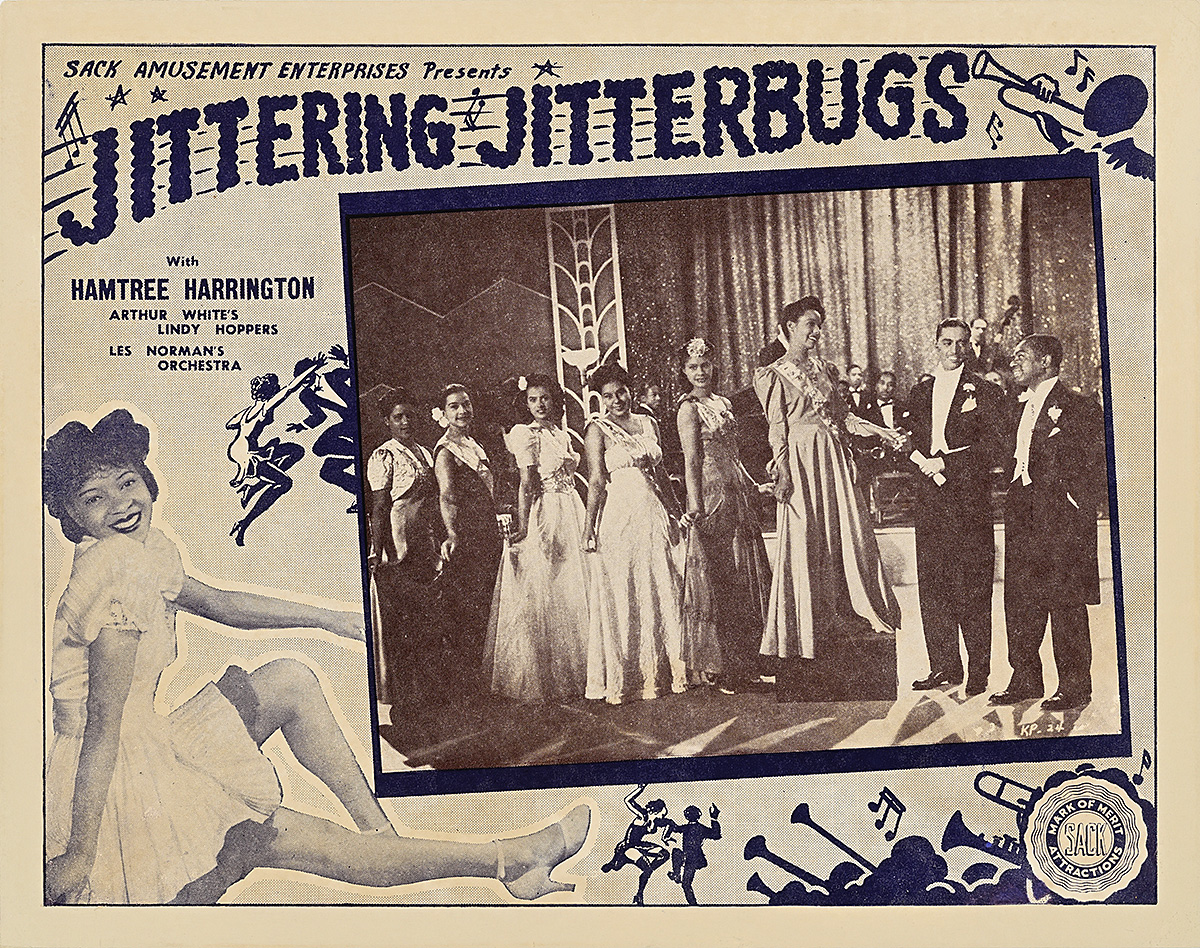
  • States throughout the country reinforced miscegenation and segregation laws, upholding the idea that Black and white people should neither share space nor form romantic relationships. Hurst, a lifelong supporter of civil rights, contributed to the discussion in her book focusing on a light-skinned daughter who is aware of her Black identity but resents it and, in turn, her Black mother.
  • Posters for both the original 1934 film and the rerelease (like this one) typically center the white characters, especially the star Claudette Colbert. This design, however, gives prominence to Black actresses Louise Beaver and Fredi Washington, suggesting that it promotes a screening specifically intended for Black theaters.

A poster of a kneeling woman holding the arm of a young woman looking distressed.

Imitation of Life, 1949 

Designer Unknown

The Black Canon Collection

  • This lobby card from the 1949 rerelease of Imitation of Life also emphasizes the daughter’s longing to be seen as white despite her Black identity. Advertising for the original 1934 release, however, omits any explicit reference to this identity or her desire to racially pass.
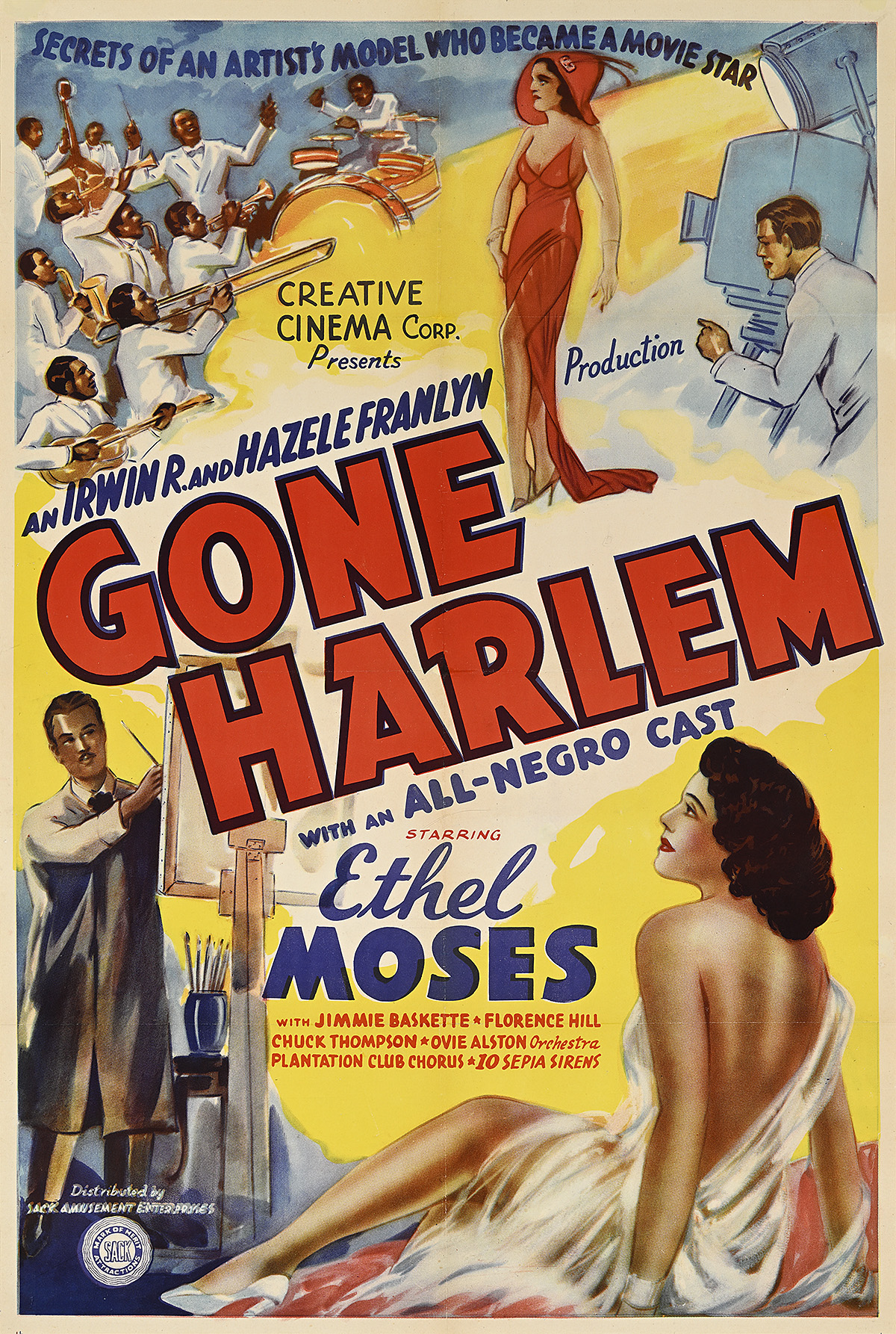
  • The Hays Code had prevented the production of an earlier version of the script for Imitation of Life as it explicitly alluded to miscegenation. Joseph Breen, the head of the Production Code Administration, stated in an internal memo that “a partly colored girl who wants to pass as white…violates the…clause covering miscegenation in spirit, if not in fact!”—a decidedly reductive interpretation of Black and mixed-race identity. Breen’s statement was especially egregious as Fredi Washington was a Black American actress and activist for racial justice who explicitly chose not to pass in her own life.

A poster of five photographs of Black men and women's faces arranged around text.

The Betrayal, 1948

Designer Unknown

Poster House Permanent Collection

  • The Betrayal, adapted from Oscar Micheaux’s 1941 novel The Wind from Nowhere, was his final film. It tells the story of a Black farmer who falls in love with a woman whom he assumes is white. After a violent and failed marriage to a different woman, he reconnects with his previous love as she uncovers her mixed-race identity. No footage from the original film is known to have survived. 
  • The Betrayal was the first race film to premiere in a Broadway venue, in this case the Mansfield Theatre (now the Lena Horne Theatre). After Micheaux’s eight-year hiatus from the movie industry, his fans were eager to see his latest film, and the theater had to issue tickets for reserved seating due to popular demand. Nonetheless, the film received mostly negative reviews with many Black critics claiming that its portrayal of mixed-race relationships was both tasteless and overwrought.
  • The Betrayal’s two stars were both complete unknowns in the film world at the time. Leroy Collins had originally applied for a stagehand job on set, but was instead hired as the male lead—his first and only performance in a film. Myra Stanton had only appeared in school plays but was discovered by Micheaux’s wife.

A poster with blue and white toned photographs of men and women smiling and dancing.

Rock ‘n Roll Burlesque, 1954

Designer Unknown

The Black Canon Collection

  • Like many sexploitation films, Burlesque in Harlem from 1949 was rereleased under a new name a few years later to allow the studio to make more money from the same footage while appealing to a new market. The title of the 1954 version was Rock ‘n Roll Burlesque, reflecting the rise in popularity of rock ‘n’ roll music. The movie did not, in fact, feature rock ‘n’ roll music but since this genre was heavily informed by blues, jazz, and folk, the title worked.
  • Like the flyer for Burlesque in Harlem, this design balances sex appeal with humor; it features the comedian Pigmeat Markham in the lower-right corner performing an audacious skit as an expert at the “Love Making Bureau” where he teaches a woman how to be a good lover for her husband. Such risqué scenes demonstrated the growing public interest in the sexploitation genre and wavering approaches to film censorship during this decade.

A printed card of a young man with a cigarette and a gun surrounded by several small vignettes of Black men and women.

Souls of Sin, 1949

Designer Unknown

Poster House Permanent Collection

  • William D. Alexander worked in the Office of War Information (OWI) during World War II, documenting the concerns of Black American soldiers overseas and creating newsreels for Black theaters. He produced more than 250 newsreels during his time at All-American News, some of which were criticized by audiences for not reflecting the realities of the lives of Black soldiers at war, most especially the racism they faced in the army. After the OWI was dissolved in 1945, he opened his own film company, Alexander Productions.
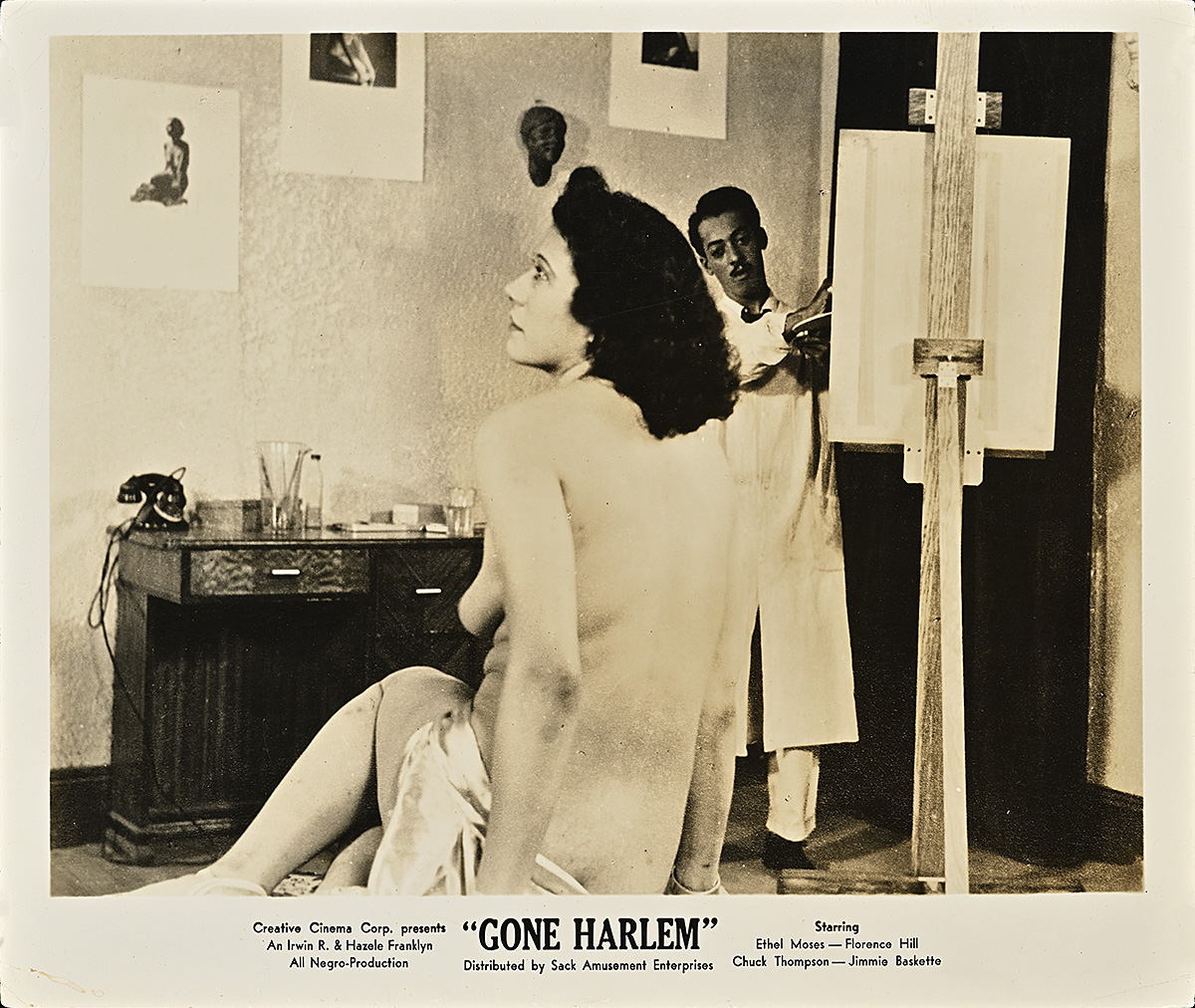
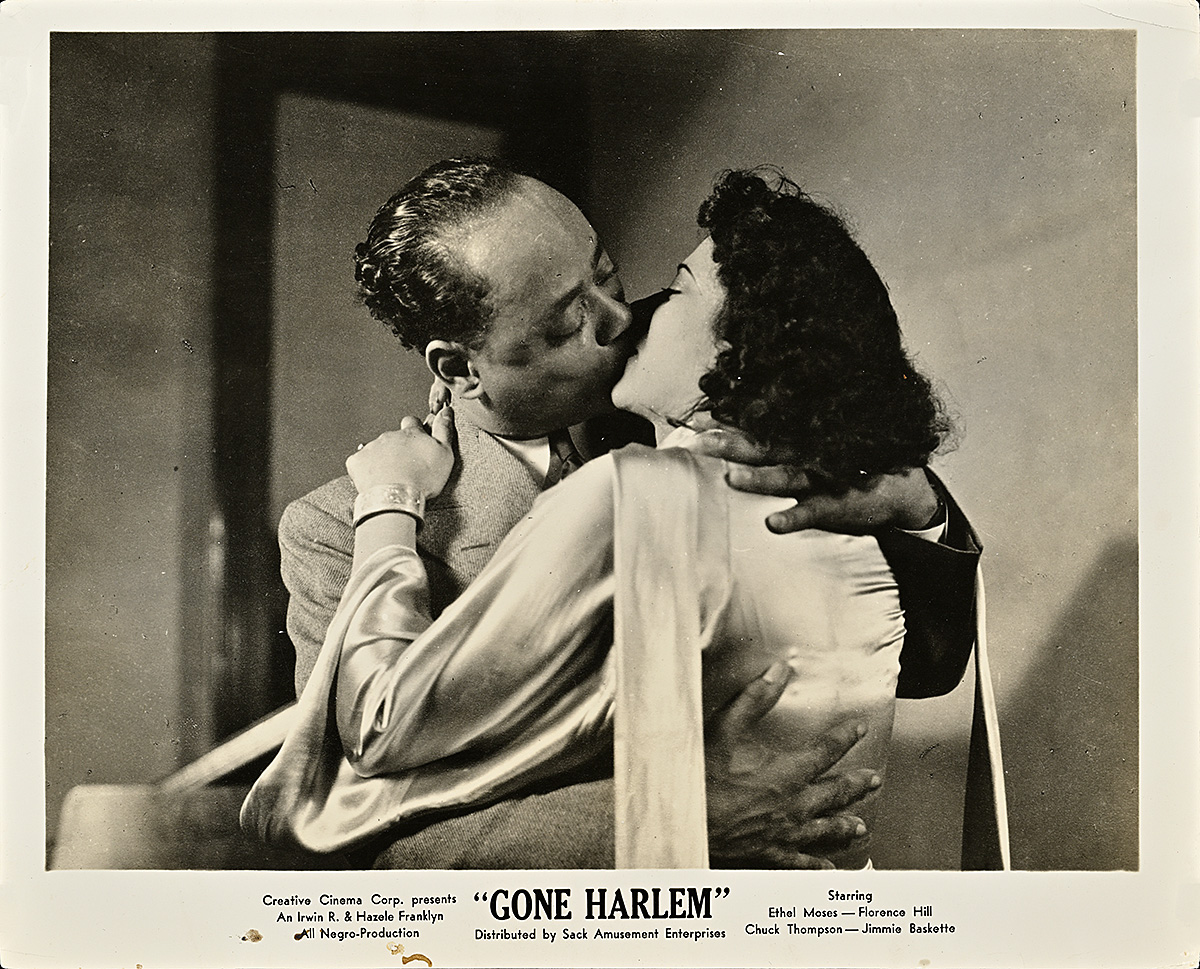
  • In the style of the popular gangster films of the decade, Souls of Sin tells the story of an unsuccessful gambler who shares a rundown basement apartment in New York with two roommates. Desperate to start a new life, he begins selling drugs to earn a living.
  • This collage-style window card showing the male lead holding a smoking gun clearly situates the film in the gangster genre. But its storyline is actually even darker than this image suggests, and marks a shift in the way Black gangsters were represented by Black filmmakers. Most significantly, it addresses drug dealing and use as horrible realities of Black urban life. Souls of Sin is considered the last race film created by a Black director (Powell Lindsay).

Three purple-toned photographs of men and women talking and dancing surrounded by music notes.

Burlesque in Harlem, 1949

Private Collection, NYC

  • Since Las Vegas and other hubs of “gentlemen’s entertainment” were segregated, Harlem became a center for Black burlesque during the 20th century.
  • Burlesque in Harlem was the first all-Black film intended for the sexploitation market. It had been preceded in 1945 by Big Times, which included a lengthy burlesque scene but was not entirely dedicated to the genre.
  • Sexploitation films began appearing in the 1940s, and, despite their name, did not typically feature hard-core sex scenes but rather nudity and other titillating material. Due to strict censorship laws, the theaters that showed these films often operated outside the traditional cinema circuit. 
  • Black burlesque in movies drew overtly from vaudeville and often incorporated comedy, music, and general entertainment in the style of a variety show—complete with a chorus line and partnered dance sequences.
  • This flyer would have been circulated to theater owners and other showmen who might be interested in screening the film. It invites them to send away for one of three tempting poster designs, any of which can be customized with the name of a specific theater for a small fee.

A poster with a photograph of two Black men fighting in front of a scared looking Black woman sitting on a couch.

Girl in Room 20, 1949

Designer Unknown

Poster House Permanent Collection

  • The Girl in Room 20 follows an aspiring singer from Texas who travels to New York City where she is manipulated by a sleazy nightclub owner. This poster captures one of the film’s most intense scenes in which the club owner attempts to assault the singer before he is fought off by her boyfriend. 
  • While the film was originally filmed and released in 1946, it was not widely distributed until three years later after it was submitted to the New York State censors. By that time, public perceptions around the Great Migration had evolved, both within and outside the Black community. 
  • Poster design had also developed in that three-year period; by 1949, most studios preferred to pay for illustrated advertisements rather than compositions featuring photographs of actors from the film as this allowed them to get away with more graphic, violent, and sensual imagery. This poster, based on a photo still from the film, was, therefore, slightly unusual for the time.

A black and white poster of a smiling Black woman with light skin framed by spooky cartoon vampires.

Murder With Music, c.1947

Designer Unknown

Poster House Permanent Collection

  • In early 1946, Bob Howard directed Mistaken Identity, a film about a singer who is accused of murdering a piano player. Musical sequences from the film were combined with new footage and released soon after as Murder with Music. In this new movie, in which footage from Mistaken Identity is used for flashback sequences, the singers and musicians investigate the murder. 
  • The poster incorporates illustrated figures that may be intended to represent Dracula and Frankenstein, monsters that often appeared in horror films of the era, in spite of the fact that this movie is more of a whodunit or thriller. Advertising like this incorporating popular fictional characters was not common for race films and represents a creative effort to attract audiences and venues. 
  • Posters for films Big Timers (1945) and Stars on Parade (1946) are visible in the background of one of the scenes in this movie, folding contemporary Black film culture into the film’s larger narrative.
  • Another scene shows a Black actor in blackface minstrel makeup surrounded by a line of chorus girls as they perform a “primitive” dance sequence. This kind of scene in a 1940s film aimed at Black audiences serves as a reminder of the persistence of 19th-century minstrelsy tropes.

Legacy 

With the advent of the civil rights movement in the 1950s, race films began to change dramatically. Many started to focus on the question of integration and were more inclined to include Black and white actors on screen together. Hollywood studios now introduced more Black content into their standard fare, presenting examples of a range of interracial relationships. Black actors also took on more complicated roles in serious films that articulated some of the political and social implications of racism. During this decade, civil rights organizations like the NAACP and the NAG continued to call for the removal of stereotypical roles for Black actors and within the Hollywood system at large while individual actors began to see themselves as representatives of the wider Black community, leveraging their talents and influence to condemn racism and discrimination in all forms of entertainment.

This shift toward broader and more profound Black narratives also prompted playwrights and filmmakers to remake or reinterpret old plays and movies from a contemporary perspective, supplying richer characters and more nuanced plotlines as they gradually abandoned overtly racist tropes and stereotypes. Black-owned and -operated theaters, like other Black businesses, began to lose their Black audiences as legal racial barriers were lifted throughout the country. Ultimately, Black theater and films presented stories that would have a lasting impact on these creative fields as directors and actors defined and developed their own narratives about the talent, culture, and plight of Black Americans.

The first lines of Langston Hughes’s “Note on Commercial Theatre,” are quoted at the beginning of this exhibition. The poem concludes “But someday somebody’ll/Stand up and talk about me/And write about me/Black and Beautiful/And sing about me/And put on plays about me!/I reckon it’ll be/Me myself!/Yes, it’ll be me.”

Curator

Es-pranza Humphrey


Designer

Ola Baldych


Registrar

Melanie Papathomas


Production

Ola Baldych

Mihoshi Fukushima Clark


Installation

John F. Lynch

Rob Leonardi

Diego Cadeña Bejarano


Graphic Installation

Keith Immediato


Woodwork

Rob Leonardi


Printer

Full Point Graphics

XDFour


Animation

Mihoshi Fukushima Clark


Video Installation

Billy Jackson


Textiles

Noël Martin

Special Thanks

Dominique M. Jean-Louis, public historian

Kelly Walters, designer & design historian

Michael Gillespie, New York University 

John T. Reddick, Harlem historian

Catherine Bindman, editor

Randy Ferreiro, proofreader

Sofía Jarrín, Spanish translator


Typefaces

Spike by Vocal Type TBD


This program is supported, in part, by public funds from the New York City Department of Cultural Affairs in partnership with the City Council, and the New York State Council on the Arts (NYSCA).

Pull Quotes

“The 1920’s were the years of Manhattan’s black Renaissance. It began with Shuffle Along, Running Wild, and the Charleston. Perhaps some people would say even with The Emperor Jones…”—Langston Hughes, poet

“Oscar Micheaux deserves a lot of encouragement and support for his persistence in keeping the Negro on the screen, even in a small way.”—Vere E. Johns, journalist