Love & Fury: New York’s Fight Against AIDS

AIDS in New York: A Timeline of Action & Loss

  • 1980–81 In late 1980, New Yorkers begin to witness symptoms of mysterious illnesses in gay men. Friends, lovers, and partners—people like Paul Popham, Larry Kramer, and Enno Poersch—watch as those around them fall ill and die without explanation. Physicians are also observing similarly inexplicable illnesses among women and injection-drug users. 
  • July 1981 The CDC reports 41 cases of Kaposi’s sarcoma (a type of cancer that forms in the lining of blood vessels and lymph nodes, causing lesions on the skin) and Pneumocystis pneumonia (PCP, a serious lung condition that typically affects people with weakened immune systems) in gay men. New York City is one of the early epicenters. By year’s end, dozens have died in the city, but despite medical evidence of a new epidemic, there is no official government response.
  • January 1982 Gay Men’s Health Crisis (GMHC), the first AIDS service organization in the country, is founded in Larry Kramer’s apartment. Volunteers answer calls, create support groups, and launch public education campaigns.
  • July 1982 The New York AIDS Network, a coalition of community groups and individuals, is established to disseminate accurate information and to pressure local leaders to take action.
  • September 1982 The CDC first uses the term Acquired Immune Deficiency Syndrome (AIDS) to describe the illness and provides the first official definition: “A disease at least moderately predictive of a defect in cell-mediated immunity, occurring in a person with no known cause for diminished resistance to that disease.”
  • December 1982 New York has more than 500 reported AIDS cases by the end of the year. Compassionate, community-based responses are emerging faster than any form of government aid.
  • 1983 GMHC receives its first public funding from the New York City Department of Public Health.
  • May 1983 Michael Callen and Richard Berkowitz, both living with AIDS, publish their pamphlet How to Have Sex in an Epidemic: One Approach, providing some of the first “safer sex” guidelines grounded in care, intimacy, and lived experience.
  • 1984 Design Industries Foundation Fighting AIDS (DIFFA) is established in New York City to raise funds for the cause.
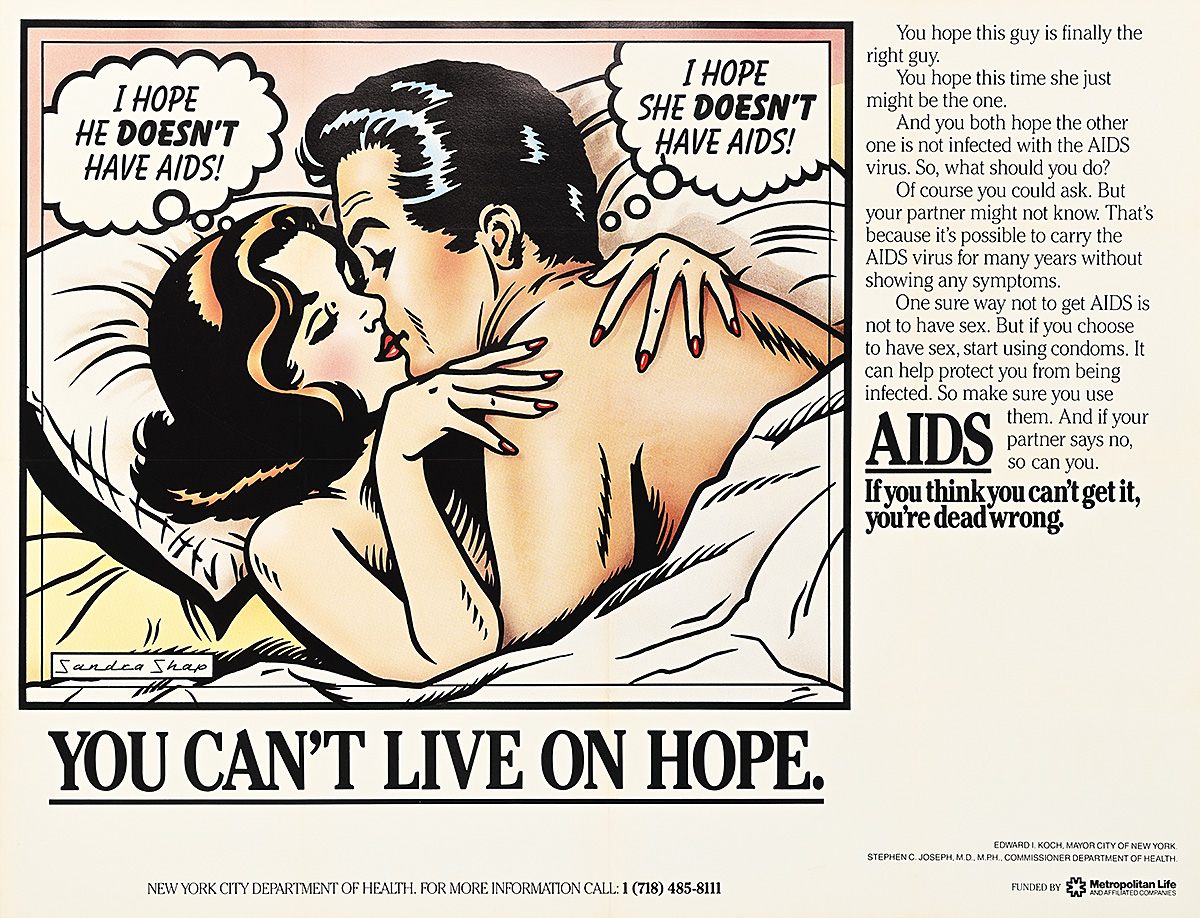
    The city’s health department launches its first public campaigns, relying on fear-driven messages like “You Can’t Live on Hope.”
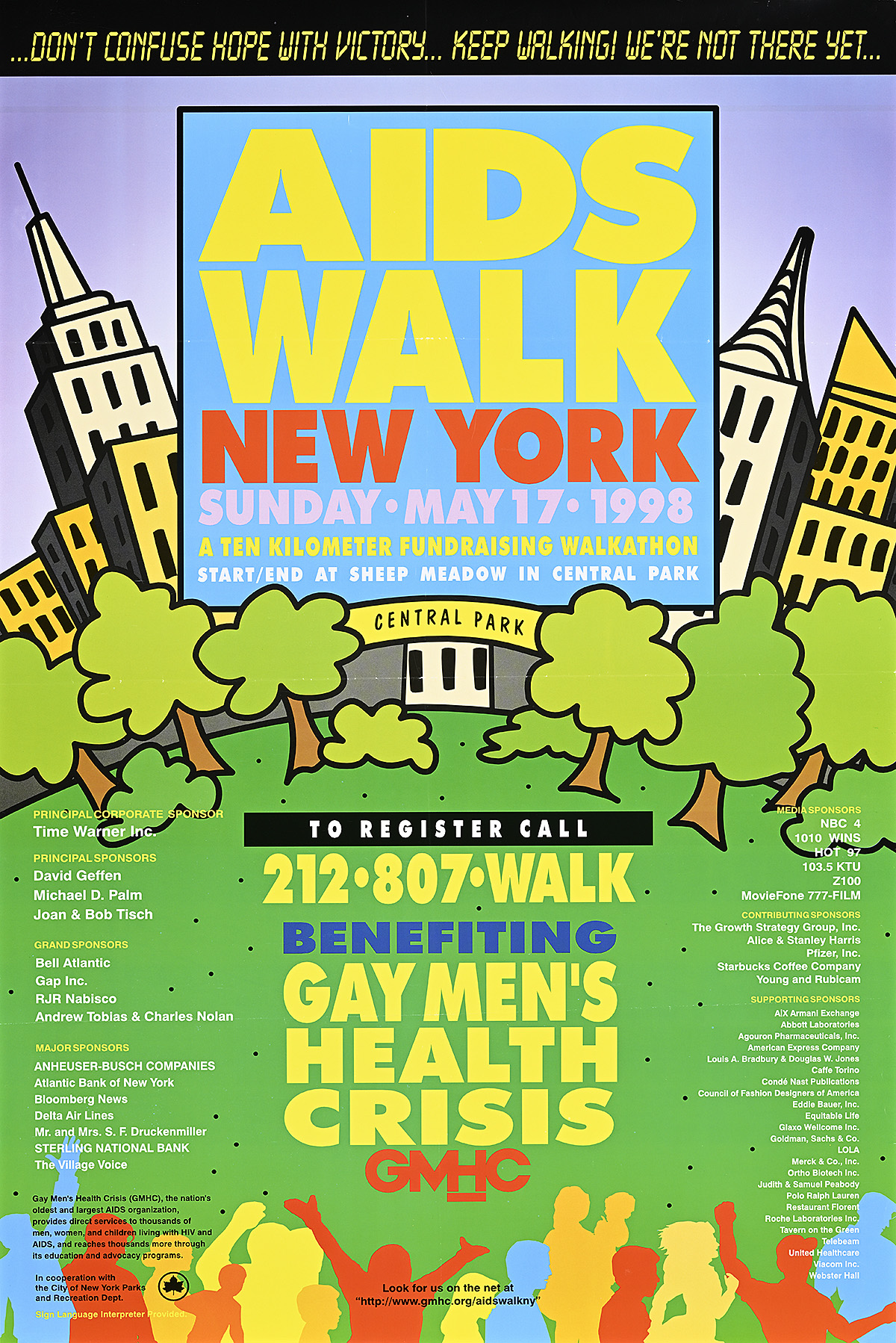
  • May 18, 1986 AIDS Walk New York begins with more than 4,500 participants, raising nearly  $710,000 for GMHC. This annual event becomes a mainstay of New York’s AIDS response.
  • June 1986 The U.S. Supreme Court upholds Georgia’s sodomy law in Bowers v. Hardwick, ruling that the Constitution does not protect the right of gay men to have consensual sex in the privacy of their own homes. The decision reinforces criminalization and stigma at a time when the AIDS crisis is devastating the gay community.
  • December 1986 AIDS-related deaths in the city exceed 6,500 by the end of the year.
  • March 1987 AIDS Coalition to Unleash Power (ACT UP) is founded at the Lesbian and Gay Community Services Center in New York. What begins as a furious speech by Larry Kramer becomes a force that reshapes public discourse through direct action and fearless graphic design.
  • February 1988 Broadway Cares is established by members of The Producers’ Group to raise funds for AIDS-related causes as arts and fashion professionals join the movement.
  • 1989 AIDS becomes the leading cause of death among young men in New York City and the cumulative death toll surpasses 19,494.
  • May 1989 “Queen of the Night” Susanne Bartsch inaugurates her first Love Ball at the Roseland Ballroom in New York City, rallying the fashion community to raise $400,000 for those affected by AIDS.
  • December 1, 1989 Visual AIDS, founded in 1988, launches its Day Without Art as “a day of action and mourning” to honor artists lost to the disease. By this time, more than 19,000 New Yorkers have died of AIDS. Angry activists take over city walls with their posters and flyers, demanding drug access and forcing AIDS onto the national agenda. 
  • 1992 By now, more than 35,000 people have died of AIDS in New York City. The epidemic crosses racial, gender, and economic lines, yet services remain unevenly distributed.
  • 1993–95 The epidemic peaks.
  • January 1993 After years of activism, the CDC finally expands its definition of AIDS to include conditions affecting women—such as cervical cancer—following pressure from ACT UP’s Women’s Caucus and Women’s Health Action and Mobilization (WHAM!).
  • 1993 Internal tensions over race, gender, and strategy lead to declining participation in ACT UP/New York as members debate the future of direct-action organizing in the epidemic’s second decade.
    Housing Works, founded by former ACT UP members, escalates legal and activist efforts to secure housing for low-income New Yorkers living with HIV/AIDS.
  • December 1994 By the end of this year alone, more than 7,000 New Yorkers have died from AIDS-related causes.
  • June 1995 The U.S. Food and Drug Administration approves the first protease inhibitor, signalling the beginning of a new era of highly active antiretroviral therapy (HAART).
  • 1996–99 Effective antiretroviral therapies become widely available. Deaths begin to decline—but unevenly. Inequities in access, especially across race and class, remain stark. Community organizations shift their work from crisis response to long-term care and survival. By 1999, there are more than 123,000 cumulative AIDS diagnoses in New York City and nearly 78,000 New Yorkers have died from AIDS-related causes.

“Epidemics do not announce themselves but enter on the cat’s paw.”—Ronald Bayer & Gerald M. Oppenheimer, AIDS Doctors

New York Responds to AIDS: Love, Action, & the Power of Posters

During the late 1970s and early 1980s, clusters of rare illnesses—Kaposi’s sarcoma, Pneumocystis pneumonia—began appearing among young, otherwise healthy gay men in New York, Los Angeles, and San Francisco, as well as among injection-drug users. Doctors, activists, and those affected noticed before public health authorities that this new disease manifested in unusual ways, often looking like the late stages of unrelated illnesses.

At the time, homosexuality was still criminalized in much of the United States. In 1986, Bowers v. Hardwick challenged this at the federal level; however, the Supreme Court ultimately upheld the constitutionality of state sodomy laws. This legal context shaped the risks people took simply by gathering in clubs, bars, and bathhouses—spaces that were not only social and erotic havens but also sites of potential surveillance, police raids, and arrest. These dangers made the early community response to AIDS even more courageous: people fought to protect and care for each other under the constant threat of legal persecution. Posters from this period reflect both defiance and vulnerability, created by communities that had long been criminalized for their very existence. At the same time, activists were engaging in harm-reduction methods such as needle exchange to reduce transmission among people who injected drugs.

Initial confusion around this illness was compounded by stigma: early names like GRID (Gay-Related Immune Deficiency) framed the epidemic through homophobia. In communities of injection-drug users, what came to be known as HIV/AIDS was called “the dwindles” or “Rikers Island adenopathy.” In 1982, the CDC officially named the syndrome AIDS (Acquired Immune Deficiency Syndrome). As the death toll mounted, New Yorkers organized in the absence of a state response, publishing community bulletins and launching the first self-determined care and advocacy programs.

When AIDS hit New York as early as the late 1970s, posters spoke where institutions stayed silent. In a city wired for visual competition—crowded streets, subway ads, nightclub flyers—posters became lifelines. They appeared in all five boroughs, from bathhouses in the Bronx to beauty salons in Brooklyn, from Staten Island health centers to Queens Pride events and Manhattan street corners. They helped people to find clinics, mourn the dead, demand justice, and fight for the living.

This exhibition explores how graphic design shaped New York’s grassroots response to AIDS between 1979 and 1999. Public health campaigns, agitprop, benefit flyers, and club handbills document more than messages—they map how communities built survival systems from the ground up, often before the state was willing to act. 

These posters were not ornamental. They served as a communications infrastructure: maps to clinics, calls to protest, love letters, and warnings. They made an invisible epidemic visible, and they did more than express grief—they organized. As scholar Douglas Crimp has written in his book Melancholia and Moralism, AIDS demanded both “mourning and militancy.” These posters ask viewers to see the epidemic not only as a public health crisis but also as a fight over who is seen, who is heard, and who is allowed to live. While posters were a medium for reflecting an experience, they were also intended to affirm and secure life itself.

Please note that this exhibition contains visual and written references to sexual situations and drug use. 

Unless otherwise noted, all posters in this exhibition are part of the Poster House Permanent Collection.

Whenever feasible, Poster House reuses materials from previous shows to drive sustainable practice. 

Large text, Spanish translation, and a Plain language summary are available via the QR code and at the Info Desk.

El texto con letra grande, la traducción al español y un resumen en lectura fácil están disponibles a través del código QR y en atención al público.

A Response Born in Crisis

At the start of the AIDS crisis, fear spread quickly—but official help was painfully slow to arrive. Government agencies hesitated, public messaging misfired, and the mainstream media often ignored the growing death toll. In the absence of institutional support, grassroots networks in New York City stepped in.

In 1983, activists Michael Callen and Richard Berkowitz published How to Have Sex in an Epidemic: One Approach, a groundbreaking guide rooted in care, frankness, and gay men’s sexual autonomy. Their message—that sex can be safe, loving, and joyful even under such circumstances—helped launch a new paradigm of prevention: safer sex. Written by two gay self-identified PWAs (person or people with AIDS), this publication embodied the community’s approach—nothing for us without us, gay men and PWAs alike.

Like the safer sex guide, early AIDS posters did not look or sound like standard government health warnings but instead incorporated bold colors, bilingual text in English and Spanish, comic art, and vernacular language. Printed at community offset presses and distributed by hand in bookstores, bars, and clinics, these pieces were made by and for the people most affected by the AIDS crisis. Early organizers plastered the city with this new messaging.

Groups like Gay Men’s Health Crisis (GMHC) launched hotlines and counseling services out of apartments, offering support when hospitals would not. These early community-driven campaigns did not shame people—they educated them, empowering vulnerable populations with the tools to survive.

The posters in this section show how public health messaging can begin at the margins. They offer a blueprint for survival through design, courage, and collective care. When the government failed to respond to the epidemic, the community stepped up and did the work necessary to help itself. 
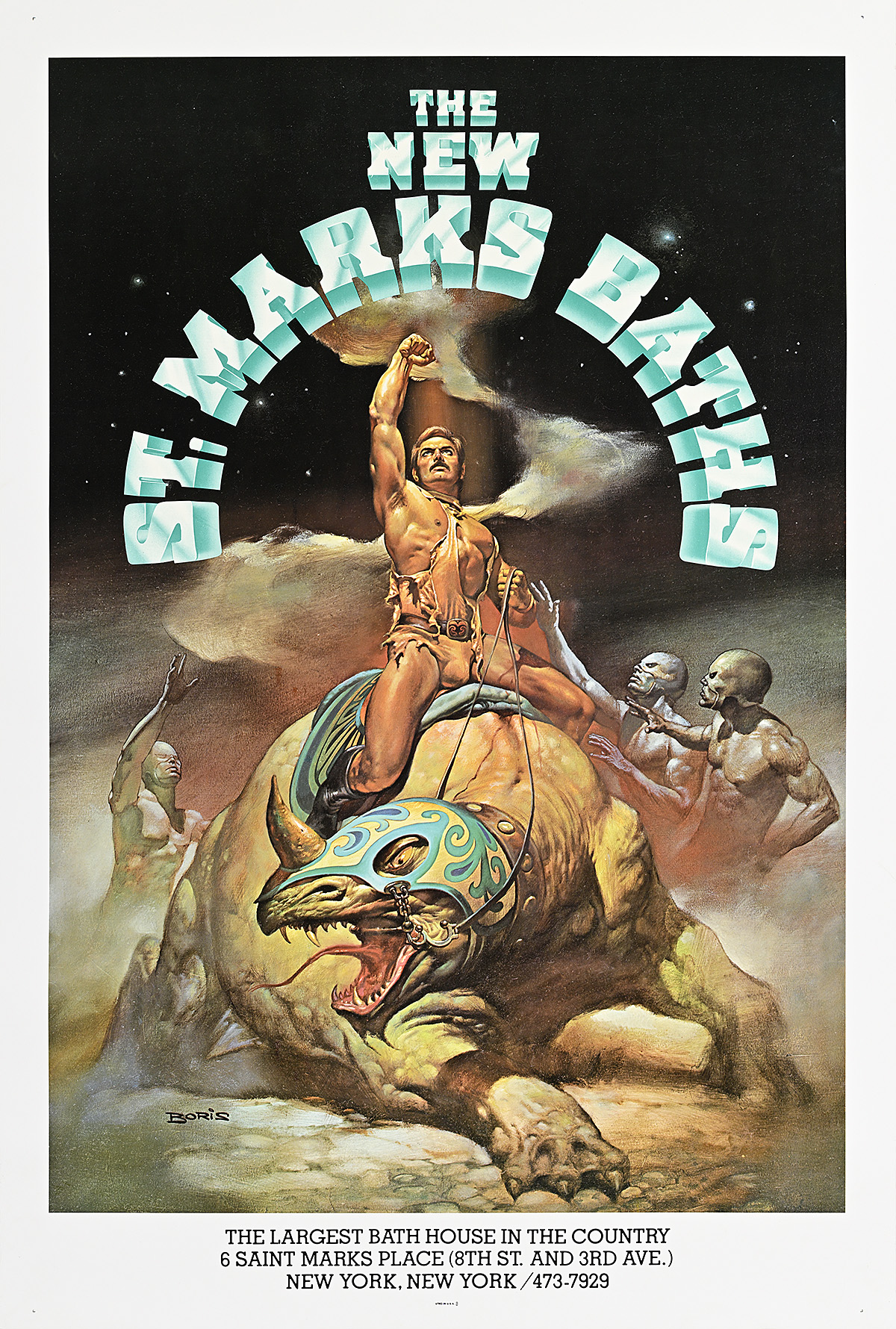
A poster of a man with his fist raised riding a dinosaur surrounded on all sides by nude men.

The New St. Marks Baths, 1979

Boris Vallejo (b. 1941)

Poster House Permanent Collection

  • Before AIDS, a vibrant gay sexual culture flourished in New York, simultaneously shaped by the energy of gay liberation and constrained by widespread homophobia. Bathhouses (communal venues offering private rooms, saunas, and plunge pools for relaxation and sex), backrooms (darkened rooms at the back of bars for sex), tearooms (public restrooms used for clandestine encounters), and a plethora of bars formed “the circuit,” a network of communal sex spaces where gay men explored pleasure, identity, and intimacy. St. Marks Baths stood at the center of this world—not just as a place for sex but also as a site of community, routine, and self-fashioning that would soon become central to early AIDS organizing.
  • Located in the East Village, St. Marks was one of the largest bathhouses in the country and a symbol of urban gay freedom. It drew thousands of visitors each week and offered massage rooms, lounges, a restaurant, and private spaces for sex. Places like St. Marks represented autonomy and erotic possibility at a time when few public institutions welcomed gay life.
  • This fantastical poster in the style of classic sci-fi illustration captures the surreal, sex-positive exuberance of the pre-AIDS era. The design suggests erotic spectacle, inviting viewers into a world where pleasure is both routine and liberatory.
  • While he is best known in popular culture for his illustrations for the Conan the Barbarian and Tarzan paperbacks and his movie posters for National Lampoon, Knightriders, and Q: The Winged Serpent, Boris Vallejo did not specialize in gay subject matter nor was he part of the gay scene. His hypermasculine, homoerotic aesthetic, however, found an enthusiastic audience in gay communities. This poster remains one of the few known instances of Vallejo’s commercial work being used to directly market a gay space, demonstrating how the fantasy genre could be used to visualize or embody gay freedom.

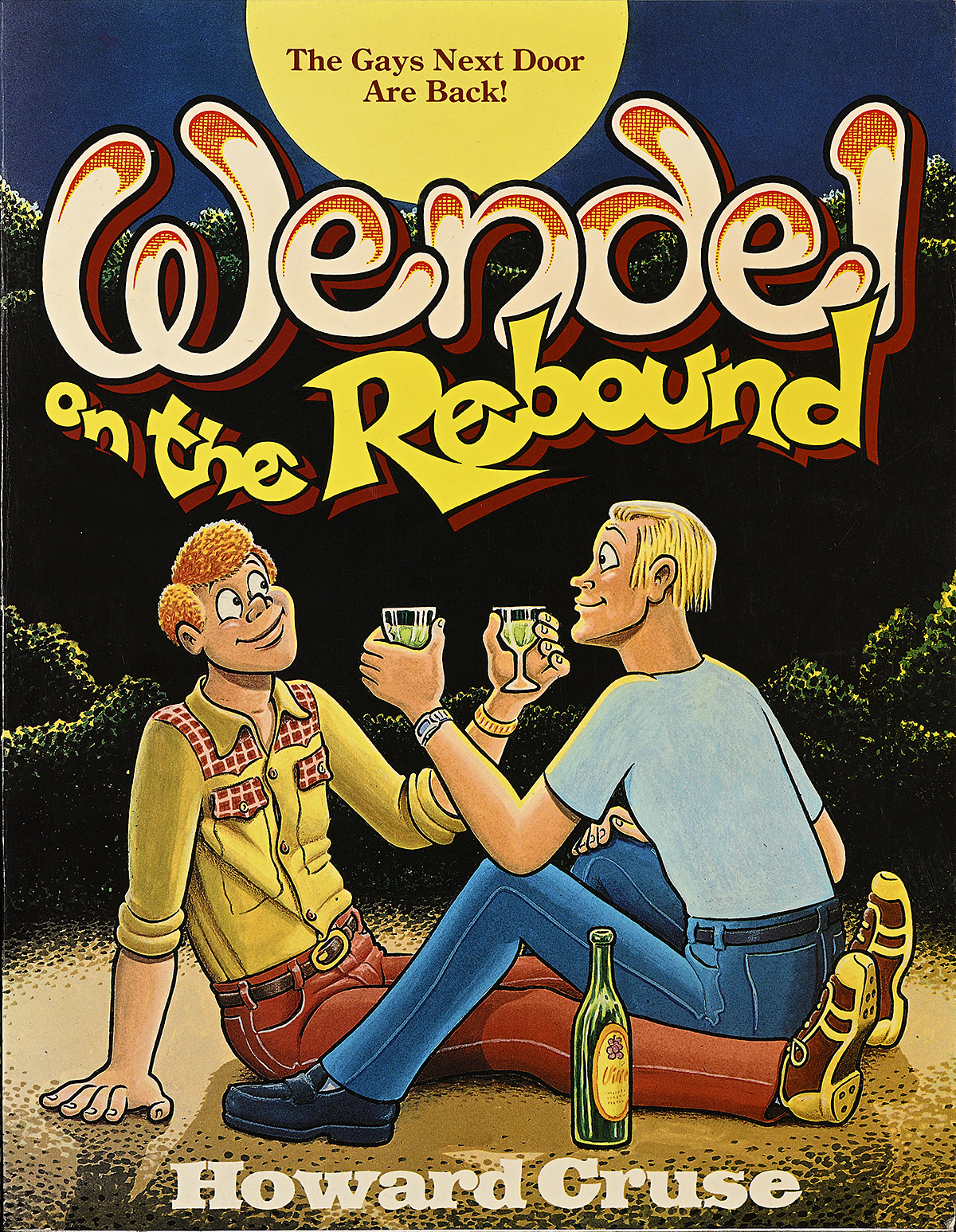
A book cover of two cartoon men sitting facing each other and holding up drinking glasses.

Wendel on the Rebound, 1989

Howard Cruse (1944–2019)

Private Collection, NYC

  • This collection of comics captures the life of Wendel and his partner Ollie as they navigate sex, love, and survival amid the AIDS crisis. First serialized in The Advocate, one of the oldest and most prominent gay magazines in the United States, the comic strips confront anti-gay violence, government inaction, and loss with tenderness, wit, and rage. Cruse did not just acknowledge AIDS; he made it central to the everyday gay experience through the eyes of Wendel, his protagonist.
  • As one of the first openly gay cartoonists, Howard Cruse pioneered gay comics as a medium for political truth-telling and emotional realism. Wendel on the Rebound offered representation when it was rare, insisting that gay men’s lives—and their losses—mattered.

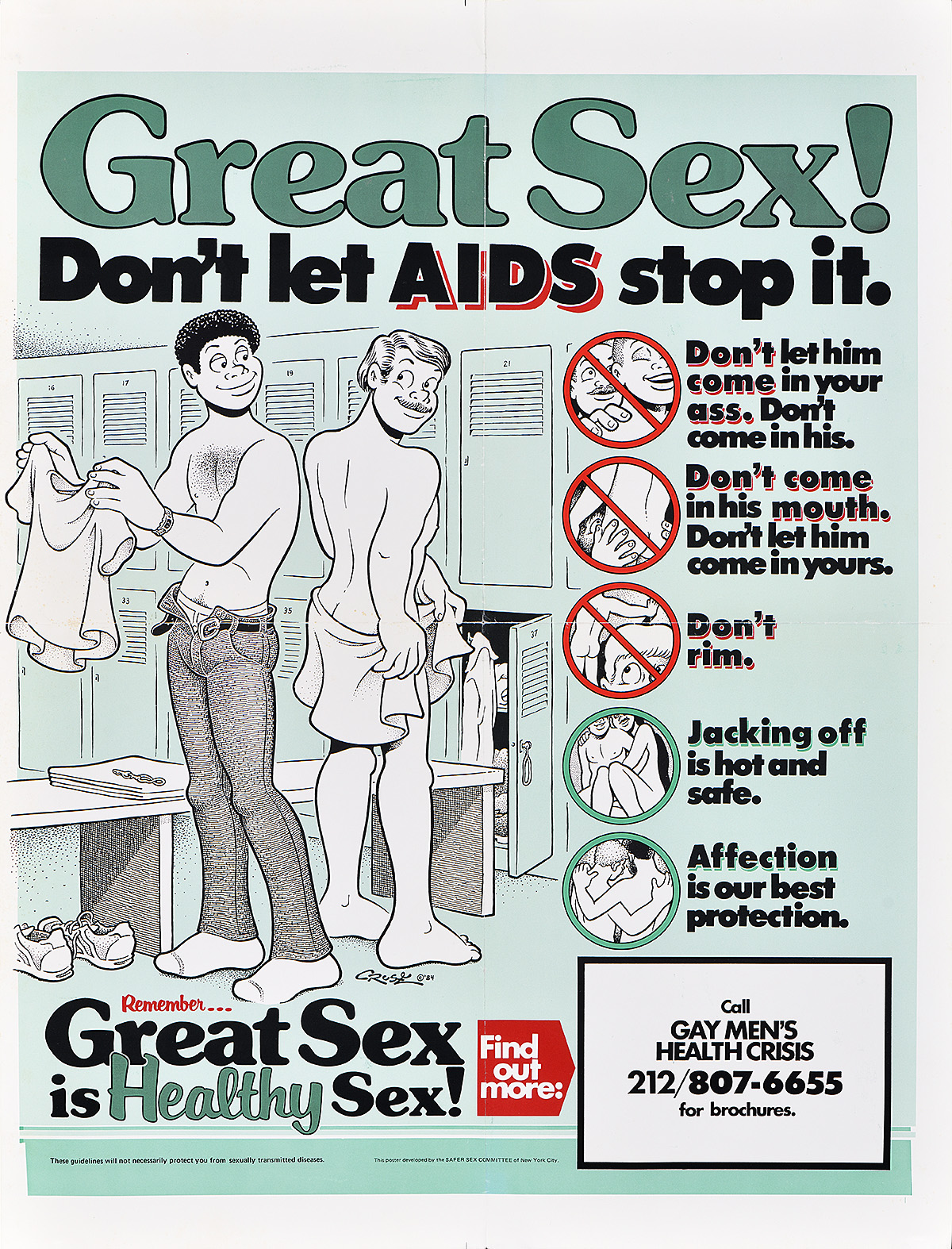
A poster of two cartoon men undressing next to each other on a green background.

Great Sex! Don’t Let AIDS Stop It., 1984

Howard Cruse (1944–2019)    

Poster House Permanent Collection                                                                                                                                                                       

  • This poster was adapted from How to Have Sex in an Epidemic (1983), the first safe-sex guide written by and for gay men who were active in the gay circuit during the AIDS crisis. The pamphlet was written by two PWAs, Michael Callen, a musician, and Richard Berkowitz, a sex worker deeply affected by the emerging crisis, with editorial supervision from Richard Dworkin, Callen’s boyfriend, and Dr. Joseph Sonnabend, a specialist in sexually transmitted diseases whose practice focused on gay men’s sexual health. It promoted medically informed risk reduction without moralizing. In particular, it advocated communication, sobriety, and affection as strategies for safer sex, offering a radical alternative to abstinence or shame. 
  • The authors were initially criticized as internally homophobic and anti-sex since they presented evidence suggesting that AIDS was at least partly related to sexual behaviors and therefore encouraged risk reduction. 
  • Circulated in bathhouses and bookstores, the pamphlet presented a new ethic of care grounded in the belief that sex could be both pleasurable and responsible—even in a crisis. Printed in a similar style, this poster was displayed at gay community venues like the New St. Marks Baths.
  • Howard Cruse was a groundbreaking gay cartoonist known for his 1995 graphic novel Stuck Rubber Baby, in which he tackled race, sexuality, and the civil rights movement in the South through the eyes of a young gay man growing up in the 1960s and ’70s. He is also known for launching the 1980 anthology Gay Comix. Here, he includes a Black man and a white man, indicating the early inclusivity in AIDS messaging that was not as prominent in later posters.

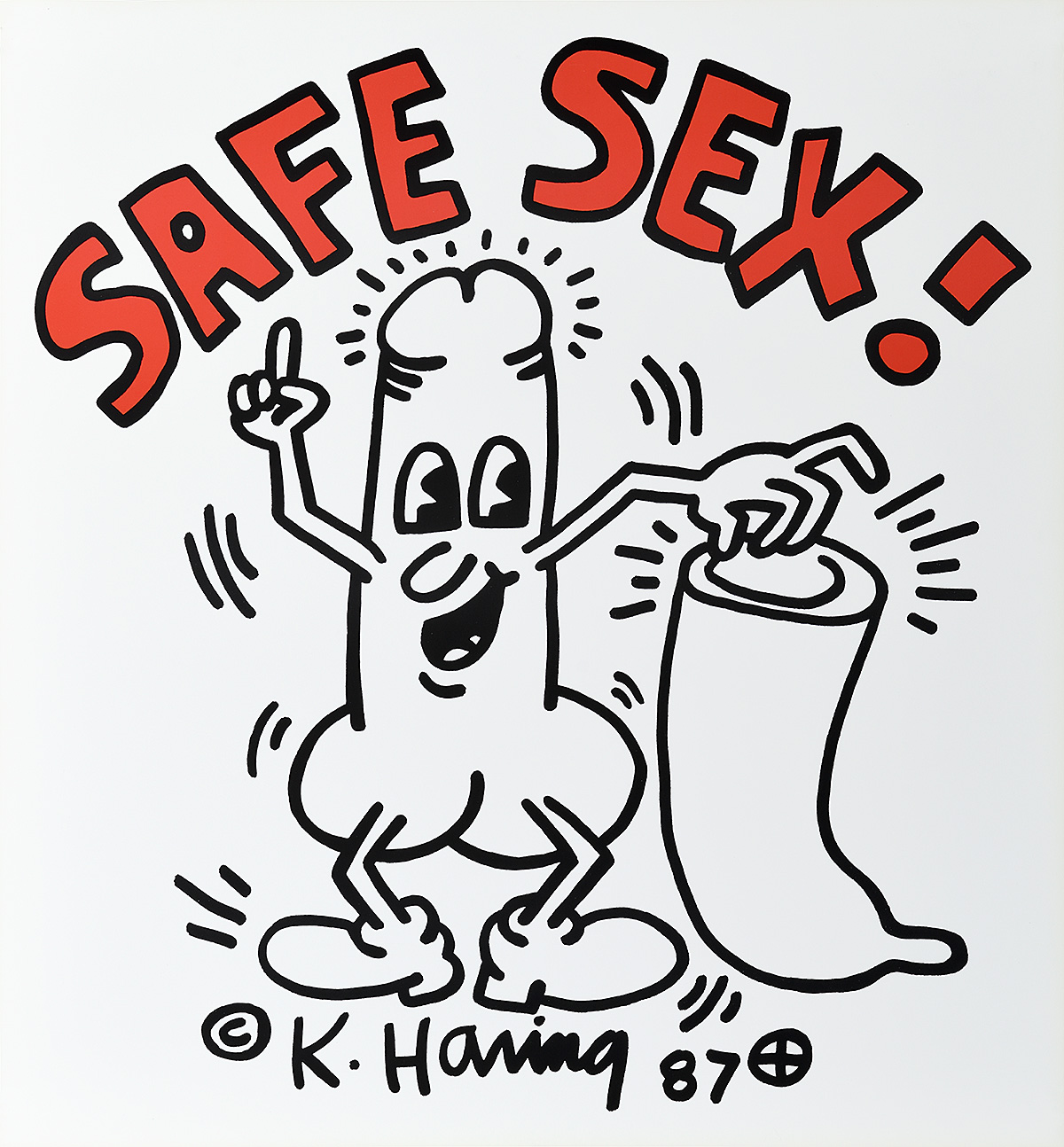
A poster of a smiling cartoon penis holding a giant condom with the words safe sex in red above.

Safe Sex!, 1987 

Keith Haring (1958–90)

Poster House Permanent Collection

  • This cartoon-style poster by Keith Haring features a joyful anthropomorphic penis holding a condom beneath the bold red headline “SAFE SEX!” While the concept of safe sex practices predated AIDS in conversations about pregnancy and sexually transmitted diseases, Callen and Berkowitz coined the phrase in 1983 as both a term and a practice related to AIDS prevention. 
  • Before AIDS, condom use was rare among gay men and was often associated with distrust or repression. In the face of staggering loss, community health organizations and activists reframed condoms as tools of love, respect, and survival. Haring’s poster joined that movement, using humor and sex-positivity to counter fear-based messaging.
  • By the late 1980s, Keith Haring was one of the most recognizable artists in the world. Known for his public murals and subway drawings that drew from geometric motifs found in North African art, graffiti, animation, and commercial design, he brought the same bold lines, playful figures, and kinetic energy to this poster. He would be diagnosed with HIV the following year. 
  • This silkscreen design, self-published by Haring, was widely distributed in clubs and clinics, emphasizing a concept jointly championed by the artist, community health initiatives, and emerging activist organizations like ACT UP.

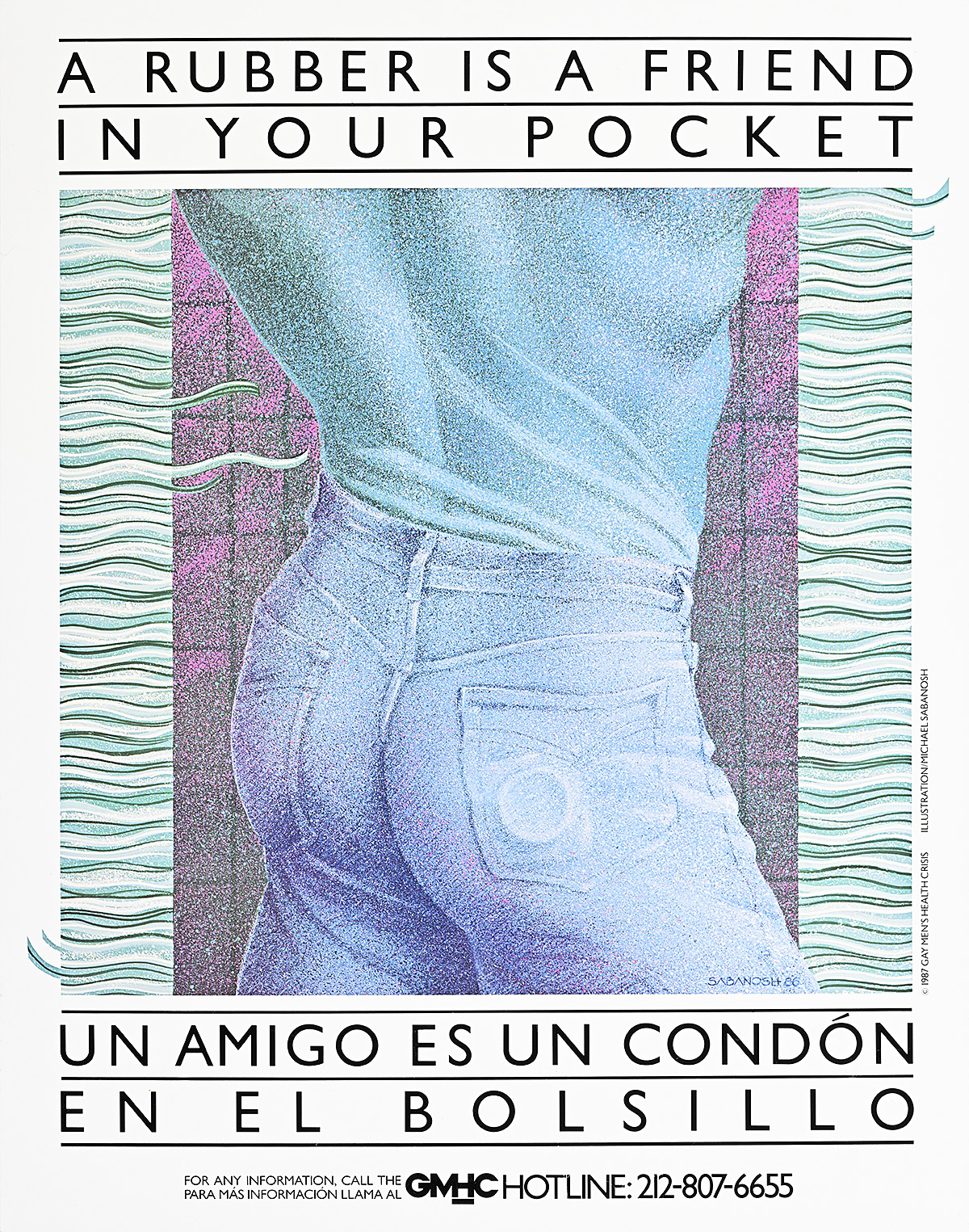
A poster showing a man's butt in tight jeans; inside his pocket there is the outline of a condom.

A Rubber is a Friend in Your Pocket, 1987

Michael Sabanosh (Dates Unknown)

Poster House Permanent Collection

  • By 1987, GMHC had become a powerful institution in the world of AIDS advocacy—professionalized, well funded, and widely respected by city and state agencies responding to the epidemic. Inside and outside the organization, however, tensions were rising. 
  • GMHC worked closely with city agencies like the NYC Department of Health to deliver public education campaigns, train service providers, and administer city-funded care programs. This collaboration brought vital resources but also sparked internal debate about the risks of aligning too closely with slow-moving or indifferent institutions. Nevertheless, community organizations leveraged this type of access to official institutions to demand structural change, tapping into professional relationships to shape policy while continuing to organize protests, lawsuits, and direct actions.
  • This poster’s bilingual slogan and casual tone signal GMHC’s effort to broaden its reach beyond white, English-speaking gay men. The design showcases condoms as accessible, unthreatening tools that are part of daily life.
  • The composition also highlights GMHC’s still-crucial infrastructure, including its groundbreaking AIDS hotline, which by 1987 had answered tens of thousands of calls.
  • This same year, Larry Kramer, who helped found GMHC, publicly denounced the organization’s reluctance to confront power. His speech on March 10 at the Gay and Lesbian Community Center in the West Village catalyzed the founding of the AIDS Coalition to Unleash Power (ACT UP), ushering in a new era of AIDS activism—one defined by confrontation, civil disobedience, and a forceful demand for systemic change.

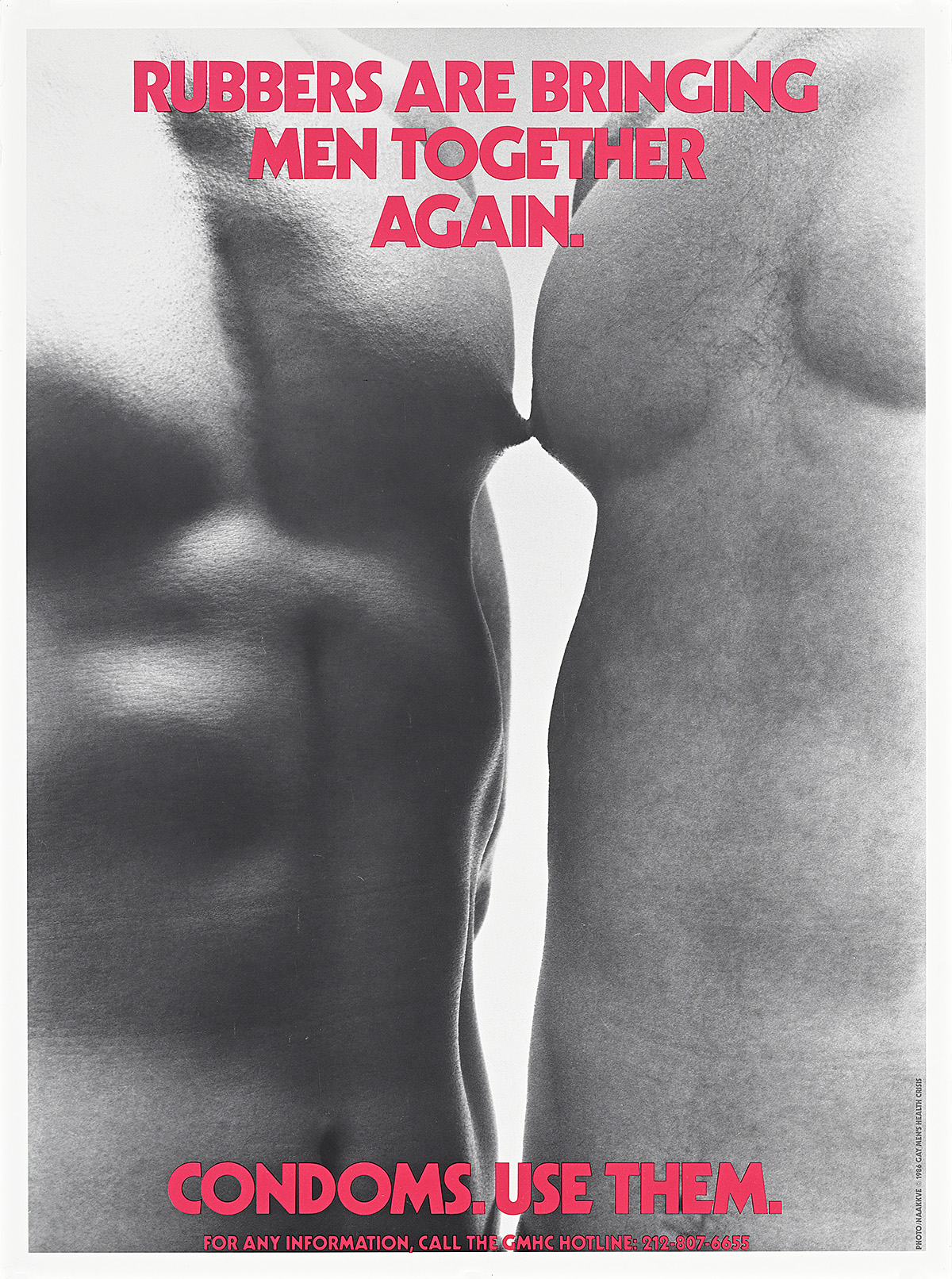
A poster of two muscular nude male torsos with their nipples touching.

Rubbers Are Bringing Men Together Again, 1986

Joseph Leonote III (Dates Unknown) and Naakkve (Dates Unknown)

Poster House Permanent Collection

  • Produced by Gay Men’s Health Crisis (GMHC), this poster marked an early moment in sex-positive AIDS education. Rather than warning against sex, it framed condoms as instruments of connection and protection—reclaiming eroticism and care at a time when fear and misinformation dominated public messaging.
  • GMHC was founded in 1982 in the apartment of famed playwright and activist Larry Kramer as a volunteer-run hotline and support service for people affected by a mysterious new illness. It quickly evolved into the country’s largest AIDS organization, providing counseling, legal aid, medical referrals, and public outreach. Its early messaging stood apart from institutional fear tactics, offering compassion and practical tools in a moment of crisis.
  • GMHC’s service-oriented approach was not without critics. Activists like Michael Callen and Richard Berkowitz saw the organization as a mouthpiece for the larger medical establishment and argued that people with AIDS were being treated as passive clients, not as leaders. Their 1983 pamphlet How to Have Sex in an Epidemic helped define an alternative vision: one rooted in autonomy, peer education, and self-determination. This poster reflects a time when community protection was being reimagined—and debated—on the ground.

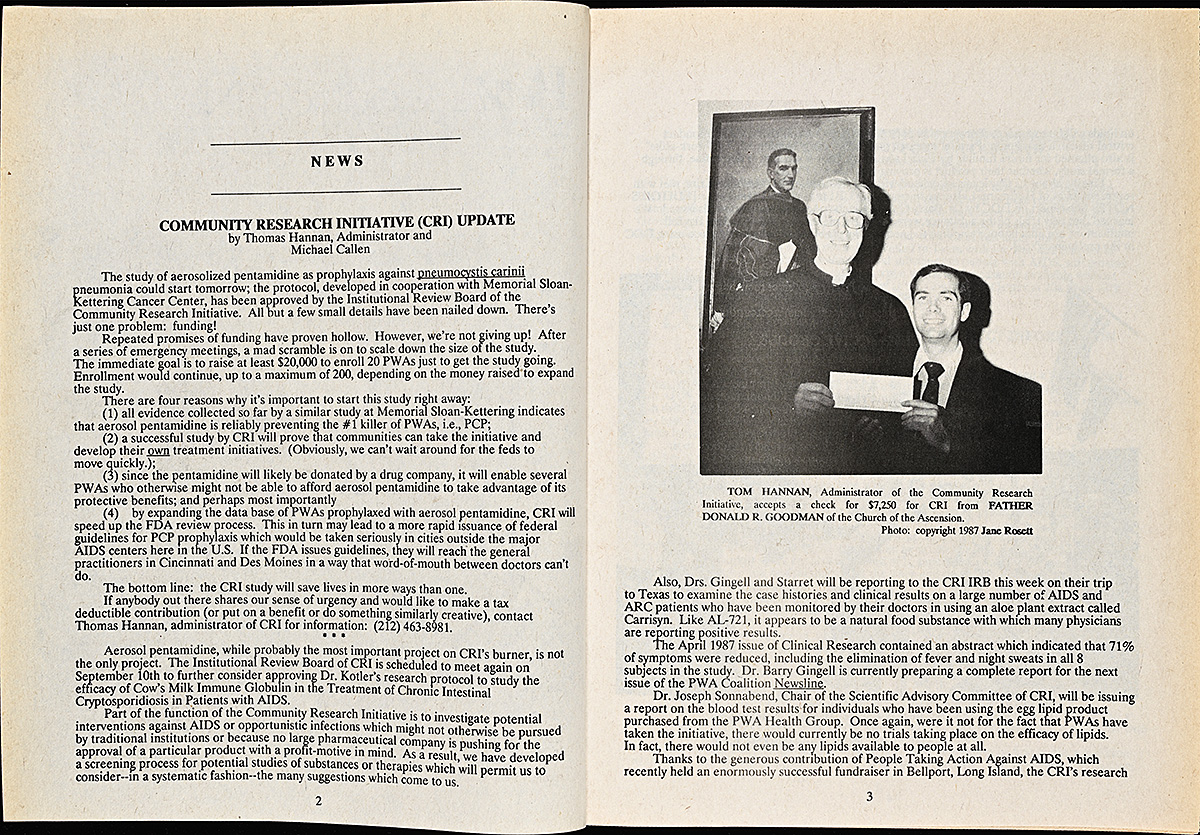
An open book showing a picture of two white men in suits with book text.

PWA Coalition Newsline, 1987

Private Collection, NYC

  • Launched by and for people with AIDS, PWA Coalition Newsline was a monthly publication that prioritized peer leadership, radical transparency, and practical survival strategies. Circulating nationally through AIDS service organizations, clinics, and activist networks, it offered community-generated updates on clinical trials, treatment options, and political organizing—often months before mainstream outlets covered them.
  • This issue features an update on the Community Research Initiative (CRI), a New York-based group committed to democratizing access to experimental treatments like aerosolized pentamidine (used to treat immunocompromised individuals with the lung infection PCP). The article outlines the barriers to drug access and the need for community-led studies, highlighting how Newsline has connected readers to urgent, actionable information.
  • With the motto “Nothing about us without us,” Newsline embodied a vision of health justice and activism in which people with AIDS were the experts, organizers, and narrators of their own lives.

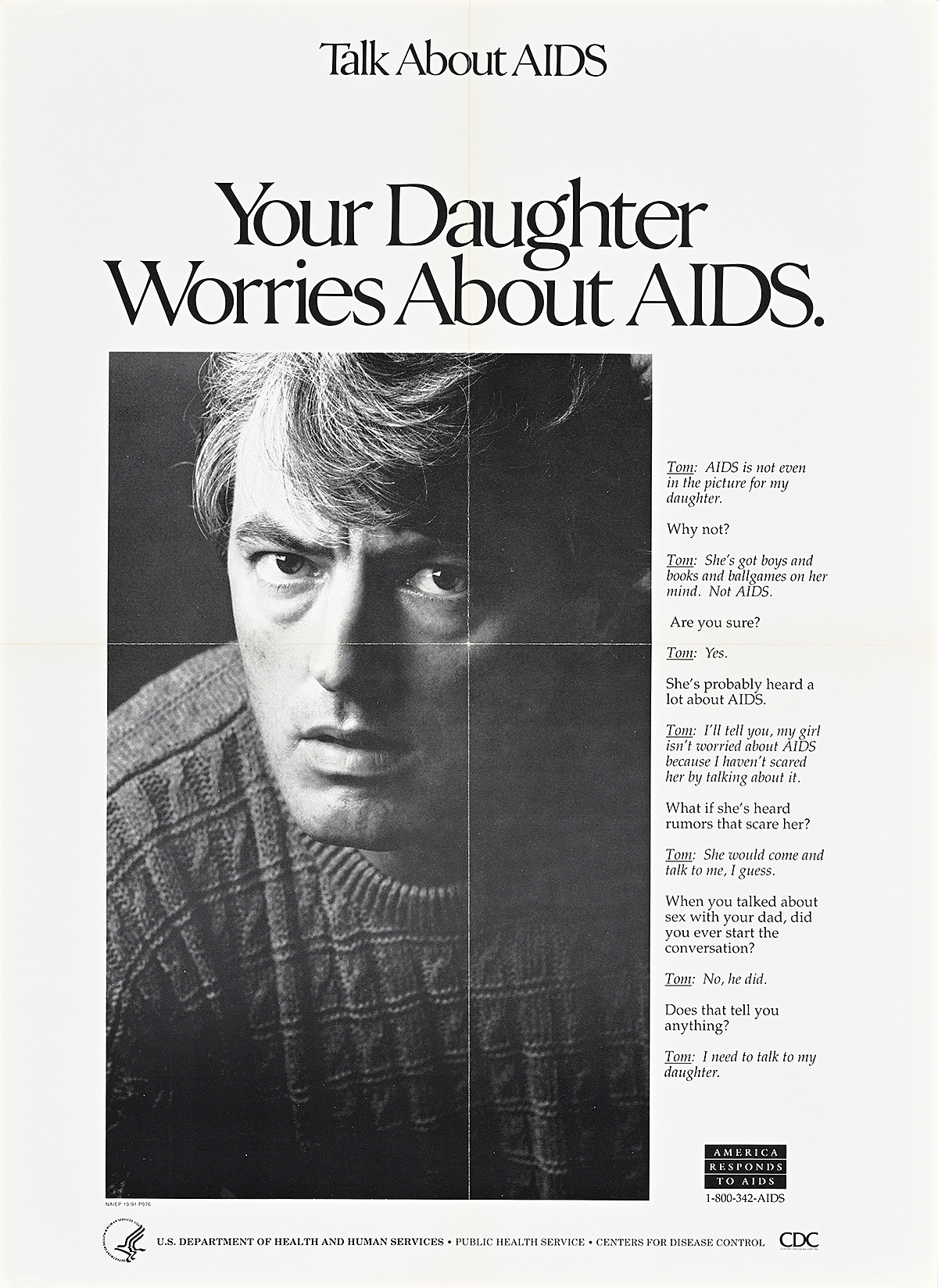
A poster of a concerned white man in black and white looking at the camera.

Your Daughter Worries About AIDS, 1991

Designer Unknown

Poster House Permanent Collection

  • This poster was part of Talk About AIDS, a campaign launched under the Center for Disease Control’s national initiative America Responds to AIDS (ARTA). Introduced in 1987, ARTA marked the federal government’s first coordinated attempt to educate the general public about HIV/AIDS.
  • Framed around family and emotional intimacy, Talk About AIDS targeted heterosexual, middle-class Americans—especially white men—with indirect appeals to responsibility, echoing the messaging common in the drug education campaigns of organizations like D.A.R.E. (Drug Abuse Resistance Education) in the 1980s and ’90s. Such materials were widely distributed in schools and community centers, contributing to the fact that a generation of children—particularly in suburban and rural areas—grew up with a distorted understanding of the risk that HIV actually posed to them.
  • Critics, especially from activist groups like ACT UP and People With Aids Coalition (PWAC), condemned the campaign’s euphemistic tone and its focus on mainstream audiences at the expense of  those at highest risk, most especially gay men, sex workers, and people who used drugs. While it expanded the public conversation about AIDS, campaigns like this one simultaneously diluted the urgency of the situation and misdirected the public’s understanding of HIV/AIDS risks. This poster embodies a national strategy that chose political palatability over truth-telling.

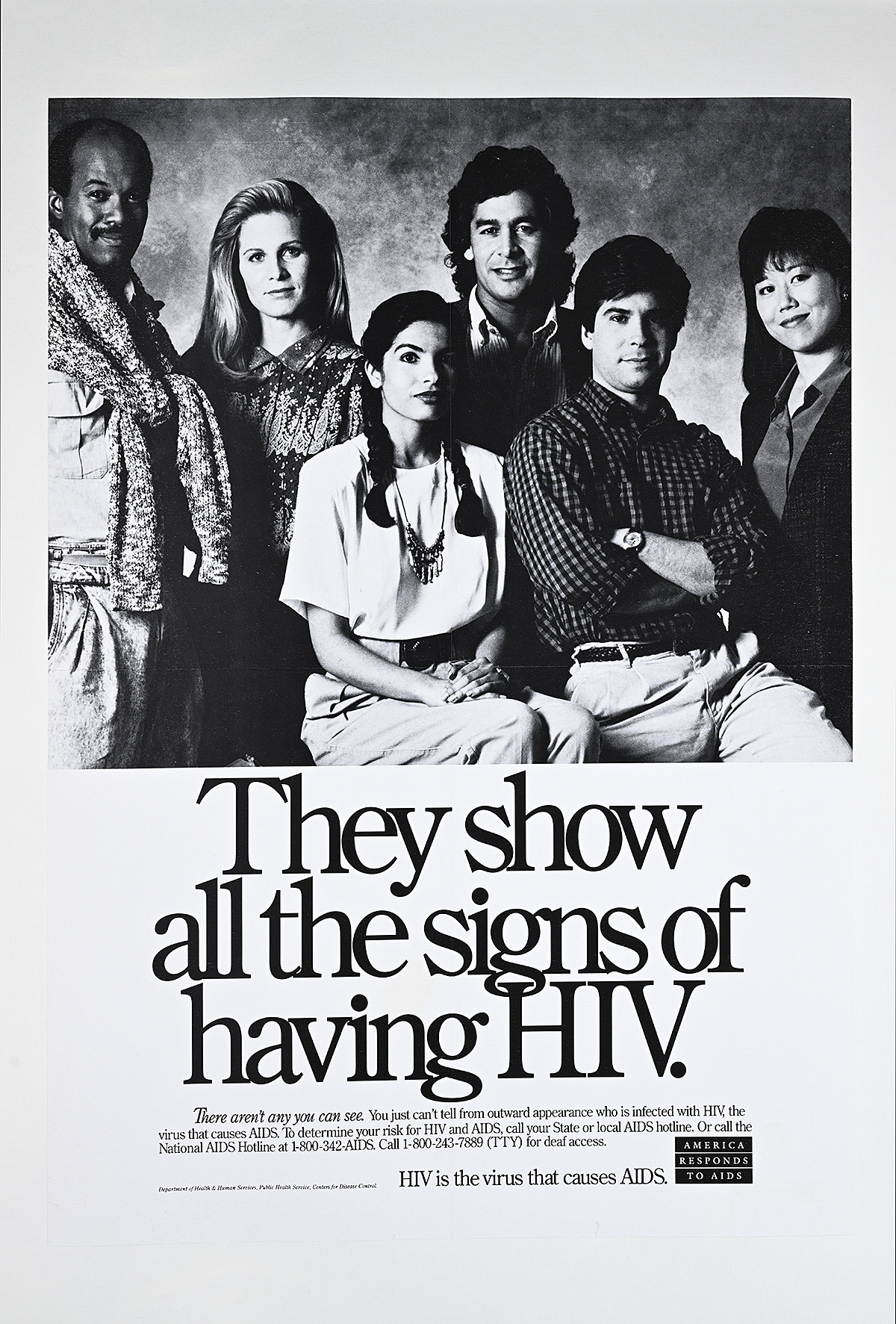
A poster of a group of people looking directly at the camera printed in black and white.

They Show All the Signs of Having HIV, 1991

Designer Unknown

Poster House Permanent Collection

  • Also issued by America Responds to AIDS (ARTA), this poster challenges the idea that HIV has a “look.” Its message is direct: anyone can have HIV, and assumptions based on race, gender, or appearance are both inaccurate and dangerous. This campaign marked a shift in federal messaging; it now began to prioritize education and inclusion over fear.
  • This updated tone came with its own contradictions, displaying diversity without context. While aiming to reduce stigma, the campaign still avoided naming the communities most impacted by the epidemic. Posters like this one circulated in public transit and clinics across the country but rarely addressed gay sex, harm-reduction strategies, or the structural inequalities that drove infection rates. It also failed to reflect the lived realities of those most affected, most especially Black, Latino, and Asian members of the gay community and those who had sexual or drug practices that put them at high risk for HIV infection.
  • Activists criticized the federal approach of the early 1990s as too little, too late. Compared to community-generated materials that focused on empowerment, posters like this one were aimed at a mass audience and presented information in a way that conservative viewers would find relatively inoffensive. By choosing not to talk directly to the most impacted communities, they flattened the story of AIDS, helping to normalize the disease in public discourse but often failing to reach those who needed the message most.

A poster of an illustrated white man and woman embracing in bed.

You Can’t Live on Hope, 1989 

Sandra Shap (Dates Unknown) 

Poster House Permanent Collection

  • In the mid-1980s, well after community groups like GMHC had launched grassroots public health efforts, the New York City Department of Health began issuing AIDS-related posters. City campaigns initially focused on heterosexual couples, reflecting political discomfort with addressing gay sexuality in public spaces. Posters like this were displayed in clinics, subways, and neighborhood centers, printed in both English and Spanish. This poster also bears the seal of New York City mayor Ed Koch, whose homosexual identity was never publicly acknowledged during his lifetime, adding layers of controversy to his administration’s slow response to the crisis.
  • While little is known about the designer, she visually references Pop Art in her composition, specifically the work of Roy Lichtenstein, who often paired comicbook-style or pulp imagery with anxious or cheeky comments in thought bubbles. Here, the couple is paralyzed by the unspoken concern: What if one of us has AIDS? The headline—“You Can’t Live on Hope”—is less an invitation than a warning, reflecting the city’s early reliance on fear-based appeals to shift sexual behavior.
  • While the poster’s cautionary tone contrasts with sex-positive messaging from community groups, it points to a larger story of uneasy collaboration. Organizations like GMHC often advised city officials, shared data, and offered cultural insight, but their calls for more inclusive and affirming public messaging were frequently ignored. These partnerships, which began tentatively in the mid-1980s, deepened over time but remained fraught. While some officials welcomed the expertise of grassroots groups, political caution and moral discomfort often limited the extent of their input in official campaigns. The result was a fractured public health landscape: grassroots innovation from below, cautious intervention from above, and posters like this one caught in the middle.

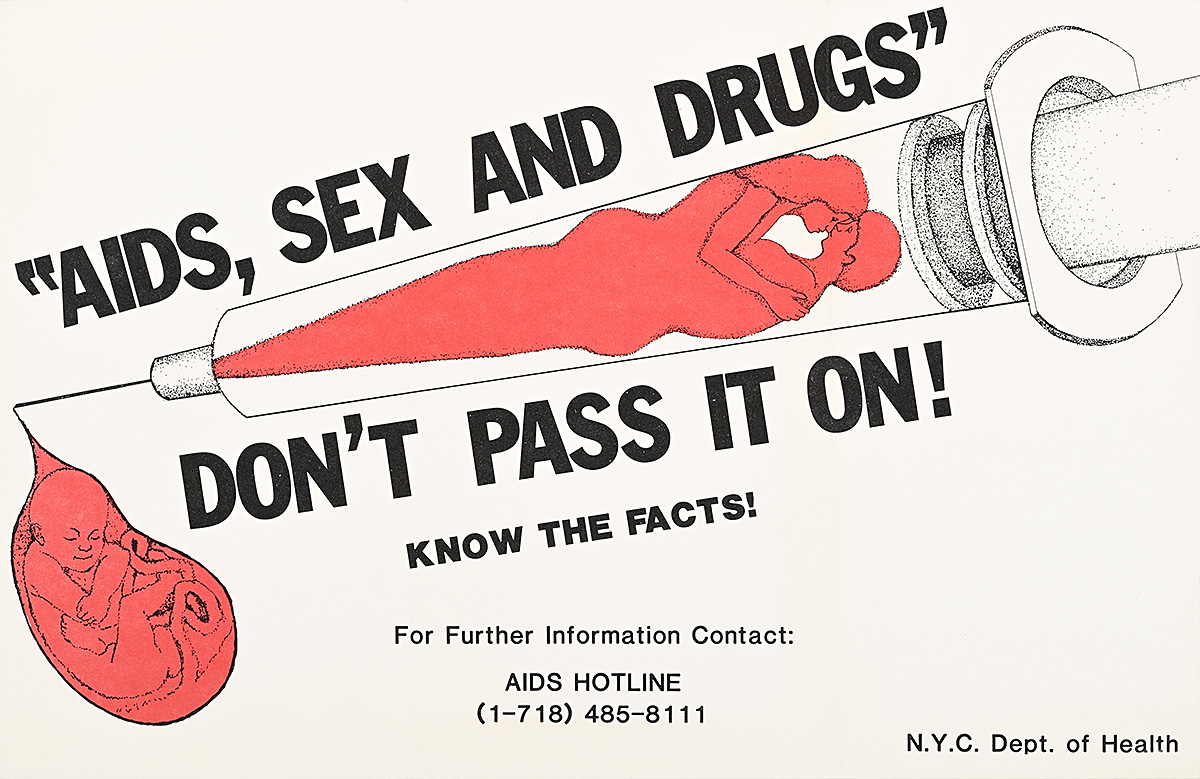
A poster of a syringe with blood inside in the shape of a couple embracing and a blood drop coming out of the syringe.

AIDS, Sex and Drugs, c. 1990

Designer Unknown  

Poster House Permanent Collection

  •  Produced by the New York City Department of Health, this poster marks a shift in public health strategy as the city sought to address the broader epidemic of HIV transmission through intravenous drug use among heterosexual couples. It features a syringe filled with a red couple made out of blood producing a fetus, framing AIDS primarily as a danger to families and unborn children. The slogan “Don’t Pass It On” further links drug use, sex, and reproductive risk through the visual language of contamination and blame.
  • Graphically stark and emotionally charged, the poster reflects a moment when the politics of AIDS messaging was heavily shaped by public fears around “innocent victims,” most especially babies and heterosexual women. The impact of the epidemic on communities beyond white, gay men was critical from the beginning, particularly among gay men of color; however, this was poorly represented in early government and community responses. 
  • While AIDS had never been confined to any one group, this poster reveals how stigma determined which lives were deemed relatable or worth saving. Its focus on heterosexual drug users illustrates the policy priorities of the time: expanding public awareness, but often at the cost of erasing or marginalizing those who had long been living with, and organizing against, the epidemic.

New York Fights Back

When government and public health institutions failed to address AIDS with urgency, activists refused to be silent. In New York City, people living with AIDS and their allies launched an insurgency, demanding attention and justice. With wheatpaste and fury, they plastered city walls in posters that turned grief into action, silence into speech, and fear into power.

Advocacy groups like ACT UP and artists’ collectives such as Gran Fury transformed the visual language of protest in the AIDS era. Drawn from guerrilla graphics, punk zines, and commercial advertising, their work was designed for impact and often named the institutions they held responsible, from the FDA and the CDC to the Catholic Church. These designs framed the epidemic as a political failure as much as one of public health. Posters were accessible and reproducible, intended for mass distribution in streets, subways, and media coverage. Rather than seek institutional approval, activists paired visual messages with direct action—die-ins, disruptions, and public interventions that forced the epidemic into public view.

This section examines how visual protest functioned as a survival strategy. These posters did not just inform; they intervened. In a media-saturated city, activist design operated as confrontation and documentation, making visible those who were otherwise ignored or erased.

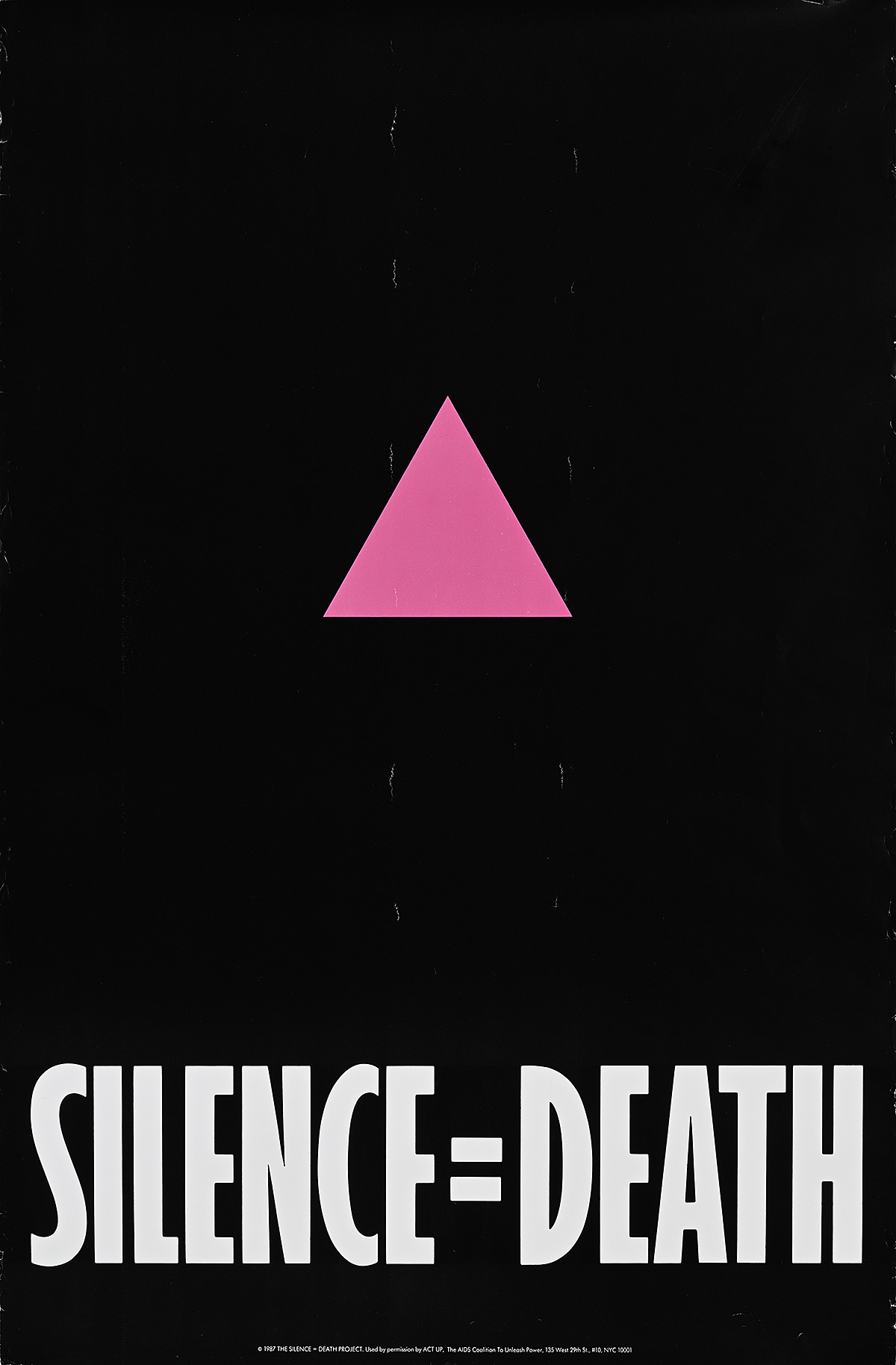
A poster of a small pink triangle on a black background with white text that reads silence equals death.

SILENCE=DEATH, 1987

Silence=Death Project: Avram Finkelstein (b. 1952), Brian Howard (Dates Unknown), Oliver Johnston (1952–90), Charles Kreloff (Dates Unknown), and Chris Lione (Dates Unknown)

Gift of Mirko Ilić, Poster House Permanent Collection

  • The pink triangle, originally used by the Nazis to identify gay prisoners in concentration camps, has been reclaimed in this poster as a weapon of resistance. Produced by a political collective of six gay men, who established the Silence=Death Project, it was intended to be wheatpasted across the city. Its visual minimalism was not just an aesthetic strategy, however, but also a political one. The bold contrast of pink and white on a black ground and the spare geometry of this composition make its message legible from a distance, commanding attention in crowded urban spaces and serving as a call to arms.
  • Designed in December 1986 before ACT UP was founded, SILENCE=DEATH first circulated anonymously on the streets of New York in February 1987. Later printings would include fine print that called out the CDC, the FDA, the Vatican, and the Reagan-era White House, demanding direct political action.
  • Early public reactions to the poster ranged from shock to awe, sparking discussion in the local press and gay media. Despite this, it was largely ignored by mainstream outlets. Its wide-scale visibility, especially in downtown Manhattan, nonetheless forced conversations among those previously untouched by AIDS activism.
  • Within weeks of this poster’s first appearance, ACT UP was founded by writer and activist Larry Kramer and others during a community meeting at the Lesbian and Gay Community Services Center in March 1987. From that point forward, posters like this one were at the frontline of resistance. 
  • Over the following years, this image was reprinted multiple times and continued to appear in protests and public spaces well into the 1990s—not just in New York but also in other U.S. cities and abroad. Its longevity and adaptability helped solidify it as the most iconic visual symbol of AIDS-era activism.

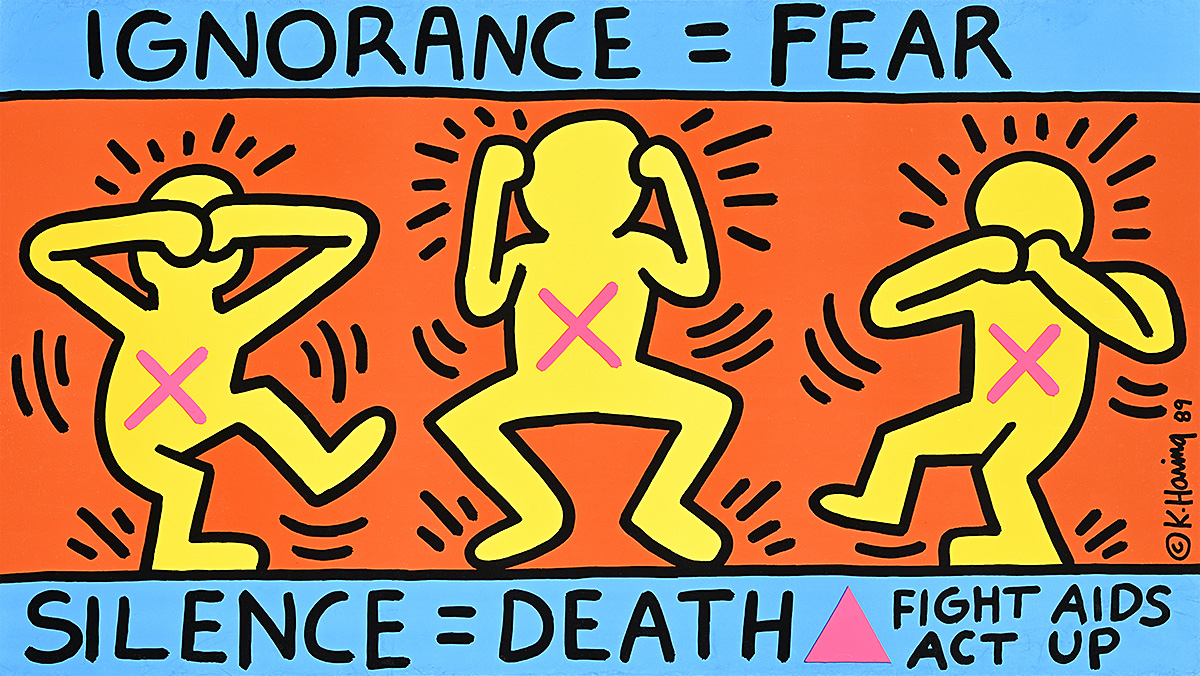
A poster of three yellow cartoon figures with a pink x on their torsos on an orange background.

Ignorance = Fear/Silence = Death, 1989

Keith Haring (1958–90)

Poster House Permanent Collection

  • Created in collaboration with ACT UP, this poster by Keith Haring uses his emblematic cartoon figures and declarative text to recall the already famous SILENCE=DEATH poster, updating it with new motifs while still including the pink triangle and the key phrase. Recalling comic-book imagery, the three yellow figures—miming the expression “see no evil, hear no evil, speak no evil”—represent denial and censorship.
  • Haring’s visual style—bold outlines, a limited range of colors, and kinetic forms—is instantly accessible. Paired with slogans in all caps, the composition merges street art with activist urgency, translating complex issues of government inaction, media silence, and public fear into a graphic demand for attention and accountability. The image appeared widely at ACT UP protests, on placards, and in community spaces.
  • Despite being just months from his death in early 1990, Haring remained directly involved in AIDS activism, continuing to produce and donate artwork like this poster for campaigns, fundraisers, and protests. 
  • In 1989, Haring established the Keith Haring Foundation to manage his estate and ensure his work continued to serve charitable causes, especially HIV/AIDS education and support. He assigned full rights to his name and artwork to the foundation, which oversees all licensing and directs proceeds to nonprofits aligned with his priorities. The foundation’s structure and mission reflect Haring’s explicit intent that his body of work should remain an instrument of activism not commercial exploitation.

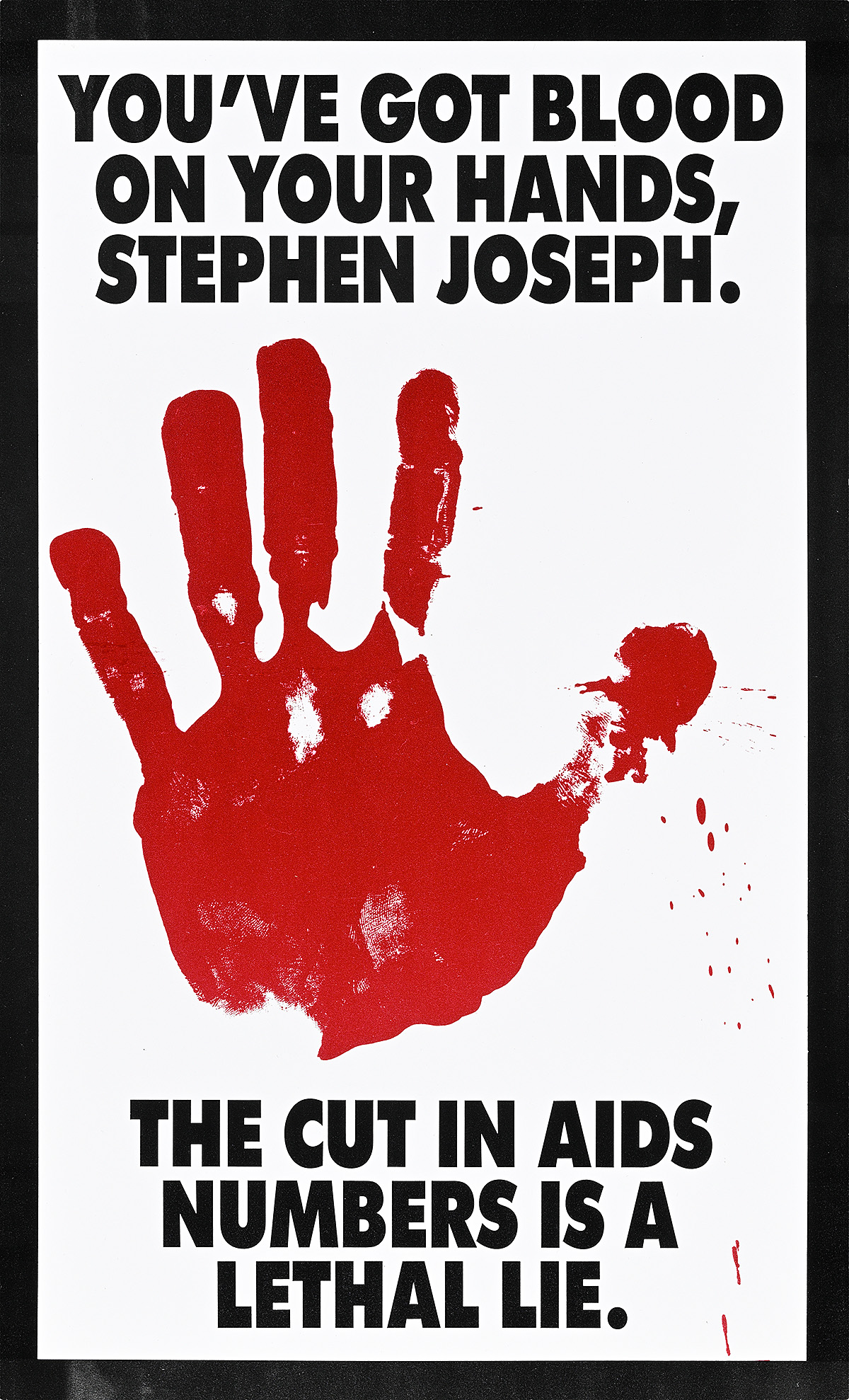
A poster of a red handprint on a white background with black text.

You’ve Got Blood On Your Hands, Stephen Joseph, 1988

Gran Fury

Courtesy of the Avram Finkelstein Archive

  • Formed in 1988 by members of ACT UP, Gran Fury functioned as one of the group’s unofficial artists’ collectives. Where ACT UP organized direct actions, Gran Fury built visual campaigns, harnessing the aesthetics of commercial advertising and political propaganda to create powerful signs of protest. Its works were often anonymous, collaborative, and meant for mass public circulation. One of Gran Fury’s most visible early interventions was a protest installation in the windows of the New Museum in 1989, where they arranged Catholic symbols alongside blood vials and political slogans, directly confronting church doctrine and linking it to state violence and death.
  • This poster targets Dr. Stephen C. Joseph, New York City’s Commissioner of Health from 1986 to 1990. During his tenure, Joseph controversially lowered the city’s estimated number of people with HIV/AIDS from more than 200,000 to approximately 50,000. Activists accused him of using revised epidemiological models to downplay the crisis and reduce public health spending. Although Joseph argued that the lower figures were based on improved data, ACT UP charged that the reclassification simply served political ends and directly undermined the city’s AIDS response.
  • Issued in July 1988, this design was part of a coordinated campaign called “Blood on Their Hands” in which Gran Fury and ACT UP members wheatpasted the posters across New York and marked city surfaces with blood-red handprints. It exemplifies a strategy of public accountability through visual protest—using design to name officials and hold them responsible for policy decisions with life-and-death consequences.

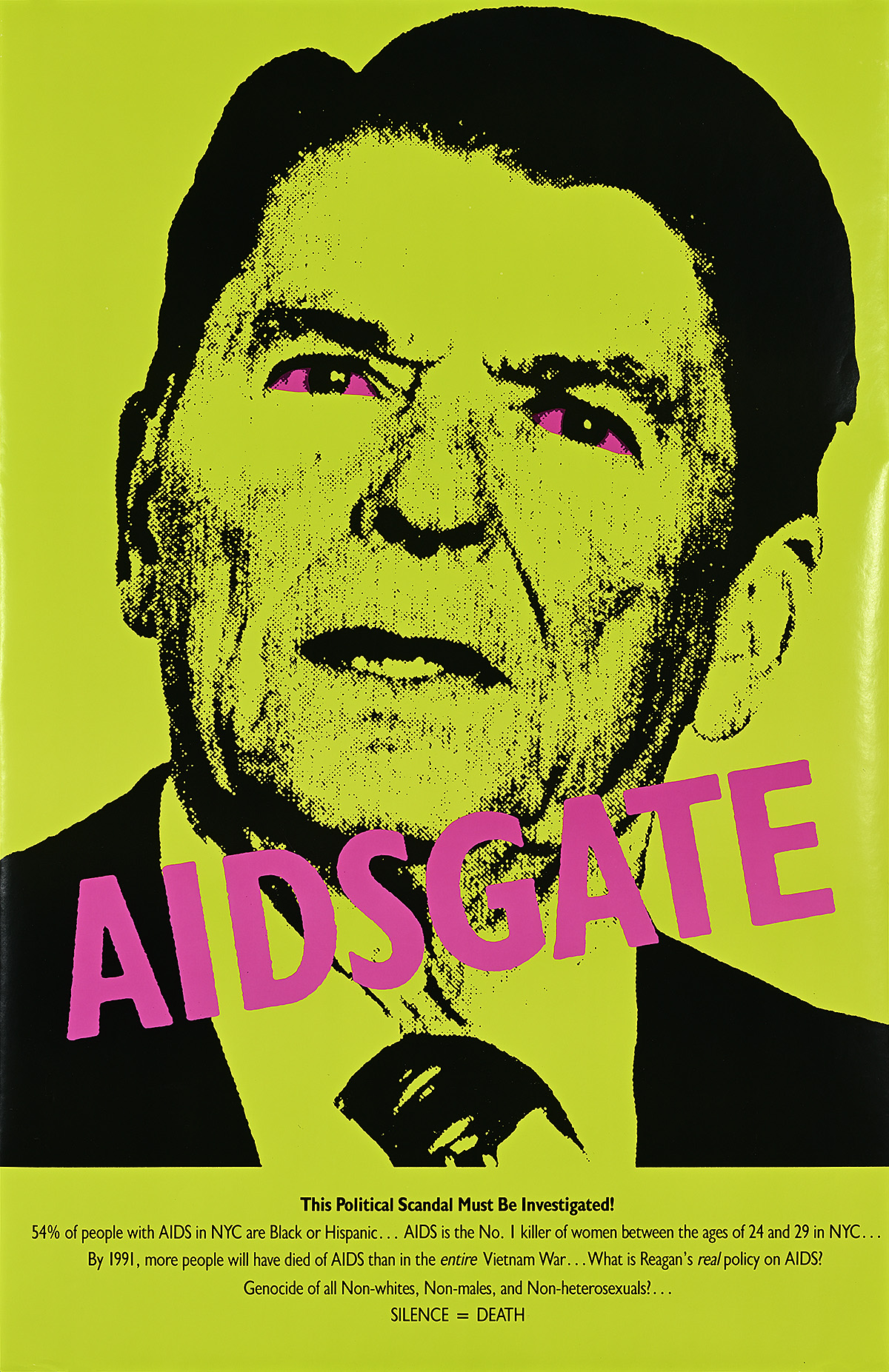
A poster of a white man's face printed on a green background with pink text overlaid which reads Aidsgate.

AIDSGATE, 1987

Silence=Death Project: Avram Finkelstein (b. 1952), Brian Howard (Dates Unknown), Oliver Johnston (1952–90), Charles Kreloff (Dates Unknown), and Chris Lione (Dates Unknown)

Poster House Permanent Collection

  • This second poster printed by the Silence=Death Project was created for the June 1987 ACT UP demonstration during the Third International AIDS Conference in Washington, DC. It was among the earliest posters to publicly name President Reagan as responsible for the federal government’s delayed and inadequate response to the epidemic (while the first American cases of AIDS were documented as early as 1981, Reagan would not publicly acknowledge the situation until four years later). 
  • AIDSGATE deliberately borrows the terminology of the Watergate scandal of the previous decade, reframing government inaction as not just neglectful but also as a form of political malfeasance that merits investigation and public accountability. As noted in other posters of the period, the death toll of the Vietnam War was often cited as lower than that of AIDS, an important marker of the scale and scope of the virus.
  • The fine print at the bottom of this poster expands the frame of the epidemic beyond gay white men and notes the disproportionate levels of AIDS mortality among Black, Latino, and female New Yorkers while confronting dominant media narratives and public health priorities as well as the social dynamics of the disease at the time.
  • The activist community immediately recognized the power of this image and disseminated it widely at subsequent rallies, protests, and public actions. Reproduced in multiple sizes, it appeared on the streets, was carried at demonstrations, and was turned into T-shirts and buttons.

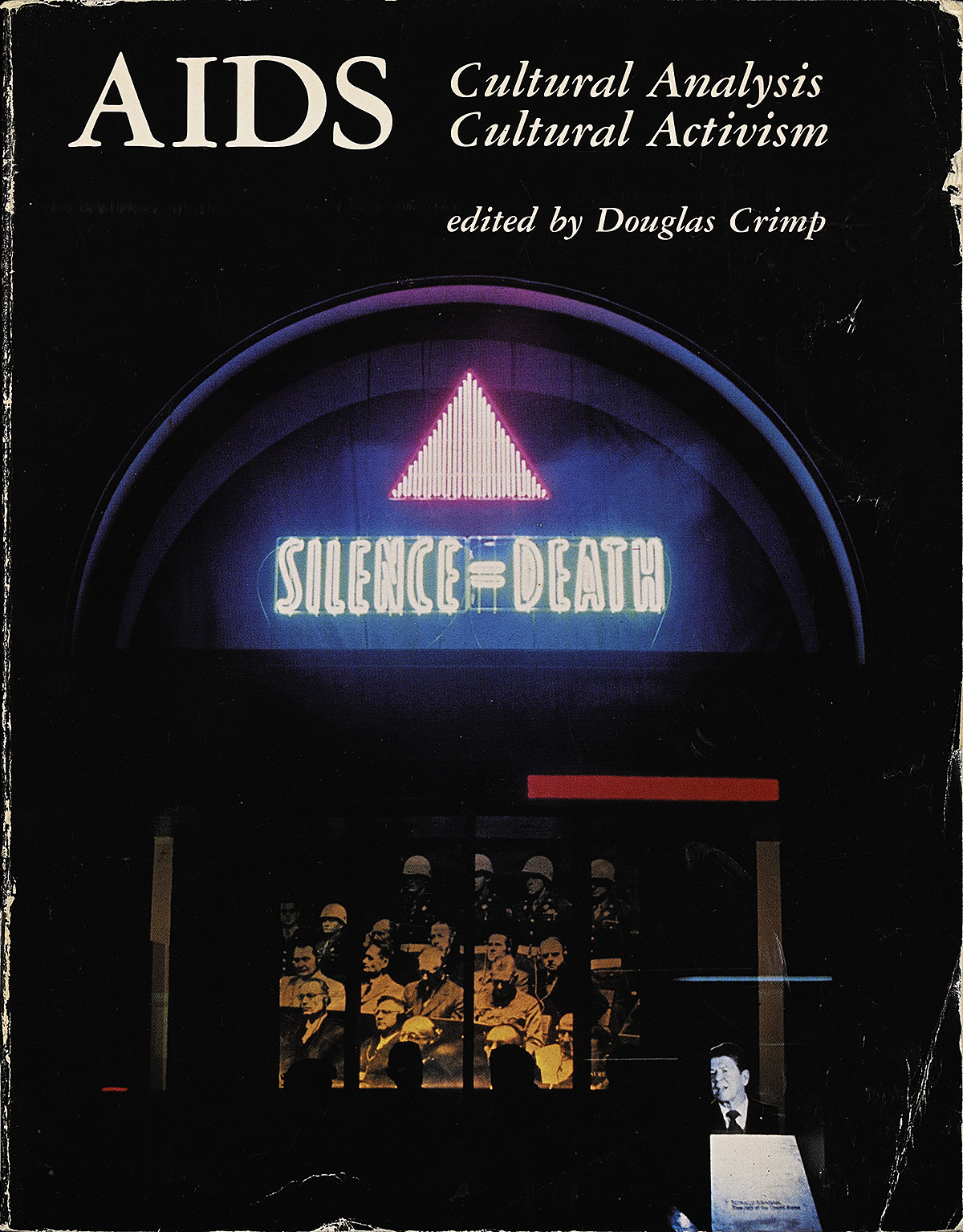
A book cover showing a photograph of a window with a neon sign with a pink triangle.

AIDS: Cultural Analysis/Cultural Activism, 1988

Edited by Douglas Crimp (1944–2019)

Private Collection, NYC

  • Initially published as a special issue of October, an academic arts and culture journal printed by the Massachusetts Institute of Technology (MIT), at a time when AIDS was widely misunderstood and misrepresented, this anthology brought together scholars, artists, and activists to argue that AIDS was not just a biomedical crisis but a battle over meaning, symbols, and representation.
  • Later published as a book by MIT Press, the collection of essays became a foundational text for AIDS activism, offering a framework linking art, theory, and protest that emphasized the need for critical analysis alongside direct action. The authors helped define “cultural activism” as a form of resistance that could contest dominant narratives and reclaim public spaces.
  • This book reflected a growing alliance between academic theory and activist practice, while also revealing the limitations of such an approach. The publication legitimized AIDS as a subject of cultural critique but some activists questioned whether scholarly discourse could keep pace with the urgency of the crisis—or adequately represent those most affected. As with so much of the activist response, the relationship between theory and practice was contested within the group, with some arguing that the rarefied air of academia undermined the work of the organization and was not the place to address the material issues raised by the epidemic.

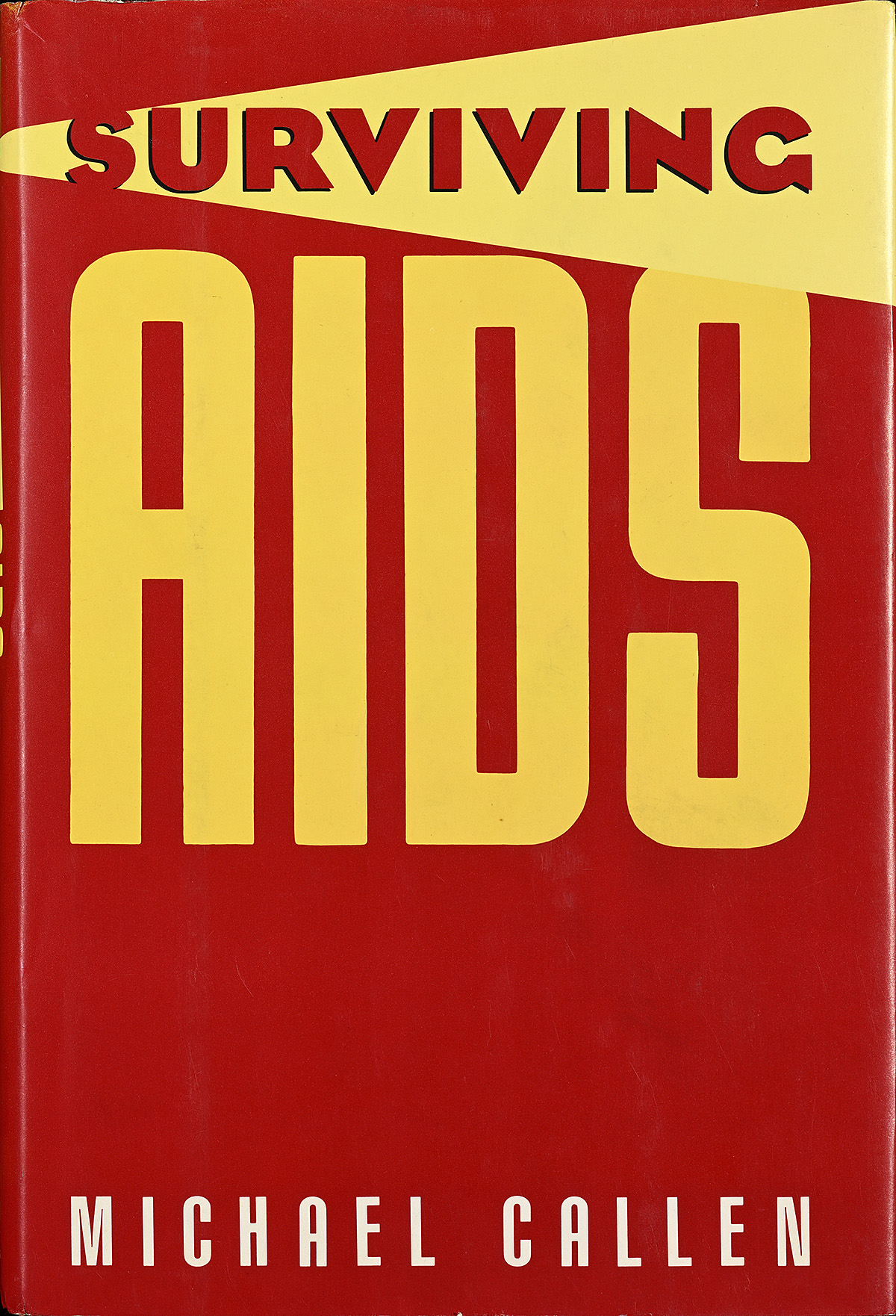
A book cover with yellow text on a red background that reads surviving AIDS.

Surviving AIDS, 1990

Author: Michael Callen (1955–93) 

Private Collection, NYC

  • In Surviving AIDS, activist and singer Michael Callen reframed life with AIDS as an ongoing project of resistance. Published in 1990, the book argued that people with AIDS were not doomed patients but active survivors capable of building care networks, embracing unorthodox treatments, and redefining what it meant to live with the virus.
  • Drawing on his own experiences, Callen championed treatments outside the clinical mainstream, including aerosolized pentamidine for PCP prevention and IVIG (intravenous immune globulin) for chronic intestinal cryptosporidiosis—both infections often contracted by those with AIDS. He also supported community-based clinical trials through organizations like the Community Research Initiative (CRI), rejecting the slow, exclusionary protocols of pharmaceutical companies and the National Institutes of Health. This stance brought praise from grassroots activists but also provoked backlash—some felt his faith in survival romanticized suffering or ignored structural barriers to care, while others challenged the scientific basis for his preferred treatments.
  • While Callen’s book was polarizing, it offered a model of AIDS activism that was neither resigned nor abstract, but grounded in the messy, urgent work of living. Surviving AIDS radically declared that to live with AIDS was not only possible but also political.
  • Surviving AIDS was published by HarperCollins, one of the largest trade presses in the United States, and was widely available in bookstores and libraries—a rare achievement at the time for a book by and about a person living with AIDS. Callen’s essays also reached broad audiences through publications like Newsweek, the Village Voice, New York Native, and Gay Community News, extending his influence beyond activist circles into mainstream public discourse. His work helped bring the language of survival into the national conversation.

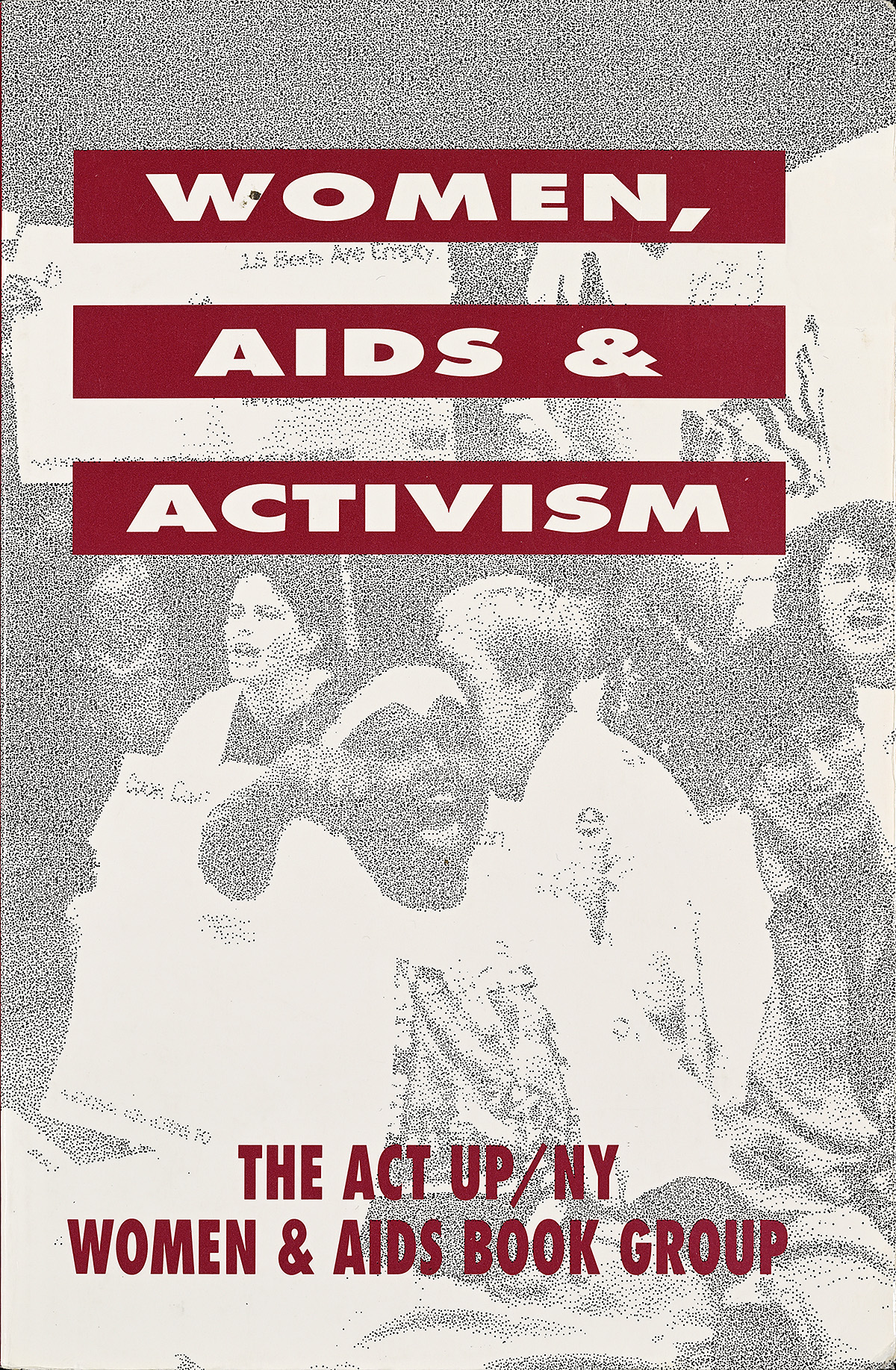
A book cover with a black and white photograph of Black and white women at a protest.

Women, AIDS & Activism, 1990

The ACT UP/NY Women and AIDS Book Group

Private Collection, NYC

  • Women played a central role within ACT UP, expanding the movement’s focus beyond white gay men to include issues like reproductive rights, intravenous drug use, incarceration, and gender bias in clinical research. Through caucuses, working groups, and independent publishing efforts like this book, they challenged sexism within the movement while shaping national debates about care, access, and representation. 
  • One of ACT UP’s most widely circulated posters included the phrase “Women don’t get AIDS, they just die from it.” Used in protests and printed materials, it drew attention to the CDC’s narrow definition of AIDS, which excluded infections common in women and effectively barred them from receiving diagnoses, benefits, and treatment. The slogan became a rallying cry for activists demanding gender equity in research, treatment, and policy, and ultimately led to the 1993 expansion of the CDC’s definition to include women-specific manifestations of AIDS.
  • Written by members of the multiracial feminist collective ACT UP/NY Women and AIDS Book Group, Women, AIDS & Activism chronicled the work of women in ACT UP and women’s AIDS activism more generally. 
  • One particularly potent essay addresses the fact that women were systematically excluded from drug trials in the early era of HIV/AIDS, reflecting broader gender biases in clinical research. It was only in the face of persistent activism by the ACT UP Women’s Caucus and public pressure that policy ultimately shifted. Landmark changes like the 1993 National Institutes of Health Revitalization Act finally mandated the inclusion of women and minorities in clinical studies.

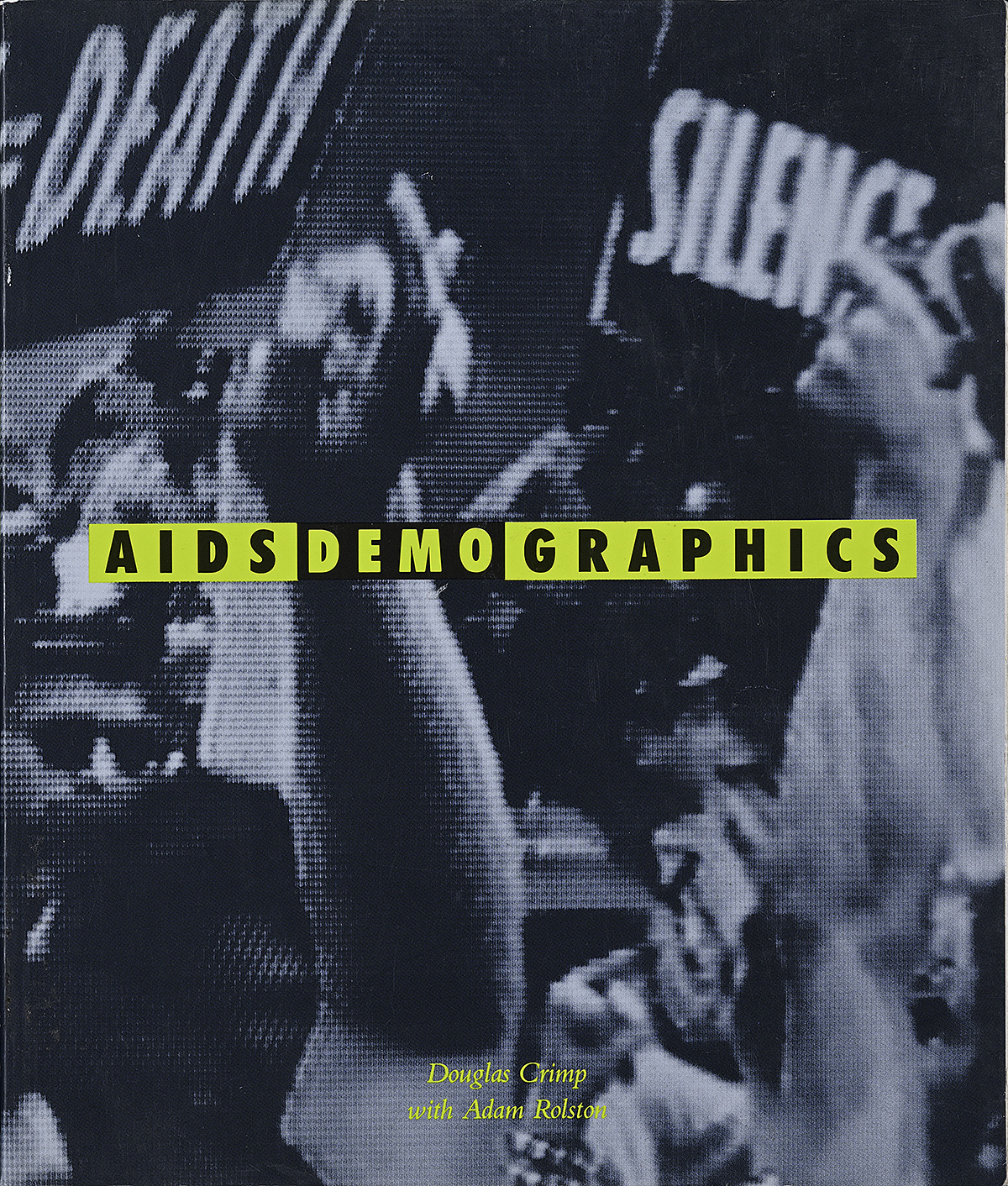
A book cover showing a group of men at a protest holding signs in the air.

AIDS Demo Graphics, 1990

Douglas Crimp (1944–2019) & Adam Rolston (b. 1962)

Private Collection, NYC

  • This collaborative publication between critic and activist Douglas Crimp and graphic designer Adam Rolston documents the visual language of AIDS activism in New York, particularly the work of ACT UP and Gran Fury. It analyzes how protest graphics used advertising aesthetics to subvert mainstream narratives and demand action, as well as how AIDS activists reclaimed public space through imagery to challenge power, honor the dead, and fight for the living.
  • Published by Bay Press, AIDS Demo Graphics was a widely circulated paperback aimed at both activists and scholars. It was distributed through independent bookstores, activist networks, and academic circles, reflecting the growing demand for documentation and analysis of AIDS visual culture. Its accessibility and low cost made it usable as a teaching and organizing tool, not just as a catalog or an art book.
  • The book combines photographic documentation of protests with reproductions of posters, stickers, and street graphics alongside essays and commentary that contextualize their creation and deployment. While rooted in activist practice, it offers critical analysis of visual strategy, making it one of the earliest efforts to theorize AIDS graphics as a form of political communication. Some critics noted the challenge of translating ephemeral action into static form, but many found it a valuable resource for understanding how design and direct action intersected in the movement. It remains a critical early archive of ACT UP’s work.

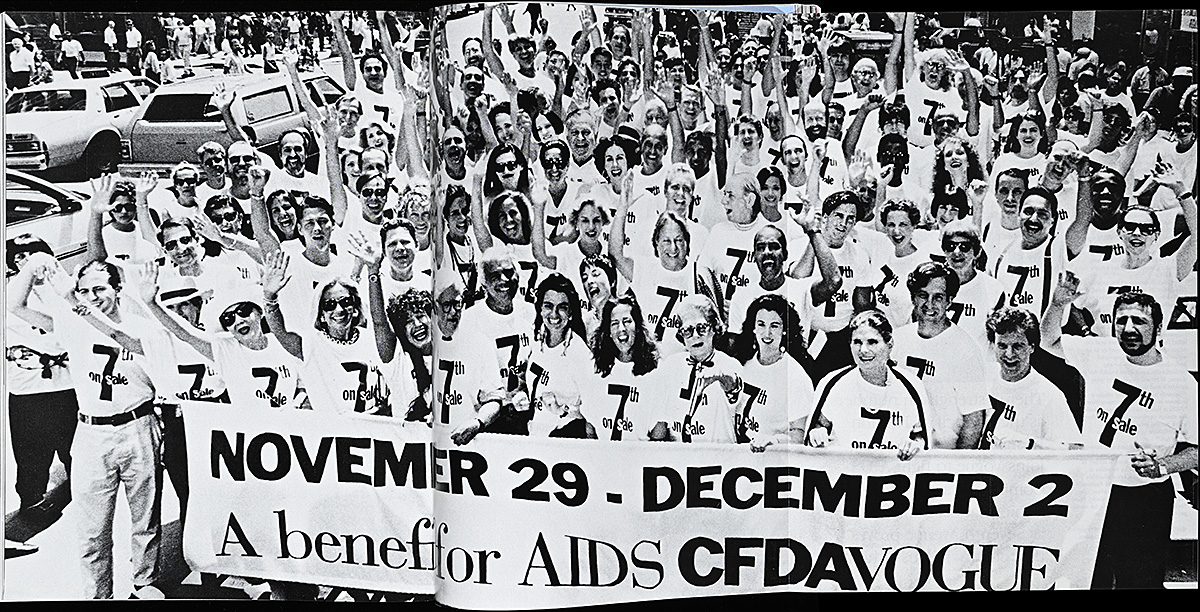
An open magazine showing a black and white photograph of a crowd at a protest.

Vogue, 1990

Photographer: Patrick Demarchelier (1943–2022)

Private Collection, NYC

  • On November 29, 1990, New York’s fashion industry mounted a landmark response to the AIDS crisis: 7th (Seventh) on Sale, a four-day designer sale at the 69th Regiment Armory in downtown Manhattan that opened with a star-studded benefit reception. Organized by the Council of Fashion Designers of America (CFDA) in partnership with Vogue, the event raised more than $4 million (approximately $10.5 million today) for the New York City AIDS Fund. It was the largest fashion fundraiser for AIDS to date—and a transformative moment within an industry reeling from unimaginable loss.
  • Established in 1989 by the New York Community Trust, the New York City AIDS Fund was a collaborative initiative meant to address the HIV/AIDS crisis. It was part of a broader effort by the trust to support programs responding to the epidemic, including the first grant for HIV research from a private institution in 1983. The fund, which operated until 2014, worked with the United Way of New York City to distribute grants and support various initiatives aimed at prevention, treatment access, and research related to HIV/AIDS.
  • The article in this issue of Vogue announced this ambitious project to the magazine’s large, nationwide audience. Hundreds of designers donated merchandise, celebrities volunteered at checkout tables, and shoppers flooded the Armory. Anna Wintour, the magazine’s editor-in-chief, who helped spearhead 7th (Seventh) on Sale, has since been credited with raising more than $10 million (nearly $26 million today) for AIDS-related programs.
  • The CFDA and Vogue organized 7th (Seventh) on Sale every few years until the 2008 financial crisis, but since then they have frequently raised money at their other events for organizations responding to AIDS.

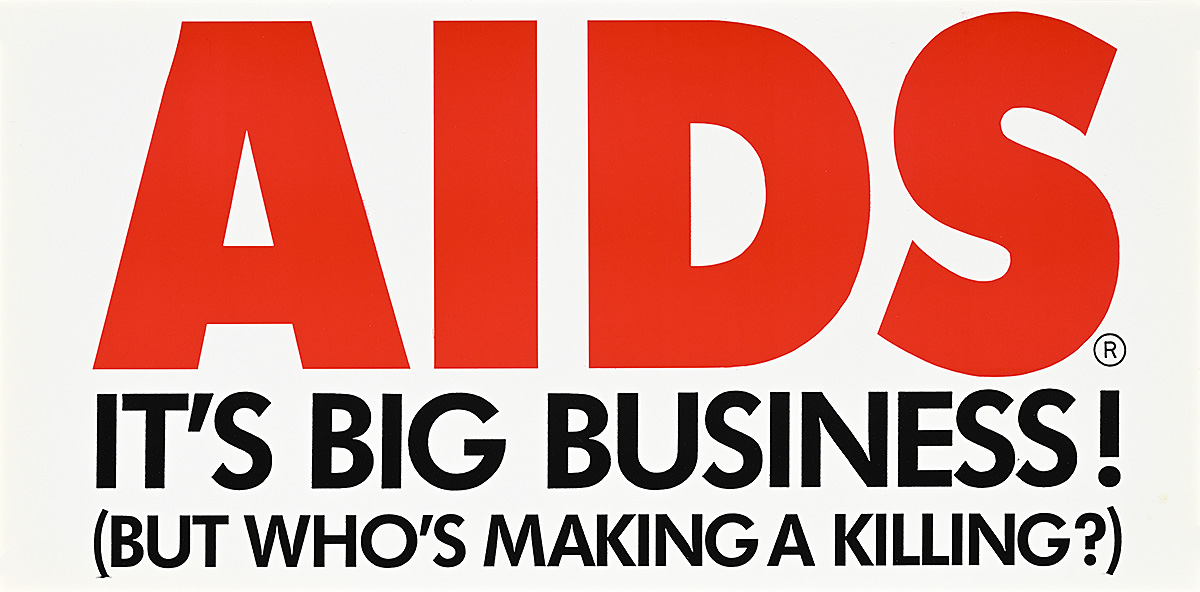
A poster of bold red text spelling AIDS with black text on a white background.

AIDS/It’s Big Business!, 1989

Richard Deagle (b. 1952)

Poster House Permanent Collection

  • This poster is both a visual parody and a political indictment. By mimicking corporate branding and attaching the trademark symbol after the word “AIDS,” it accuses pharmaceutical companies and the federal government of turning mass death into a money-making opportunity. 
  • As ACT UP gained momentum, its focus expanded beyond symbolic protest to economic justice. This poster emerged during its campaign against pharmaceutical profiteering, particularly the pricing of AZT (the first pharmaceutical treatment for HIV/AIDS that showed clinical benefit) by Burroughs Wellcome, which cost $10,000 per year (approximately $28,000 today). While AZT offered some therapeutic hope, activists decried the lack of access, the design of the drug trial that excluded early-stage patients, and the government’s slow approval process for other potentially life-saving drugs that treated the myriad infections to which those with AIDS were vulnerable. 
  • This poster stems from ACT UP’s drug-access agenda, demanding affordable medications, faster drug approvals, and the inclusion of people with AIDS in every stage of decision-making. It reflects a foundational insight of the community AIDS response—that AIDS was not only a public health crisis but also a crisis of capitalism, bureaucracy, and political will. Profit, they argued, was being prioritized over people. In contrast to the soft messaging of city and federal agencies, this was capitalism called to account.

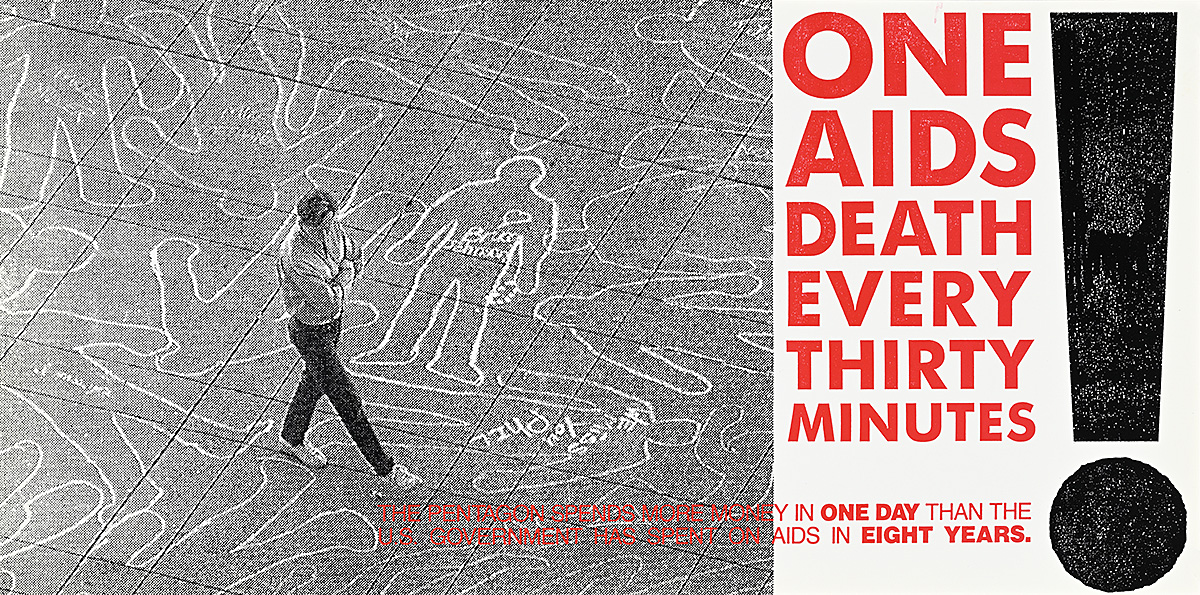
A poster of a white man walking over a sidewalk covered in chalk outlines of bodies.

One AIDS Death Every Thirty Minutes, c. 1988

Richard Deagle (b. 1952)

Poster House Permanent Collection

  • By 1988, AIDS-related deaths in the United States were averaging one every thirty minutes. That year alone, nearly 16,000 people died, yet federal investment in research, treatment, and prevention remained grossly inadequate. Under the Reagan administration, AIDS was treated as a political liability, not a national emergency.
  • Before this poster was issued, ACT UP’s catchphrase had been “One AIDS death every 13 minutes.” Here, that phrase has been updated to “thirty minutes” (still a shocking and horrible statistic) to take into account the evolving CDC data on mortality rates for those with AIDS. It also reflects ACT UP’s attention to accuracy and detail.
  • On October 11, 1988, ACT UP organized a large-scale protest at the FDA’s headquarters in Rockville, Maryland, to demand faster drug-approval processes and expanded access to experimental AIDS treatments. The action was a response to what activists saw as institutional delays that contributed to preventable deaths. With more than 1,000 participants, it combined civil disobedience with policy critique, drawing national media attention. The protest helped pressure the FDA to adopt new mechanisms, including accelerated approval and parallel track trials, and marked a shift in how government agencies engaged with people living with AIDS and community activists. This poster, along with the two others by the same designer, were used widely to underscore the human costs of inaction and the ways in which big business and government negligence contributed to this extreme human toll.

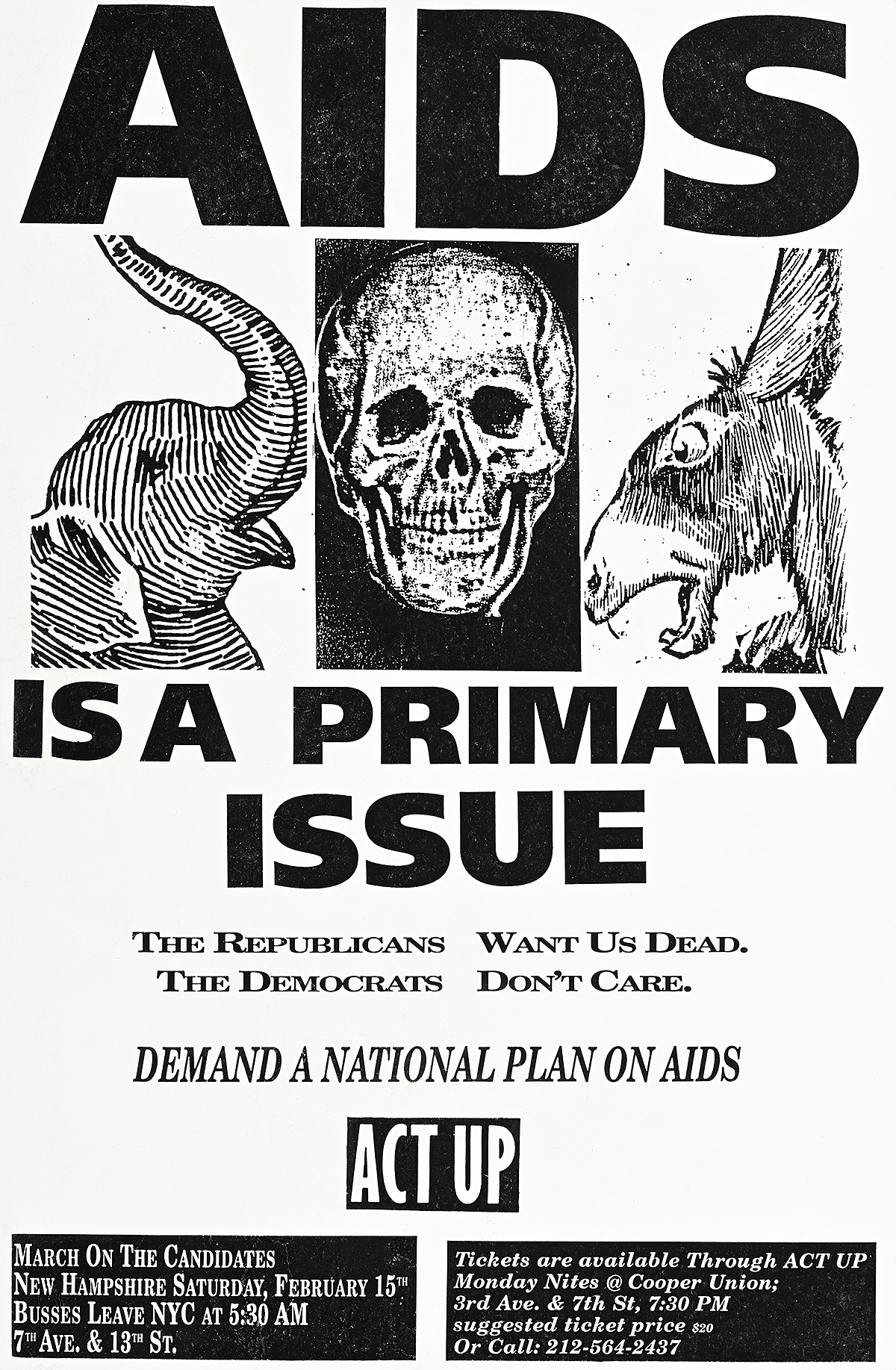
A poster of an illustrated elephant and donkey head looking at a human skull with black text reading AIDS is a primary issue.

AIDS Is A Primary Issue, 1992 

ACT UP 

Poster House Permanent Collection

  • As New Hampshire prepared to host the first of the 1992 presidential primaries, ACT UP organized a major protest there to challenge the silence surrounding AIDS. This poster was created as part of that “March on the Candidates” and was posted throughout New York City to mobilize activists to travel north. 
  • The poster uses zine-style, grainy photomontage of a skull set between the woodcut-like illustrations of an elephant and a donkey—the symbols of the Republican and Democratic parties—to criticize both sides for their inaction during the AIDS crisis.
  • The campaign was one of several interventions by ACT UP during the election cycle. On January 23, 1991, the Day of Desperation involved coordinated protests across New York City, among them a “die-in” on the floor of Grand Central Terminal under banners reading “Money for AIDS, Not For War” and “One AIDS Death Every Eight Minutes.”  The evening before, AIDS activists jumped on air during the CBS Evening News as well as on the MacNeill/Lehrer News Hour, proclaiming “Fight AIDS, not Arabs; AIDS is news!” These actions aimed to establish that the AIDS crisis demanded attention at the highest levels. Pressure on then-candidate Bill Clinton led by Michael Petrelis, a member of ACT UP’s Treatment and Data Committee, resulted in 16 AIDS-specific policy promises from his campaign.
  • Cooper Union’s Great Hall served as a critical organizing space for ACT UP during this campaign and throughout its activities of the late 1980s and early 1990s. The venue had been a gathering place for many of the social movements of the modern era, including those advocating for women’s suffrage and civil rights. ACT UP saw itself as being part of this history. In the Great Hall, students and activists prepared posters, held meetings, and coordinated buses to New Hampshire—demonstrating how New York’s cultural and intellectual infrastructure continued to support national activism.

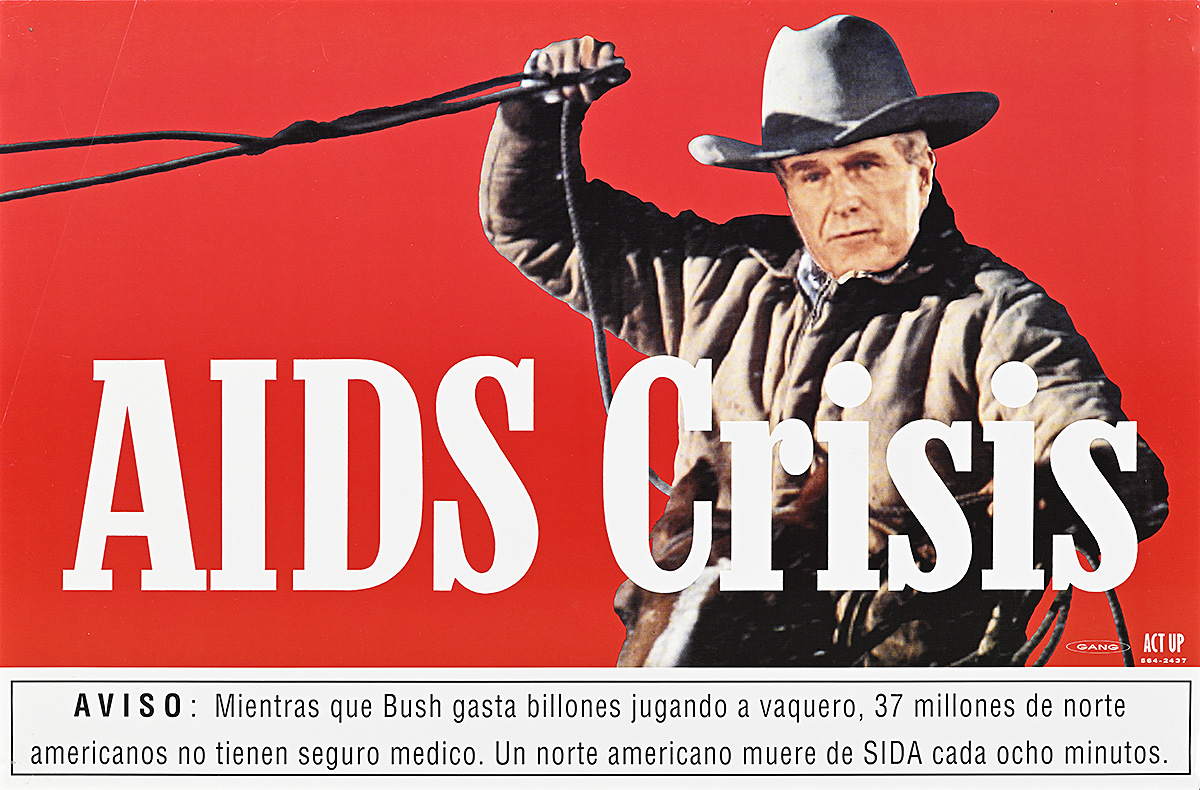
A poster of George W. Bush dressed as a cowboy on a horse with white text that reads AIDS crisis.

AIDS Crisis, 1990 

ACT UP/Gang 

Poster House Permanent Collection

  • This poster takes aim at the contradiction between the traditional, macho American self-image and the reality of the AIDS crisis. By hijacking the Marlboro Man—a symbol of rugged individualism—the composition challenges the myth of national strength in the face of widespread government negligence. A layer of irony was added by the growing recognition of the public health threat posed by cigarettes, positioning President H. W. Bush as the public health threat in the context of AIDS.
  • Released shortly after Bush’s first year in office (after he had served as vice president under Reagan), this poster voiced ACT UP’s frustration with a president who offered rhetorical support but no meaningful funding. 
  • In 1990, Bush signed the Ryan White CARE Act that provided federal funding for medical care, support services, and treatment for people living with HIV/AIDS, particularly those without insurance. The legislation marked a major shift in federal AIDS policy by prioritizing access to care for low-income and marginalized populations and it remains one of the largest sources of HIV/AIDS funding in the United States today. Despite this landmark legislation, Bush’s government approved only one-third of the requested budget for the program.
  • Ryan White was a teenager from Indiana who contracted HIV through a blood transfusion. He became a national symbol of the epidemic after his expulsion from school drew widespread media attention. He died in 1990.
  • Unlike federal campaigns such as America Responds to AIDS that focused on palatable slogans and broad appeal, this poster explains that AIDS is political and that its death toll is the result of conscious inaction. Posters like this one were produced by activist organizations that named the institutions and individuals they held responsible, used appropriation and irony to subvert dominant cultural symbols, and prioritized political clarity over consensus-building.

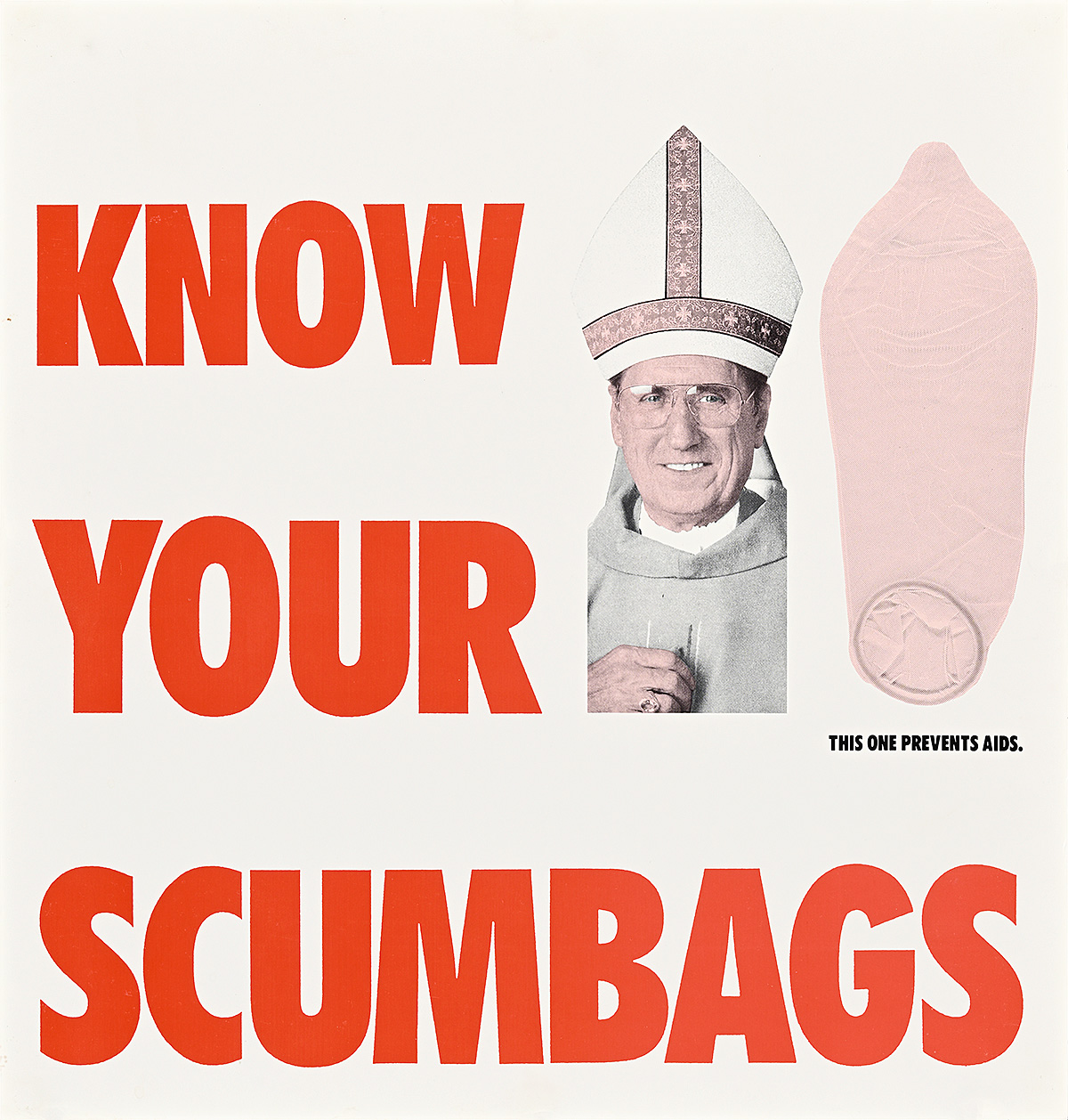
A poster with a photo of a white man in an archbishop's hat next to a condom with large red text.

Know Your Scumbags, 1989

Richard Deagle (b. 1952) and Victor Mendolia (Dates Unknown)

Poster House Permanent Collection

  • During the AIDS crisis, the Catholic Church—particularly under New York’s Cardinal John O’Connor—vocally opposed condom use, abortion, and gay rights. O’Connor condemned safer-sex education in schools and blocked condom distribution in city hospitals, aligning with policies that, activists argued, directly endangered lives. 
  • This ACT UP poster condemns the Catholic Church’s opposition to condoms during the AIDS crisis. Its title plays on the double meaning of “scumbag”—both a slang term for a condom and an insult—underscoring the activists’ refusal to champion politeness over survival.
  • Held on December 10, 1989, at St. Patrick’s Cathedral in New York City, Stop the Church was a major ACT UP protest that targeted the Catholic Church’s opposition to condom use, abortion rights, and gay rights during the AIDS crisis. More than 4,500 protesters participated and more than 100 were arrested, including activists who disrupted the mass to draw attention to church policies they insisted were contributing to preventable AIDS deaths. 
  • This action marked a turning point in ACT UP’s visibility and ability to create public controversy, generating national media coverage and backlash. It also exposed internal tensions within the movement around strategy, religious respect, and the use of disruption in sacred spaces. Despite criticism, the protest succeeded in reframing debates over religious influence on public health policy and underscored the urgent stakes of AIDS activism in the face of institutional power. In the weeks that followed, attendance at ACT UP meetings surged as the protest attracted new members galvanized by its boldness and visibility.

A poster of a white man's face printed on a black background with bold red text.

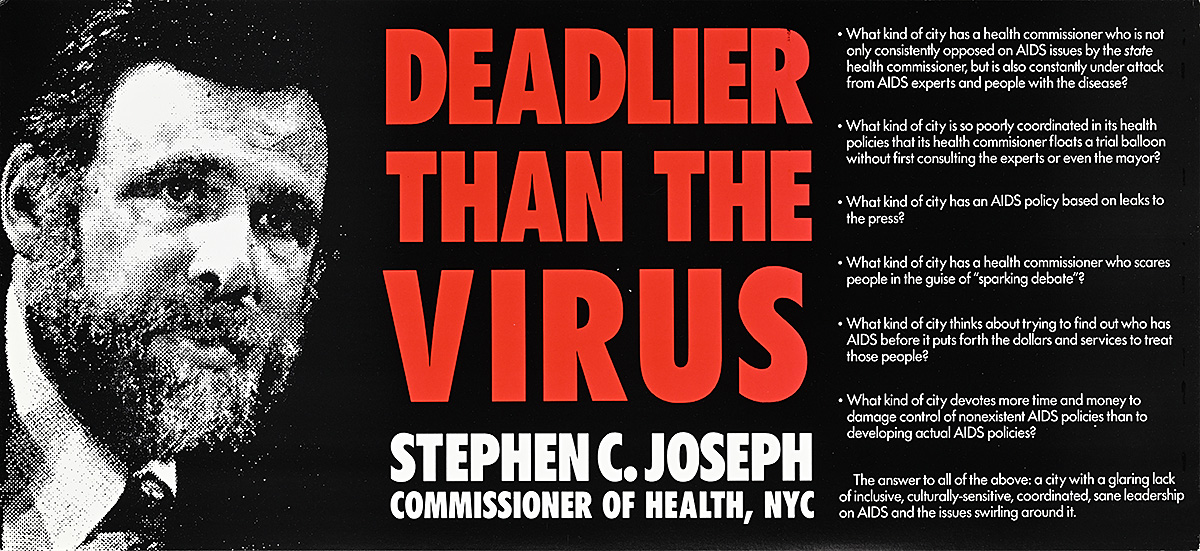
Deadlier Than The Virus, 1988

Richard Deagle (b. 1952)

Poster House Permanent Collection

  • This ACT UP poster further indicts New York City’s AIDS response under Health Commissioner Dr. Stephen C. Joseph. Created during Gran Fury’s “Blood on Their Hands” campaign that infiltrated the walls, subways, and outdoor public spaces of Lower Manhattan, it reflects a shift in tactics from general institutional critique to personal accountability. 
  • The rhetorical questions on the right of the poster reflect the activists’ frustrations with Joseph’s tenure, one marked by delays in implementing needle-exchange programs, hesitancy around condom distribution, and the exclusion of community organizations from policymaking. He was widely criticized for favoring bureaucratic control over the urgent need to address a public health crisis.
  • The poster’s answer below its litany of questions is scathing: New York was a city lacking “inclusive, culturally-sensitive, coordinated, sane leadership” on AIDS. More than a critique of one man, this poster condemned larger institutional failures that activists believed had cost lives.
  • Like many of ACT UP’s other visual works, this poster demanded individual accountability and reckoning, calling out not just policy gaps but also the power structures and values that allowed them to persist. In doing so, it made public health a public fight. While federal messaging warned individuals, ACT UP warned the public about power: who had it, how they used it, and who paid the price when they failed.

The Power of Design

When AIDS hit New York’s creative communities, the response was not silence; it was spectacle. Designers, musicians, theater artists, and fashion insiders transformed the very tools of their trades into lifelines. They did not just raise money, they changed what AIDS looked like and how it was seen.

In the 1980s and ’90s, cultural industries became crucial players in the AIDS response. Broadway Cares, Design Industries Foundation Fighting AIDS, the Council of Fashion Designers of America, and the Red Hot Organization mobilized celebrity, glamour, and style to raise millions for healthcare, treatment, and prevention. Their posters used the visual languages of high fashion and pop music—edgy editorial photography, glossy finishes, and sensuality—taking AIDS awareness from the raw language of protest into the mainstream. The line between entertainment and activism blurred, transforming runways, galleries, and stages into spaces of support where visibility, defiance, and memory were celebrated. 

In 1988, Visual AIDS was founded to mobilize visual culture as a platform for political engagement and public accountability. Through coordinated initiatives like Day Without Art and the Red Ribbon project, the organization established new models for collective cultural response, situating AIDS activism within the infrastructure of museums, galleries, and art institutions.

As the broader culture recognized the importance of AIDS awareness, major corporate campaigns joined the fight, occasionally going so far as to weaponize commercial design to confront the epidemic’s erasure. Displayed in subways, magazines, and record stores, these images insisted that AIDS was not just a medical crisis but also a cultural, emotional, and social phenomenon.

This section shows how design served both to mourn those who were lost and to glamorize survival. Creativity became a mode of resistance. Art, music, and fashion did more than reflect the crisis—they shaped its meaning, rallied the public, and made support contagious.

A poster of two muscular nude men embracing surrounded by orange text reading safe sex is hot sex.

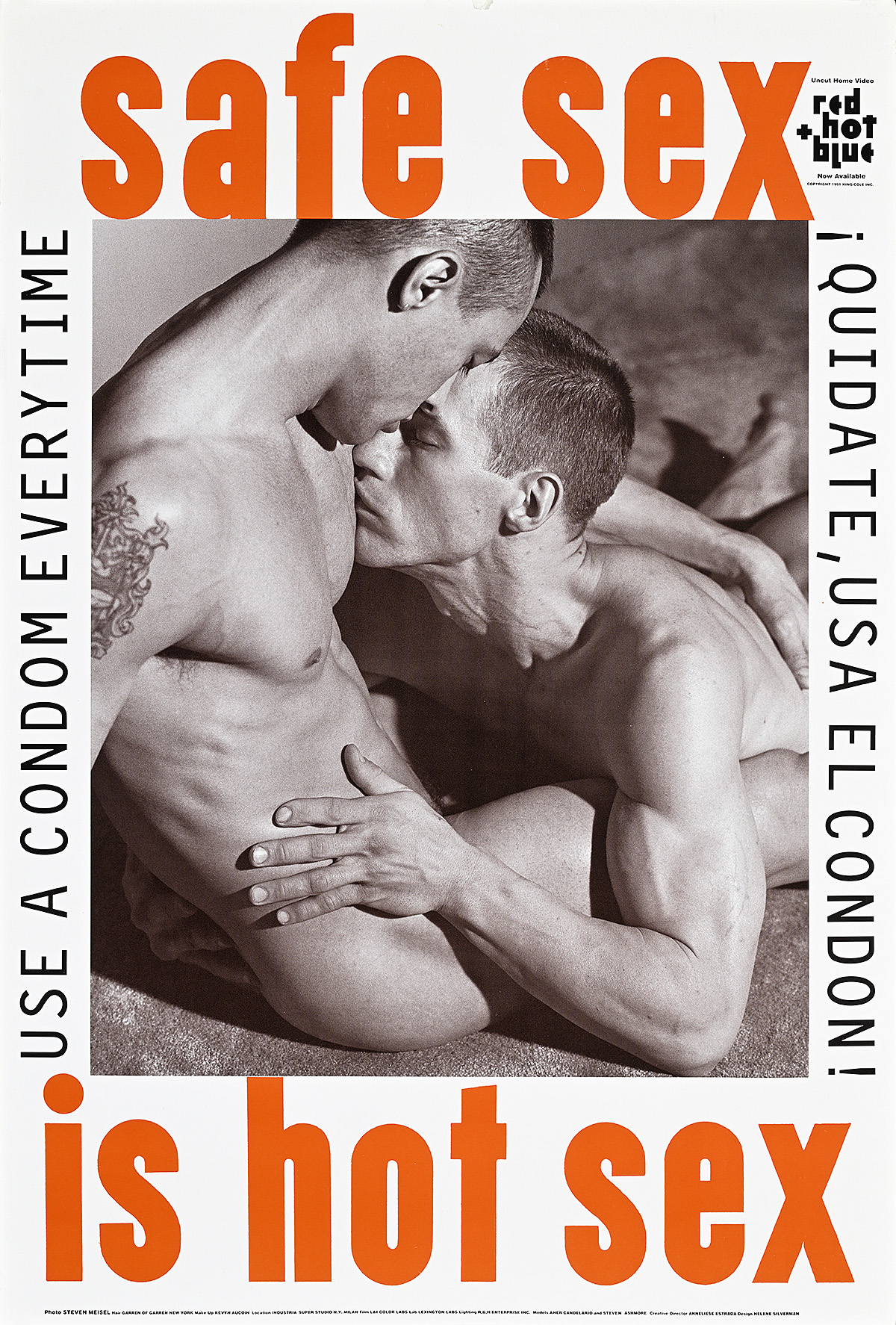
Safe Sex is Hot Sex, 1991

Photographer: Steven Meisel (b. 1954)

Poster House Permanent Collection

  • Coproduced by the Red Hot Organization and Design Industries Foundation Fighting AIDS (DIFFA), this poster presented an entirely new look within the cultural response to the virus. Featuring imagery by fashion photographer Steven Meisel (best known for his work for Vogue), the “Safe Sex is Hot Sex” poster series adapted the industry’s editorial and artistic vocabulary to promote condom use as sexy and fashionable—a striking alternative to the fear-based messaging that dominated the 1980s.
  • The Red Hot Organization was a nonprofit founded in 1989 by John Carlin and Leigh Blake to raise awareness and funds for AIDS through music, fashion, and design. Carlin began his career as a curator, professor, and art writer, and his friendship with David Wojnarowicz and other prominent contemporary artists who had or were impacted by AIDS inspired him to help. His friend Leigh Blake, who was involved in the music and film world and had been instrumental in the early punk scene, convinced David Byrne to get involved, connecting it with some of the greatest musicians and filmmakers in the world. The organization’s first major fundraising project was Red Hot + Blue, a tribute album released in September 1990, that reimagined the music of Cole Porter, the famous gay, American composer, to honor those lost to AIDS.
  • Posted across New York City subways, buses, and nightlife spaces, the poster series brought safer-sex messaging into everyday life while also targeting gay men and others at high risk of contracting AIDS.

A poster of Ronald Reagan with brown lesions on his face.

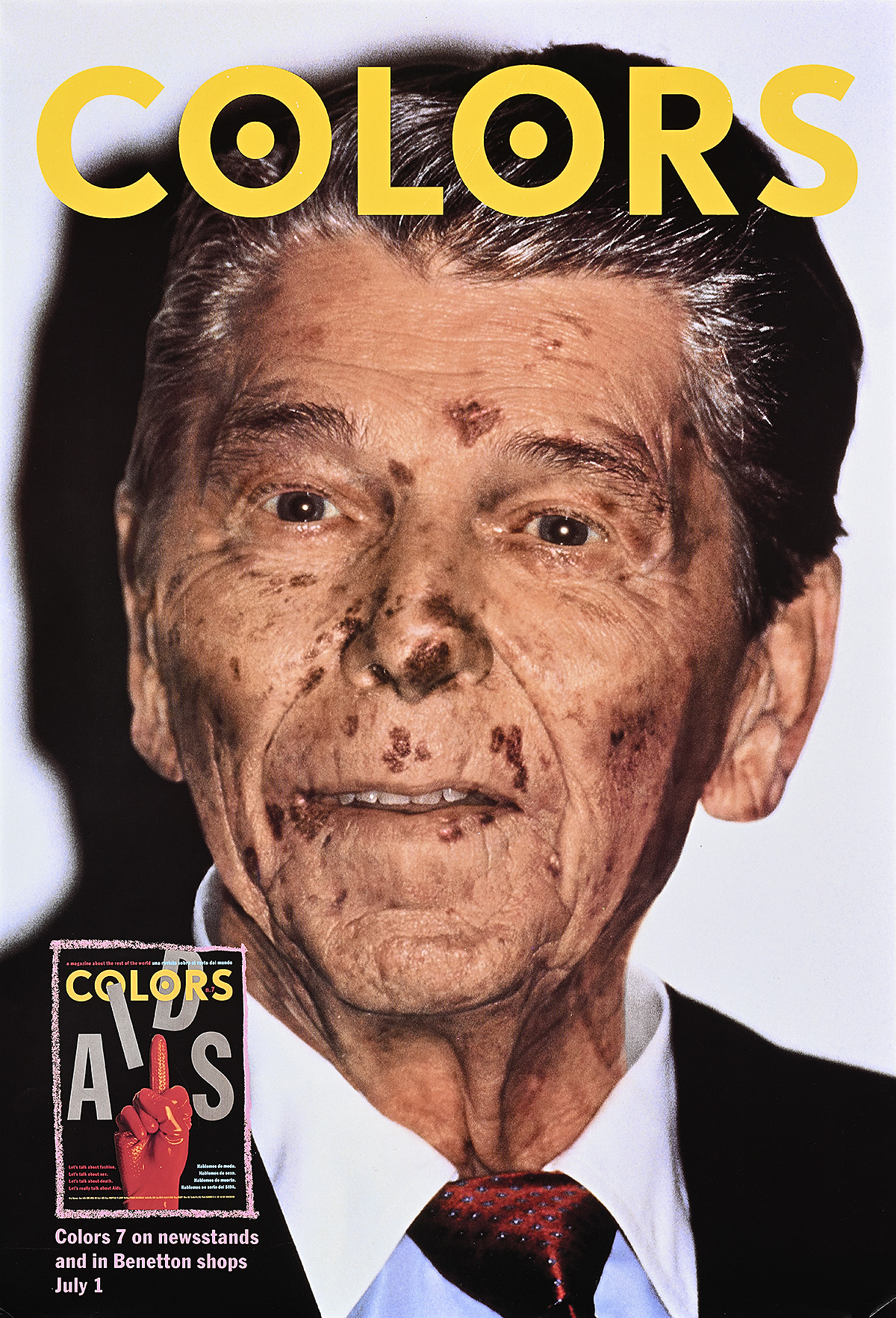
Colors, 1994 

Tony Spengler (1951–2019), Kathy Grove (b. 1948), and Mary Reilley (Dates Unknown)

Poster House Permanent Collection

  • This poster advertises the AIDS-themed issue of Colors, the global magazine launched by fashion giant Benetton in 1991. Designed at Fabrica, Benetton’s in-house communications lab, Colors was distributed in more than 40 countries and printed in multiple languages. Its mission was radical for a corporate publication: to merge youth culture, global media, and social commentary using the language of advertising to provoke public debate.
  • While Benetton’s approach was often criticized as exploitative, Colors broke with the sanitized language of public health to challenge power and politicize beauty. Its use of shock was strategic: to force viewers to see what was being ignored—race, sexuality, death, and state failure. In the context of New York’s activist poster culture, Colors stood at a strange intersection, with corporate money funding the kind of visibility ACT UP had fought for years to achieve.
  • This poster is one of the most famous designs created by Benetton during the 1990s, featuring an altered photograph of President Ronald Reagan covered in the type of skin lesions often seen on advanced-stage AIDS victims. As Reagan was frequently criticized for ignoring the AIDS crisis, such a composition was an irreverent and pointed image that marked the former president with the disease he had failed to meaningfully address. The lower-left corner shows a logo with a red hand flipping off AIDS and the president’s inaction.

A magazine showing a group of men and women wearing all black standing in a cluster looking at the viewer.

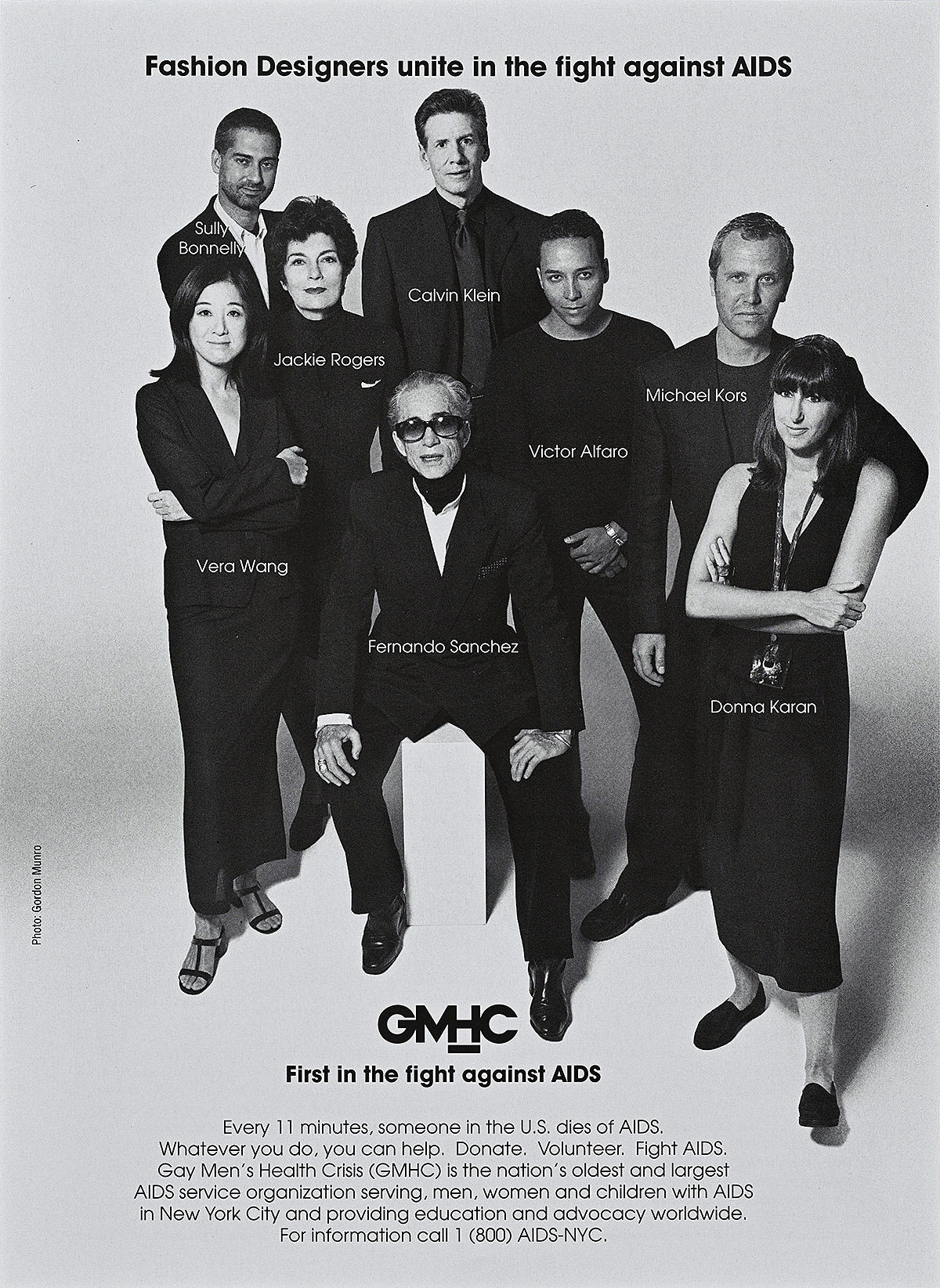
GMHC Magazine Advertisement, 1996

Photographer: Gordon Munro (b. 1939)

Private Collection, NYC

  • This magazine advertisement from the October issue of Vogue features some of the top American fashion designers of the 1990s, including Calvin Klein, Donna Karan (a longtime AIDS advocate), Michael Kors, and Vera Wang, who came together to support the efforts of Gay Men’s Health Crisis. 
  • By the mid-1990s, the fashion industry had been hit hard by AIDS, with hundreds of designers, artisans, stylists, and collaborators lost to the virus. Many famous personalities within the industry came out in support of AIDS research and treatment, with magazine advertisements like this one appearing in numerous publications throughout the period. Despite this, many felt such sleek, sanitized statements did not do enough for the cause since they lacked personal stories, grim statistics, and any real sense of urgency.
  • This advertisement reflects the ambivalence of 1990s AIDS philanthropy, where high-fashion branding and elite consumer culture intersected with public health appeals. While events like 7th (Seventh) on Sale raised substantial funds, their messaging and visibility were shaped by the interests of affluent, mostly white donors and consumers. By 1996, life-saving antiretroviral therapies were available but primarily only to those with private insurance, highlighting how access to care often mirrored the class and racial disparities embedded in both the healthcare system and the fundraising strategies that supported it.
  • As AIDS fatigue set in, public attention began to fade. This advertisement reflects that moment: when AIDS messaging from the fashion world shifted from radical mourning and the rage of protesters to a quieter, more institutional voice.

A magazine showing a woman with medium-tone skin standing in front of a car looking at the viewer in black and white.

7th on Sale Magazine Advertisement, 1990

Photographer: Ellen von Unwerth (b. 1954)

Private Collection, NYC

  • This advertisement appeared in both magazines and newspapers; it promotes 7th (Seventh) on Sale as the hottest shopping event of the season, featuring every major designer, “streets of shops,” and “discounts like you’ve never seen”—with all the proceeds benefiting the New York City AIDS Fund.
  • With its sharp copywriting and glamorous editorial photograph of supermodel Christy Turlington (an AIDS advocate), this advertisement positioned AIDS relief not as charity but as integral to the cultural fabric of the fashion world and the survival of its creators and makers. 
  • The event was widely promoted through fashion publications and mainstream media, mobilizing both the industry and consumers. Major designers donated merchandise and hundreds of volunteers staffed booths while attendees waited in long lines for exclusive products, all contributing to the normalization and fashionability of AIDS fundraising within public and retail spaces.

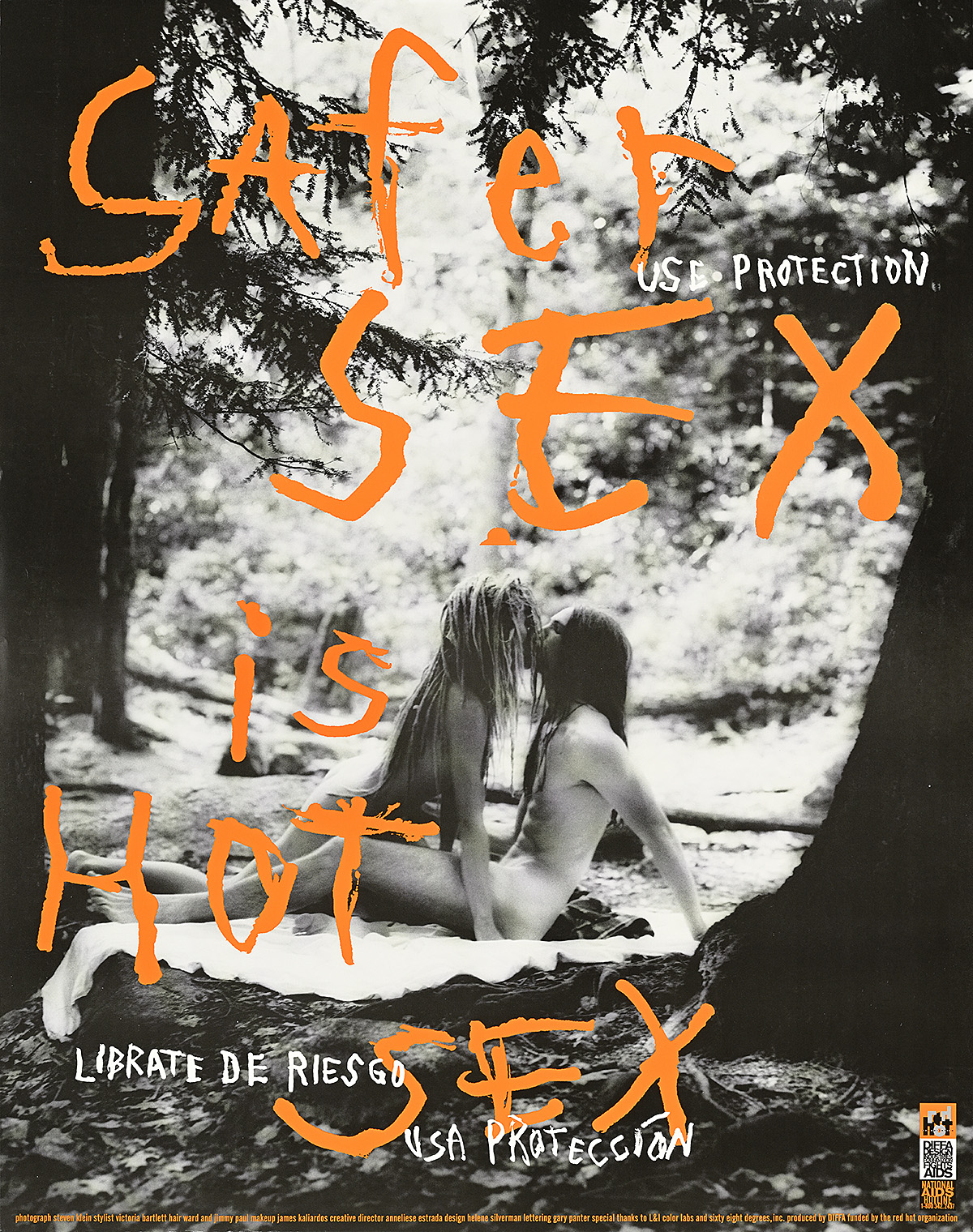
A poster of two black and white nude figures with long hair embracing with orange words safer sex is hot sex overlaid.

Safer Sex is Hot Sex, c. 1992

Photographer: Steven Klein (b. 1965)

Poster House Permanent Collection

  • A follow up to the Safe Sex is Hot Sex series, Safer Sex is Hot Sex expanded the previous campaign’s reach and tone by shifting its language from safe to safer.  It was produced as a collaboration between the Red Hot Organization and Design Industries Foundation Fighting AIDS (DIFFA), a nonprofit founded in 1984 by textile designer Patricia Green and Larry Pond, vice president of Stendig International (who died of AIDS-related complications in 1992), to mobilize the design industry in response to the AIDS crisis and the enormous impact it was having on people in the field. 
  • DIFFA helped fund early prevention initiatives like condom distribution and needle exchanges (a public health program for people who inject drugs to exchange used needles for sterile ones), and put the creative power of the design industry to work on fundraising, advocacy, and public health awareness.
  • The activists and educators increasingly emphasized harm reduction—acknowledging that while no sex was risk free, individuals could protect themselves and others through informed, realistic choices. “Safer sex” offered clarity and acknowledged the value of a range of practices that could reduce harm in a rapidly changing informational landscape.
  • Posted in clubs, within the public transit system, and in other urban spaces, the bilingual poster series implemented the sexy, editorial palette of fashion photography in campaigns about public and sexual health.

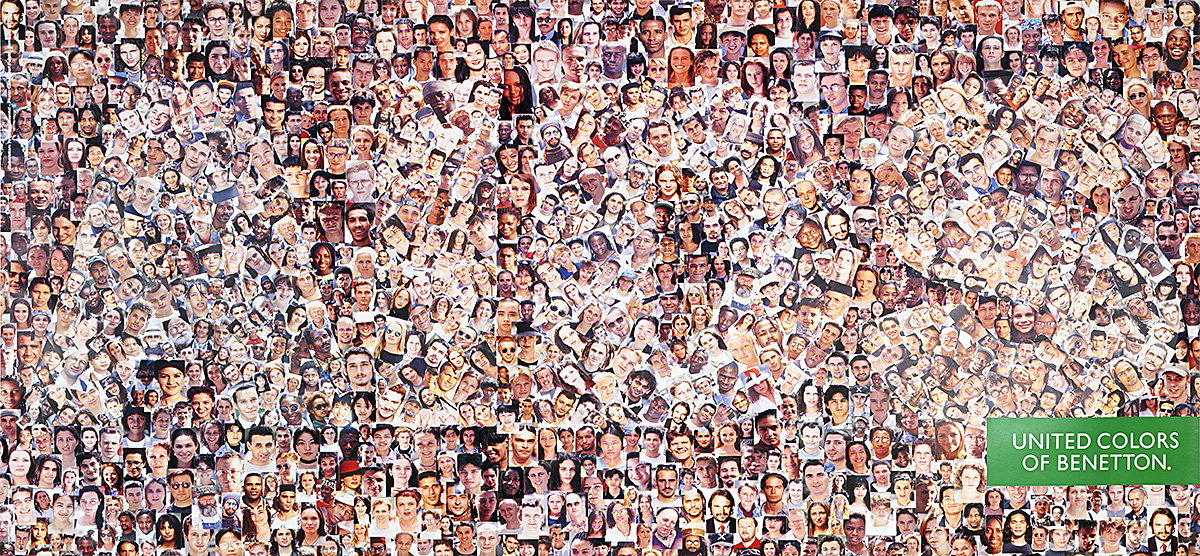
A poster showing the word AIDS made out of many small photos of diverse people.

United Colors Of Benetton, 1994 

Oliviero Toscani (1942–2025) 

Poster House Permanent Collection

  • During the 1980s and ’90s, Benetton was one of the most visible fashion brands in the world. Known for its brightly colored basics—especially knitwear—the Italian company sold affordable, coordinated clothing. Its global identity was shaped by its punchy advertising. Under the direction of Oliviero Toscani, Benetton pioneered a new visual strategy, “shockvertising,” that used advertising space not to sell clothes but to provoke and provide social commentary. 
  • As part of a wider multiyear campaign that drew attention to the AIDS crisis, this poster uses a dense mosaic of photographic portraits to spell out the name of the disease, an effect created through early digital compositing. Each image is of a real person who died of AIDS-related illness, reflecting a range of ages, races, and sexual orientations rarely acknowledged together in public-facing AIDS campaigns at the time. While potentially out of sync with the opinions of many AIDS activists, Benetton and many who saw such advertisements viewed the campaign as radical in its inclusivity and tone. ​​
  • Like the Ronald Reagan poster, this image appeared in Benetton’s Colors magazine as well as on commercial billboards, pushing AIDS awareness into public spaces. The design echoes both memorials and advertising campaigns, forcing viewers to recognize the epidemic not as marginal but as universal.
  • Two years earlier, Toscani had produced the best known of his AIDS posters for Benetton based on a devastating photograph by Therese Frare of AIDS victim David Kirby on his deathbed, surrounded by his grieving family. His “shockvertising” strategy was divisive: some called it exploitation; others saw it as cultural intervention.

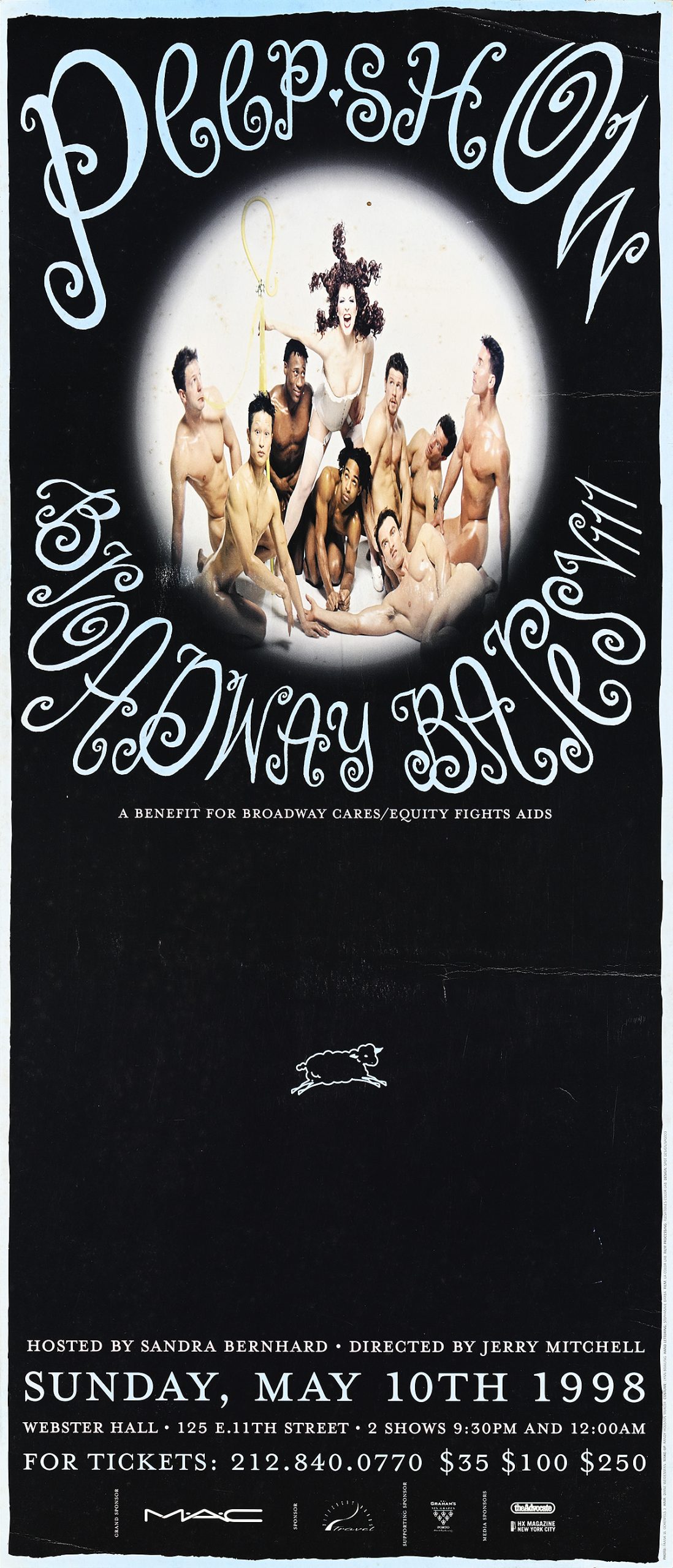
A narrow poster with a photograph of naked dancers posing suggestively inside a circle surrounded by black.

Peep Show/Broadway Bares VIII, 1998 

Designer Unknown 

Poster House Permanent Collection

  • Created by choreographer Jerry Mitchell in 1992, Broadway Bares began as an evening of striptease and cabaret in a New York nightclub in which members of the Broadway community donated their time, talent, and bodies to raise funds for Broadway Cares/Equity Fights AIDS (BC/EFA). It quickly grew into an annual, full-scale theatrical production. 
  • BC/EFA was formed from the merger of two theater-based AIDS fundraising efforts and quickly became a central charitable entity for the performing arts. By the late 1990s, it had developed a year-round calendar of fundraising events, broadened its mission to include general health and social services for entertainment workers, and institutionalized its partnerships with programs at the Actors Fund.
  • In 1998, BC/EFA launched the first Broadway Bears auction, introducing a new fundraising model centered on Broadway-themed collectibles. That year, the organization distributed more than $4.18 million in grants, significantly expanding its support for national AIDS service organizations and solidifying its role as a consistent funder of both direct care and institutional infrastructure.
  • The event was prominently sponsored by MAC Cosmetics and Absolut Vodka, two brands that became synonymous with AIDS-era cultural philanthropy. MAC launched its VIVA Glam campaign in 1994, donating 100 percent of sales from the lipstick line to AIDS organizations. Absolut, one of the first alcohol brands to market directly to gay audiences, sponsored both activist and artistic events. While its support brought much-needed visibility and funding, it also raised questions about the commercialization of AIDS-related art and whether brand alignment risked overshadowing grassroots activism. Still, for many in the theater and nightlife communities, these partnerships were lifelines.

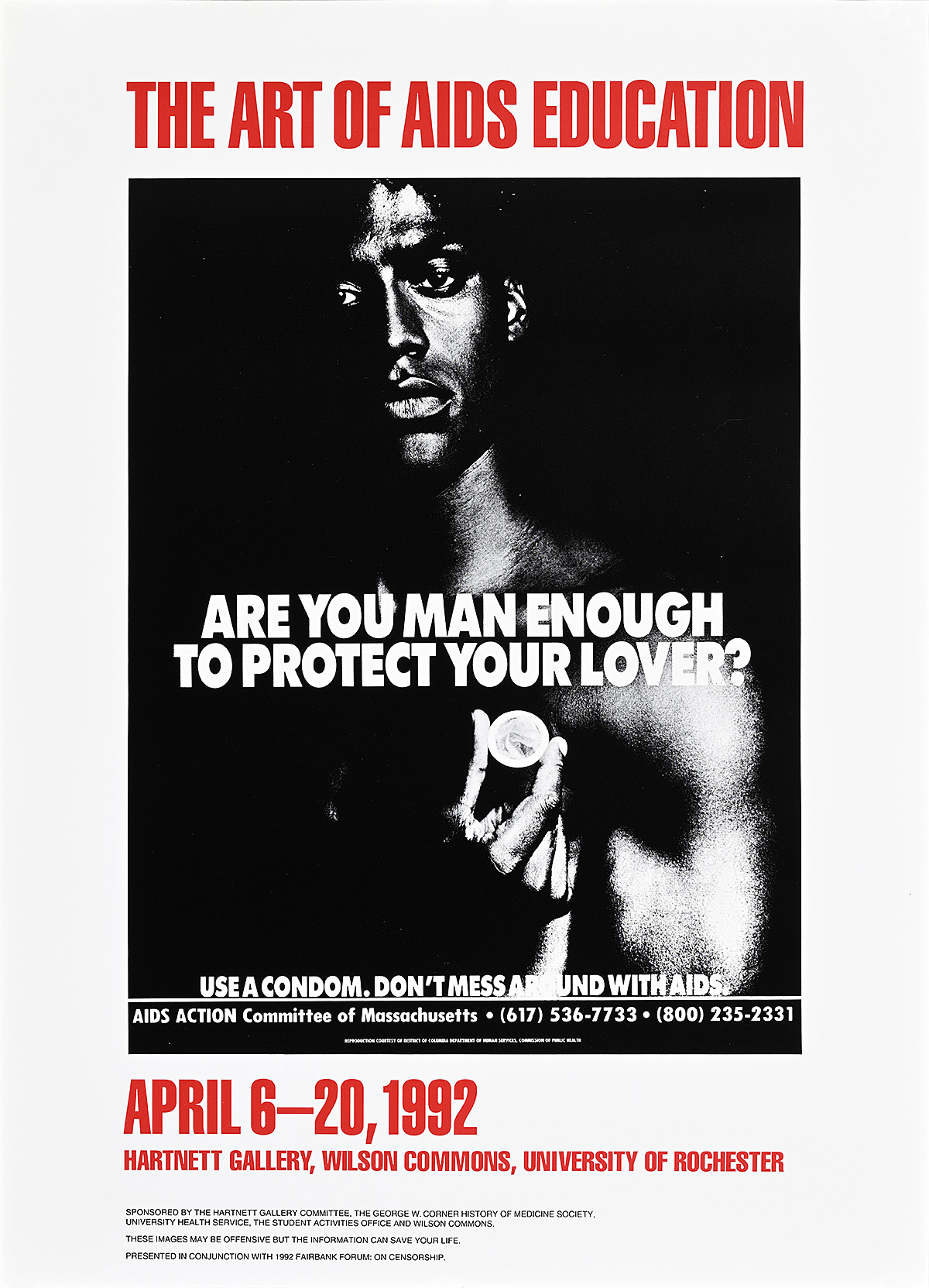
A poster of a Black man holding a condom looking at the camera on a black background with a white border.

The Art of AIDS Education, 1992

Designer Unknown

Poster House Permanent Collection

  • The Art of AIDS Education was an exhibition of posters held at the University of Rochester’s Hartnett Gallery. By presenting public health posters as visual art, it validated the graphic strategies of activists, designers, and public health workers. It emphasized that images could save lives and that design—especially when created by or for marginalized communities—was central to that effort.
  • The poster’s minimalist layout, stark lighting, and bold typography echo the aesthetic of public health materials while simultaneously calling out toxic masculinity. In doing so, it honors activist design movements like Visual AIDS and GMHC that turned everyday communications into instruments of resistance and survival. 
  • The use of a Black male subject aligns with a broader set of visual interventions by Black artists, designers, and activists who challenged their exclusion from early AIDS narratives and framed protection, intimacy, and accountability as shared responsibilities within their own communities.

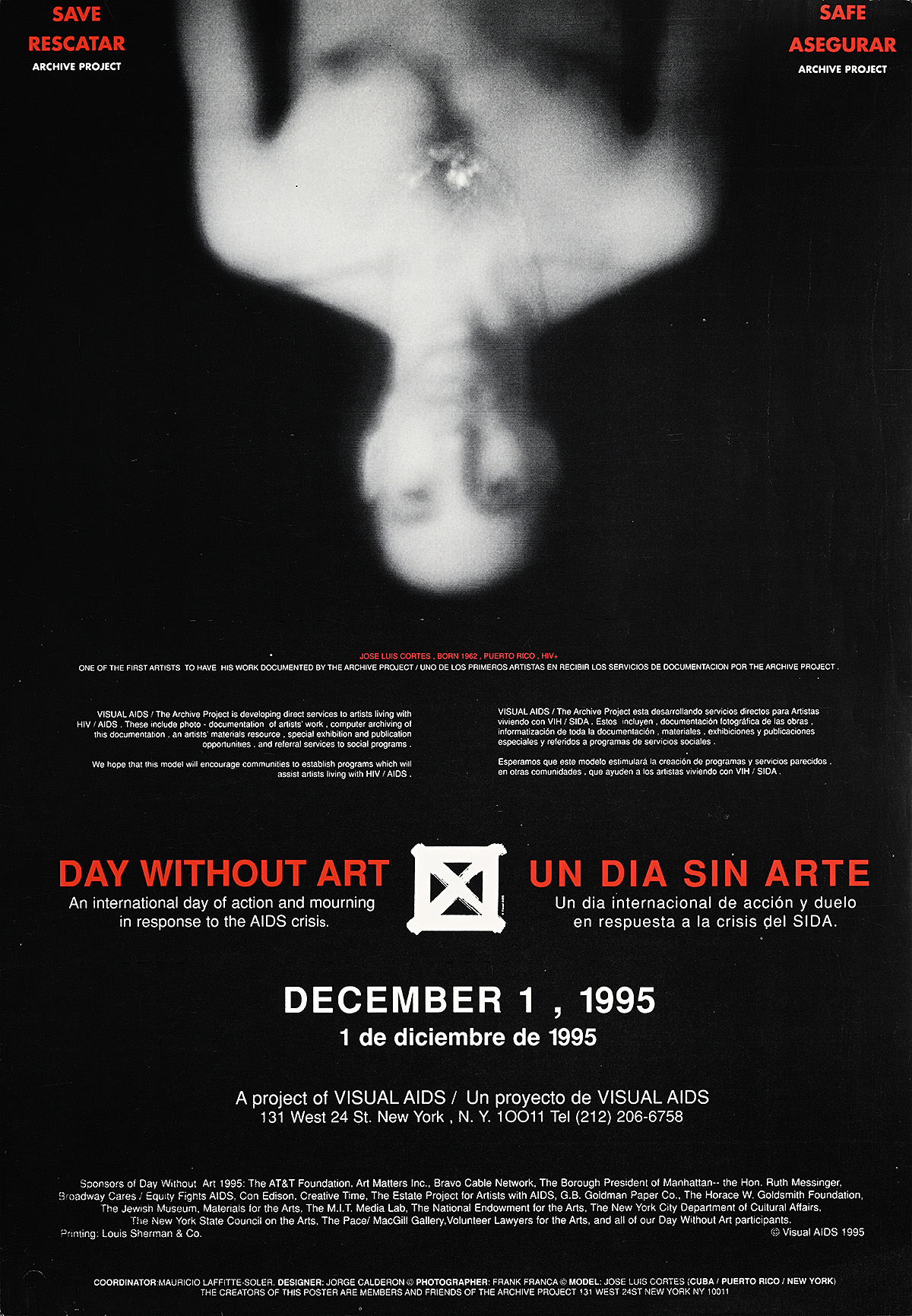
A poster of a blurry white man upside down on a black background.

Day Without Art, 1995

Designer: Jorge Calderón (b. 1963)

Photographer: Frank Franca (Dates Unknown)

Poster House Permanent Collection

  • First observed on December 1, 1989, to coincide with World AIDS Day, Day Without Art called on museums, galleries, and cultural institutions to close, shroud artworks, or suspend programming to mourn the loss of artists to AIDS and demand greater public awareness. The event was one of many projects produced by Visual AIDS, a New York-based collective of arts professionals founded the previous year to help document and raise awareness about the virus and its impact on the cultural sector. 
  • Virtually all major New York City art institutions took part in Day Without Art from its inception. That year, the Metropolitan Museum of Art removed Picasso’s Portrait of Gertrude Stein from view, the Museum of Modern Art hosted a special Leonard Bernstein musical tribute, and the Whitney Museum of American Art (along with numerous galleries) closed or shrouded artworks in solidarity. The Solomon R. Guggenheim Museum also marked the day by draping a large black sash over its facade as a symbol of mourning. In subsequent years, Day Without Art—later “Day With(out) Art”—continued to be widely observed across the city’s cultural institutions, with no notable holdouts among major museums, as the focus shifted from symbolic closures to proactive arts programming and commemoration.
  • This poster incorporates a blurred photograph of José Luis Cortes, a Puerto Rican artist living with HIV. He was one of the first artists documented by the Visual AIDS’s Archive Project that aimed to preserve the work and stories of artists living with the virus. The accompanying description outlines the program’s services—documentation, exhibitions, and referrals—as part of a broader effort to combat the cultural erasure of people with AIDS.

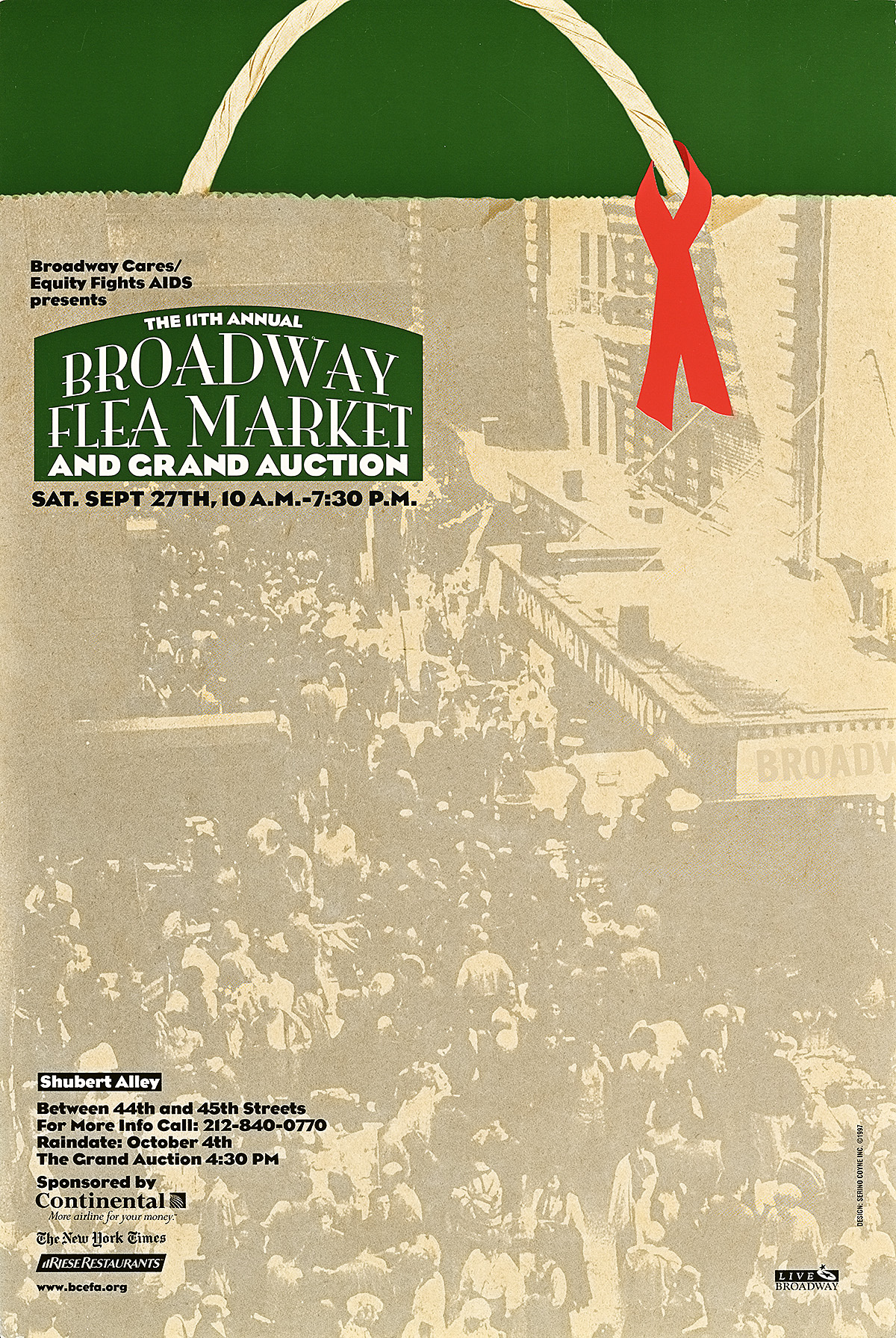
A poster of a black and white street scene printed on a paper bag with a red scarf draped over the handles.

The 11th Annual Broadway Flea Market and Grand Auction, 1997

Designer Unknown

Poster House Permanent Collection

  • Held annually in Shubert Alley—a narrow pedestrian passage tucked between 44th and 45th Streets in the heart of New York’s Theater District—the Broadway Flea Market & Grand Auction began in 1987 as a grassroots fundraiser for Broadway Cares/Equity Fights AIDS (BC/EFA). Cast and crew members of Broadway shows donated costumes, props, posters, and personal memorabilia, while fans browsed, bid, and mingled—all in support of people living with HIV/AIDS. Over the years, it grew into one of Broadway’s most beloved and enduring charitable traditions.
  • By 1997, the Flea Market had expanded dramatically, attracting thousands of attendees and major corporate sponsors, including Continental Airlines, the New York Times, and the Times Square Business Improvement District. These partnerships helped extend the event’s reach while preserving its grassroots spirit of generosity and community. 
  • This poster for the 11th installment of the event was designed by Serino Coyne, one of Broadway’s foremost theatrical advertising firms. Its involvement reflects the degree to which the Broadway industry—at every level—mobilized to support the AIDS response.

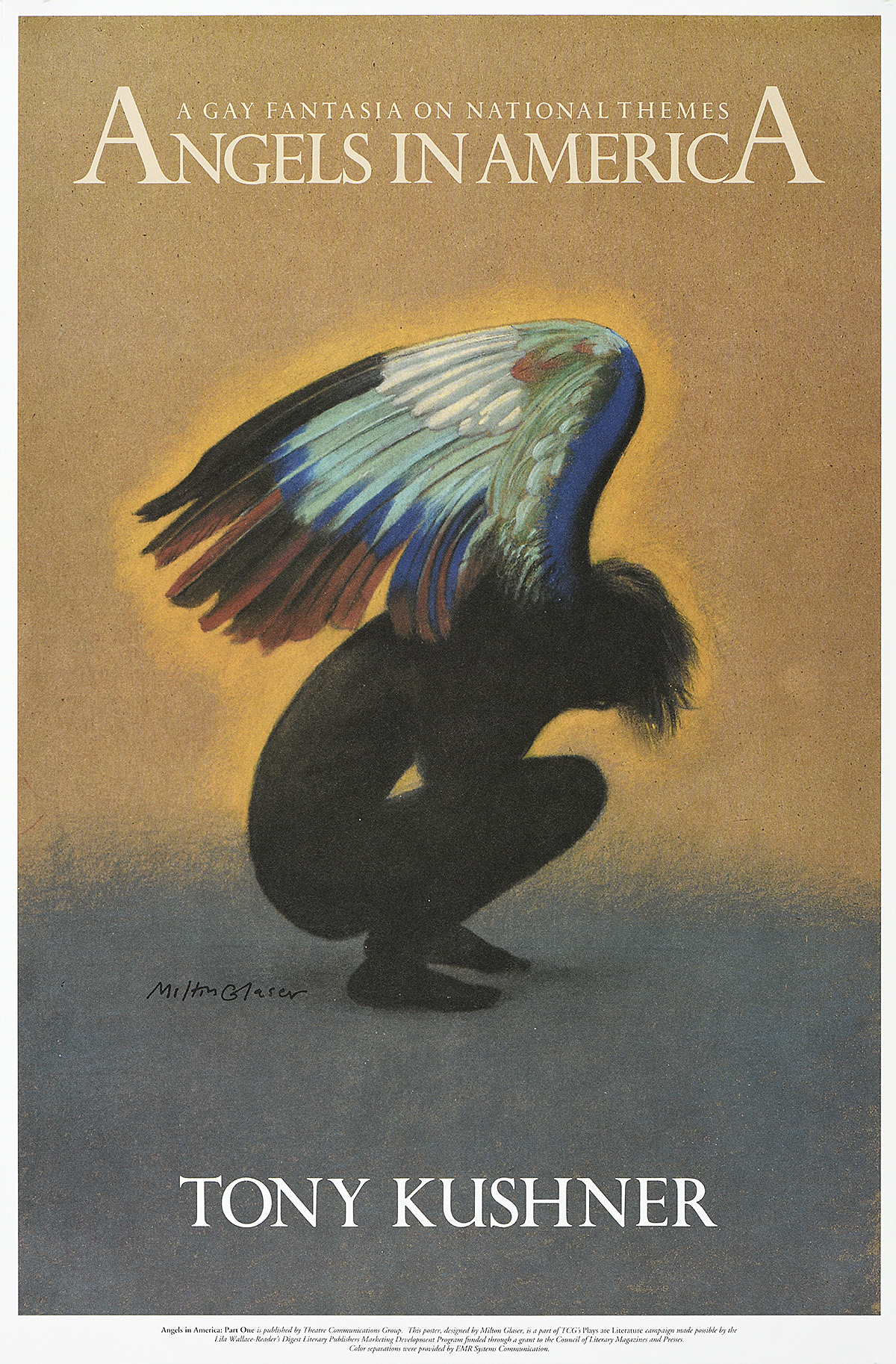
A poster of an angel with colorful wings crouching with its head in its hands on a tan and grey background.

Angels in America, 1993 

Milton Glaser (1929–2020)

Poster House Permanent Collection

  • Designed by Milton Glaser, this poster announces the Broadway premiere of Angels in America: A Gay Fantasia on National Themes, a two-part epic play by Tony Kushner that examines the AIDS crisis, homosexuality, and American society in the 1980s. Through a mix of personal narrative and supernatural allegory, the play critiques the Reagan administration’s inaction and explores themes of identity, religion, and political abandonment. Kushner, who is openly gay, wrote the play amid the AIDS epidemic, channeling his activism into a theatrical work to reflect the crisis’s toll on the gay community.
  • Angels in America premiered on Broadway in 1993 under the direction of George C. Wolfe after earlier productions in San Francisco and Los Angeles. It won the Pulitzer Prize for Drama and multiple Tony Awards, and was widely regarded as representing a turning point in American theater. The play’s candid portrayal of gay life and AIDS drew national acclaim but also sparked protests in some cities, including legal challenges to productions in North Carolina.
  • Milton Glaser is often credited with creating the first international AIDS poster. Commissioned in 1987 by the United Nations and issued in Spanish and English, the poster was distributed internationally and remained the symbol of the epidemic until it was replaced by the now-iconic red ribbon.

A poster of colorful cartoon figures dancing.

Red Hot + Dance, 1992

Keith Haring (1958–90)

Poster House Permanent Collection

  • This poster was created for Red Hot + Dance, the second major album project by the Red Hot Organization, a New York–based nonprofit that combined pop culture, visual art, and music to raise funds and awareness for AIDS. The poster was displayed in record stores and clubs, and as a centerfold in magazines. 
  • The Red Hot + Dance project began as a series of live club events in London, New York City, Paris, Berlin, Rome, Los Angeles, Toronto, Dublin, Dallas, and Tokyo to commemorate World AIDS Day on December 1, 1991. This album ended up being the first major-label release devoted to one of the most influential and distinctive aspects of contemporary music: the remix. 
  • The AIDS-benefit album and series of corresponding dance parties united a broad, multicultural spectrum of artists, from white pop icons to Black dance-music innovators, to reach diverse youth audiences. By tapping into club-music culture rooted in Black and Latino gay communities, the project turned nightlife into a vehicle for safe-sex education and global solidarity against AIDS.
  • Although Keith Haring had died of AIDS-related complications in 1990, his estate granted permission to use this artwork. Haring had long used his art to support AIDS activism, including coproducing the Public Art Fund’s Once Upon a Time mural for the NYC Lesbian and Gay Community Services Center. The Public Art Fund, a nonprofit that brings contemporary art into New York’s public spaces, and the New York City Lesbian and Gay Community Services Center, a hub for gay advocacy, health services, and cultural programming, both played key roles in supporting art and activism during the AIDS crisis.

The City That Danced for Its Life

In New York City, the fight against AIDS was never waged only in clinics or courtrooms; it was also shaped on the dance floors. When funding ran dry and services lagged, gay nightlife figures stepped in, hosting benefit parties, drag balls, and dance marathons that raised millions of dollars while also raising spirits. More than escapism, these events were strategic responses to the overlapping crises of health, housing, and cultural exclusion. Posters for these events borrowed design and style from fashion advertisements, club flyers, burlesque, and Broadway marquees, demonstrating that the AIDS response, like the city itself, came to life at night. 

Dramatically impacted by AIDS, New York’s nightlife scene simultaneously became one of the most important sites of the city’s response to the virus. Circuit parties (extended dance events that often ran overnight into the next day) of the 1980s and ’90s redirected their fundraisers, theme parties, and performances to build community support and funds. 

At the same time, the raging epidemic caused club attendance to decline as fear escalated. Venues like Paradise Garage and The Saint—once cornerstones of gay nightlife—closed in 1987 and 1988 respectively as their founders and patrons succumbed to AIDS. The Saint became so closely associated with early losses that AIDS became known colloquially as “Saint’s Disease.” In 1985, city authorities ordered the closure of high-risk sexual venues as part of public health interventions; rather than eliminating nightlife altogether, however, the crisis catalyzed its transformation. Clubs and promoters adapted by organizing benefit parties for AIDS-related causes and shifting toward outreach-oriented events.

A poster of a man in a suit with wings on a pink city background.

Open Your Heart, 1995

Photographer: Frank W. Ockenfels (b. 1960)

Poster House Permanent Collection

  • Founded in 1983 in New York City, the AIDS Resource Center (later renamed Bailey House) was one of the first organizations to offer supportive housing for people living with HIV/AIDS, becoming a lifeline for marginally housed people in crisis due to the epidemic. Its holistic model of care, combining housing, health services, and advocacy became a national blueprint during the AIDS crisis.
  • Hosted annually near Valentine’s Day, Open Your Heart began in 1989 as a community-driven fundraiser initiated by the Union Square Community Coalition. It featured a wide array of auction items—from artwork and designer furnishings to fashion, entertainment experiences, and signed memorabilia—all donated to raise funds for Bailey House’s supportive-housing programs.
  • This iteration of the event, held on February 13, 1995, at the Puck Building, reflected its growing profile, attracting guests from the design and theater communities, including Broadway supporters and emerging fashion-industry donors. Past honorary chairs included Susan Sarandon, and the ongoing attendance of high-profile guests like Cindy Crawford and Ashley Judd during the late 1990s points to its continuing cultural and philanthropic prominence.
  • This poster, featuring an image by renowned photographer Frank Ockenfels, promotes the seventh annual Open Your Heart benefit auction. Collaborations like this one were central to a broader activist strategy that used design, celebrity, and symbolic imagery to shift narratives, humanize the epidemic, and build solidarity through art.

A colorful illustrative poster of a tiger jumping through a hoop in front of a circus tent.

Ringling Bros and Barnum & Bailey Circus, 1983

Enno Poersch (1944–90)

Poster House Permanent Collection

  • On April 30, 1983, Gay Men’s Health Crisis (GMHC) organized the first major AIDS fundraiser in the United States—a sold-out benefit performance of the Ringling Brothers and Barnum & Bailey Circus at Madison Square Garden, attended by nearly 18,000 people. The event raised approximately $300,000 (around $968,000 today), far surpassing expectations, and was used to fund GMHC’s hotline, safer-sex education programs, and volunteer-based support services for people with AIDS.
  • This poster, designed by Enno Poersch, mimics vintage circus advertisements to draw attention to and destigmatize AIDS fundraising. Below the word “AIDS” is the term “Kaposi’s Sarcoma,” linking the crisis directly to its visible symptoms.
  • The event featured Broadway star Patti LuPone, composer Leonard Bernstein, opera singer Shirley Verrett, and New York City’s closeted mayor Ed Koch. It marked a key moment in AIDS activism.
  • GMHC’s partnership with the corporate owners of Ringling Bros. was one of the earliest collaborations between an AIDS organization and a mainstream entertainment brand. Media coverage was broadly supportive, and activists later described the event as a political landmark that challenged stigma by aligning gay-led AIDS fundraising with a major public institution.

A poster with five multicolor figures dancing expressively surrounded by a black border.

AIDS Dance-A-Thon, 1993

Keith Haring (1958–90) 

Poster House Permanent Collection

  • Featuring the same composition by Keith Haring as the Red Hot + Dance poster from the previous year (donated to the cause by his estate), this poster announces a five-hour dance-a-thon at the Javits Center in New York City. Organized by Gay Men’s Health Crisis, the event combined dancing with direct fundraising and community mobilization.
  • Sponsored by radio station HOT 97 and the David Geffen Foundation, the AIDS Dance-A-Thon signaled growing support from both mainstream media and high-profile philanthropy. For HOT 97, a leading commercial station targeting youth and hip-hop audiences, the sponsorship marked a public alignment with AIDS awareness that challenged the genre’s frequent associations with homophobia. 
  • The Geffen Foundation—founded by music and film mogul David Geffen who had publicly come out as gay the previous year—was part of a broader shift in celebrity philanthropy toward openly supporting gay and AIDS causes.
  • Featuring the same composition by Keith Haring as the Red Hot + Dance poster from the previous year (donated to the cause by his estate), this poster announces a five-hour dance-a-thon at the Javits Center in New York City. Organized by Gay Men’s Health Crisis, the event combined dancing with direct fundraising and community mobilization.
  • Sponsored by radio station HOT 97 and the David Geffen Foundation, the AIDS Dance-A-Thon signaled growing support from both mainstream media and high-profile philanthropy. For HOT 97, a leading commercial station targeting youth and hip-hop audiences, the sponsorship marked a public alignment with AIDS awareness that challenged the genre’s frequent associations with homophobia.
  • The Geffen Foundation—founded by music and film mogul David Geffen who had publicly come out as gay the previous year—was part of a broader shift in celebrity philanthropy toward openly supporting gay and AIDS causes.

A colorful illustrated poster of a cowboy riding on a horse with a psychedelic background.

The World’s Toughest Rodeo, 1983 

Enno Poersch (1944–90)

Poster House Permanent Collection 

  • Held at Madison Square Garden on October 1, 1983, The World’s Toughest Rodeo was GMHC’s second major AIDS benefit. Rodeo culture was—and still is—coded as hypermasculine and heteronormative, symbolizing an idealized, rugged American manhood. At the same time, the cowboy is a long-standing figure within gay visual culture, featured in everything from Tom of Finland illustrations to leather-bar dress codes. Chaps, boots, and spurs were not just Western gear, they were erotically charged emblems of gay male fantasy and self-expression.
  • By staging a rodeo in New York’s most iconic arena, GMHC occupied a space of cultural contradiction, at once subverting and celebrating the figure of the cowboy. The event tapped into this layered symbolism, challenging stereotypes of both cowboys and gay men, and bringing AIDS into the center of a spectacle rarely associated with gay life.
  • German-born artist, set designer, and activist Enno Poersch was a founding member of GMHC. Trained at Yale, his bold poster designs helped transform public health messaging with vivid imagery that blended political urgency with popular entertainment.

A poster of a collage of close up images of nude men's bodies arranged in a grid behind a disco ball with a blue border.

The Sleaze Ball, 1992

Jon McEwan (Dates Unknown)

Collection of David Kennerley

  • Held at The Roxy, a legendary nightclub in Chelsea, the Sleaze Ball was presented by The Saint at Large, a promotions company that emerged after the 1988 closure of The Saint nightclub, continuing its legacy of large-scale gay dance events with philanthropic aims. With performances by DJs like Frankie Knuckles and a focus on all-night dancing, the Sleaze Ball was emblematic of early 1990s gay nightlife. 
  • This event directed 100 percent of its door proceeds to three beneficiaries that embodied grassroots responses to issues impacting the larger gay community: the Community Research Initiative on AIDS (CRIA), a community-based clinical trials organization; The New Festival, New York’s LGBTQ film festival; and the New York City Anti-Violence Project (AVP), which addressed hate violence and police accountability. The event’s erotic, nightlife aesthetic in this poster reclaims the term “sleaze” as a form of defiance against AIDS-related stigma and conservative moralism, signaling that gay sexuality and public health activism were not mutually exclusive.
  • Circuit parties—a term for extended, themed dance events within the gay community—evolved into gatherings that paired music with fundraising, memorialization, and political awareness, using spectacle and sexual aesthetics to raise money for grassroots AIDS organizations.
  • Although it operated outside the original Saint space, the Saint At Large maintained ties to the earlier club’s technical staff, DJs, and aesthetics. It became known for combining spectacle with philanthropy and contributed materially to AIDS-related services, cultural programming, and safety initiatives throughout the 1990s.

A poster of two shirtless men embracing printed in black and white.

The Third Annual Dance on Manhattan, 1997

Photographer: David Morgan (Dates Unknown)

Poster House Permanent Collection

  • Held during Pride weekend on June 28, 1997, the Third Annual Dance on Manhattan transformed Chelsea Piers into a sprawling benefit for Gay Men’s Health Crisis (GMHC) and Empire State Pride Agenda, New York’s leading LGBTQ civil rights lobbying organization. 
  • By the late 1990s, large-scale dance benefits had become central to the fundraising ecosystem of New York’s LGBTQ organizations. What set this event apart was its extraordinary sponsorship list, printed in full across the back of the poster. National brands like Pepsi-Cola, Miller Brewing, Tanqueray Sterling, and Virgin Megastore shared billing with LGBTQ-owned businesses, nightlife promoters, magazines, and hundreds of individual supporters. Their participation indicated that the stigma around AIDS was no longer something companies feared. 
  • Benefit events like this one drew both praise and critique. While many celebrated the increasing corporate sponsorship as a sign of visibility and political legitimacy, others raised concerns about the commercialization of gay space and the dilution of activist intent. Scholars and activists noted that some sponsorships prioritized branding over sustained support, echoing broader debates around the corporatization of Pride.
  • As noted on the poster, the event was dedicated to the “creative spirit and unfailing energy of Bruce Mailman (1939–1994),” a pioneering figure in New York’s gay nightlife. Mailman founded The Saint, a legendary private dance club that helped define the cultural life of gay men in the 1980s, and the New St. Marks Baths, one of the city’s most iconic bathhouses. Both venues played vital roles in the early response to AIDS—hosting fundraisers, distributing safe-sex materials, and supporting organizations like GMHC. Mailman died of AIDS-related complications in 1994.

A poster of a leather jockstrap lying on red fabric with white lettering reading love ball.

Love Ball II, 1991

Julian Schnabel (b. 1951)

Poster House Permanent Collection

  • In the early 1990s, aspects of ballroom began to be appropriated by the fashion and entertainment industries, with songs like Madonna’s “Vogue” and the cult documentary Paris is Burning introducing the world to a culture created by Black and Latino gay and trans New Yorkers. These balls had been established to offer safe and supportive opportunities for performance, community, and political critique through dance and fashion, addressing racism, homophobia, and social marginalization. 
  • Ballroom “houses” were built around charismatic individuals who often took their names from luxury fashion brands. As the AIDS epidemic spread, some of these brands began commandeering ballroom culture for fundraising events. While these parties were intended to assist those impacted by the virus, such help rarely reached those who had birthed the scene.
  • In the neighborhoods where ballroom originated, balls raised funds for organizations addressing incarceration, homelessness, and systemic racism. Organizations founded by Black and Latino New Yorkers, including ACE, Housing Works, the Latina/o Caucus of ACT UP, and the Audre Lorde Project, both served and received support from its members.
  • In 1989, nightlife visionary Susanne Bartsch organized the first Love Ball at Roseland Ballroom to raise funds for Design Industries Foundation Fighting AIDS (DIFFA). Two years later, Love Ball II was held on a grander scale, with celebrity judges like Queen Latifah, Jean Paul Gaultier, and Susan Sarandon scoring presentation categories like Delusions of Grandeur, while the city’s underground, predominantly Black and Latino ballroom houses, including Xtravaganza, Omni, and Pendavis, competed alongside teams sponsored by major fashion designers. The event raised more than $600,000 (approximately $1,415,000 today).
  • Widely covered in the fashion and nightlife press, the event was dubbed a “fashion victim fundraiser.” Many icons of the ballroom scene, including Angie Xtravaganza, Willi Ninja, and Dorian Corey, would die in the next few years.

A poster of an illustrated man singing on a blue background.

A Gala Night for Singing, 1985

Paul Davis (b. 1938)

Poster House Permanent Collection

  • As one of the first public AIDS fundraisers in the Hamptons (and one of the first arts-led AIDS benefits), A Gala Night for Singing activated a network of gay residents, weekenders, and allies with strong ties to New York City’s arts and advocacy scenes. 
  • The event was co-organized by the East End Gay Organization (EEGO), founded in 1977 to build community and fight discrimination on Long Island’s East End, and the Linda Leibman Human Rights Fund, created to honor a beloved local activist. Together, these groups fostered political change and mutual aid—including East Hampton’s landmark 1985 vote to ban anti-gay discrimination. Fashion designer Stan Herman, then chairman of EEGO, co-chaired the benefit, underscoring how the fashion industry mobilized early in the AIDS crisis through grassroots leadership. The event was catered by Ina Garten, later known as the “Barefoot Contessa,” indicating the broad coalition of cultural figures contributing to early AIDS organizing in the Hamptons.
  • The concert featured rising opera stars Aprile Millo and Jerry Hadley and was produced by Opera News editor Robert Jacobson and impresario Matthew Epstein. Their participation signaled how deeply the AIDS crisis had affected the classical music world, and how artists were among the first to mobilize cultural capital for support and remembrance.
  • Artist Paul Davis, known for his emotionally resonant theater posters for Lincoln Center, donated his talents and brought a sense of transcendence and dignity to a moment of rising grief. Unlike the more politically charged graphics that came later, this poster speaks with understated power. It imagines voice—in the form of music, protest, or prayer—as a way to rise above despair and summon collective action.
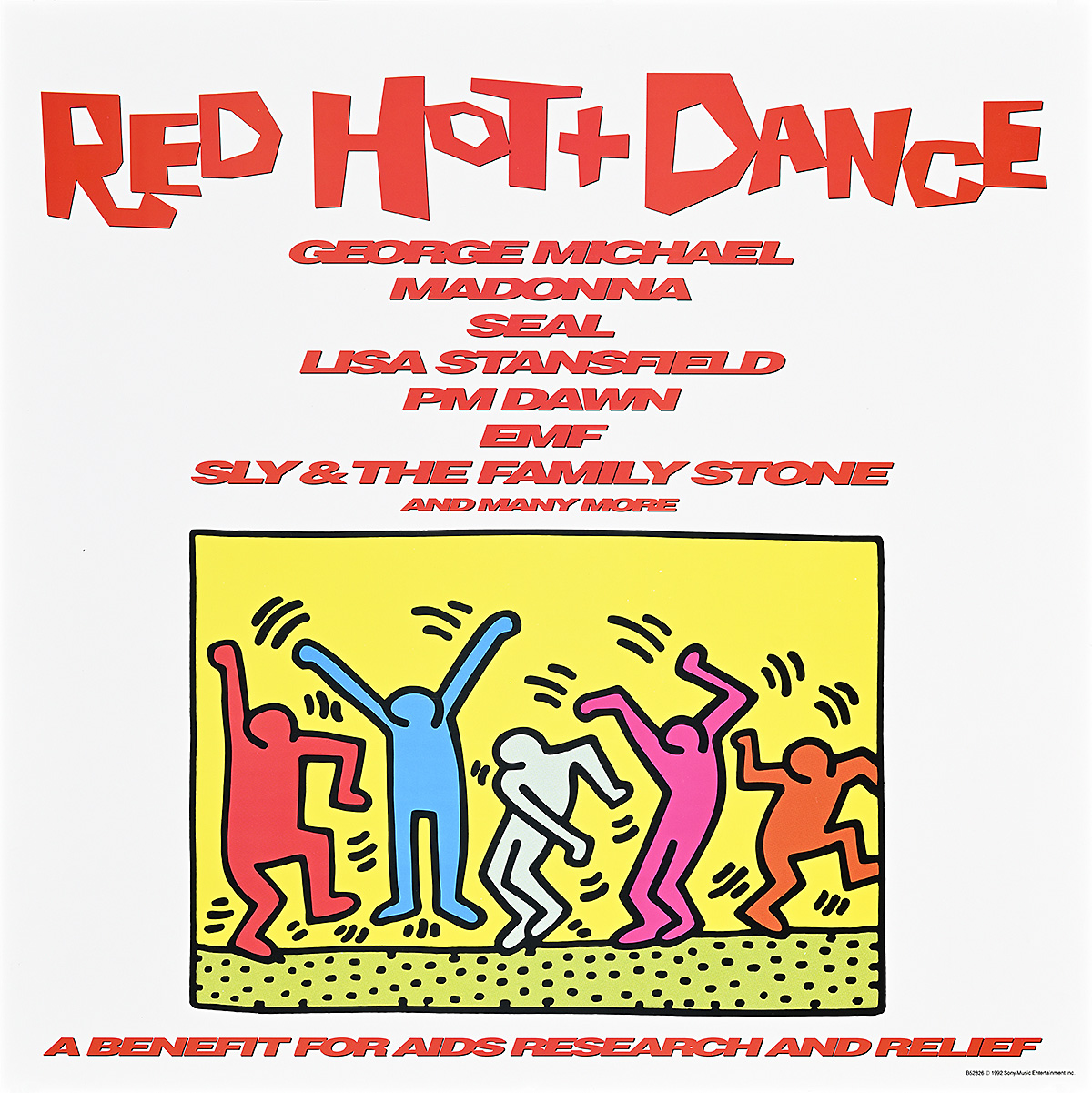
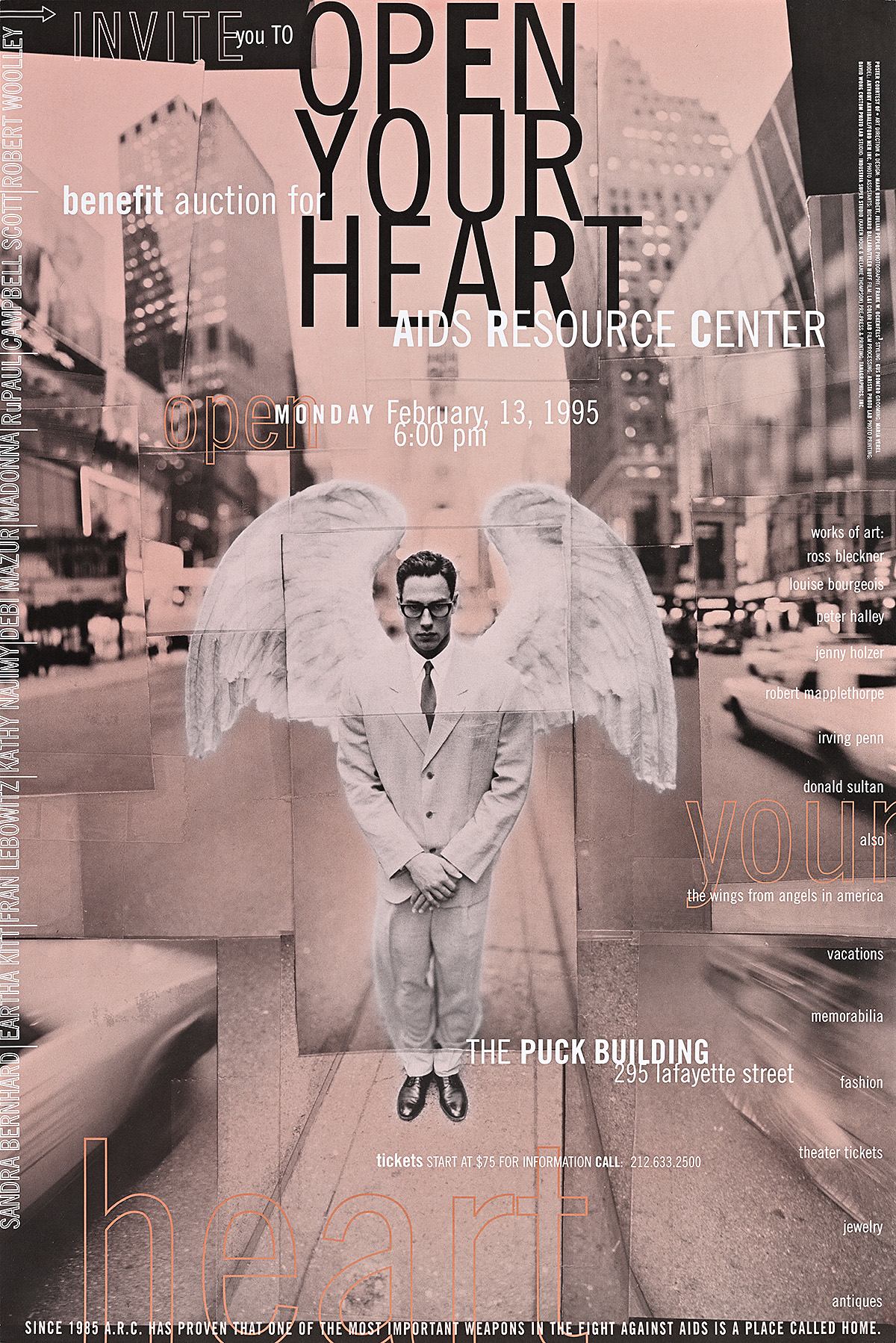
A poster split in four equal squares with household objects inside three of the squares and text inside the other.

Open Your Heart Benefit Auction, 1998

Neil Flewellen (Dates Unknown)

Poster House Permanent Collection

  • In 1995, the AIDS Resource Center formally adopted the name Bailey House, honoring its cofounder Reverend Mead Miner Bailey. The organization continued its core mission of offering permanent housing to people living with AIDS, particularly those who were low-income, unstably housed, or otherwise marginalized. The renaming also reflected its now well-established identity as an organization focused on AIDS housing services.
  • During the early AIDS crisis, people living with the virus were frequently evicted by landlords, turned away from shelters, and otherwise denied stable housing, making it harder to access consistent medical care. Many were also refused treatment by hospitals or lost their insurance coverage, revealing that AIDS was not only a medical crisis but also a crisis of structural inequality—especially for those already facing poverty or discrimination. 
  • Bailey House helped establish the principle that housing is healthcare, providing stable shelter that enabled people with HIV to  maintain treatment, reduce hospitalizations, and improve survival rates. These findings influenced national policy, including the creation of the Housing Opportunities for Persons With AIDS (HOPWA) program in 1992—the only federal initiative focused on housing people living with HIV/AIDS. 
  • Designed by Neil Flewellen, this poster announces the 10th annual Open Your Heart auction with stylized furnishings in bold colors subtly evoking the idea of home. The three panels are artistic renderings of domestic scenes and reinforce Bailey House’s mission to create safe, dignified living environments for people affected by AIDS.

A poster of an illustrative colorful city park with trees and buildings.

AIDS Walk New York, 1998

Designer Unknown

Poster House Permanent Collection

  • First held in 1986, AIDS Walk New York quickly became one of the world’s largest and most visible AIDS fundraising events. By 1998, tens of thousands participated annually in the ten-kilometer walkathon, with that year alone drawing 38,000 walkers and raising $4 million (approximately $7.8 million today) for GMHC’s services, including healthcare, housing, education, and advocacy.
  • When Highly Effective Antri-Retroviral Therapy (HEART, a cocktail of medications that effectively controlled HIV) was approved in 1996, public awareness of the continued urgency for AIDS awareness and treatment diminished. Such medical advances did not actually fix many of the social issues that enabled the epidemic in the first place and prevented those affected from seeking healthcare and support. This poster emphasizes the ongoing struggle with the phrase: “Don’t confuse hope with victory…Keep walking! We’re not there yet.” 
  • Corporate participation in these types of fundraising and awareness events expanded significantly in the early 1990s, with major firms such as Gap Inc. organizing employee teams and underwriting costs. By the mid-1990s, such sponsorship became a prominent feature of the event, contributing to record fundraising totals. As new treatments emerged in the late 1990s, however, organizers reported challenges in sustaining engagement. By 2000, annual proceeds plateaued at around $4 million, suggesting that corporations were losing interest in AIDS Walk New York.
  • The walk united diverse participants, from corporate teams to church groups, and helped transform public understanding, reduce stigma, and fuel the broader AIDS movement.

A flyer with neon yellow text on a black background.

ACT UP at MEAT, 1993 

Aldo Hernández (b. 1957)

Collection of David Kennerley

  • This photocopy-style flyer promotes a benefit for ACT UP at MEAT, a gay nightclub and performance space at 432 West 14th Street in the Meatpacking District. It was designed by Aldo Hernández, a Cuban-American arts activist who also founded the illegal bar as an alternative to mainstream gay clubs, which he felt lacked diversity and creativity. He envisioned MEAT as a clubhouse where patrons could socialize or dance and “be yourself” outside the dominant “gay clone” aesthetic. 
  • This commitment to individuality was reflected in MEAT’s eclectic dance mixes, its dancers’ wide range of body types and gender expressions, and its use of dynamic décor. The bar maintained an inclusive no-guest-list policy and low admission price to foster accessibility.
  • MEAT featured dancing and live performance but operated precariously without a cabaret license. Most weeks featured low-budget themed parties that cultivated an eroticized atmosphere and were promoted by hand-distributed flyers like this one. International performers such as RuPaul and Ron Athey were among the guests featured onstage.
  • A monitored basement space was designated for sexual activity, which sparked concern among AIDS activists. To comply with city health policies, the area was posted with safer-sex information and signs warning “No lips below the hips.”
  • MEAT closed in February 1994 with the farewell party Point of No Return. Hernández continued to host parties at the venue under names like Underworld, Skin Up, and Puta Scandalosa, with a broader, mixed crowd.

A flyer showing a purple cartoon muscular woman fighting angry cells with text below reading divas fight AIDS.

Divas Fight AIDS, 1992 

Designer Unknown

Collection of David Kennerley

  • This handbill promotes a benefit for LIFEbeat, a newly formed nonprofit that used music and nightlife to promote HIV/AIDS awareness and prevention, especially among young people. Founded after music executive Bob Caviano publicly disclosed his AIDS diagnosis in Billboard, LIFEbeat organized concerts, club nights, and educational outreach to connect fans with safer-sex information and support services. The organization is now part of the Elizabeth Taylor AIDS Foundation. 
  • Held at the Palladium, an East Village nightclub run by the former owners of Studio 54, the event was hosted by drag icon Lady Bunny and featured powerhouse “Diva” performances by Adeva, Shawn Christopher, Kym Sims, Gwen Guthrie, Loleatta Holloway, Jomanda, the Cover Girls, Sybil, Lonnie Gordon, Georga Jones, and House music pioneer Frankie Knuckles.
  • Divas Fight AIDS was cosponsored by local gay publications QW Magazine and Homo/Xtra (HX) Magazine, signaling the deep interconnection between club culture and grassroots activism. Promotional flyers like this one circulated in bars, record shops, and dance floors.
  • This event, held just months after LIFEbeat’s founding, helped establish the group’s model of fusing music with outreach. Volunteers at concerts distributed condoms and HIV-prevention literature, while programs like Hearts & Voices brought live performances into AIDS wards.

A flyer showing a painted hand handing over a red condom to another hand.

Always the Season, 1991

Designer Unknown

Collection of David Kennerley

This double-sided handbill pairs nightlife promotion with public health. One side reimagines Michelangelo’s Creation of Adam in which God hands Adam a condom, framing safer sex as sacred and “approved” by God. The other side advertises Homo-Sensual Sundays—a gay dance party with DJs, drag, and drink specials—at the third and final iteration of the iconic nightclub Danceteria inside the Martha Washington Hotel.

A flyer of a muscular nude man's upper body in black and white above text reading tropical heat with two small palm trees.

Tropical Heat, 1992

Designer: Jon McEwan (Dates Unknown)

Photographer: David Morgan (Dates Unknown)

Collection of David Kennerley

  • Held at the Palladium nightclub on April 5, 1992, Tropical Heat was “the hottest morning dance party.” It benefited God’s Love We Deliver, a charity providing meals to people with AIDS, and boasted hot tubs, go-go boys, and a tropical dress code. Morning parties were one adaptation to the closure of certain nightlife spaces.
  • The AIDS crisis reshaped nightlife in New York, with iconic clubs like The Saint and Paradise Garage closing amid mass illness, declining membership, and shifts in public policy on gay sexual community and commercial spaces. City officials also intervened, shuttering sex venues deemed high risk by 1985. Despite closures, nightlife in the early 1990s rebounded with renewed purpose. Large-scale dance parties like those produced by The Saint at Large continued to draw crowds, now emboldened by activism and community support.

The Love That Fought Back

The posters in this exhibition are not just relics of the past—they are records of a revolution. They show how New Yorkers, facing indifference and death, built new systems of care through culture, community, and design. In clinics and clubs, on street corners and gallery walls, these works made AIDS visible and demanded that lives be counted.

Nationally and globally, AIDS remains a crisis. As of 2026, more than 116,000 New Yorkers have died of AIDS-related causes, the majority of them during the period covered in this show. Many of the inequalities that fueled the epidemic remain ever present, including structural racism in healthcare; stigma against gay, trans, and drug-using communities; and unequal access to treatment. Efforts by many of the organizations discussed in this show, including BC/EFA, DIFFA, Visual AIDS, and GMHC—founded in part by activists represented here—have carried forward the fight. Today’s movements for health equity, housing justice, harm reduction, and bodily autonomy stand on the foundations laid by AIDS activists—and often use the same graphic tools as these posters, incorporating them into murals, zines, and digital media to resist erasure and demand justice.

To look at these posters today is to witness how communities responded to unimaginable loss with urgency, creativity, and love of community. The AIDS epidemic was not only a public health crisis, but also a moment of collective invention and resistance. These materials document how people made meaning, demanded action, and shaped the terms of survival—leaving behind a visual record of one of the most devastating and powerful moments in New York history.

Acknowledgements


Curator

Ian Bradley-Perrin


Designer

Ola Baldych


Registrar

Melanie Papathomas


Production

Mihoshi Fukushima Clark

Randee Ballinger 


Installation

John F. Lynch

Rob Leonardi

Diego Cadeña Bejarano


Graphic Installation

Keith Immediato


Woodwork

Rob Leonardi


Metalwork

Nikki Romanello


Printer

Full Point Graphics

Drive21

Crown Prints Studio


Special Thanks:

Avram Finkelstein, artist & writer

Natalie Nudell, FIT-SUNY

Theodore Kerr, AIDS researcher 

Catherine Bindman, editor

Randy Ferreiro, proofreader

Sofía Jarrín, Spanish translator 


This program is supported, in part, by public funds from the New York City Department of Cultural Affairs in partnership with the City Council, and the New York State Council on the Arts (NYSCA).

Pull Quotes

“Maybe affection is our best protection. Hard questions for hard times. But whatever happened to our great gay imaginations?”—Michael Callen & Richard Berkowitz, authors of How to Have Sex in an Epidemic

You’re all going to be dead in six months. Now what are we going to do about it?”—Larry Kramer, cofounder of GMHC and ACT UP

“If silence equals death, then art equals language equals life.”—David Wojnarowicz, artist

“We have a responsibility as leaders in an industry that’s been devastated by the disease. And my hope is to raise money–and awareness–not only in the fashion world but in the country at large.”—Carolyne Roehm, president of the CFDA

During the darkest days of the AIDS crisis we buried our friends in the morning, we protested in the afternoon, and we danced all night, and it was the dance that kept us in the fight because it was the dance we were fighting for.”—Dan Savage, LGBT author