From Monarchy to Modernity: Travel, Identity, & the Czechoslovak First Republic (1918–1938)

On October 28, 1918, Czechoslovakia declared its independence and became a new country formed from Bohemia, Moravia, Slovakia, parts of Silesia, and Carpathian Ruthenia—all lands that had been part of the Austro-Hungarian Empire, dissolved after its defeat in World War I. This period, from October 1918 until the signing of the Munich Agreement in September 1938, which allowed Nazi Germany to annex the Sudetenland (along Czechoslovakia’s northern and western borders)—is referred to as the First Czechoslovak Republic, more commonly known as the First Republic.

As a newly formed state comprising diverse ethnic groups and regions, the young republic faced the challenge of building not only its economy and political system but also a cohesive national identity. It sought to present itself to the world—and to its own citizens—as united and forward-looking, using the power of visual culture to assert its presence on the global stage. Travel posters were among its most striking tools: vivid, stylized images that celebrated the country’s landscapes, cities, culture, industry, and technological achievements while projecting an identity that was proud, sovereign, progressive, stable, and distinctly Czechoslovakian. These posters reveal the aspirations of a young state eager to claim its place in Europe.  

During this brief 20-year period, the nation experienced such extraordinary progress, prosperity, technological innovation, and optimism that it rose to prominence as one of the most industrialized in Europe. Its per capita income was also one of the highest on the continent, establishing it as an economic and political success story. 

This exhibition explores seldom-seen travel posters from this golden age of Czechoslovakian statehood. They were created by artists, designers, and directors of commercial studios who understood that tourism was more than leisure—it was diplomacy. In a region that had long been defined by the imperial borders of the Austro-Hungarian Empire, travel posters in the post- World War I era became vehicles for soft power, enticing both domestic and foreign audiences to see the First Republic as a land of opportunity, beauty, and progress. With the dissolution of the monarchy, gone, too, were the artistic but static landscapes that had populated the posters of the Kaiserlich-Königliche Österreichische Staatsbahnen (Imperial Royal Austrian State Railways). Spas, medieval towns, and mountain resorts were no longer seen just as attractive destinations but were now symbols of a unified, modern nation. These travel posters also became more than advertisements, emerging as instruments of national branding: a new way of cultural story telling, part of a new national narrative. They illustrate how a small fledgling republic used the promotion of its own land through art and travel to telegraph its position as a modern democracy.

The design of these posters reflects the era’s avant-garde movements—Art Deco, Constructivism, and Functionalism—while also drawing on local folk motifs and national iconography, merging tradition with innovation and crafting an image of Czechoslovakia that was at once cosmopolitan yet uniquely its own. Together, they celebrate the promise of Czechoslovakia: a democratic, cultured, and optimistic state rooted in both tradition and progress. This promise was real but short lived, ending on March 15, 1939, when Nazi Germany violated the Munich Agreement and invaded and occupied the rest of the country. 

This exhibition is held in conjunction with Visit Czechoslovakia! The Story of Czech Travel Posters, on view at the Czech Center New York from September 18 to November 30, 2026. We encourage guests to visit both shows celebrating the vibrancy and variety of Czech design.

Whenever feasible, Poster House reuses materials from previous shows to drive sustainable practice.
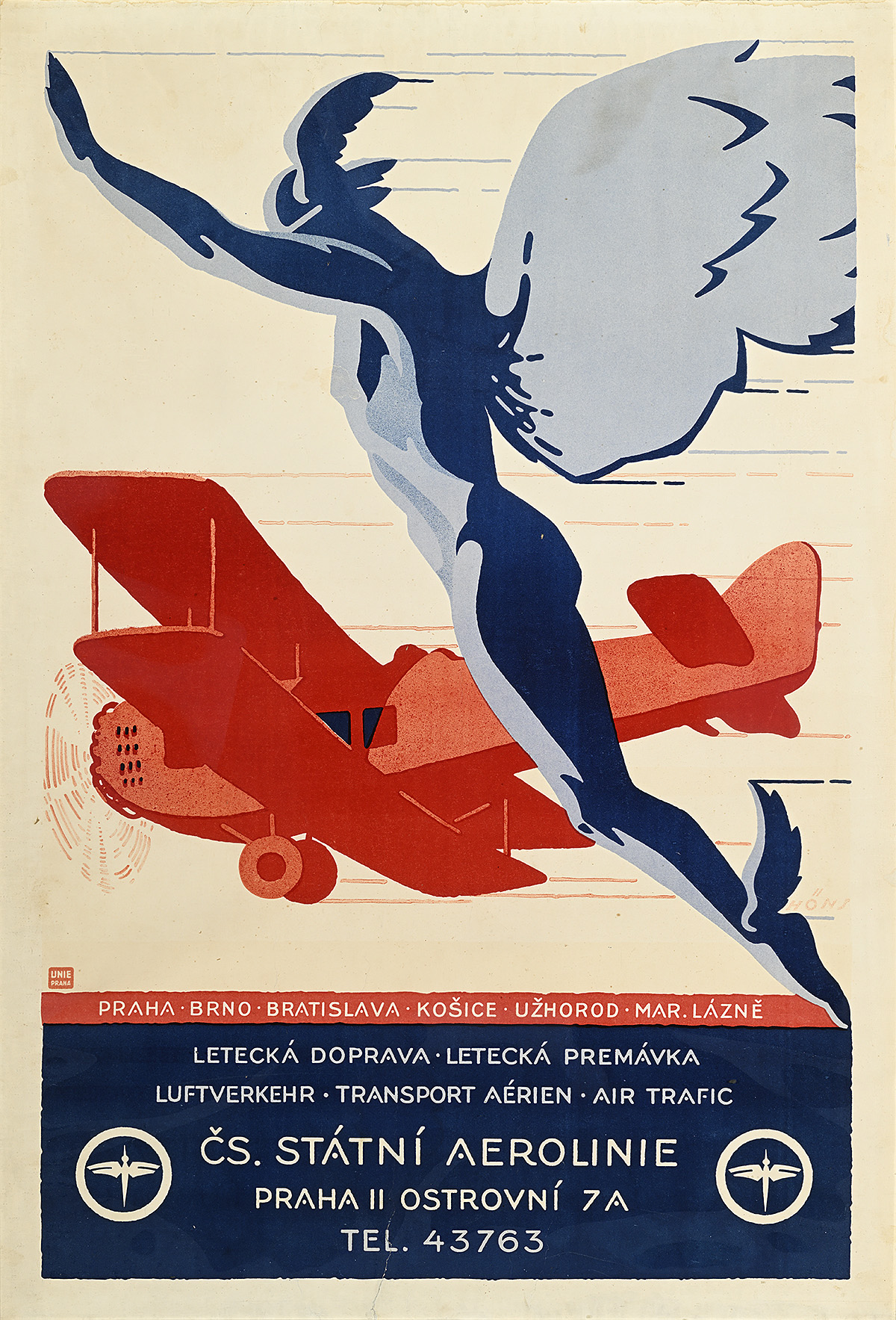
A poster of a blue figure with wings in flight in front of a red airplane.

ČS. Státní Aerolinie (Czechoslovak State Airlines), 1928

Rudolf Höns (1894–1939)

Private Collection, NY

  • In the aftermath of World War I, airplanes, airlines, and the aviation industry itself became international symbols of modernity, progress, independence, economic strength, and national prestige. Established in 1923, Czechoslovak State Airlines was the fifth oldest airline company in the world. It operated domestically until 1930, at which time its service was extended to Zagreb in Yugoslavia (present-day Croatia).
  • This design highlights an Aero A-23 biplane; it became part of the nascent Czechoslovak Airlines fleet in 1926 and was in service for approximately 10 years. It was one of the first Czech-designed and -manufactured aircraft to be widely used in civil aviation; it was also used in pilot training and for military reconnaissance. The success of the A-23 helped establish Aero as a leading aircraft manufacturer in Czechoslovakia.
  • This poster vividly captures the spirit of modernity and technological triumph, depicting an aircraft outrunning the classical god Mercury—symbolizing the pace of Czech progress and innovation in air travel. 
  • When this poster was released, the airline’s route network was made up of just six cities (all of which are listed in the red text banner), including one of the country’s most famous spa towns, Mariánské Lázně (better known internationally at the time by its German name: Marienbad)—a stop only added in 1927. This poster features the airline’s original logo, which remained unchanged until 1935.

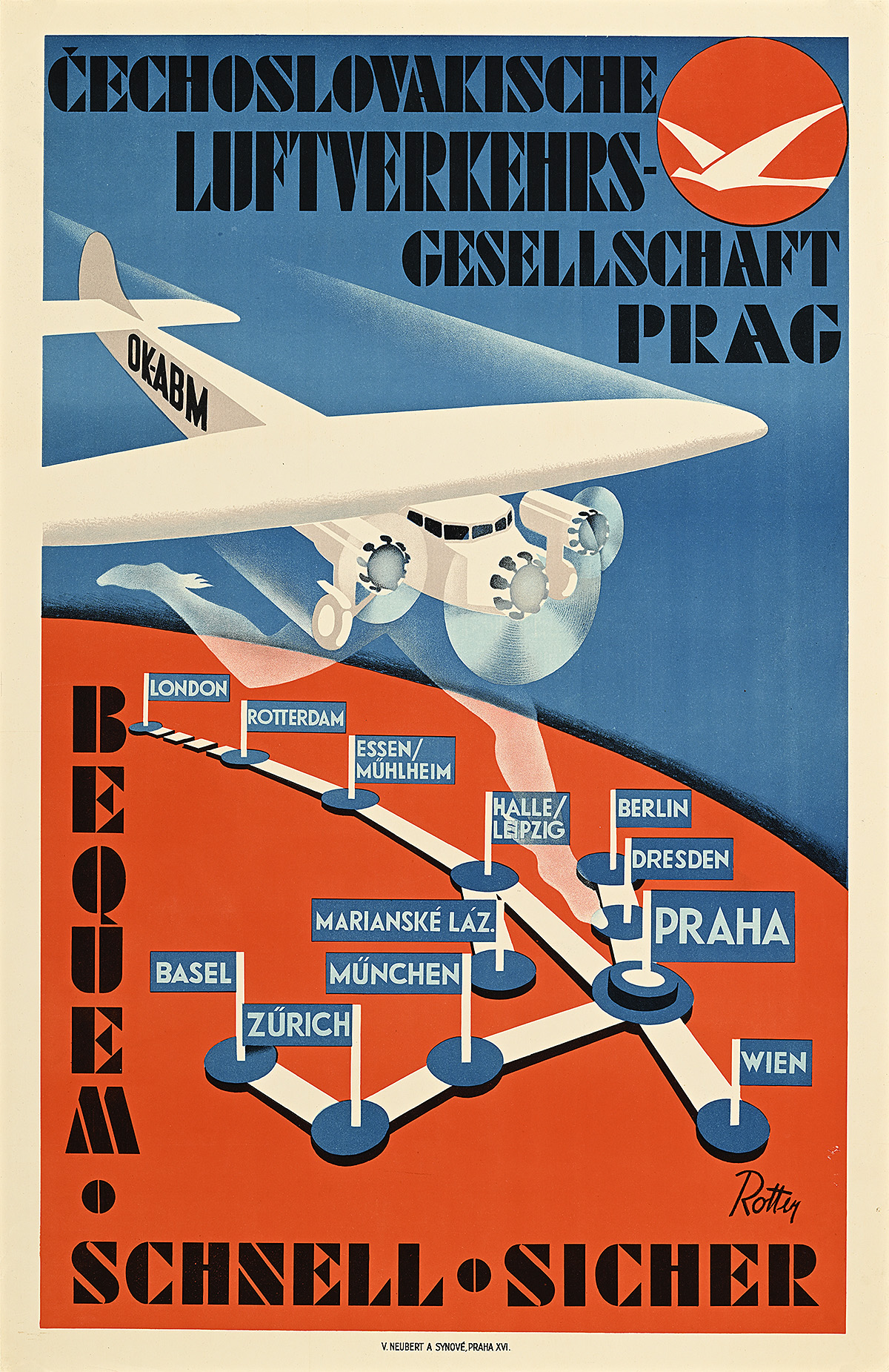
A poster of a white airplane flying over a map of European cities in red, white, and blue.

Čechoslovakische Luftverkehrs-Gesellschaft Prag (Czechoslovak Air Transport Company Prague), 1930

Vilém Rotter (1903–78)

Private Collection, NY

  • Čechoslovakische Luftverkehrs Gesellschaft Prag (Czechoslovak Air Transport Company Prague) was founded in 1927, four years after Ceskoslovenské státní aerolinie (Czechoslovak State Airline). It flew almost exclusively to foreign destinations and operated until the Nazi invasion of Bohemia and Moravia in 1939. 
  • The aircraft shown in this poster is a three-engine Avia Fokker F.VIIb/3m, which went into service for the airline in August 1930. It was a licensed Czechoslovak-built version of the Dutch-designed three-engine plane and could carry up to eight passengers. Manufactured by Avia, the biggest manufacturer of aircraft in Czechoslovakia, it was one of the region’s earliest, successful multi-engine aircraft.
  • In the 1930s, the Avia Fokker played a key role in Czechoslovakia’s vibrant aviation industry, boosting local manufacturing and technological knowledge while advancing the development of Czech air infrastructure.
  • The 1920s and 1930s in Czechoslovakia saw tremendous advancements in aviation technology, industry, and infrastructure. The country was more advanced in this field than its Eastern European counterparts (Poland, Hungary, Yugoslavia, and Romania) and was considered to be on par with the larger countries of Western Europe.
  • This Deco-inspired, whimsical design shows a cutting-edge aircraft being carried by ghostly legs, complete with Mercury-esque wings on its heels, as it swiftly leaps from London to Prague. Intended for the international market, the poster was issued in at least three languages in addition to Czech (French, English, and, as shown here, German).

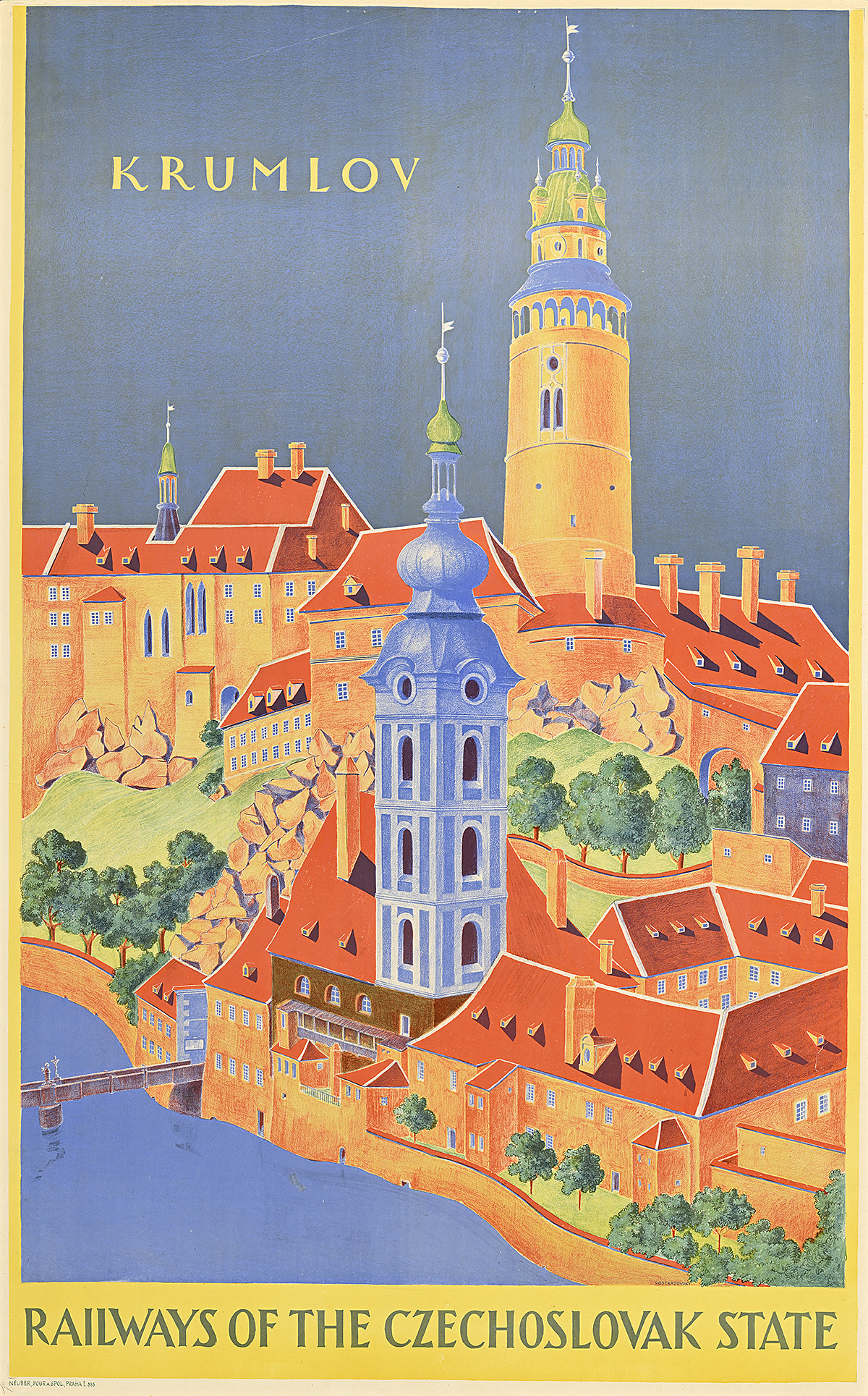
A poster of a colorfully illustrated aerial view of a city with short and tall buildings along a river.

Krumlov/Railways of the Czechoslovak State, c. 1927

Vítězslav Vostradovský (1892–?)

Private Collection, NY

  • Český Krumlov is a historic town in the south-west of what is today the Czech Republic. It is known for its remarkably well-preserved medieval, renaissance, and baroque architecture and picturesque setting along the Vltava River, and is currently the second-most visited city in the country.
  • The city’s origins date back to the 13th century, when the Český Krumlov Castle was built by a noble Bohemian family. Today, that castle dominates the skyline, much as it does in this poster that also highlights the city’s St. Jost Church Tower. Over the centuries the town’s architecture was altered and developed, resulting in a pastiche of styles and motifs.
  • Although the colors in this poster appear bold and whimsical, they reflect the vibrant reality of the city’s bright red-tiled roofs and historic colored facades. In 1992, this unique blend of Gothic, Renaissance, and Baroque architecture was included on the list of UNESCO World Heritage Sites.
  • Produced less than a decade after Czechoslovakia was founded, this early poster reflects national pride and a deep appreciation for the country’s rich history and heritage. Despite its limited tourist infrastructure at the time, Czech authorities recognized the importance of promoting Český Krumlov. The poster was also printed in English, Italian, and French, indicating an intentional effort to attract international visitors.

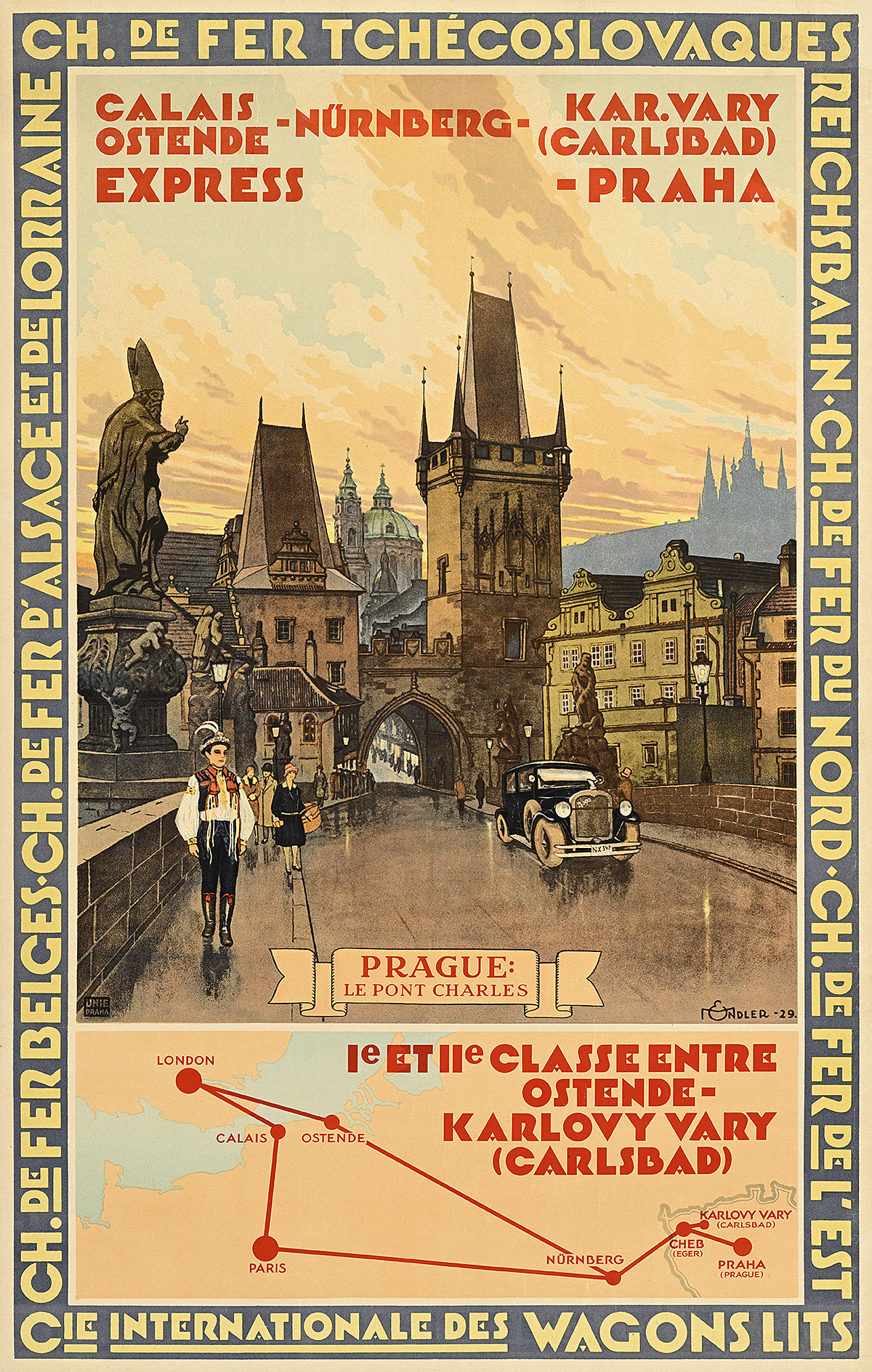
A poster of an illustrated street scene with old buildings in the background and people walking on a sidewalk.

Cie. Internationale des Wagons Lits/Prague: Le Pont Charles, 1929

Miloš Endler (1903–93) 

Private Collection, NY

  • In 1925, the Belgian Compagnie Internationale des Wagons-Lits (best known for managing the Orient Express) began running luxury express train service during the summer months between Ostend, Belgium and Calais, France and Karlovy Vary (Carlsbad), one of Czechoslovakia’s most famous spa towns. Further service was also available to Prague, then emerging as a hub for European tourism. More than just a picturesque view of Prague’s Charles Bridge, this poster signifies the way that Czechoslovakia itself, much like its railway lines, is integrated into the modern cultural fabric of 20th-century Europe. 
  • This image captures a cosmopolitan scene that blends tradition and innovation, juxtaposing stylish shoppers and couples with a man in traditional Moravian attire. While acknowledging the folk life and rich cultural heritage of the country, this poster also showcases a proud technological achievement: the Praga Grand, a luxury Czech automobile introduced in 1929 included here as a symbol of the young nation’s industrial prowess.
  • The design reflects an additional connection to Western Europe in its modern artistic language. The artist uses the same typographical conceit employed by the French designer A. M. Cassandre in his renowned posters from 1927 for Étoile du Nord and Nord Express, in which the names of the train company are positioned along the borders, allowing the central motif to remain clear and unobstructed.
  • This image of the Malá Strana (Lesser Town) side of Prague’s famous Charles Bridge also highlights two now-obsolete elements of the city’s history. The car is shown driving on the left side of the bridge. When Czechoslovakia became an independent country, it had a left-hand traffic system. It was the invading German forces in 1939 who changed Czechoslovakia to a right-hand traffic system. Also, the Charles Bridge has been closed to automobile traffic since 1965, but before that it was open to cars, buses, and even trams.

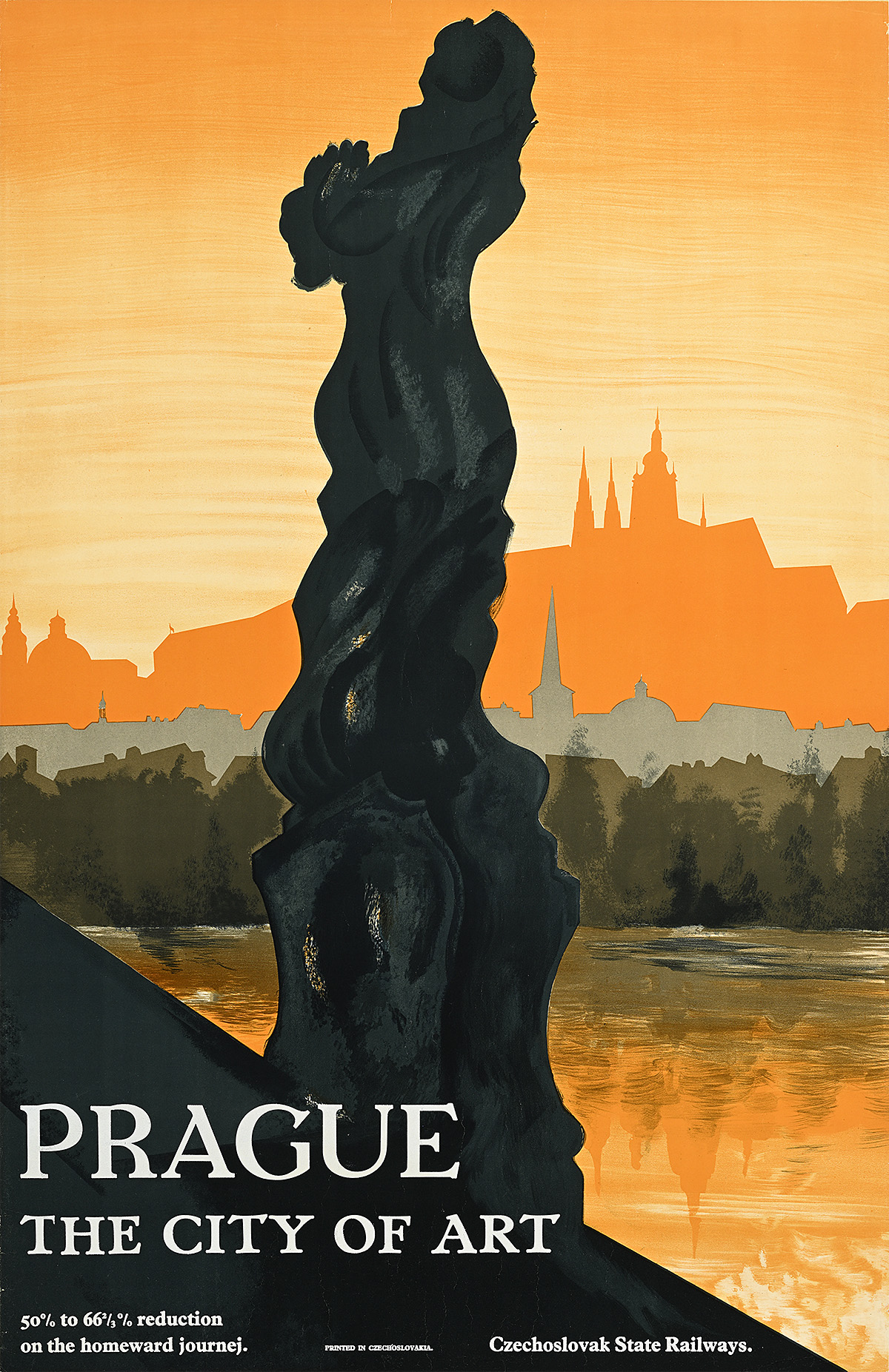
A poster of a large dark statue with a skyline silhouette and body of water in the background.

Prague/The City of Art, 1937

Zdenek Rykr (1900–40)

Private Collection, NY

  • Zdenek Rykr was a prolific Czech artist whose work exemplifies a bold, individualistic modernist style intertwined with broad experimentation. He was best known for his package and logo designs for Orion, a popular Czech chocolate company, that are still in use today. His posters often combine the principles of abstraction and Surrealism, blurring the boundaries between commercial and fine art.
  • Rykr was commissioned to design 12 large, colorful photomontages of Czech spas for installation in the Czechoslovak Pavilion at the 1937 Exposition Internationale des Arts et Techniques dans la Vie Moderne (The Paris 1937 International Exhibition)—all of which exist today only in photographs. Later that same year and into 1938, Rykr designed a series of 13 travel posters for the Ministry of Commerce and Czech Railways promoting various destinations within Czechoslovakia, of which this is one. Stylistically, they reflect the diversity of his artistic output, with several leaning on Surrealist-influenced imagery. 
  • This poster foregrounds Prague’s Charles Bridge while incorporating simple silhouettes of the Lesser Town and the castle in the distance. Though the Baroque statues lining the Charles Bridge have been extensively studied, Rykr’s abstracted depiction makes this particular figure difficult to identify. Rather than rely on a literal interpretation, he captures a poetic twilight mood in this poster, evoking imagination rather than reality. 
  • Rykr’s progressive approach to poster design served as a visual declaration of Czechoslovakia’s modernity and its sophisticated cultural presence on the international stage. This image was printed in several languages for international distribution,  including German, English, French, and Polish.

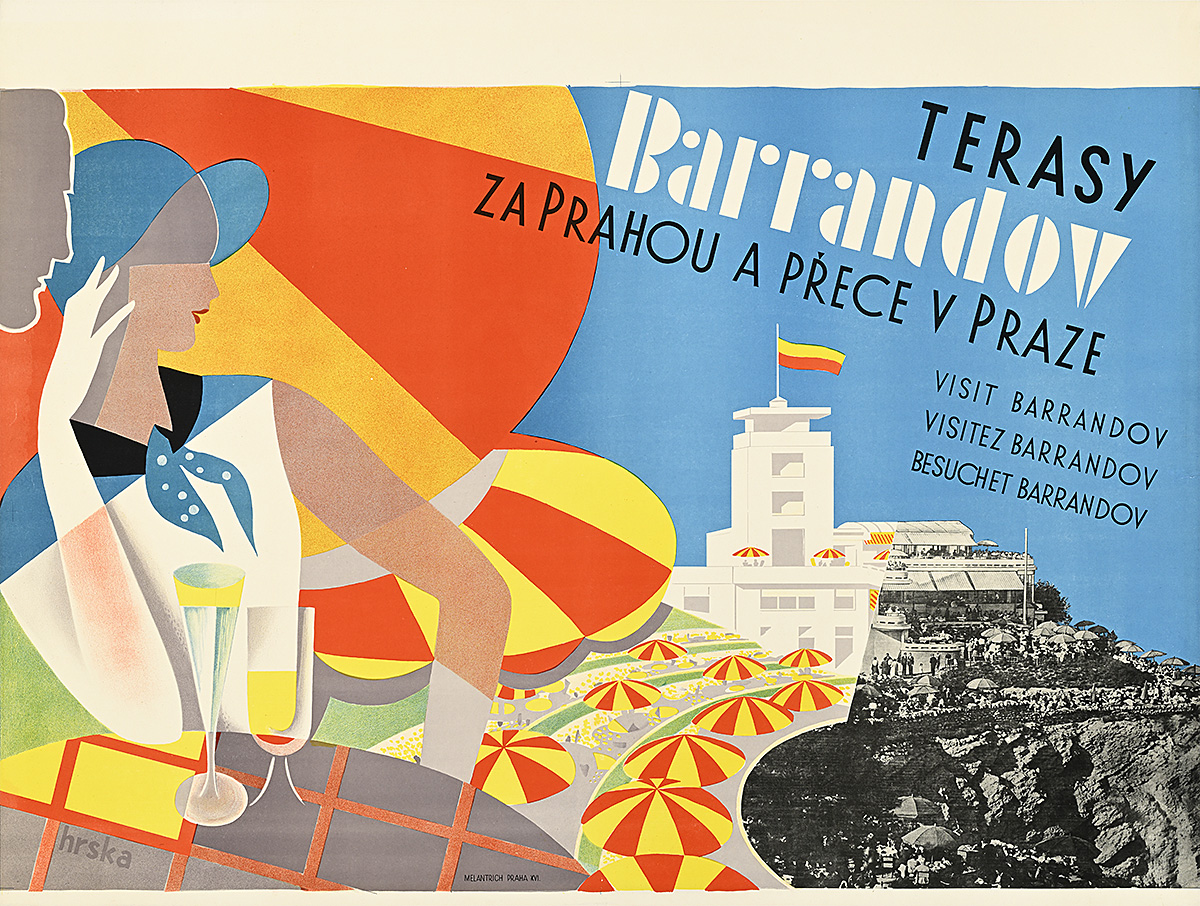
A poster of a woman sitting outdoors under a yellow and red umbrella along a coastline in a geometric style.

Terasy Barrandov (Barrandov Terraces), 1932

Alexandr Vladimír Hrska (1890–1954)

Private Collection, NY

  • The Barrandov Terraces were constructed on a hilltop on the outskirts of Prague and opened on October 4, 1929. Partly inspired by the iconic Cliff House in San Francisco, California, that overlooks the Pacific Ocean, this structure was a masterwork of Czech Functionalist architecture. Commissioned by the father of Václav Havel, Czechoslovakia’s first democratically elected president after the fall of the Communist Regime in 1989 (who was also named Vaclav Havel) and his brother Miloš, it was designed by Max Urban, a leading architect and film director of the era. The terraces, laid out in a horseshoe shape along the natural rock ridge, feature a series of interconnected cafes, restaurants, and bars as well as a ballroom, a large swimming pool, an observation tower, tennis courts, and volleyball courts. 
  • The complex, described in this poster as “Beyond Prague yet in Prague,” was designed as a vibrant social hub that could accommodate thousands—its restaurant alone could host 3,000 guests. It was a groundbreaking venue for recreation and entertainment. Urban went on to design the Barrandov Film Studio on the same hill as the restaurant complex. When the studios were completed in 1933, the terraces, with their sweeping view of Prague and unparalleled services, quickly became a swank and sophisticated playground for the elite, glitterati, and socialites of the era.
  • Designed just 13 years after the country’s founding, this poster stands out as a bold and celebratory victory lap for the young nation. Even Prague’s heraldic colors—deep yellow and red—were incorporated into the complex’s design. 
  • The terraces represented a level of advanced social, architectural, and artistic achievement that inspired national pride. The image captures this ebullience by combining the avant-garde technique of photomontage with Art Deco style, and uses a striking, unconventional horizontal format to create an advertisement that is both inspirational and aspirational.

A poster of a large red train at an angle to denote forward movement at a fast speed.

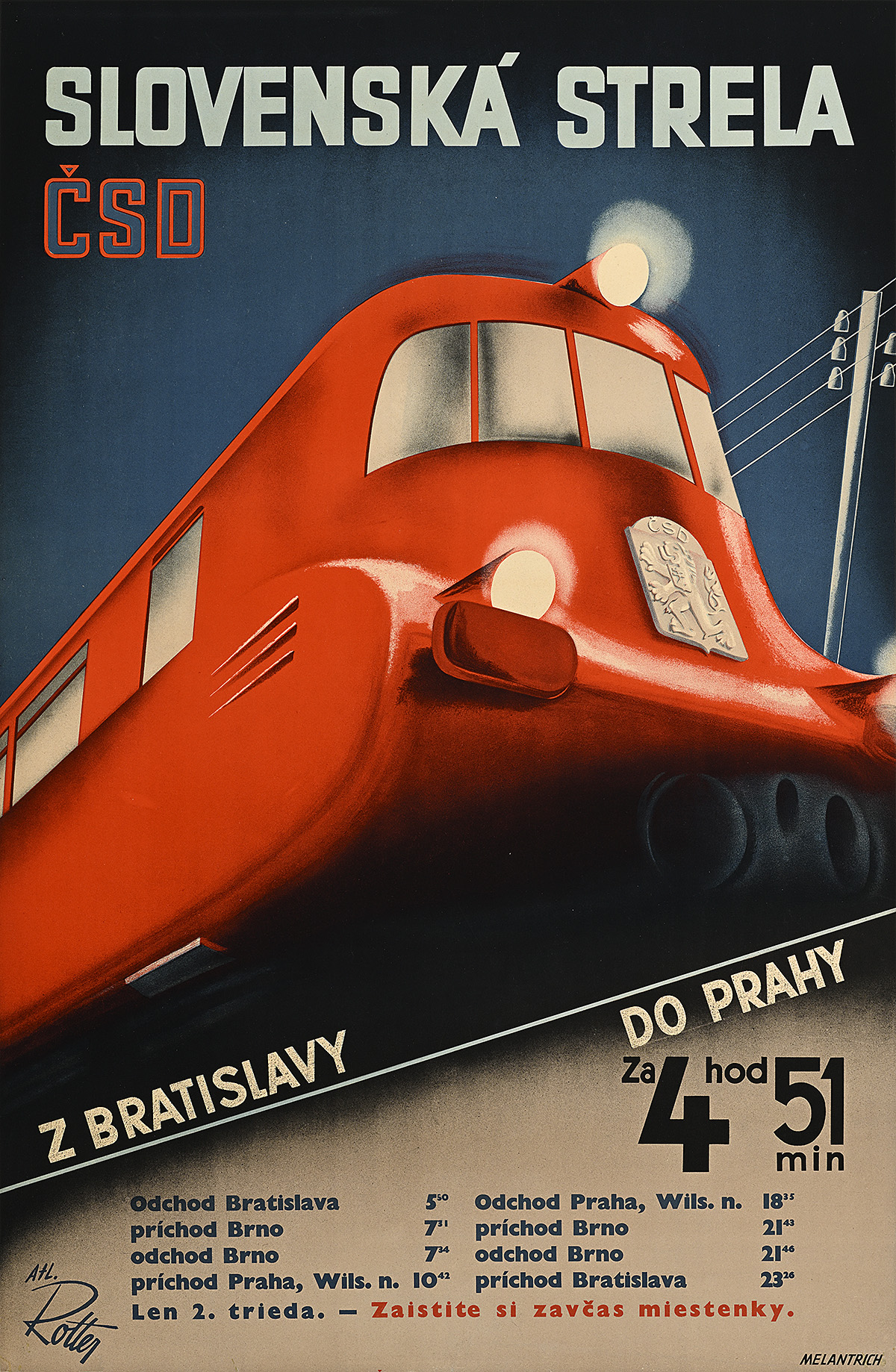
Slovenská Strela (Slovak Arrow), 1936

Vilém Rotter (1903–78)

Private Collection, NY

  • The aerodynamic Slovak Arrow was one of two trains that were manufactured and put into service in 1936, providing a high-speed connection between Prague and Bratislava (the respective capitals of the Czech and Slovak regions of the country). A point of pride, the Arrow’s fame exceeded the boundaries of the country, as it was recognized across Europe for its innovation and beauty. A contemporary Czech critic hailed this poster as “the call of a new age.”
  • The Slovak Arrow’s engine and cars were designed by noted Czech modernist architect Vladimír Grégr. It was able to achieve its high speeds due to an innovative electromechanical transmission devised by inventor and industrialist Josef Sousedík that combined electric and internal combustion. The train was a cultural artifact that became a national symbol of success. Unfortunately, it operated for less than three years, ending service upon the dissolution of Czechoslovakia in March 1939.
  • This striking technological achievement reflected Czechoslovakia’s industrial strength, engineering capabilities, creativity, and innovation, and positioned the young nation on the same level as other progressive European countries that had similar cutting-edge trains, including Germany’s Fliegender Hamburger, France’s Bugatti Autorail, and England’s LNER Class A4.
  • The Czech answer to A. M. Cassandre’s Nord Express in many ways, this poster is a significant Art Deco image in its own right and a widely admired and frequently referenced work of Czech modernist design.

A poster with black and white photos of a landscape and of people hiking on a geometric background.

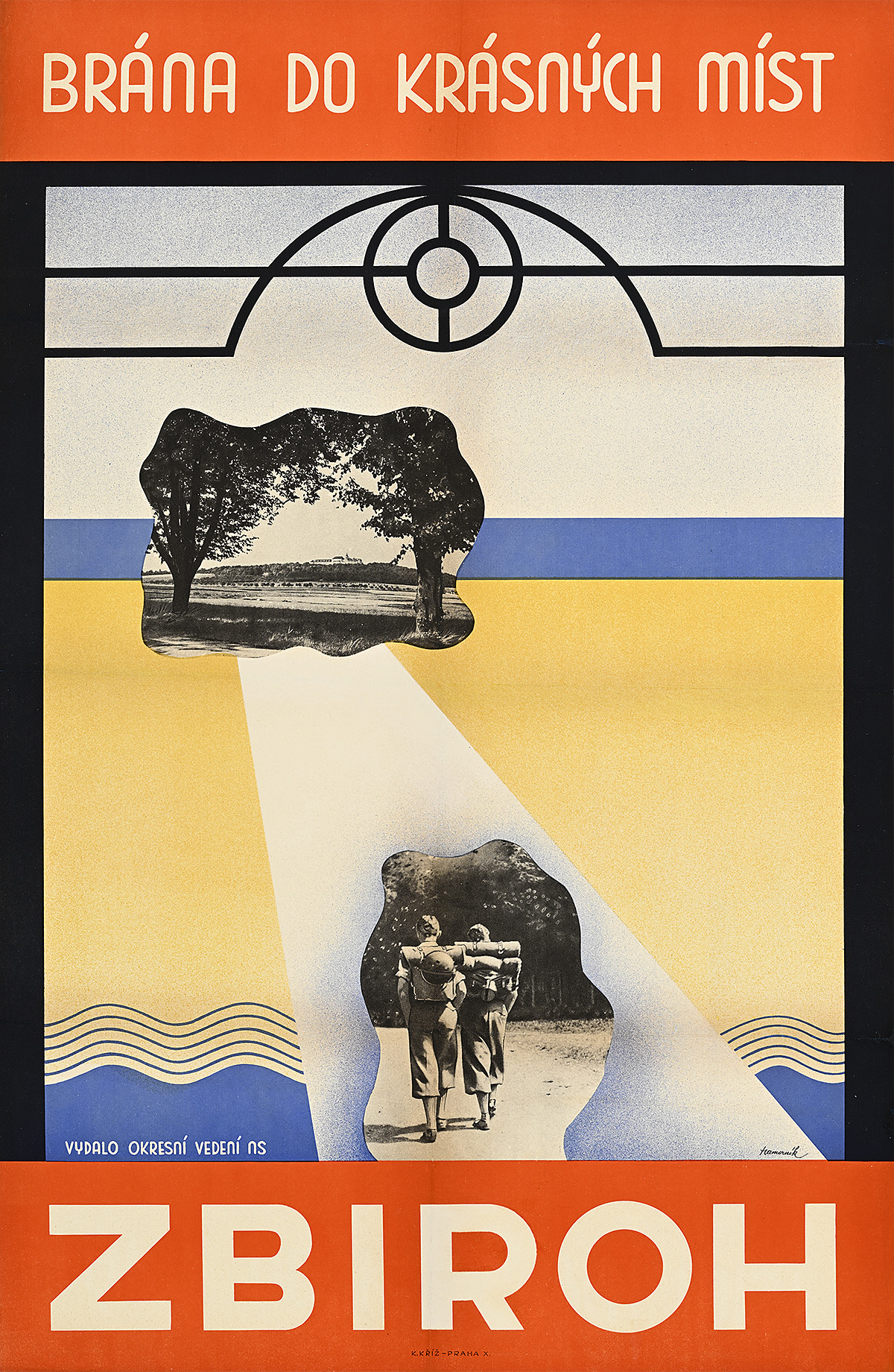
Zbiroh/Brána do Krásných Míst (Zbiroh/Gateway to Beautiful Places), c. 1928

Kamerník (Dates Unknown)

Private Collection, NY

  • Zbiroh is a small town in the middle of the beautiful western Bohemian countryside. Its main attraction is a large, 12th-century castle (pictured in the distance within the poster’s photomontage) that served as the residence of famed poster artist Alphonse Mucha and his family between 1910 and 1928. While there, Mucha completed the Slav Epic, a series of 20 enormous canvases representing the mythology, history, struggles, and successes of the Slavic people that is considered a national treasure today. 
  • This avant-garde poster features a patterned, geometric design that incorporates simple photomontage and airbrushing. In addition to the castle, the photographs show two hikers, emphasizing the natural beauty of the area as a tourist attraction. The graphic flourish along the top and the heavy black borders on either side of the image represent the allegorical gateway mentioned in the poster’s tagline.
  • While it might seem unusual that a small town would produce such an atypical, sophisticated poster, it was printed around the same year that Mucha presented the Slav Epic series to the city of Prague. This was the first time that all the paintings were seen together and the unveiling was promoted as a national event. It is possible that the local administration (the text at the bottom reads, “issued by the district administration of our country”) thought it was a good time to capitalize on Mucha’s renown to generate much-needed tourist revenue.
  • The Prague-based printer of this poster, K. Kříž, also printed a number of Mucha’s posters, reinforcing the likelihood that somehow Mucha’s presence in Zbiroh may have inspired this work.

A poster of a blue and yellow globe and a white vessel in front of several gray spheres on a black background.

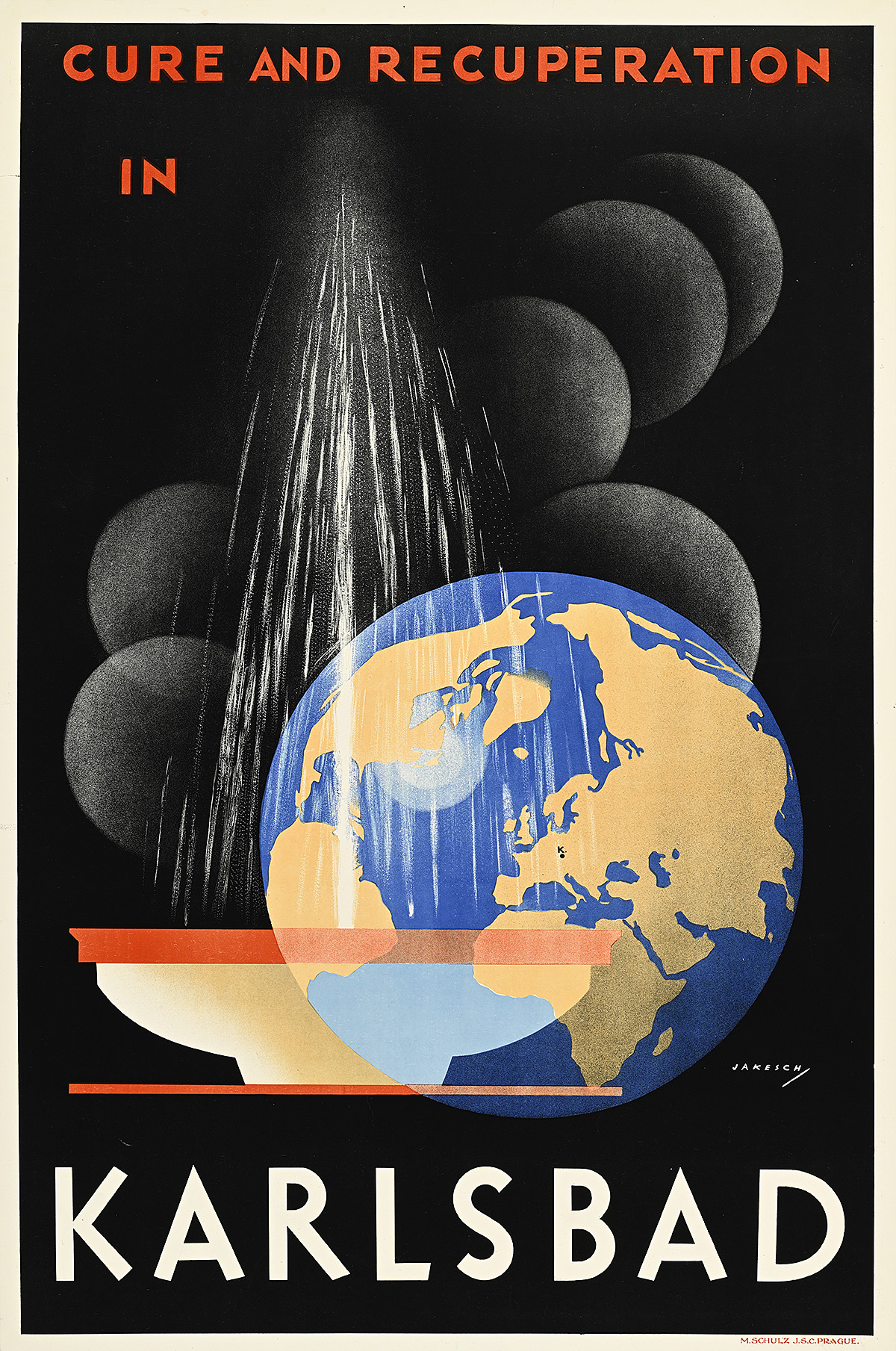
Karlsbad, 1925

Hanns Jakesch (1898–?)

Private Collection, NY

  • Founded in the 14th century by Emperor Charles IV (from whom it takes its name), Karlovy Vary (known in English as Carlsbad) is the most famous spa town in Czechoslovakia. During the 18th and 19th centuries, it grew into an illustrious destination favored by European aristocracy, heads of state, writers, composers, and celebrities for its therapeutic, thermal waters.
  • This poster highlights the Vřídlo (Geyser), the spa’s best-known and most powerful thermal spring. When the geyser erupts every two to three days, the scalding 73°C (163°F) water can reach a height of up to 12 meters (approximately 39 feet)—a magnificent natural display of the thermal power of the hot springs.
  • Designed only seven years after Czechoslovakia was formed, this poster is a modern interpretation of a traditional destination. The bright blue-and-yellow globe in Jakesch’s bold, geometrically inspired Art Deco design contrasts vividly with the dark background. It also eschews Karlovy Vary’s myriad other attractions, including its architecture, colonnades, and picturesque natural setting, signaling the town’s international status as a premier health resort.

A poster of an illustrated woman in a patterned dress standing on a map with mountains in the background.

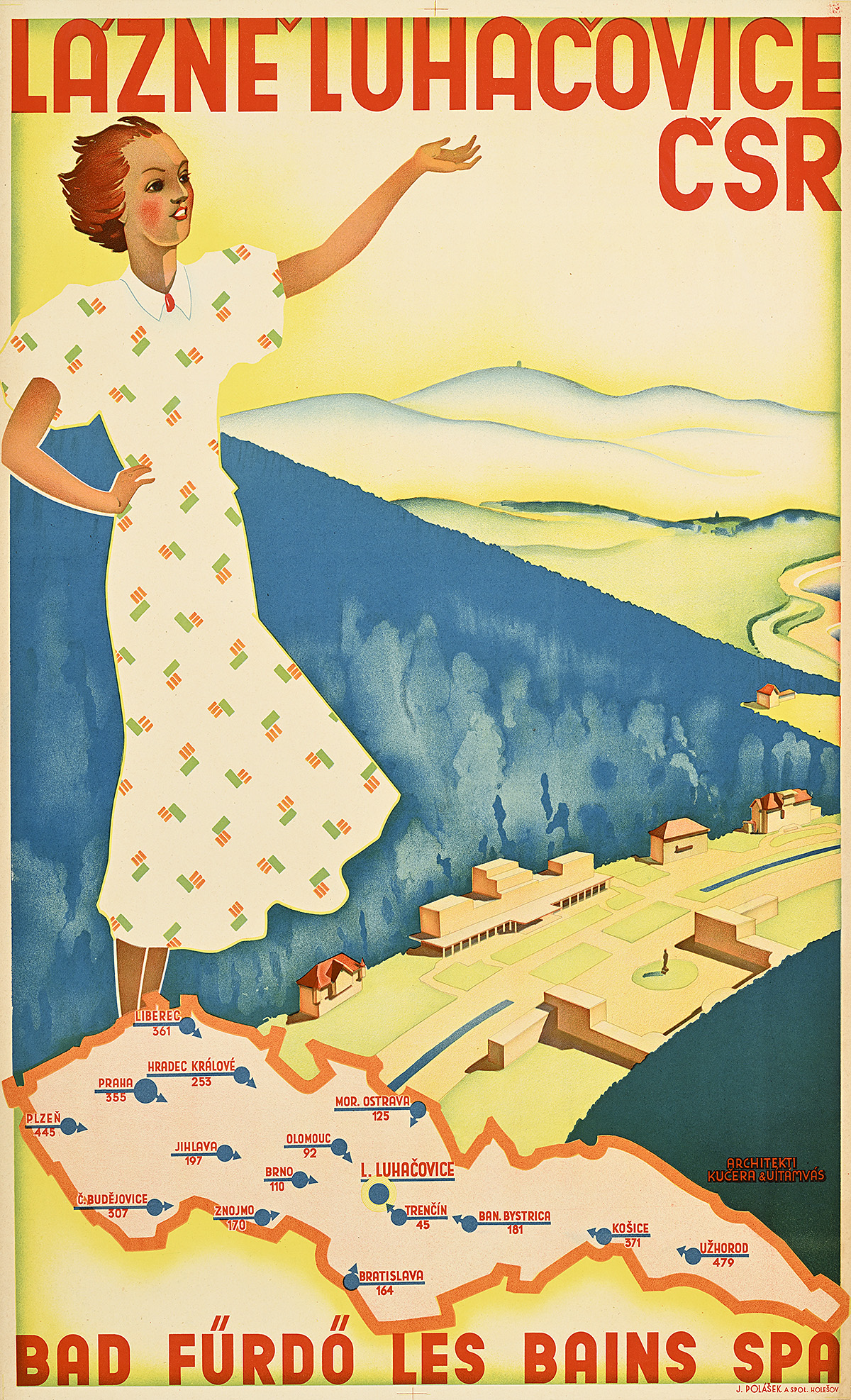
Lázně Luhačovice (Luhacovice Spa), c.1934

Stanislav Kučera (1889–1963)

Private Collection, NY

  • Luhačovice is a spa town in Eastern Moravia famous for the traditional, Slovak folk art-inspired Art Nouveau architecture of Dušan Jurkovič, often featured in advertising before World War I. By the mid-1920s, however, the town had begun to incorporate new structures by modernist architects like Bohuslav Fuchs and František Roith. The central building in this poster, with its colonnade, is Fuchs’s functionalist Společný Dům, constructed in 1934.
  • This poster highlights the town’s transition: rather than presenting the dainty architectural relics of the prewar era, it highlights Luhačovice’s evolution as a new, modern town.  
  • The Functionalism that emerged in the architecture of the 20th century emphasized utility and practicality as the primary principles of a building’s form. According to this approach, the structure and aesthetic of a building should be dictated by its intended function and purpose rather than by decorative or ornamental considerations. Progress and sophistication are represented in this poster not only by examples of Functionalist architecture but also by the female figure’s modern dress with its geometric pattern. The combination emphasizes the town’s status as a chic, up-to-date resort.
  • The lower register features a map with distances and directional arrows from numerous locations within Czechoslovakia. Such progressive infographics underscore Luhačovice’s accessibility, its location almost exactly in the center of the country positioning it as a key European spa destination. The poster was meant to appeal to the expanding intra-European tourist trade, and was printed in German, Hungarian, French, and English along the bottom, welcoming visitors from across the continent.

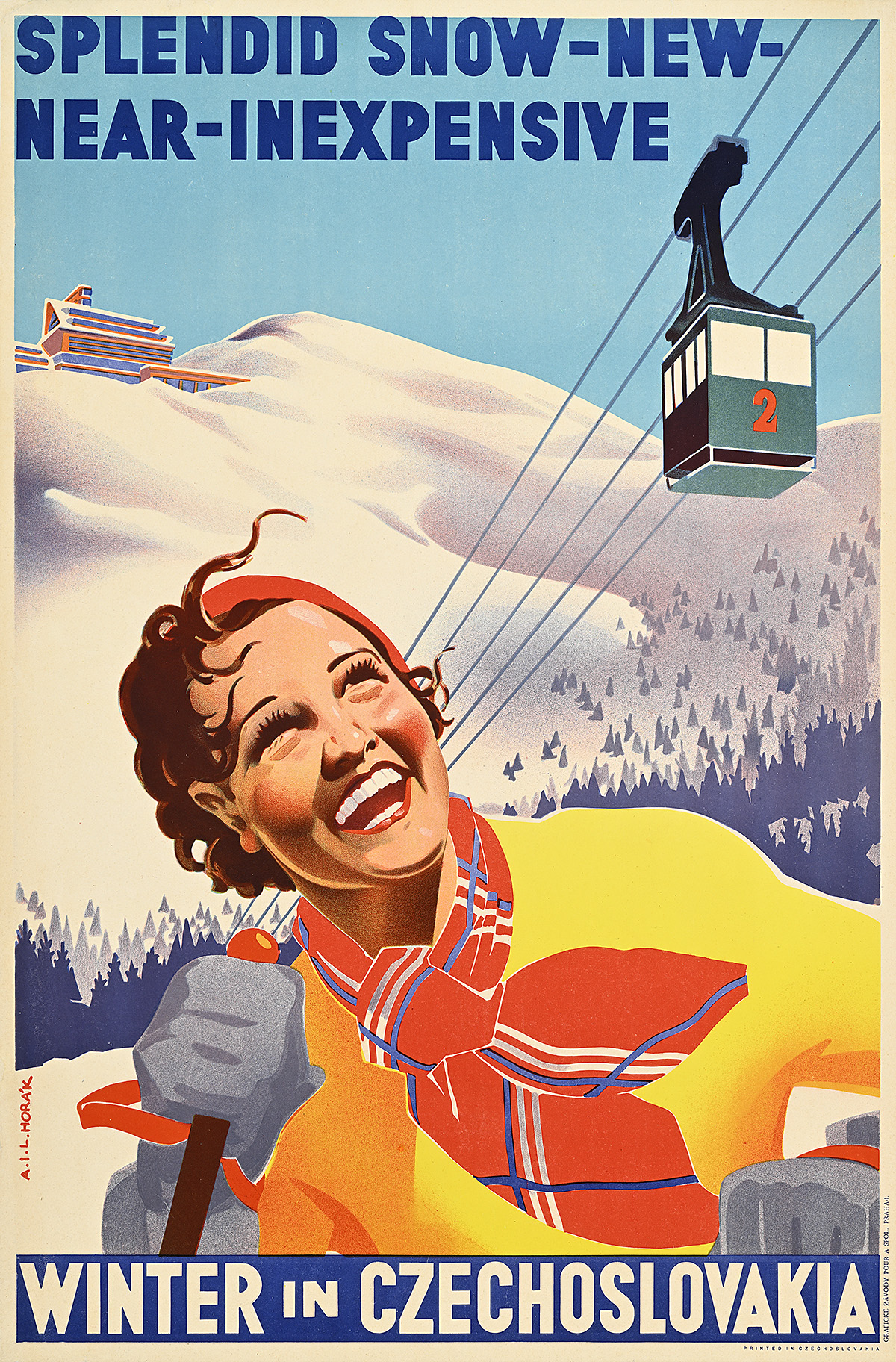
A poster of a smiling woman looking up with a ski lift and snow covered mountain in the background.

Winter in Czechoslovakia, c. 1935

Ladislav Horák (1904–c. 1951)

Private Collection, NY

  • This poster was designed to attract foreign tourists to the snow-covered slopes of Černá Hora (Black Mountain) in the Krkonoše Mountain range (located in the northern part of the country along the Polish border). Printed in German, French, and English, the imagery and text speak not just to skiing but also to a modern, progressive nation welcoming the world to its mountains. Even the advertising copy incorporates a contemporary approach to marketing by touting the country’s low prices, accessibility, and optimal skiing conditions.
  • The country’s first cable car was installed in 1928, running from the town of Janské Lázně up Černá Hora. Covering 3.1 km (nearly 2 miles), it was one of the longest in Central Europe at that time and could carry up to 120 passengers an hour. The building perched on the ridge is the luxurious Horský Hotel Černá, completed in 1935.
  • The designer’s focus on a confident, stylish, and joyful female skier reflects a shift in European visual culture: women were no longer mere companions to alpine sportsmen but central participants in such exciting activities. Such a depiction underscores the changing role of women in leisure and tourism, aligning Czech identity with that of modern Europe. 
  • The optimism of this poster stands in stark contrast to the mounting uncertainty in greater Europe by the mid 1930s; the economic depression was still widespread, Italy had invaded Ethiopia, and Germany had passed the antisemitic Nuremberg Laws and was actively building up its military power.

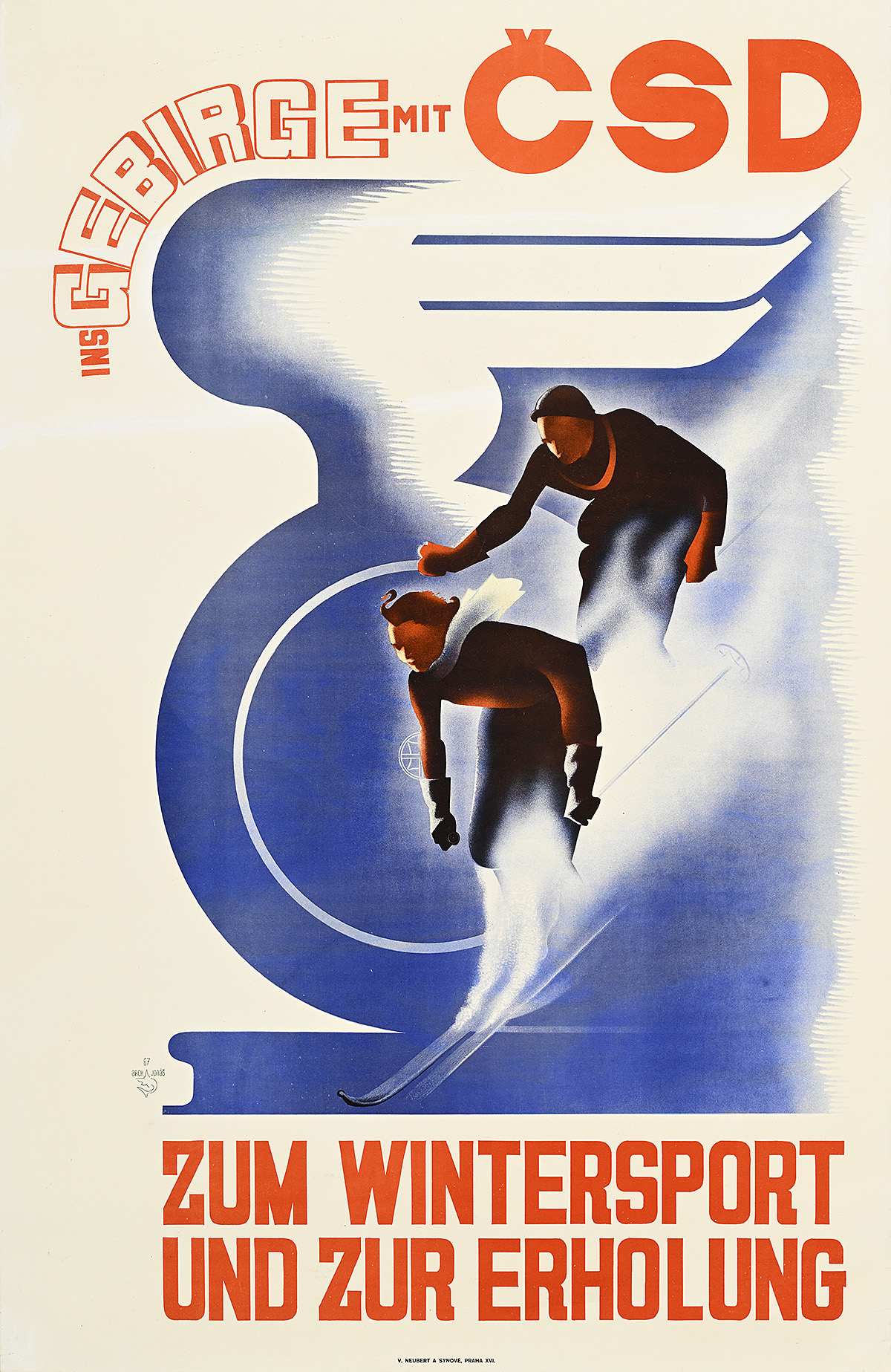
A poster of two figures skiing down at a sharp angle on top of an abstract blue and white shape.

Ins Gebirge mit ČSD (Into the Mountains with CSD), 1937

Albert Jonáš (1893–1974)

Private Collection, NY

  • Designer Albert Jonáš frequently combined stylized, flat graphic elements with hyperrealistic figures, as seen in this poster for the Czech Railways. In it, two downhill skiers race against an airbrushed background composed of a blue-and-white winged wheel, the emblem of the company. 
  • Modernist French poster design had a profound impact on Czech advertising during the interwar period, most especially the work of A. M. Cassandre whose posters, along with others, appeared in multiple exhibitions in Prague during that time. Jonáš was familiar with these posters and clearly attempted to emulate their style through his use of airbrushing and other advanced design techniques. 
  • Printed in several languages with numerous textual variants among them, this German edition of the poster indicates that the mountains are the ideal destination for both skiing and “recovery.”
  • Jonáš was an architect and designer who created four posters for the Czech Railways and is credited with helping to bring modernist European design to the medium.

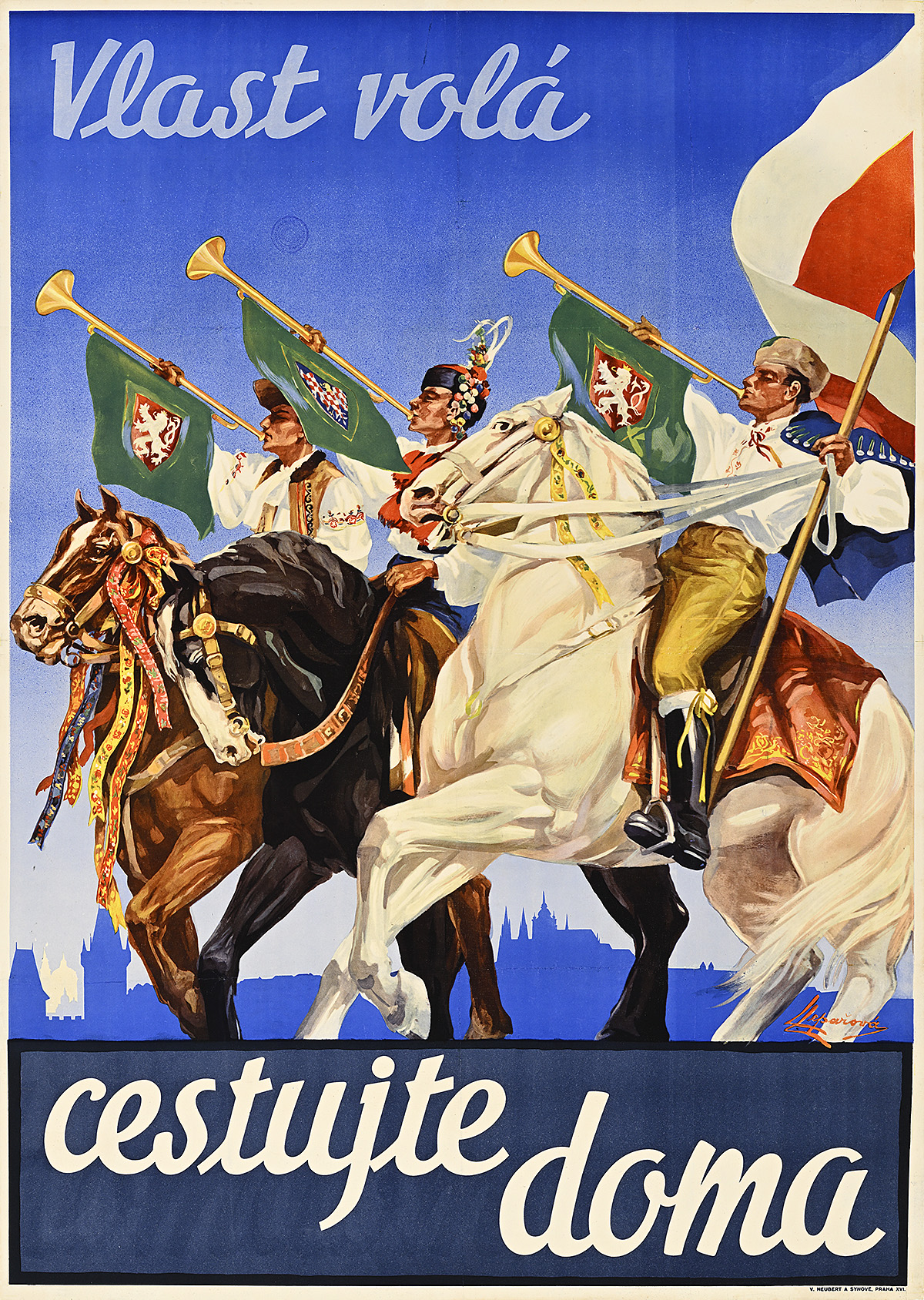
A poster of three men in elaborate dress on horseback blowing trumpets with flags on a blue background.

Vlast Volá/Cestujte Doma (Your Country Calls/Travel at Home), c. 1930

Libuše Lepařová-Samková (1896–1980)

Private Collection, NY

  • In response to the turbulent financial realities of the Great Depression of the 1930s, the Czech government began encouraging citizens to “travel at home”—another way of suggesting that they go on holiday within their own country. Such domestic travel not only helped the local economy but also allowed Czech citizens to experience Czechoslovakia’s great cultural diversity, fostering a sense of national identity and solidarity that might provide a bulwark against the rising political tensions of the time.
  • One of the goals of The First Republic was to construct a cohesive, shared “Czechoslovak” identity, helping the new country unify behind common traditional themes. Highlighting folk traditions like the one shown in this design was meant to act as a cultural glue for the various ethnic groups that made up the country.
  • This poster showcases heralds on horseback clad in folkloric outfits specific to various regions in Bohemia and Moravia carrying crested flags with the Bohemian lion and the Moravian eagle as they trumpet the glory of their own country to their countrymen with a silhouette of Prague’s distinctive skyline in the distance.

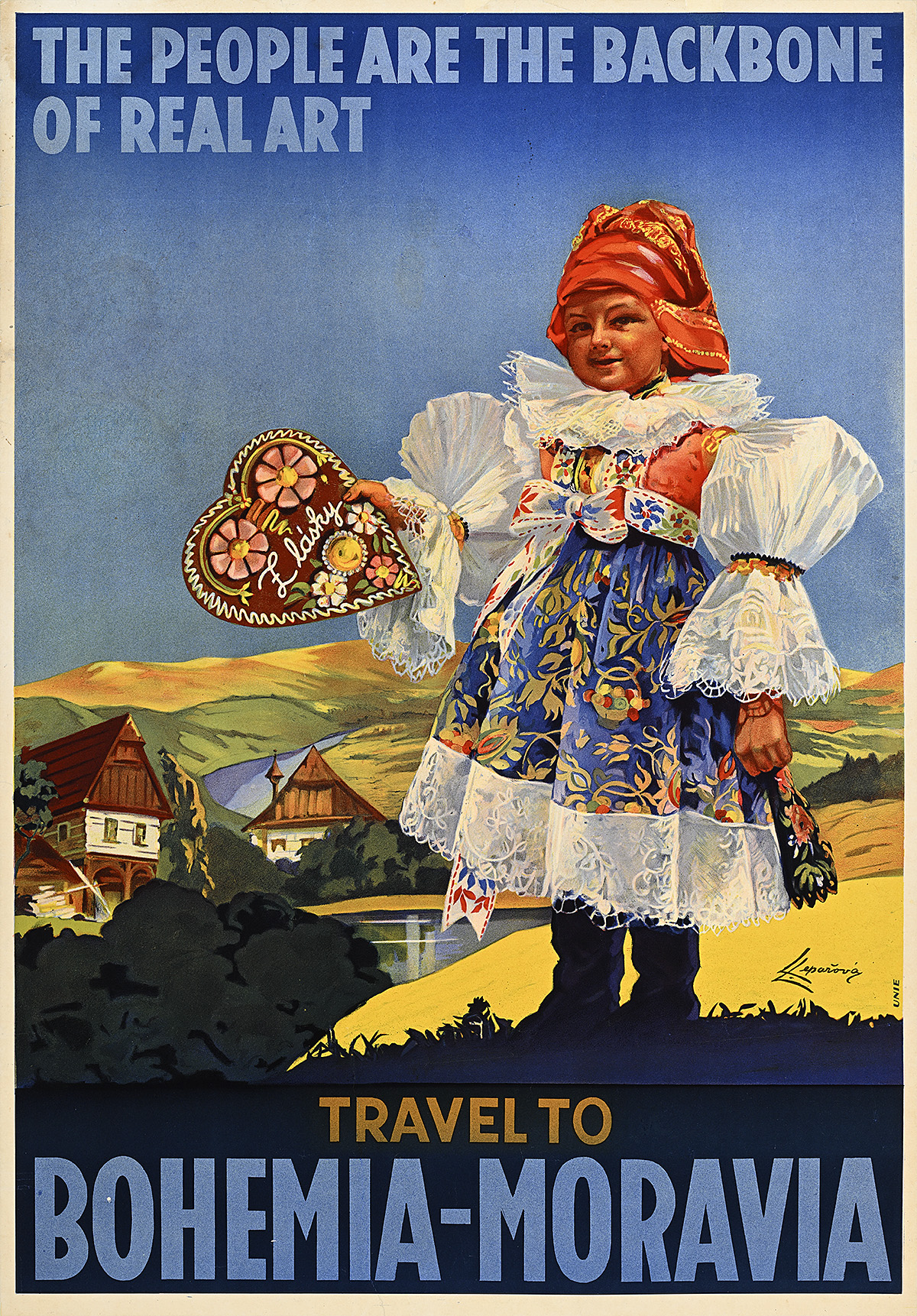
A poster of a young person in a lacy dress holding a heart shaped object with houses and hills in the background.

Travel to Bohemia-Moravia, c. 1930

Libuše Lepařová-Samková (1896–1980)

Private Collection, NY

  • The young girl featured in this poster is dressed in a ceremonial kroj (traditional folk costume) from the Veselí nad Moravou area of southeastern Moravia, known for its longstanding tradition of regional craftsmanship and rich cultural identity. Krojs from different regions are distinctive, often down to the village level, with unique embroidery patterns, color palettes, lacework, and garment structures—making the wearer’s specific origin identifiable to other locals. The girl is holding a traditional, heart-shaped perník (gingerbread) decorated in icing with the inscription z lásky (with love). A deeply ingrained part of Czech culture, perník is frequently made and consumed on religious holidays and at festivals.
  • Designed by Libuše Lepařová-Samková, one of the era’s few known Czech female designers, this poster reflects traditional village life, regional dress, and customs with colorfully authentic ethnographic detail. The design uses the thriving heritage, tradition, and ethnic identity of Czechoslovakia to promote travel. The appearance of such “exotic” imagery on travel posters projected a sense of history, tradition, and national authenticity to those abroad while fostering a sense of cultural unity rooted in shared tradition at home.

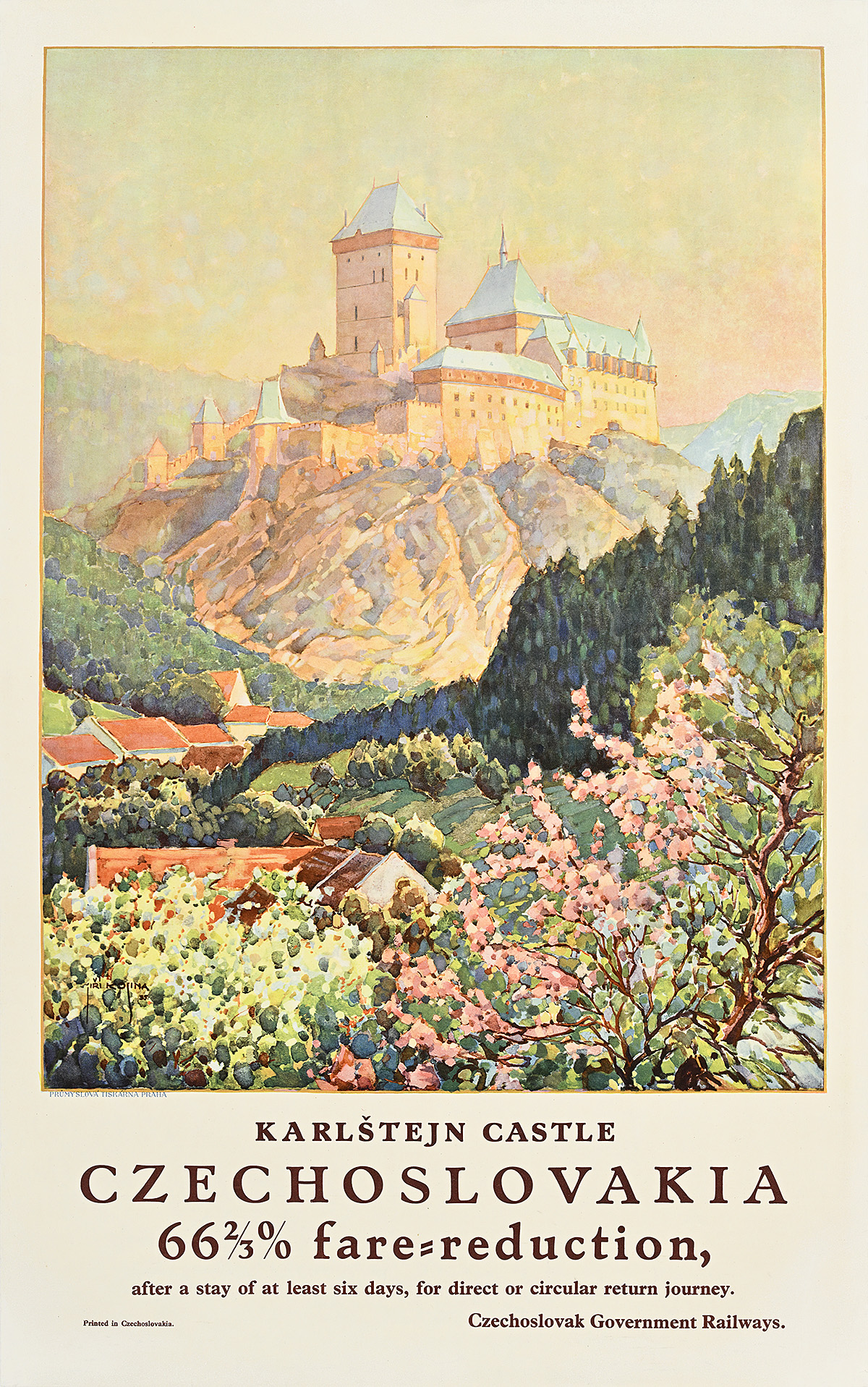
A poster of a painterly landscape with a castle on a hilltop and flowers in the foreground.

Czechoslovakia/Karlštejn Castle, c. 1935

Jiři Kosina (1891–?)

Private Collection, NY

  • This traditional landscape poster is more important for its message than its image, incorporating modern marketing techniques to promote international travel to Czechoslovakia. Specifically, it highlights one of the many promotional initiatives implemented by the Czechoslovak State Railways in the 1930s, one of which involved significant discounts—up to 66 percent—on return tickets, provided travelers stayed at least six days. These incentives successfully boosted both domestic and international tourism, stimulating economic activity and helping to bring the country to the forefront of foreign attention. 
  • Advertised through posters, magazines, and brochures, these attractive fare reductions also encouraged its own citizens to explore Czechoslovakia, something that not only served an economic purpose but also increased an awareness of their own country, expanding a sense of national pride. 
  • Karlštejn Castle was built in the late 14th century by King Charles IV as a residence and  secure stronghold for the Crown Jewels of Bohemia, holy relics, and other treasures. Located near Prague, it is renowned for its Gothic architecture and historical significance, and remains one of the country’s most important cultural landmarks.

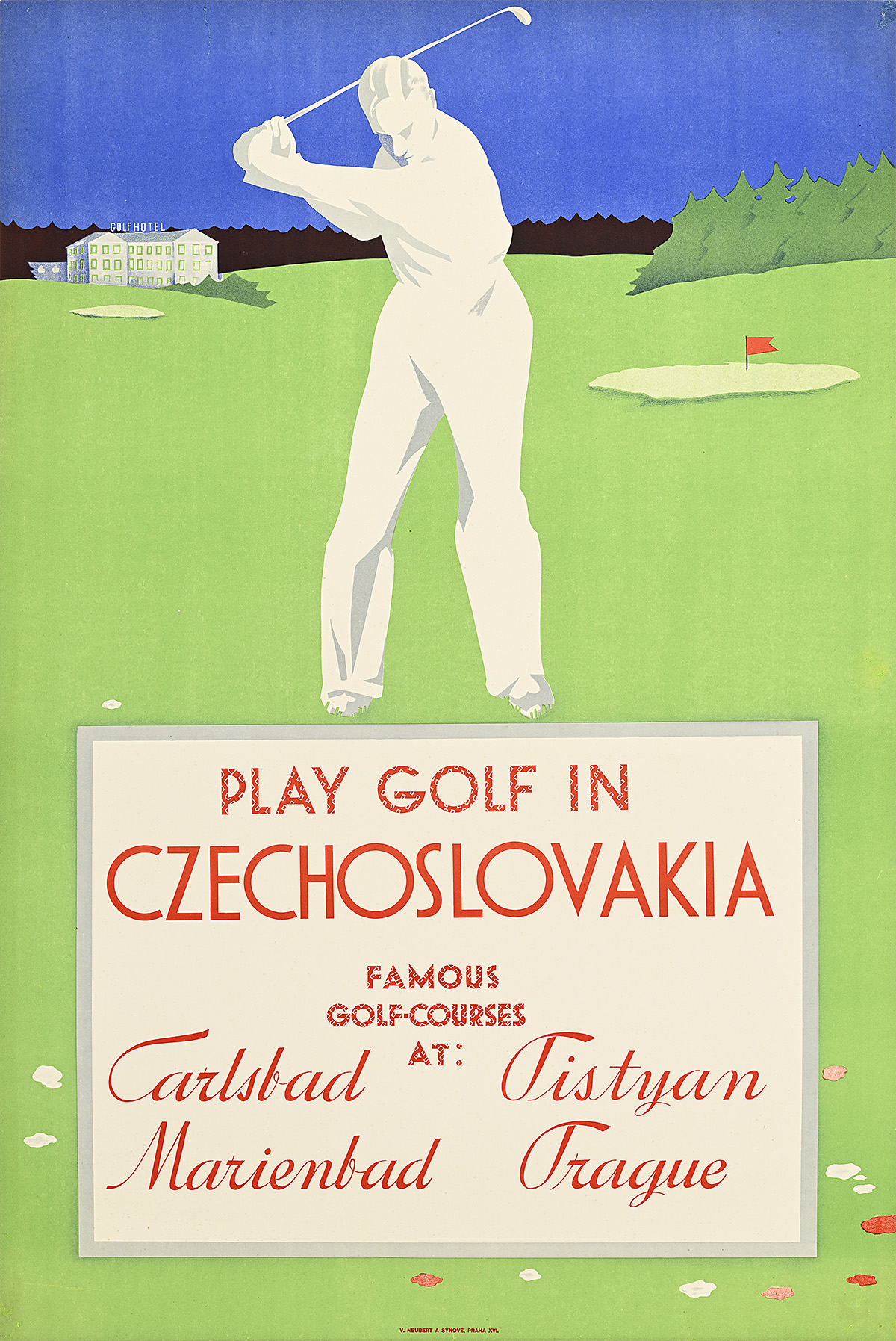
A poster of a man all in white holding a golf club on a large golf green with a blue sky.

Play Golf in Czechoslovakia, c. 1930

Designer Unknown

Private Collection, NY

  • In 1904, the first golf course in the Austro-Hungarian Empire opened in Karlovy Vary (Carlsbad), The following year, it was joined by another in Mariánské Lázně (Marienbad), with King Edward VII of England attending the opening. Before the outbreak of World War II, Czechoslovakia had expanded to nine golf courses, reflecting the sport’s growing popularity and prestige in the region.
  • A golfer is pictured here in mid-swing on the fairway of the course at Mariánské Lázně; the spa town’s recognizable “Golf Hotel” is visible in the background.
  • The formal organization of golf in the country began on December 2, 1931, with the founding of the Golf Association of Czechoslovakia, marking the beginning of structured competitive play and the national promotion of golf as a formal sport. Such efforts helped to nurture local talent and elevate the game’s profile within the country.
  • From 1935 to 1938, Czechoslovakia became an important venue for international golf, hosting the Czechoslovak Open at both Mariánské Lázně and Karlovy Vary. Additionally, the Piešťany course, founded in 1914, became the site of several renowned tournaments and was the first on what would later become Slovak territory. In 1926, Prague opened its first golf course, the Golf Club Praha, further cementing Czechoslovakia’s reputation in European golf circles.
  • Promoting golf served to elevate Czechoslovakia’s profile as a modern, diverse, sophisticated, and prestigious travel destination, diversifying its tourism portfolio beyond historical sites and spas, highlighting the country’s ability to offer luxury and leisure alongside its cultural and natural attractions.

Curator

Nicholas D. Lowry


Exhibition Design
Mihoshi Fukushima Clark


Registrar

Melanie Papathomas


Special Thanks

Chris Harwood, Columbia University

Petr Štembera, Czech poster curator

Jindrich Toman, University of Michigan

Daniel Levine, Czech travel and trends writer

Michal Nanoru, Czech art scholar

Catherine Bindman, editor

Randy Ferreiro, proofreader

Sofía Jarrín, Spanish translator


Typefaces

BC Novatica designed by Marek Pistora and Tomáš Brousil

Skolar Sans design by David Březina and Sláva Jevčinová


PULL QUOTES:

“I daresay that the railways have raised nations in the same way as schools.”—Tomáš Garrigue Masaryk, First President of Czechoslovakia  

 “Art in advertising is needed like salt in bread. But too much salt is also not good.”—Vilem Rotter, artist

 “Freelance artists usually understand commercial advertising  about as much as businessmen understand free art.”—Vilem Rotter, artist

“Feels like the call of a new age”—Vladimír Ringes, artist