Reading Under Fire: Arming Minds & Hearts During Wartime

During World Wars I and II, millions of young men traveled into war zones, where they experienced horrific conditions and witnessed devastating destruction. Nearly every nation involved recognized that it was necessary to maintain the soldiers’ wellbeing and morale in these extreme situations. Because foot soldiers had to carry all of their possessions, portable forms of entertainment were needed and books became hugely popular. Between lulls in action or when waiting for orders far from the front lines, the troops read to forget their surroundings and fears, taking a mental vacation from their hardships. When they finished reading, they swapped titles with one another so they always had new material. As an Army officer observed during World War II, saturating war zones with books was “the greatest improvement in Army technique.”  

This exhibition includes book-related posters issued by the United States, Great Britain, Canada, and Germany printed during both world wars. All of these nations relied on public book donations and fundraising to supply soldiers with reading material, and many posters encouraged the public to give. Civilians tended to contribute fiction and recreational reading matter, providing the kind of escapist stories soldiers wanted most. After each war ended, however, and troops awaited their return home, they often gravitated toward more educational and vocational books to prepare for promotion within the Army, future jobs, or civilian life. 

Especially during World War II, books became a powerful symbol of freedom and democracy for America and its allies. Many American posters incorporate patriotic symbols like flags or eagles to suggest that democratic values are bolstered by the reading and sharing of books. Some American posters also contrast Nazi Germany’s book burnings and bans to American efforts to distribute millions of books and protest the enemy’s actions through reading. The United States alone distributed more books to the troops during World War II (more than 140 million) than Nazi Germany was able to destroy (roughly 100 million).

In summarizing the role of books in wartime, a poster from World War II said it best: “We Read.”

Whenever feasible, Poster House reuses materials from previous shows to drive sustainable practice.
World War I

During World War I, books were a popular form of entertainment available to the troops of all armies, and an array of organizations assisted governments in getting stories into the hands of servicemen. 

The YMCA played a chief role in providing materials—from books and musical instruments to writing paper and hot chocolate—to boost the morale of soldiers. Beginning in 1914, the British YMCA hosted book drives, sought monetary donations, and launched campaigns to educate civilians about the constant demand for books and magazines at the front. British YMCA outposts were built across France and Flanders where the bulk of the fighting occurred and soldiers were most in need of respite.

When the United States joined the war in April 1917, the military had to scramble to mobilize and prepare for combat; it therefore relied on nonprofit, civilian aid organizations to supply recreational materials to the troops. The American Library Association (ALA) took a leading role in stockpiling books by launching book-donation campaigns and fundraising so soldiers would be supplied with popular titles and magazines. Millions of books were distributed as the ALA collaborated with the American YMCA to ensure that books would be available in the YMCA’s facilities for U.S. troops, and with the Red Cross to get books to hospitalized soldiers. After the Armistice, many soldiers read books to prepare for future jobs as civilians or to advance their rank if they remained in the Army. Whether for entertainment or information, books accompanied servicemen throughout the war.  

The Allies were not alone in these efforts. Part of the Central Powers (also consisting of Austria-Hungary, the Ottoman Empire, and Bulgaria) during World War I, the German Army also understood the importance of providing troops with books to stave off boredom during long lulls in action. Book-collection campaigns were held across Germany, and civilians were asked to donate books on a variety of subjects so that every German soldier could find a tempting story to read. 

Across battlefronts and armies, many soldiers developed the habit of turning to a book whenever the fighting quieted to help relieve the stress of combat and mentally escape the war.

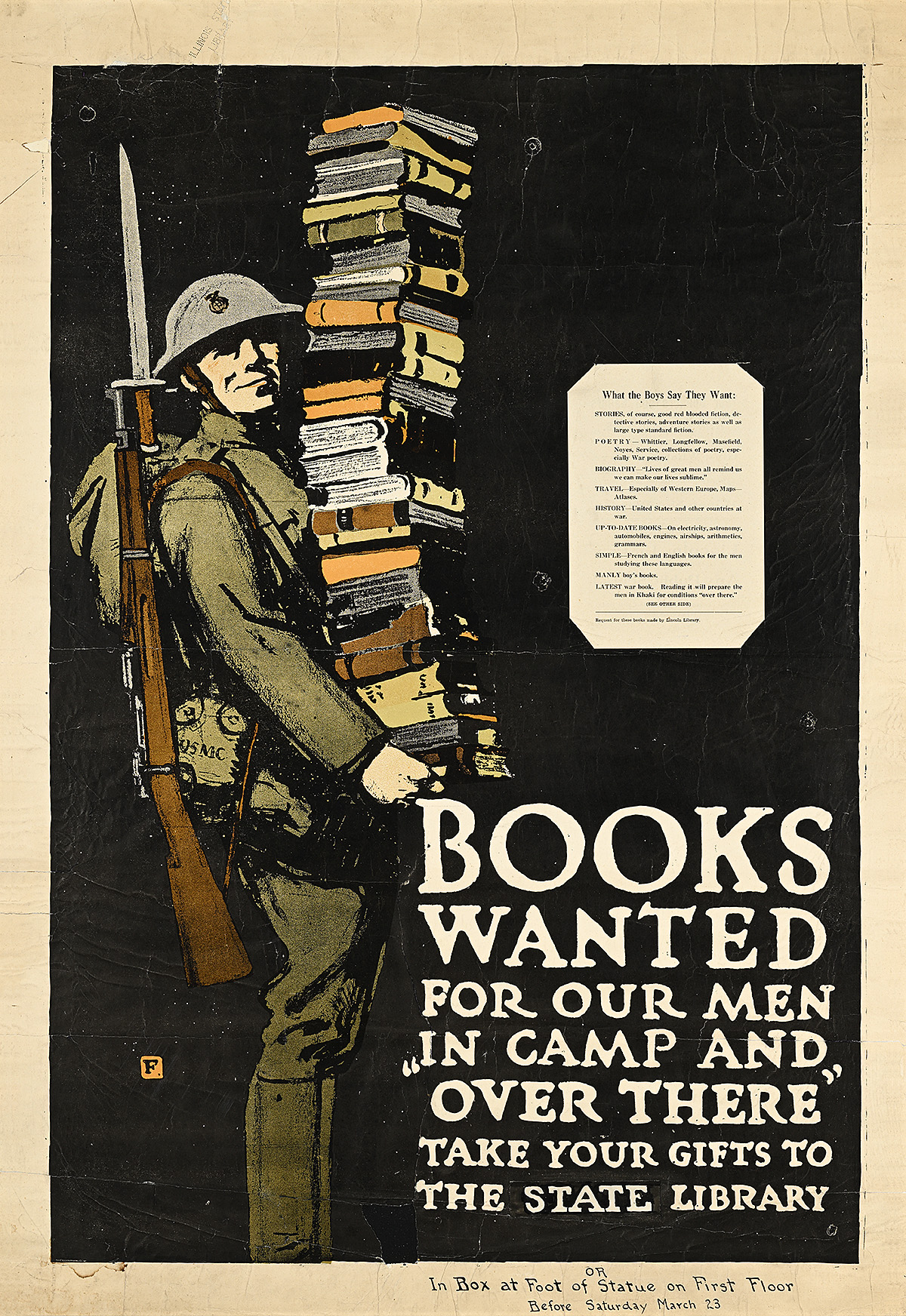
A poster of a soldier holding a tall stack of books in his arms on a black background.

Books Wanted, 1918

Charles Buckles Falls (1874–1960)

Private Collection, NYC

  • In 1918, Charles Buckles Falls was hired by the American Library Association (ALA) to paint a 15-foot mural of this design on a giant canvas at the New York Public Library’s 42nd Street entrance in Manhattan. The image was so well received that the ALA used the composition in multiple posters, both during the remaining months of the war and in its immediate aftermath. 
  • This design was printed by the thousands and distributed across the country to educate the public about the ALA’s book drive. 
  • Falls was a member of the Society of Illustrators, which worked with the Committee on Public Information (CPI), also known as the Creel Committee, to produce wartime propaganda, including posters. Falls designed several posters for the CPI but this motif became his most famous.
  • While the original version of this poster advised viewers to “take your gifts to the public library,” some librarians modified it to specify that a state library (which served state government employees rather than the general public) or a university library was collecting books. This copy of Books Wanted was altered from “public” to “state” library, and a handwritten message along the lower margin indicates where to find the donation bin. The Lincoln Library also added a separate panel to this version of the poster listing popular genres of books requested by the troops, including “good red blooded fiction,” “manly boy’s books,” biographies “of great men,” and poetry by Longfellow.

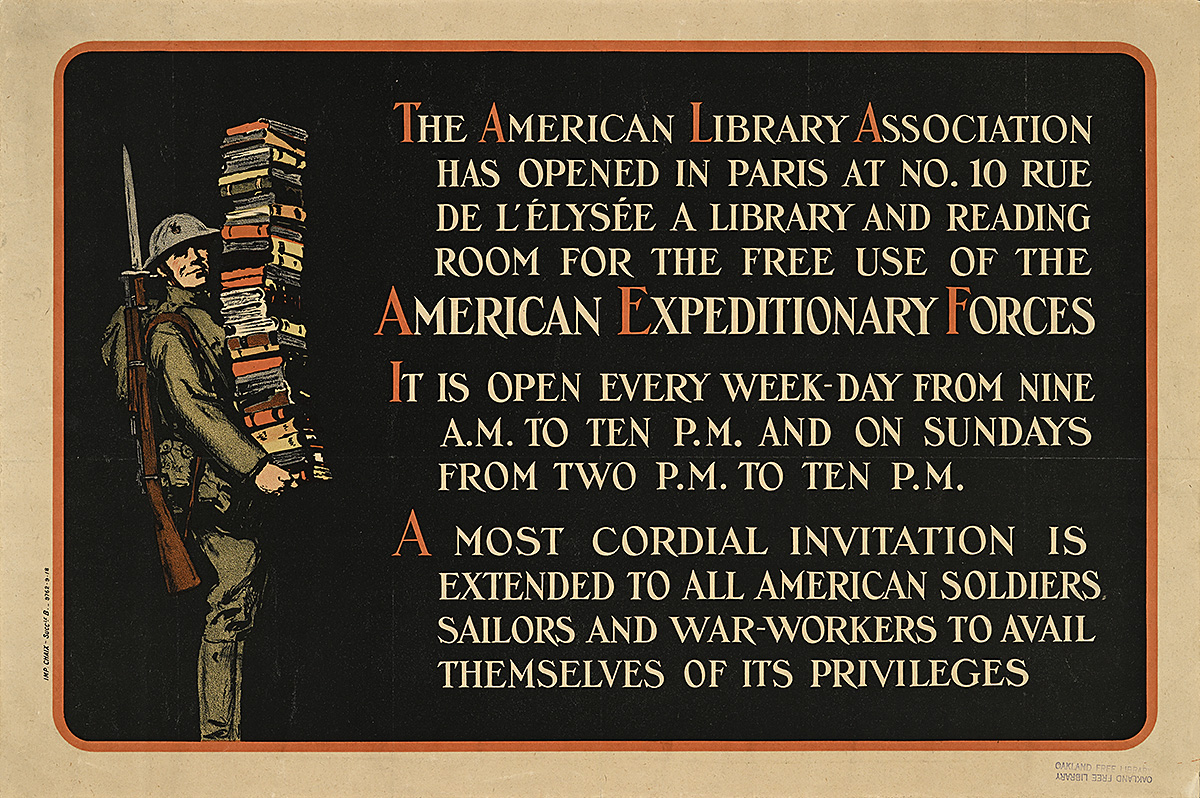
A poster of a man in a military uniform carrying a large stack of books next to paragraphs of text.

American Expeditionary Forces, 1920

Charles Buckles Falls (1874–1960)

Private Collection, NYC

  • Printed two years after the original poster, this image announces the opening of a library in Paris for American soldiers. It was distributed primarily to military training facilities and outposts overseas, informing troops and service workers about their free access to books. 
  • The American Library in Paris opened in 1920 to serve remaining military personnel and American volunteers providing humanitarian and other aid to war-ravaged areas of Europe. During the war, the ALA had maintained a headquarters in Paris that fulfilled book requests from troops serving in the American Expeditionary Forces (U.S. Army personnel in Europe); soldiers could mail a request for books to the ALA and the ALA mailed the requested titles to them. However, when the war ended, many war workers continued to be stationed in Paris and it was determined that a library could serve their needs.

A poster of illustrated men in uniform sitting together and reading.

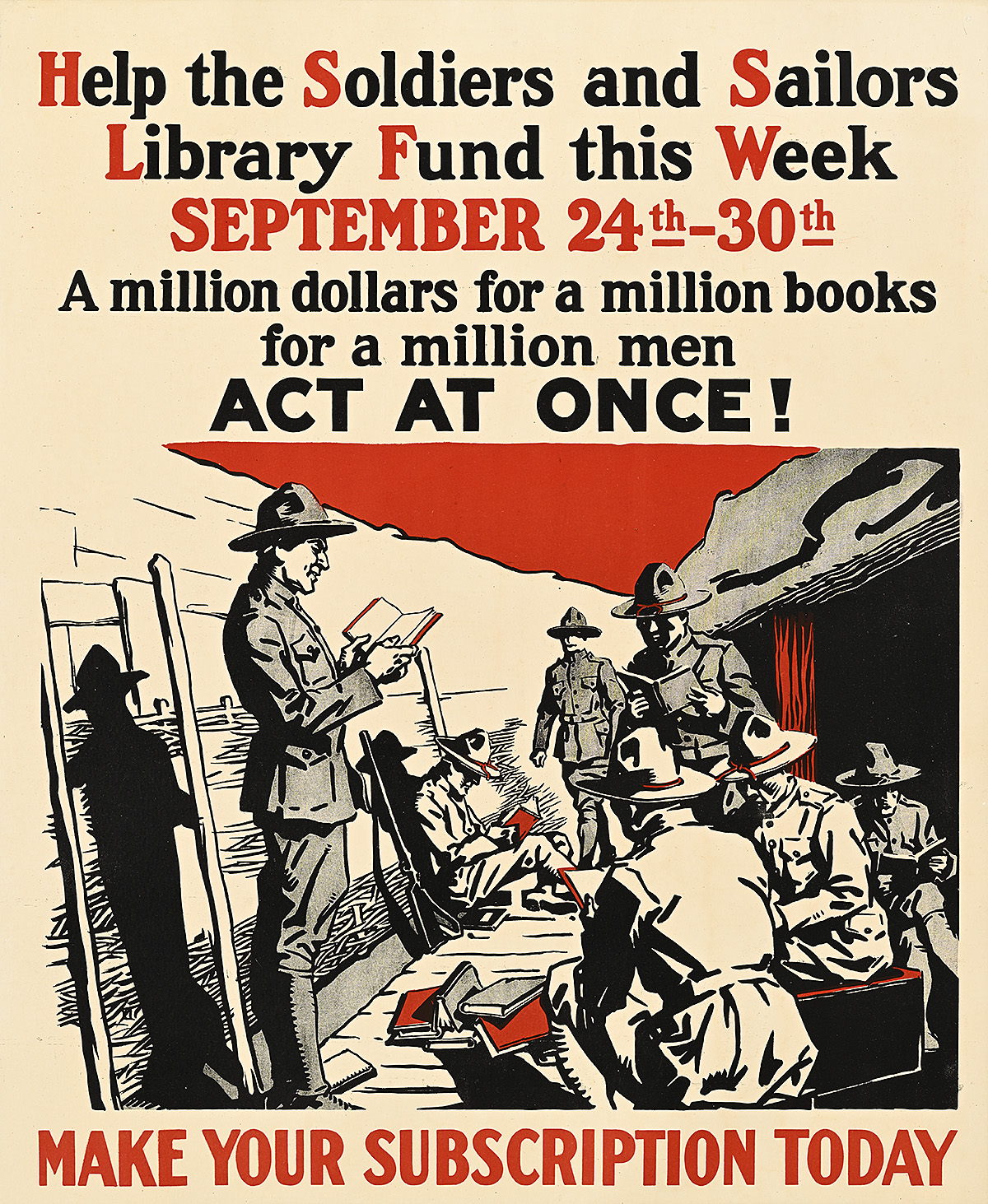
Help the Soldiers and Sailors Library Fund this Week, 1918

Designer Unknown

Poster House Permanent Collection

  • Since not all donated books were suitable for troops, librarians also raised funds that could be used by the American Library Association to buy new ones. This poster advertises the weeklong 1918 campaign encouraging public donations to the Library Fund.
  • Librarians across the United States spearheaded efforts to collect monetary donations; while some led door-to-door campaigns, others visited theaters before a show to solicit money from audience members. The campaign met its goal of raising one million dollars. 
  • Books were very popular among soldiers who often lacked entertainment after a day’s training and were eager to pass the time. Soldiers overseas clamored for books to fill empty hours of waiting for action or when relieved from active duty. They could spend days or weeks waiting to enter the front lines; books provided a mental escape from the inevitable brooding and anxiety about upcoming battles.
  • This is one of the last American posters printed during World War I promoting a donation drive to benefit a single organization. For more than a year, a slew of organizations hosted independent fundraising drives asking the public to give again and again. Concerned that the public would grow weary of these never-ending donation requests, the U.S. government encouraged the seven most prominent volunteer organizations to launch a single fundraising event, the United War Work Campaign, between November 11 and 18.

A poster of illustrated men in uniform scattered throughout a basement with books.

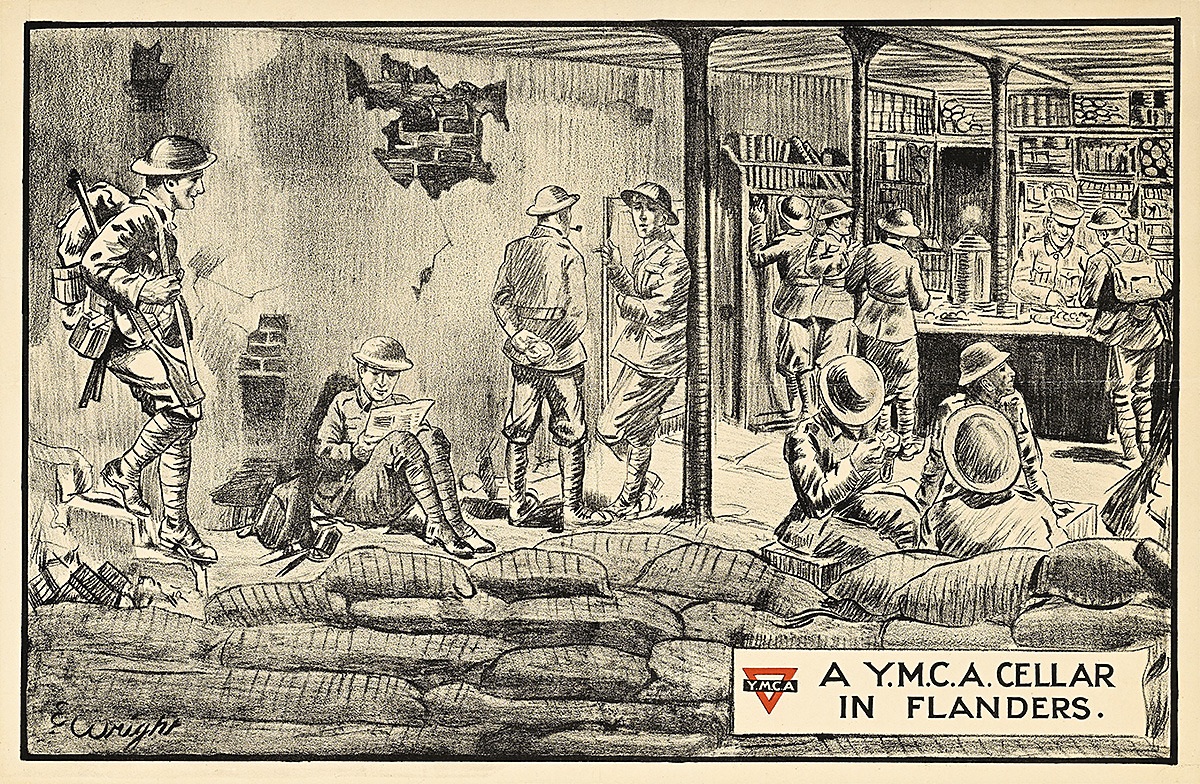
A YMCA Cellar in Flanders, 1915

Edgar Wright (Dates Unknown)

Private Collection, NYC

  • This is one of several designs created by Edgar Wright for the British YMCA, all highlighting the different ways the organization served troops in the field. This poster shows one of the typical “huts” or “cellars” that the YMCA developed between 1914 and 1918 for the fighting men in Flanders, Belgium, as rest areas filled with touches of home. Soldiers were offered a variety of activities and comforts, including educational materials, games, food, entertainment, religious books and services, and materials to write letters.
  • In this composition, a soldier is shown entering a sandbagged cellar while others grab a warm drink and a snack, look for books on a well-stocked shelf, read a newspaper, and smoke and chat.
  • Posters like this one were used to demonstrate to civilians the good work of the YMCA in the war zone while reminding them to donate funds so the organization could replenish supplies and construct and equip new huts as the Allies gained or lost ground. 
  • YMCA huts across Europe took many forms—some were housed in tents while others were built with whatever lumber could be secured, and many were situated inside bombed and abandoned buildings that met only the basic requirements of being structurally sound and still having a roof. Because troop movements at the front were unpredictable, the YMCA used makeshift facilities in combat zones like the one shown here and built more permanent structures in areas far from combat.

A poster of a map of the United States with noted locations in green on a white background and text above and below.

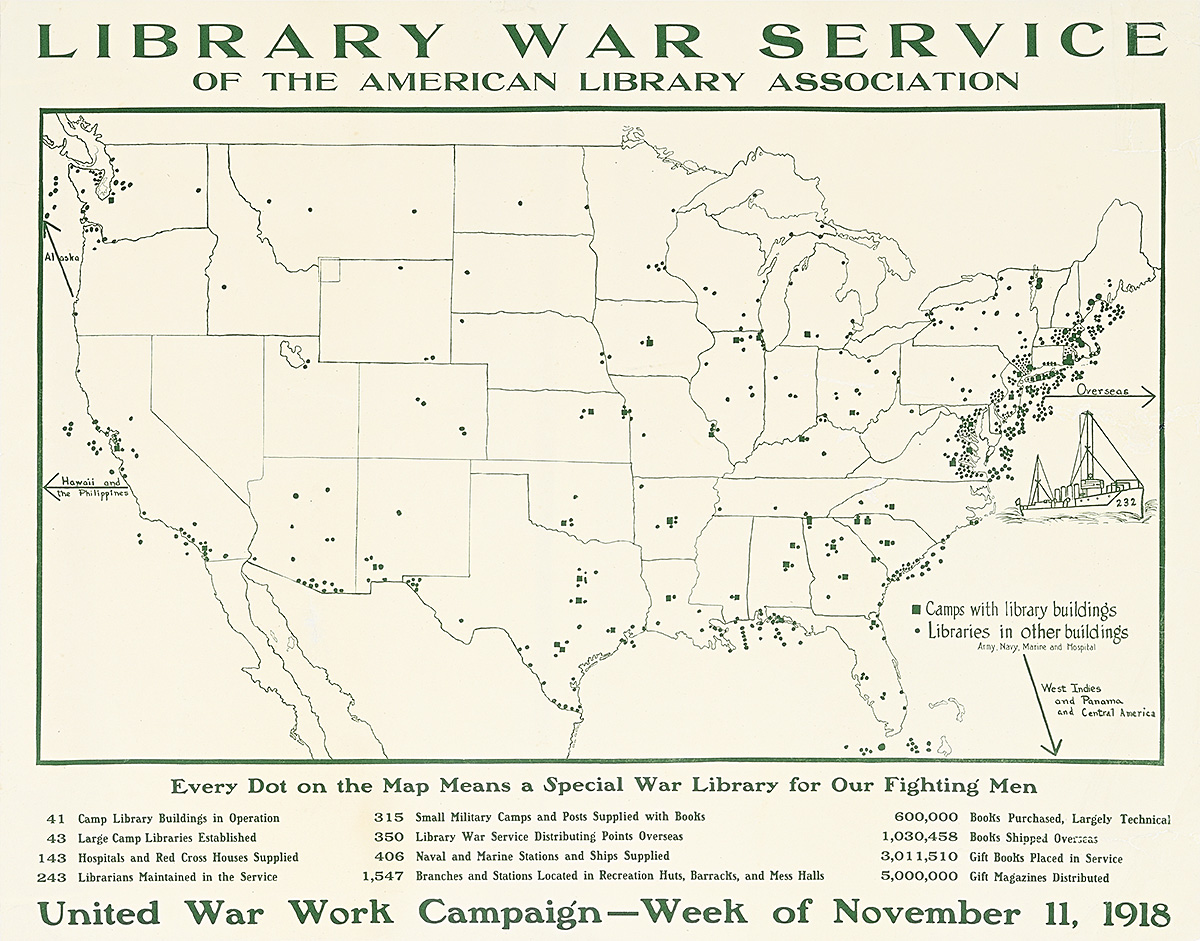
Library War Service, 1918

Designer Unknown

Private Collection, NYC

  • In 1917, the American Library Association (ALA) founded the Library War Service to orchestrate a unified library program for American troops. This new organization equipped libraries at military posts across the country, collected money from the public to purchase books, and accepted donated books for distribution to soldiers both at home and in France (where most of the Americans were stationed overseas).
  • This poster advertises the progress made in just one year, while reminding the public to continue donating funds to the United War Work Campaign so that more reading materials would reach the troops. In addition to the detailed map, figures in the lower register highlight the millions of books and magazines distributed to “our fighting men.”
  • Of the million books sent overseas, many were housed at the ALA’s Paris headquarters, which became the American Library in Paris in 1920. From its building at 10, rue de l’Elysée, a “direct by mail” book service was established so U.S. troops could make a written request for particular titles. Up to two books would be mailed to a soldier at a time and when he finished reading them, he could return them without paying postage and request additional books.

A poster of a drawing of three men reading and writing on a chalkboard with soldiers in the background.

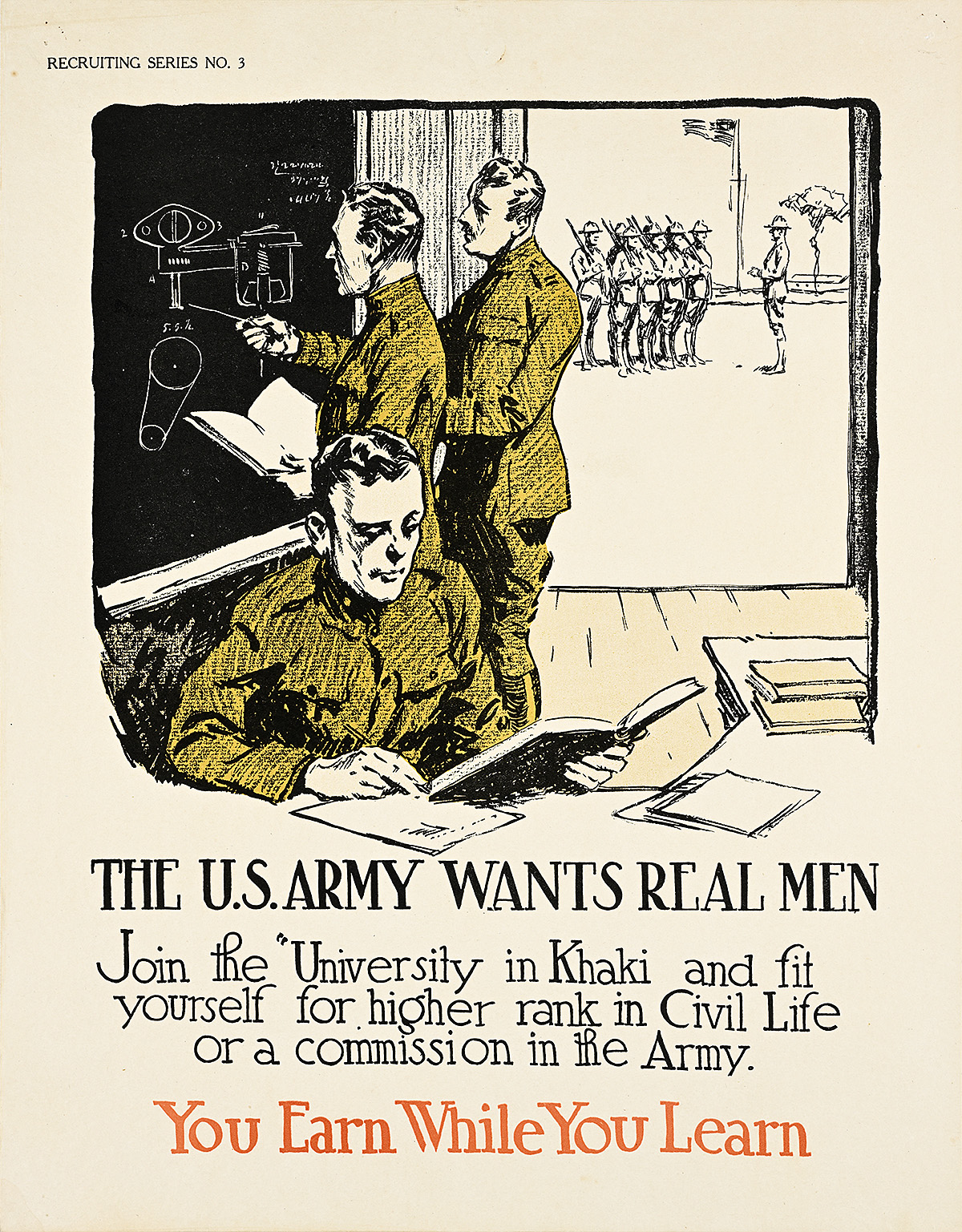
The U.S. Army Wants Real Men, c. 1918

Designer Unknown

Private Collection, NYC

  • This is the third in a series of recruiting posters that the U.S. Army produced to encourage men to voluntarily enlist. It emphasizes the educational opportunities available through the Army and that the military allowed men to “earn while [they] learn,” paying their salary while they took courses.
  • In Army camps based in the United States, a variety of educational opportunities were offered to soldiers—from English and French courses to enable them to comprehend written and spoken orders overseas, to intensive vocational classes to train them for specialties requiring technical knowledge and skills. These opportunities were so robust that the Army was colloquially referred to as the “University in Khaki” in reference to its uniforms. 
  • After the Armistice, the U.S. Army faced a crisis as nearly 1.8 million troops in Europe awaited passage back to the United States. General John J. Pershing, the commander of the American Expeditionary Forces in Europe, authorized the YMCA to spearhead a large-scale educational program so that soldiers could build skills and knowledge that would help them to secure employment once they returned home. Courses were typically taught by YMCA or Army personnel with a college or advanced degree in a given subject.
  • The YMCA’s educational program was so popular that it was ultimately absorbed into the U.S. Army as the Army Educational Corps. It represented a long-term investment in providing educational opportunities to men in service.
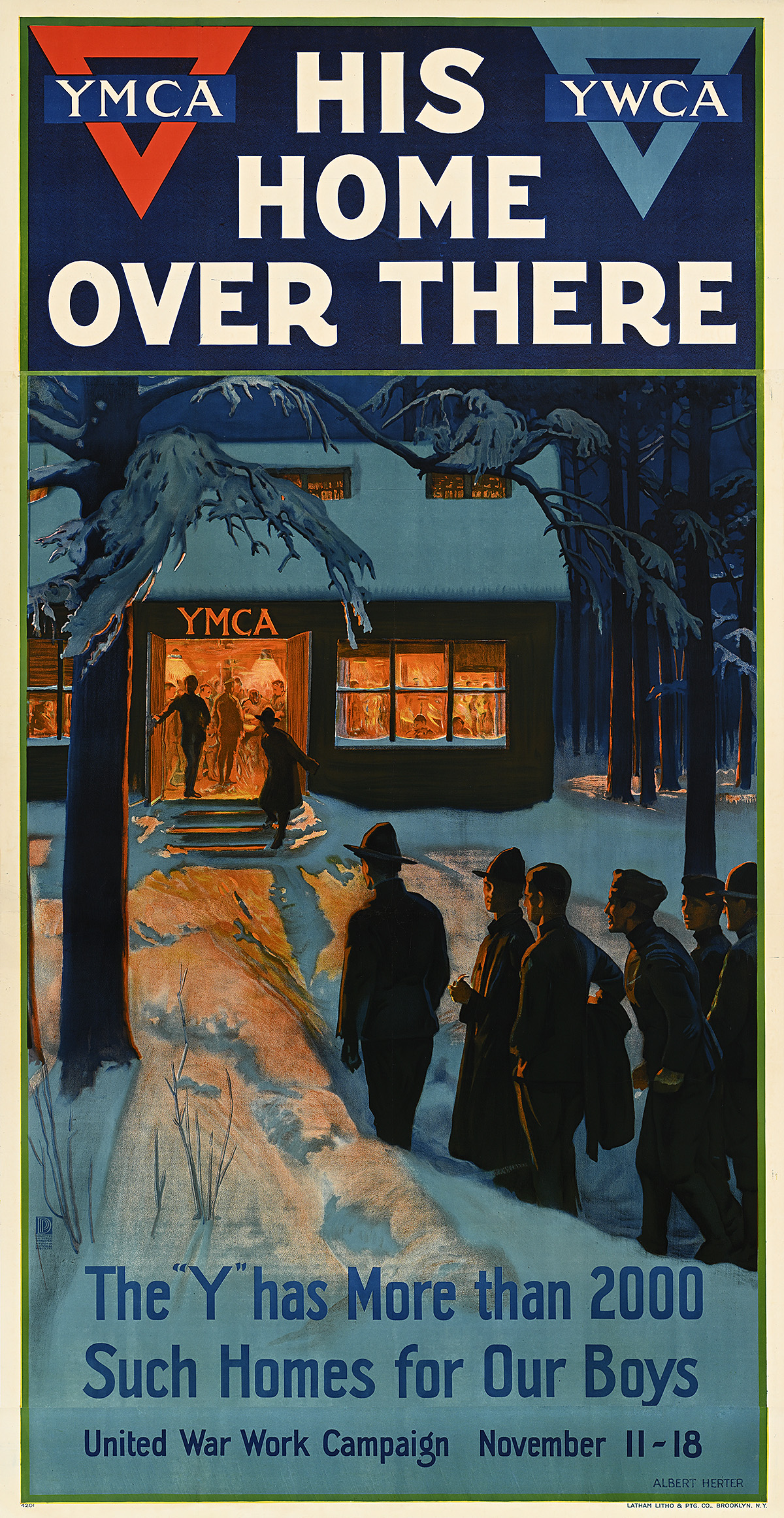
A poster of an outdoor winter scene with men in uniform walking up to a warmly lit house with an open front door.

His Home Over There, 1918

Albert Herter (1871–1950)

Private Collection, NYC

  • The United War Work Campaign was a joint effort by seven voluntary organizations that teamed up to provide recreational and welfare items for U.S. soldiers. Although the Armistice was announced on November 11 (the day this campaign was launched) and the fighting officially ceased, many American combat units remained overseas for months as they awaited transportation home and the signing of the Treaty of Versailles in June 1919. Books and other distractions were in hot demand as soldiers impatiently awaited return to the States. 
  • The groups that participated in the United War Work Campaign were the American YMCA and the Young Women’s Christian Association (YWCA), the American Library Association, the Salvation Army, the Jewish Welfare Board, the Knights of Columbus, and the War Camp Community Service.
  • In 1918, the United War Work Campaign aimed to raise at least $170,500,000 (approximately $3.6 billion today) for recreational supplies for the troops. During that weeklong campaign from November 11 to 18, the American public surpassed the goal and donated $200 million (approximately $4 billion today), with the YMCA receiving nearly 59 percent of these proceeds for its work. 
  • The American YMCA was the largest U.S. organization serving troops with morale-boosting supplies. To motivate the public to donate to the United War Work Campaign, this poster attempts to place the viewer in the shoes of soldiers trudging through snow in the dark to find a warm, welcoming YMCA hut with glowing windows and open doors. Because they were stocked with domestic comforts, including many books, the poster refers to this kind of hut as a “home.” More than 2,000 YMCA huts were constructed for troops during World War I, and donations were needed to continue building and stocking them with recreational materials, food, and beverages.

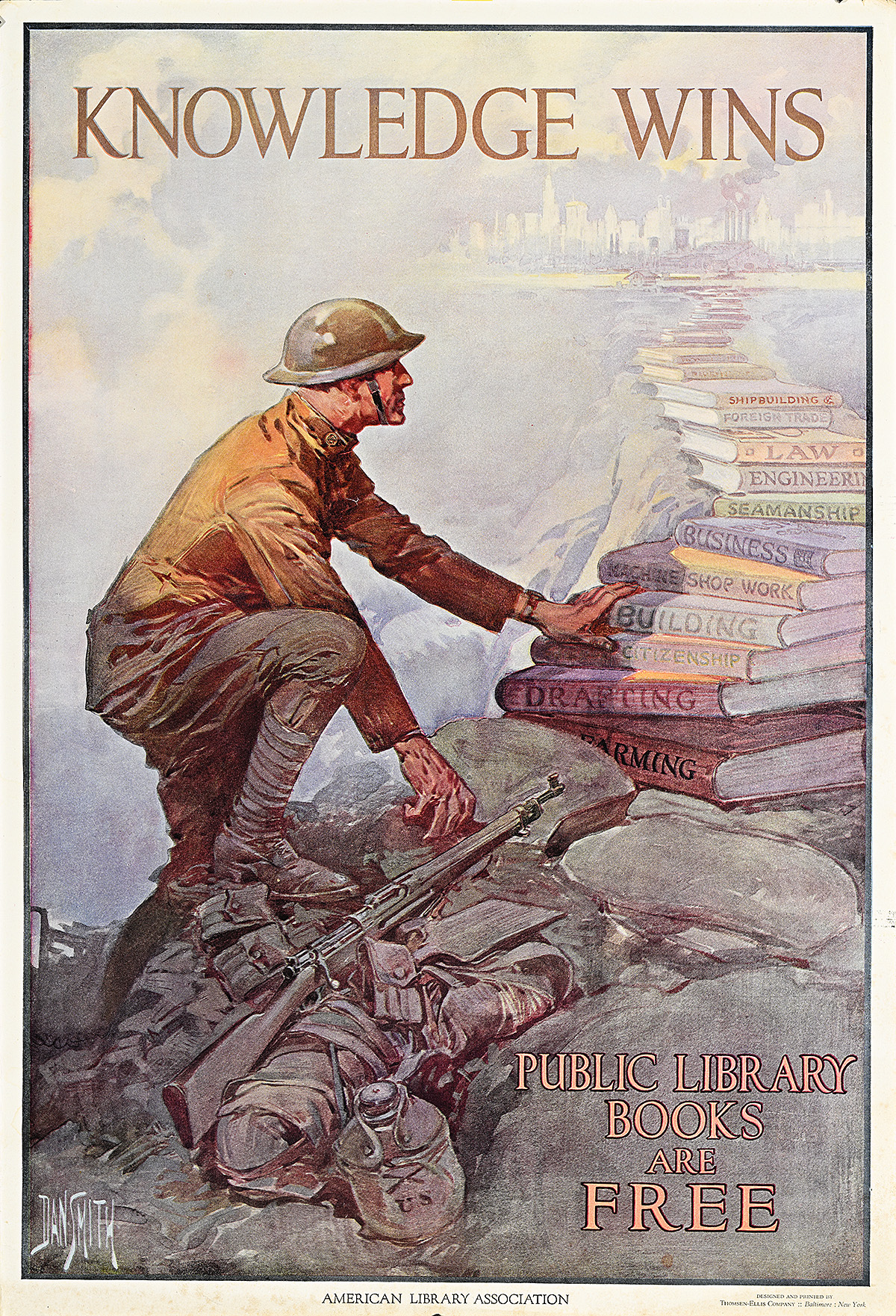
A poster of a soldier crouched down with a pile of books and a city skyline in the background.

Knowledge Wins, 1918

Dan Smith (1865–1934)

Private Collection, NYC

  • Since it had supplied millions of books to troops during World War I, the American Library Association (ALA) anticipated that soldiers’ newfound love for the written word would continue once they returned home. This poster shows a soldier laying his gun and gear on the ground and preparing to climb a staircase of educational books leading toward a shining city and busy factories, visually emphasizing the poster’s message that knowledge (through books) would provide a path to opportunity after the war.
  • Just as soldiers enjoyed free books through the ALA’s mailing service, within YMCA huts, and in military libraries, this poster reminds returning veterans that public libraries also offer the privilege of borrowing books without charge. 
  • While many troops read fiction and other lighthearted books during the war, the spines of the books pictured in this poster—creating a bridge back to society—relate to potential professions. This reflects the shift in reading habits that occurred after the Armistice, when the men were less eager for simple distraction than for the information and skills that would help them gain civilian employment.
  • It is estimated that roughly 25 percent of U.S. troops were either functionally illiterate or did not speak or write English because it was not their native language. Returning to school (vocational or otherwise) was not an easy option for most veterans due to financial concerns and family obligations; this poster suggests that books and libraries present another avenue for education and future success.

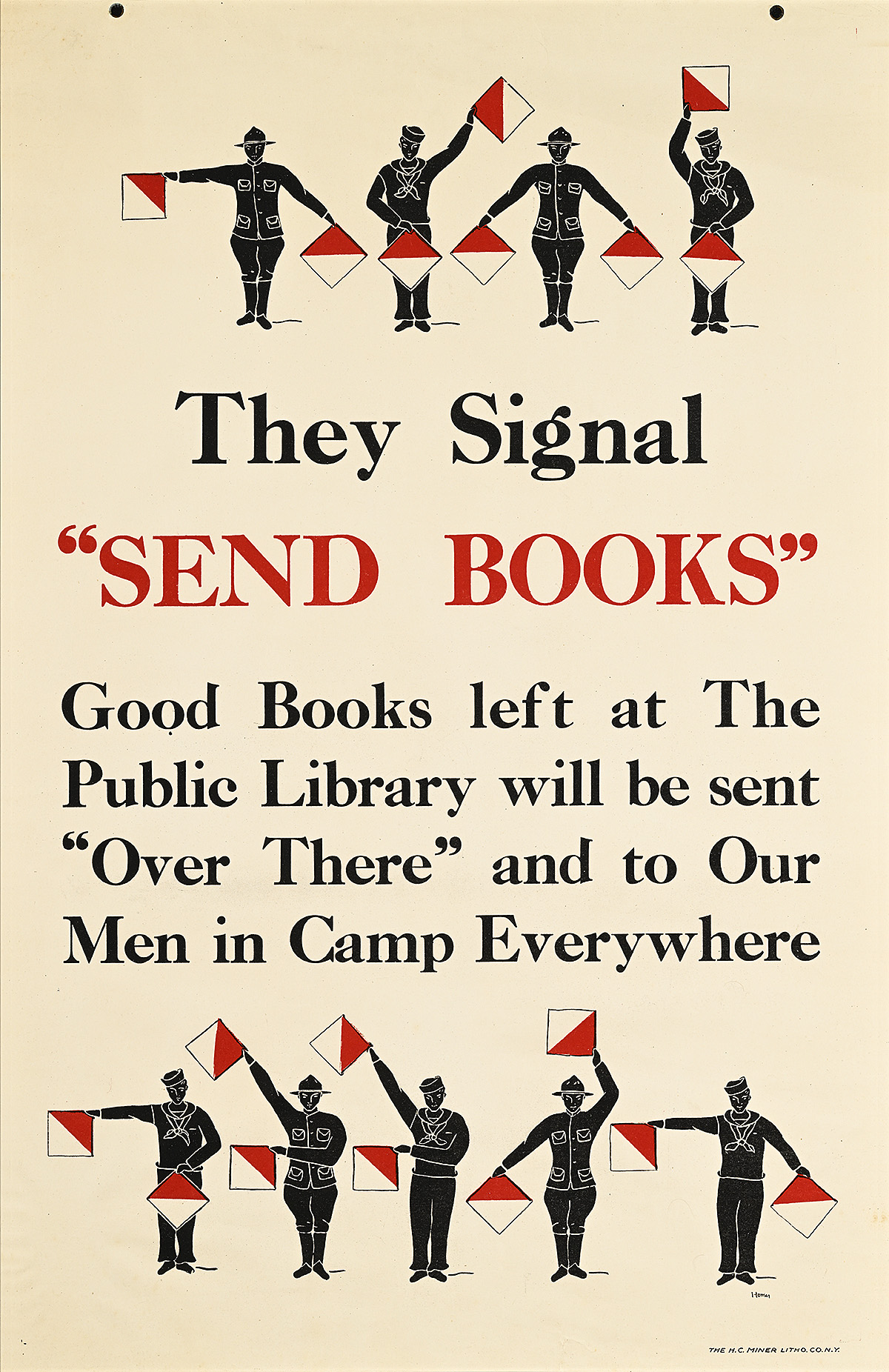
A poster of illustrated men in uniform holding white and red flags in various positions.

They Signal “Send Books,” 1917

Homer (Dates Unknown)

Private Collection, NYC

  • To encourage the American public to donate books for those in the armed forces, this poster portrays servicemen presenting their message of “Send Books” through semaphore, a system of visual signaling where a person holds a flag in each hand and denotes a letter of the alphabet based on the positioning of their hands and the flags. 
  • This poster specifically asks for “good books,” as some civilians answered the call for donations by simply cleaning their shelves of books they did not want or like. To avoid collecting unsuitable and unpopular tomes, the public was told to “give the book you prize most,” “give your favorite author,” and “give the book that is still alive but which you and your family have outgrown.”
  • The day after the United States entered the war on April 6, 1917, composer George M. Cohan wrote the song “Over There.” Its patriotic lyrics were meant to inspire men to enlist, and the song quickly became a runaway hit (its popularity even extended into World War II). Here, the poster acknowledges the popularity of the song, referring to Europe as “Over There.”
  • By the end of 1919, approximately 7 million books were in War Service Libraries and circulating among U.S. forces. This was the high-water mark of the program. Because the war was over, no further efforts were made to secure donated books or funds to purchase books.

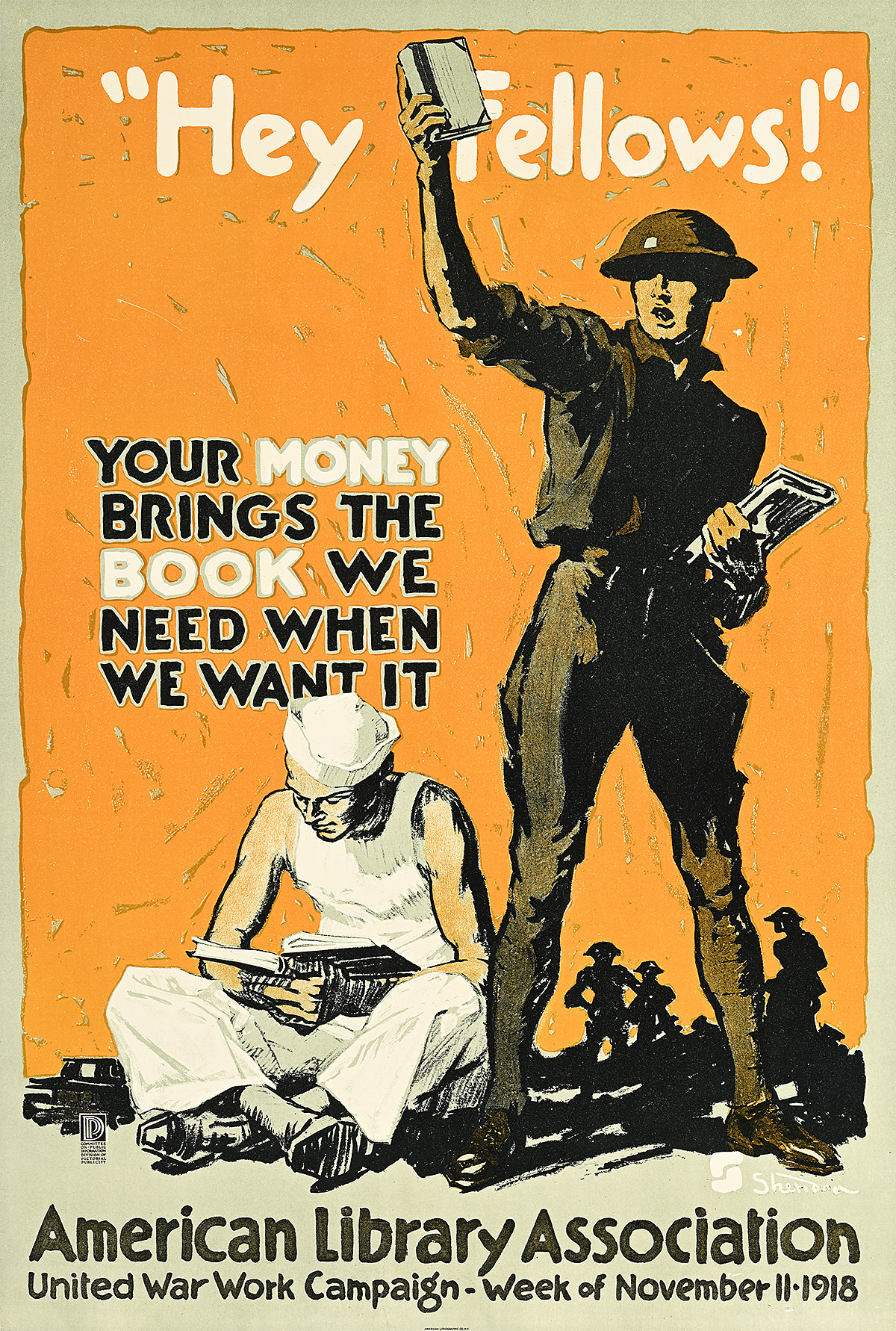
A poster of a soldier standing holding up a book while another man in uniform sits and reads.

Hey Fellows!, 1918

John E. Sheridan (1877–1948)

Private Collection, NYC

  • Just as the YMCA produced posters depicting its contributions to soldier welfare, the American Library Association (ALA) produced striking images of the role of books in soldiers’ lives, including this vibrant composition.
  • Although the ALA hosted many book drives during World War I, donations often included books that were outdated, unlikely to interest young men, or in poor condition. This poster therefore requests monetary donations to allow the ALA to purchase books that might be more appealing to servicemen. During the war, soldiers typically preferred fiction, adventure stories, mysteries, and books about the areas where they were stationed.
  • Although this poster was printed the same year as the Armistice (the agreement signed between the Allies and Germany in November 1918 to stop fighting during negotiations for a peace treaty), the ALA found that the need for books was only heightened after this ceasefire was declared. It took months for the U.S. military to secure passage for the millions of troops it had stationed in France, leading to excessive downtime and boredom. Books provided much-needed entertainment and education as the men bided their time.

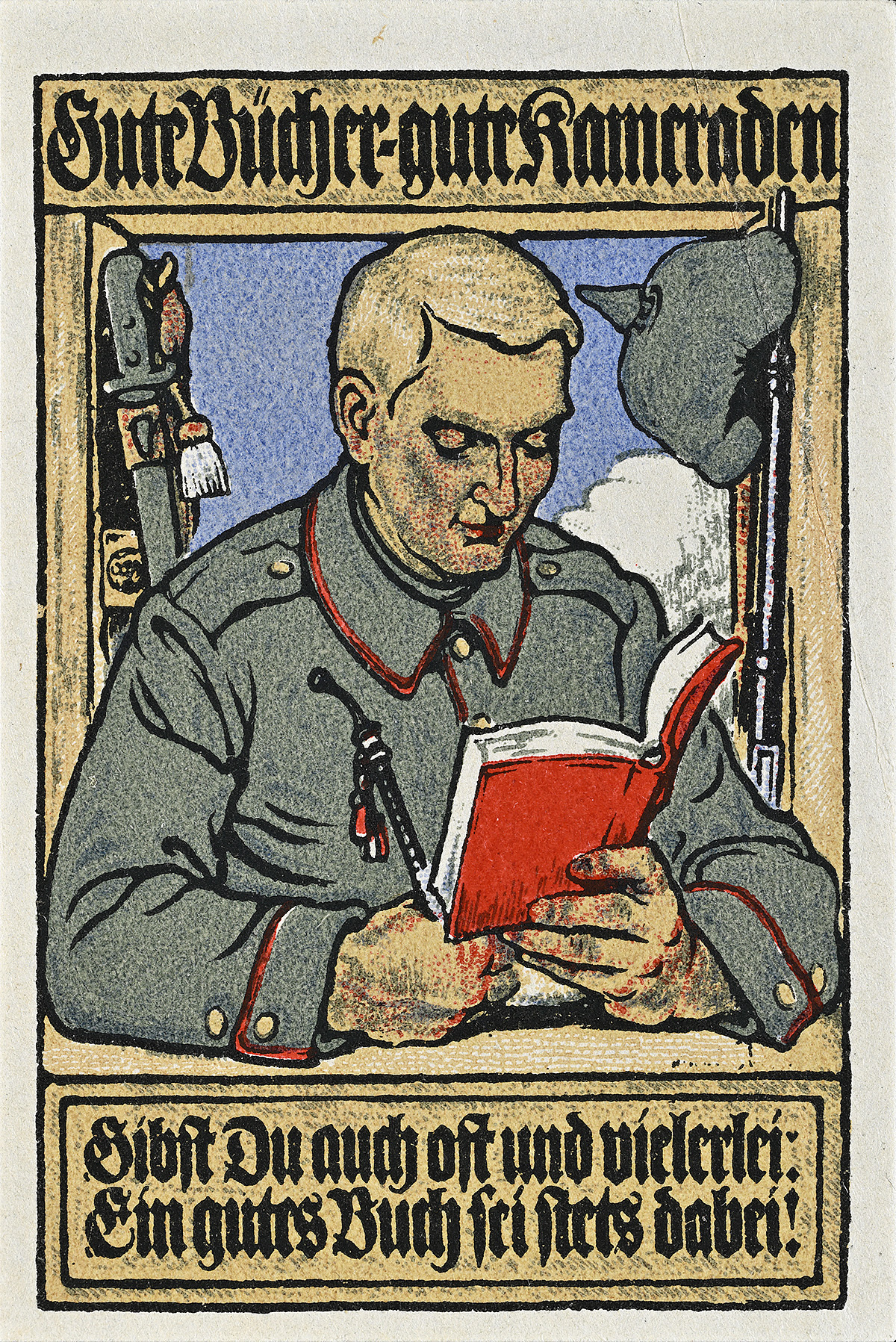
A poster of a soldier reading a book with German text above and below.

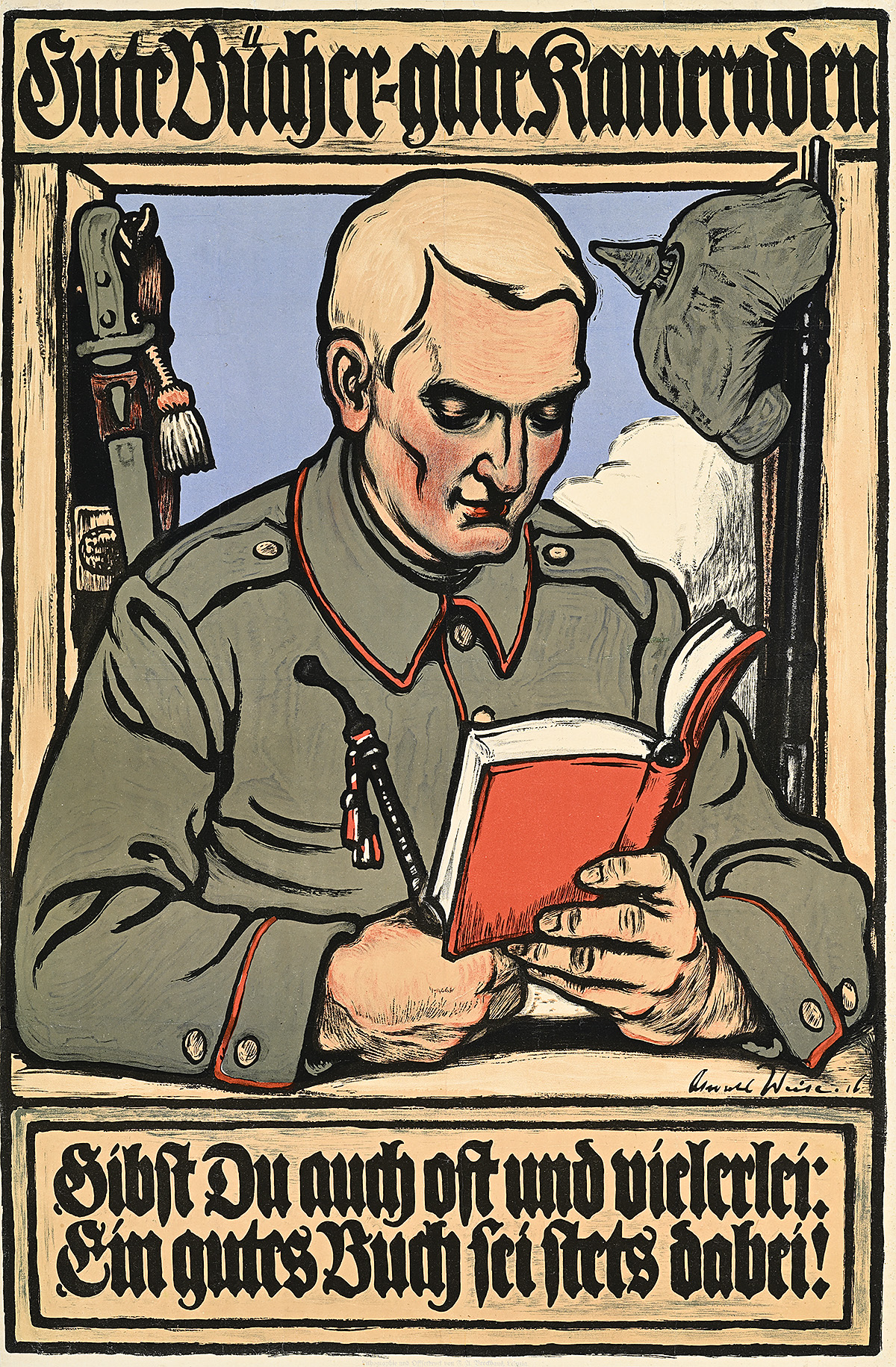
Gute Bücher–Gute Kameraden, 1916

Oswald Weise (1880–?)

Private Collection, NYC

  • American troops were not the only ones who turned to books for recreation during World War I. This German poster shows a young infantryman who has hung up his helmet and weapon, and is relaxing with a book. The accompanying text translates as: “Good Books–Good Comrades. However much and whatever you give, a good book should always be part of it!” 
  • Although military historians typically emphasize Germany’s technical innovations in the tools of warfare—such as machine guns, poison gas, and aerial bombing—the German military also took a special interest in maintaining its soldiers’ morale and fighting resolve by attending to their welfare. This included the distribution of books.  
  • This poster was displayed across Germany to advertise the government’s widespread allocation of books for its troops and to demonstrate its general commitment to the well-being of German soldiers. It also reminded the public to donate books for this purpose. To further publicize these themes, the image was also reproduced as a decorative, collectible stamp that was available for sale, with proceeds used to purchase books.
  • This is one of two book-focused designs created by Oswald Weise during World War I; the other one highlights the joy and comfort that literature can give a wounded soldier. 

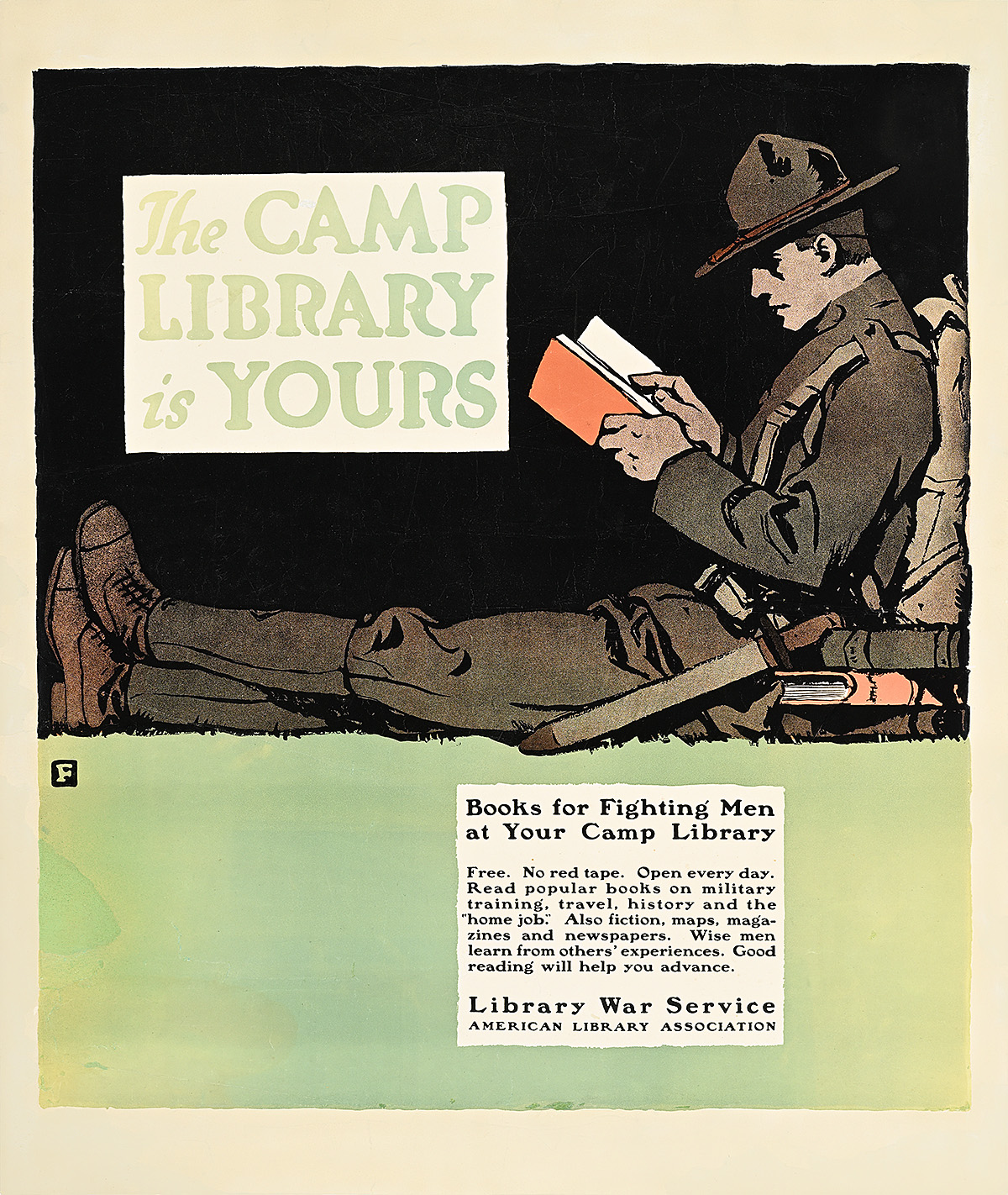
A poster of a man in uniform sitting down and reading a book on top of a green rectangle.

The Camp Library is Yours, 1917

Charles Buckles Falls (1874–1960)

Private Collection, NYC

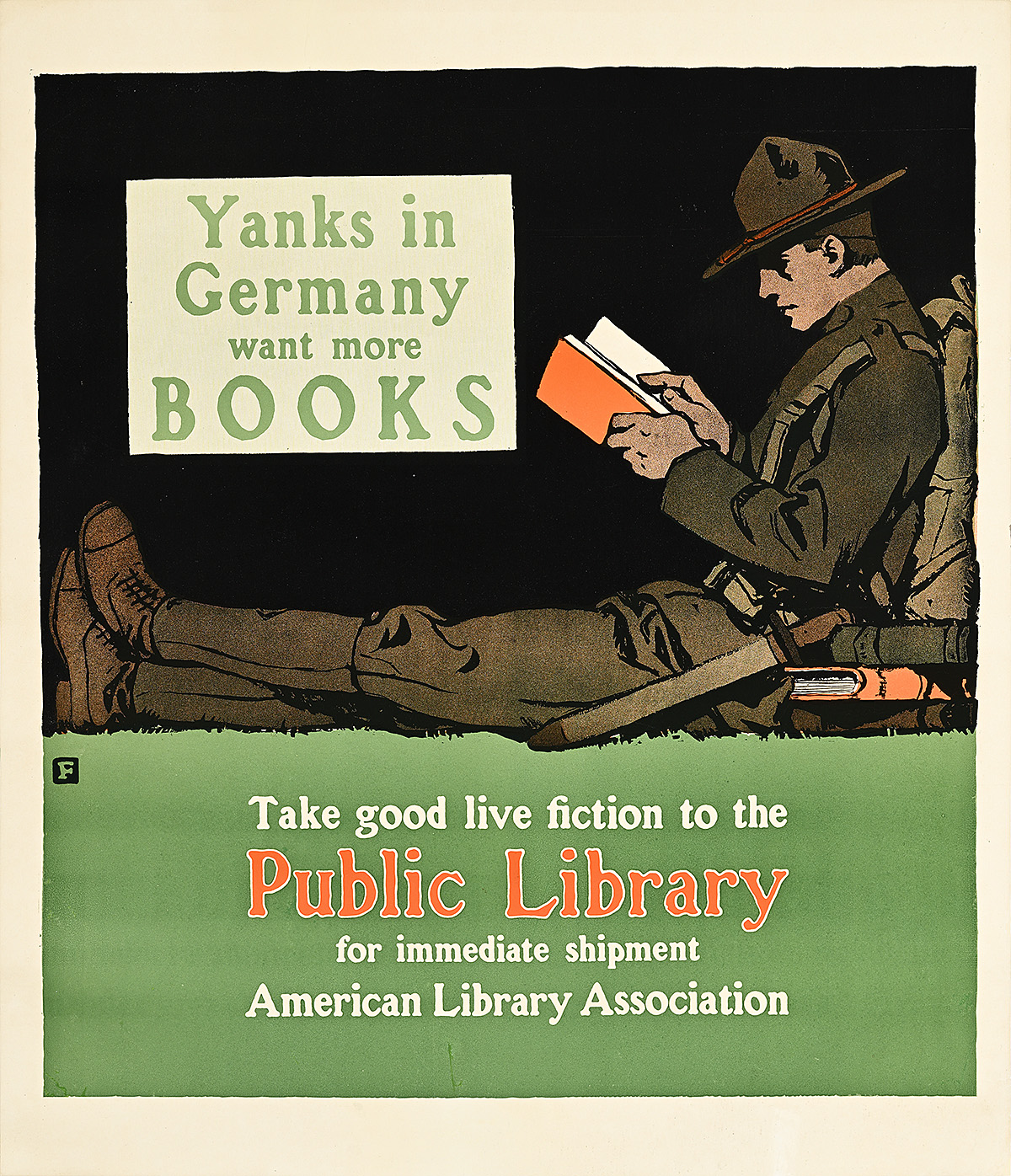
A poster of a man in uniform sitting down and reading a book on top of a green rectangle.

Yanks in Germany Want More Books, 1918

Charles Buckles Falls (1874–1960)

Private Collection, NYC

  • To show the public that soldiers wanted to read books during lulls in action or their off-duty hours (and that they therefore should donate to campaigns that supplied literature), the American Library Association collaborated with Charles Buckles Falls to produce a design depicting a reading soldier. The bright orange of the book cover immediately draws the viewer’s eye toward it, and then to the pile of books beside him.
  • Produced for display within the United States, this poster not only suggests the popularity of books but also informs servicemen that they have free access to books and magazines in their camp library.
  • For soldiers wishing to advance their rank, military libraries contained textbooks and training materials that would aid in studying for promotion. Books were also available to help prepare them for a “home job” once they became civilians again. 
  • The two versions of this poster convey slightly different messages, each reflecting the general location where collected books would be read by the troops. In 1917, most soldiers were stationed in United States training camps. As such, the version from that year casts a spotlight on “The Camp Library.” In 1918, hundreds of thousands of combat units embarked overseas and the poster was reissued to emphasize that “Yanks in Germany” need more books.

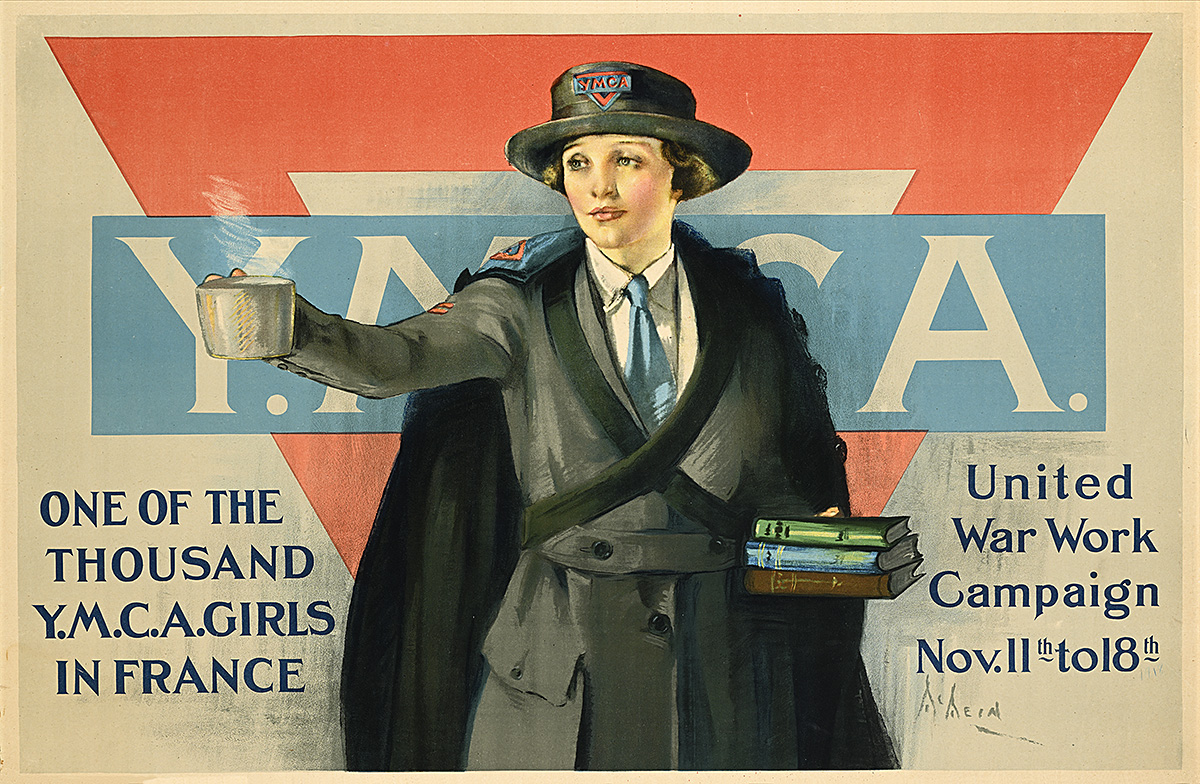
A poster of a white woman in fancy dress holding a stack of books in front of a logo reading YMCA.

One of the Thousand Y.M.C.A. Girls in France, 1918

Neysa McMein (1888–1949)

Private Collection, NYC

  • The American YMCA welcomed more than 3,000 women as “welfare workers” to run canteens and huts for the benefit of soldiers during World War I. One-third of them went to France, where most American troops were stationed. These volunteers performed essential war work, with the American YMCA describing their contributions as “indispensable.”
  • Neysa McMein was a popular illustrator whose work appeared on the covers of magazines, including the Saturday Evening Post and McCall’s. During World War I, she designed several posters for the U.S. and French governments, and even toured France as a YMCA “entertainer,” using her acting and speaking skills. In this role, McMein would have been issued a YMCA uniform and a badge to enable her to travel easily from hut to hut giving lectures and performances.
  • This poster, encouraging donations to the United War Work Campaign, emphasizes the seriousness of the work performed by the female volunteers of the American YMCA. It focuses on a woman wearing the official YMCA uniform while performing the traditional services provided by women in YMCA canteens: offering servicemen warm beverages and books.
  • The American YMCA did not distribute books outside of its huts; however, books and American magazines were among the standard supplies routinely shipped by the YMCA from the United States to France for its overseas huts. Other morale-boosting items in these shipments included writing paper and envelopes, records and gramophones, and musical instruments.

World War II

After the Nazis publicly burned hundreds of thousands of books across Germany in 1933 and began to ban those they deemed threatening to the regime, books became an important international symbol of freedom. This destruction was part of a concerted censorship campaign to remove all Jewish and “un-German” cultural contributions—by artists, authors, educators, and entertainers—and to establish the idea that only members of the superior “Aryan race” were capable of producing meaningful work in these contexts. Books containing ideas that undermined this ideology were banned and/or burned. As World War II spread across Europe, every nation occupied by Germany faced similar book bans and the destruction of libraries and reading material deemed subversive to Nazi ideals. By the war’s end, an estimated 100 million books had been destroyed.

The United States reacted to this affront to the free circulation of ideas by stressing the importance of preserving the written word and encouraging all Americans to read. The messages in posters depicting the shock of the 1933 book burnings and rallying Americans to buy war bonds reinforced the ways in which democracy was strengthened and preserved by reading, sharing, and donating books.  

To combat the Nazi censorship and propaganda that their servicemen would see as they liberated Europe in the last years of World War II, the United States and its allies made a special effort to ensure that their soldiers had free access to books. Whether for entertainment or information, the act of reading was treated as an act of resistance, one that might strengthen democratic values and individual liberty. Donation campaigns were launched in Canada, Britain, and the United States asking civilians to donate their favorite reading materials for distribution to troops. The United States launched the most comprehensive of these efforts, including the Victory Book Campaign that resulted in the donation of more than 18 million books between 1942 and 1943. This campaign was only discontinued at the end of 1943 when American publishers began supplying specially created “Armed Services Editions”—pocket-size paperbacks of popular titles issued only within the military. More than 122 million of these books were distributed. As American troops liberated areas formerly under Nazi occupation, they invaded not only with guns, but also with titles and ideas that had been banned for years by the Nazis. To read and share a book was to spread freedom.

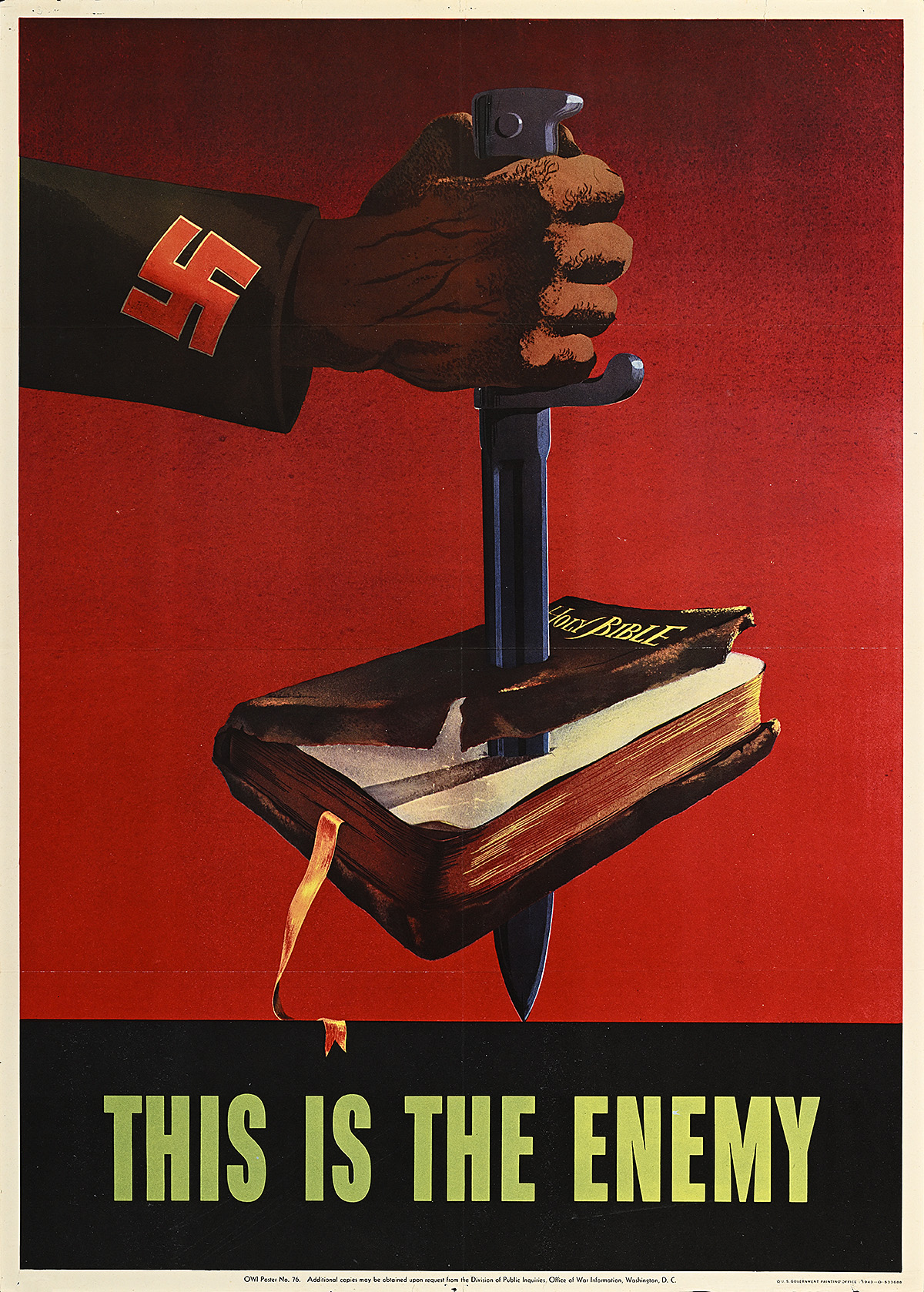
A poster of an arm with a swastika on its sleeve and the hand holding a blade piercing through a bible.

This is the Enemy, 1943

Barbara Marks (Dates Unknown)

Given in Honor of Gail Chisholm, Poster House Permanent Collection

  • The U.S. government produced a bevy of propaganda posters that emphasized why the nation was at war and the specific American values that were at stake. This particularly dramatic design depicts an arm with a swastika on its sleeve piercing the Holy Bible with a sword, a vivid evocation of Nazi attacks on Christianity that would have been especially shocking to the many devout Christian Americans who would have seen this image. 
  • Produced by the nonprofit organization Artists for Victory, this is one in a series of posters that addressed themes from President Franklin D. Roosevelt’s first war message to Congress on January 6, 1942, and references “The Nature of the Enemy.” The tagline used here would appear on numerous other posters of the period, each presenting a particularly visceral “enemy” for the viewer to fear. The other themes included production, war bonds, and careless talk, all of which inspired additional poster campaigns.
  • This design was printed and distributed by the United States Office of War Information (OWI), created by President Roosevelt to disseminate war information on a national scale through radio, newspapers, film shorts, and posters. It did not take long for the OWI to attract criticism for appearing to act more as a propaganda agency—producing material that seemed to “sell” the war—than a source of objective facts and figures.

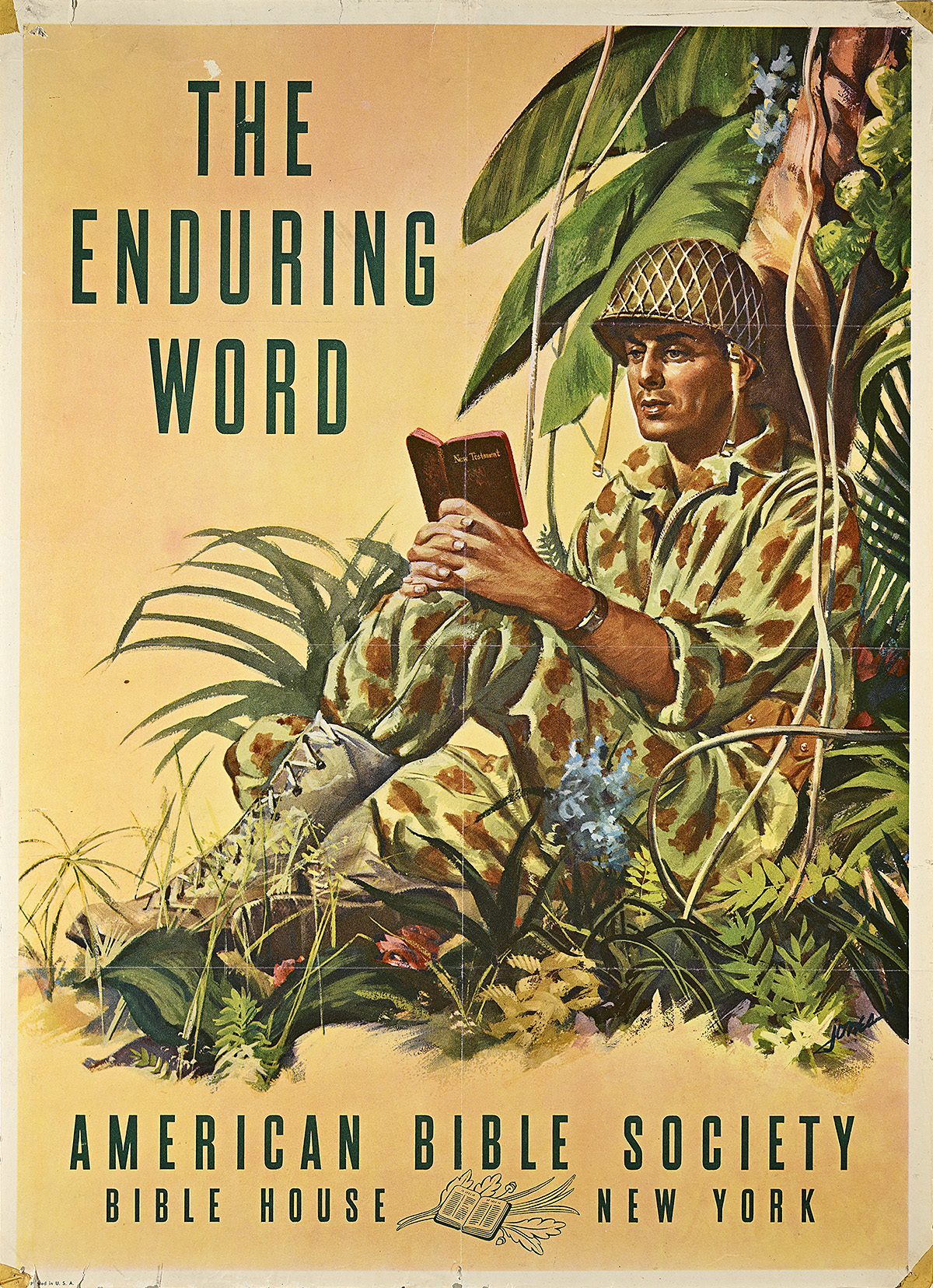
A poster of a soldier sitting down and reading against a tree in the jungle.

The Enduring Word, 1945

Jones (Dates Unknown)

Private Collection, NYC

  • Religious organizations, including the American Bible Society, the YMCA, and the Jewish Welfare Board, distributed miniature Bibles and volumes of scripture to the troops during World War II.
  • While nonprofit groups like these provided free religious texts, some enterprising companies sold “heart-shield” Bibles with gold-plated steel covers sized to fit the breast pocket of a uniform. They were marketed to deflect bullets and shrapnel, thereby saving lives, and became popular gifts for soldiers from their loved ones.  
  • A message from President Roosevelt was often included inside the covers of volumes of scripture, in which he recommended that the armed forces read “the Sacred Book” to find “words of wisdom, counsel and inspiration” while at war.
  • This poster shows a soldier deployed somewhere in the Pacific Theater, where morale was the lowest in the U.S. military. Due to the constant need to replenish essential military supplies like weapons, food, and medicines, shipments of recreational items were not prioritized on military supply ships. Instead, popular reading materials had to be mailed to soldiers through the Army Postal Service.

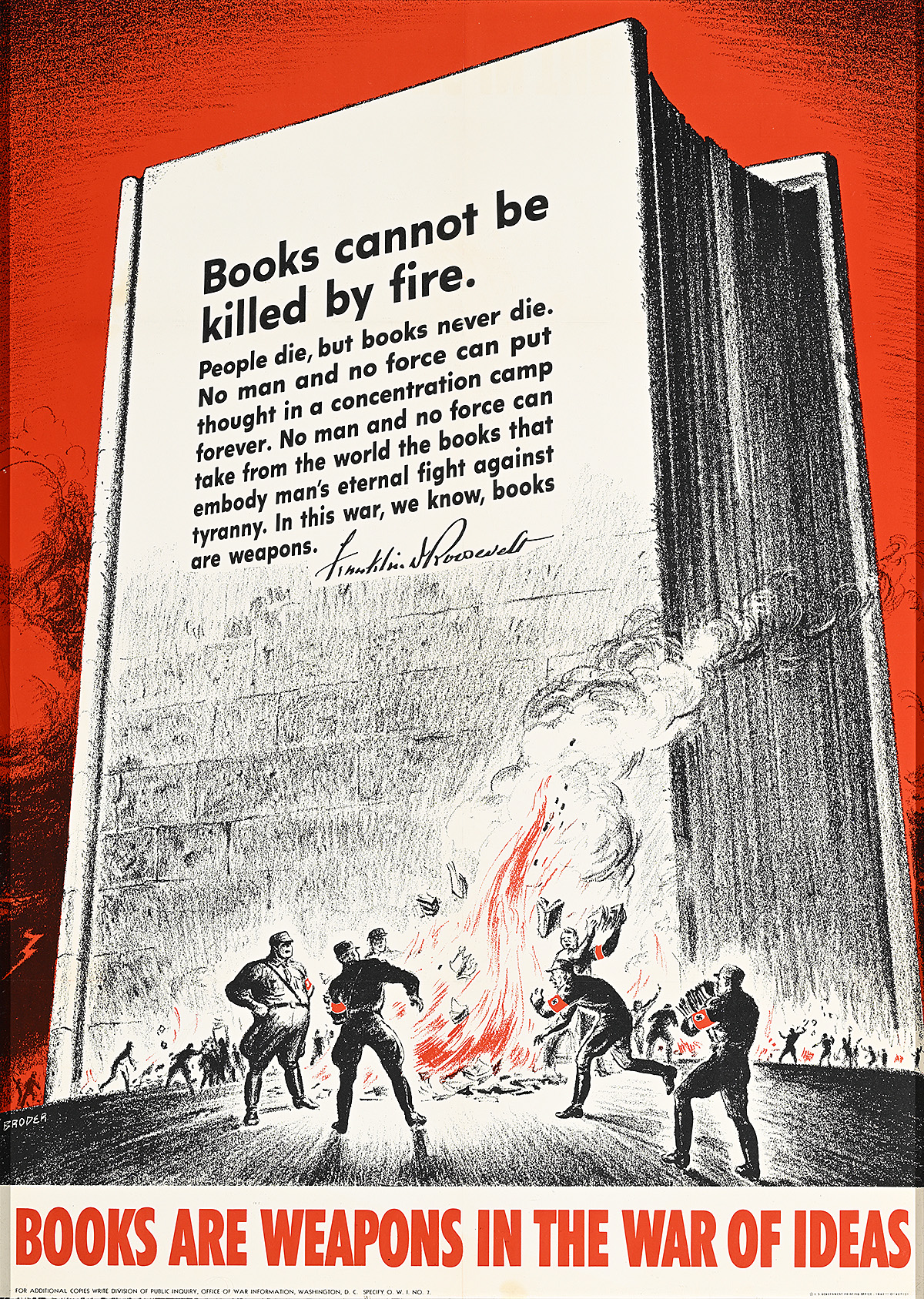
A poster of an illustration of men in uniform throwing books into a fire with a monumental book behind them.

Books Are Weapons in the War of Ideas, 1943

S. Broder (Dates Unknown)

Private Collection, NYC

  • This poster was displayed across the United States on the eve of the tenth anniversary of the Nazi book burnings of May 1933. It depicts a skyscraper-size book surrounded by flames, as miniature figures, some wearing swastika armbands, toss books into the fire. The large book, however, remains unscathed.
  • Emblazoned on the cover of the large book is an excerpt from a statement by President Roosevelt to the American Booksellers Association in May 1942: “No man and no force can take from the world the books that embody man’s eternal fight against tyranny. In this war, we know, books are weapons.”
  • The motto “books are weapons in the war of ideas” was used by the Council on Books in Wartime, a nonprofit organization of American publishers who banded together to publicize the importance of books and the freedom to read.
  • One of the council’s main projects was the distribution of more than 122 million pocket-size paperbacks to U.S. servicemen during World War II. When American troops invaded Normandy in June 1944 and began the liberation of Europe, they carried in their pockets dozens of titles previously banned by the Nazis. This served to slowly reintroduce books and ideas that had been forbidden in Nazi-occupied territories for years.

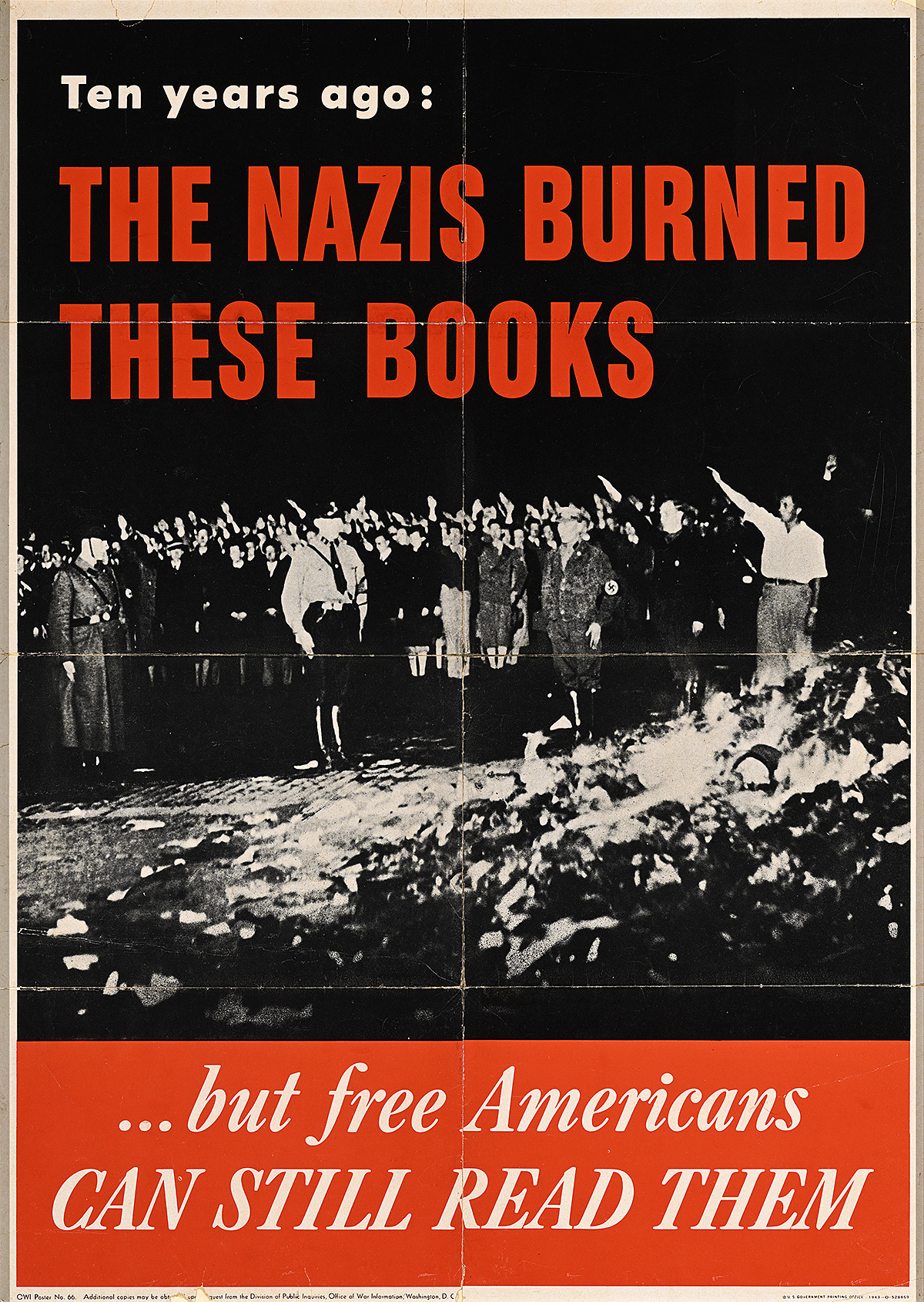
A poster of a black and white photograph of a large crowd of people performing a Nazi salute.

The Nazis Burned These Books, 1943

Designer Unknown

Private Collection, NYC

  • This poster incorporates a photograph of the public book burning by the Nazi Party in Berlin, Germany, on May 10, 1933; in it, the crowd gives the Nazi salute while books burn in the foreground. Produced by the U.S. Office of War Information (OWI), the accompanying text contrasts the German destruction of books with the American democratic freedom to read them.
  • Starting in 1933, Germany produced lists of forbidden titles, authors, and publishers, resulting in the removal and destruction of books that included ideas and information considered antagonistic to Nazi ideology. Rather than encourage debate and free thought, the Nazis limited the flow of information to create the appearance of a single, uniform belief system. 
  • Ernest Hemingway, John Steinbeck, Carl Sandburg, Helen Keller, and Dorothy Thompson were among the American authors initially banned in Germany. After the United States entered the war, all American authors were banned.
  • To protest the Nazi book bans and burnings, Americans were encouraged to read and to practice the freedoms denied those under Nazi occupation. American libraries and booksellers made displays of books banned in Germany and challenged Americans to read these books to counteract Germany’s effort to stop their circulation.

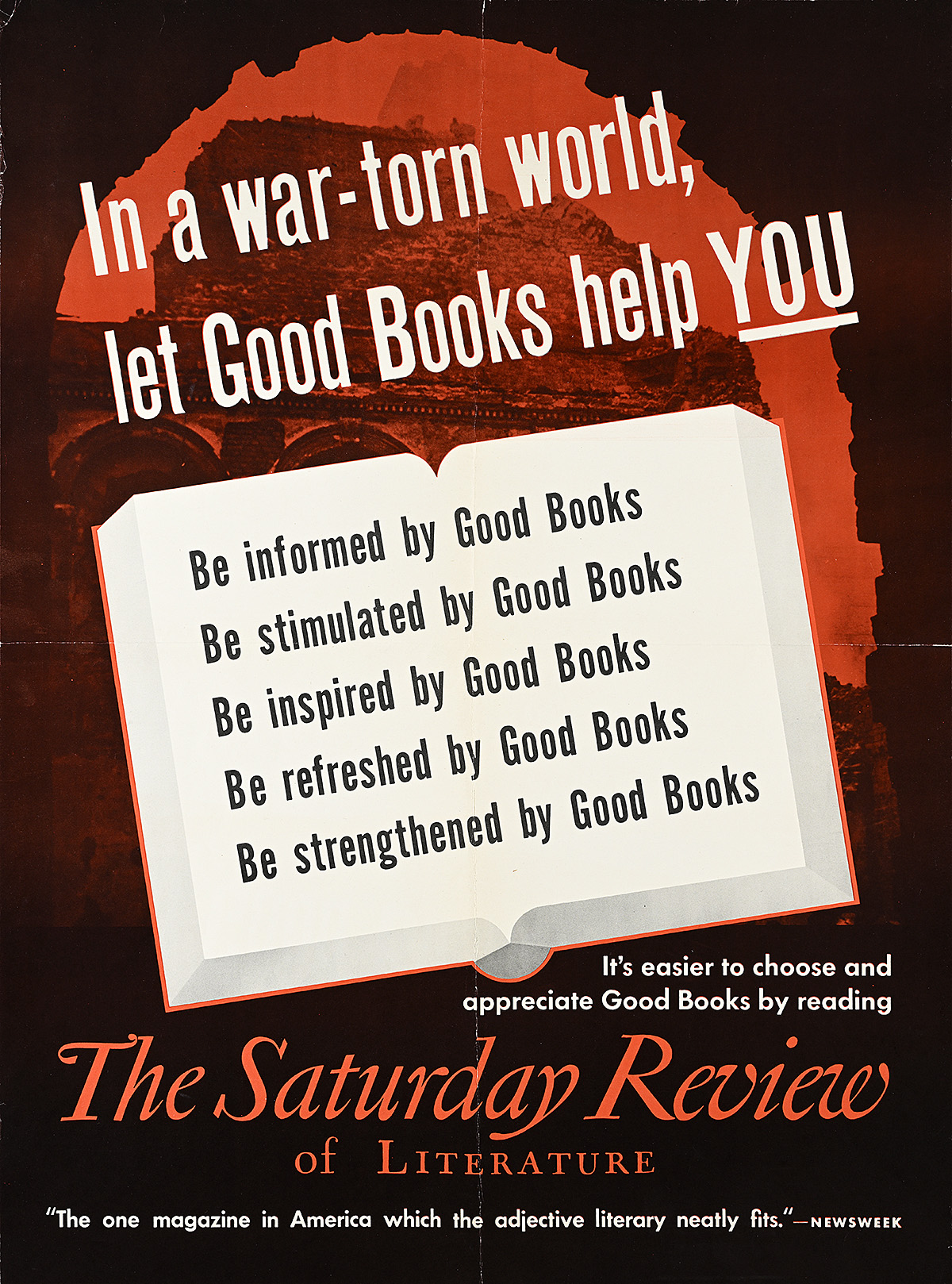
A poster of an open book with text on the pages in front of a large red and black building.

In a War-Torn World, Let Good Books Help YOU, c. 1942

Designer Unknown

Private Collection, NYC

  • The Saturday Review of Literature was a prominent American literary magazine that stressed the importance of the written word during World War II. Many of its articles discussed the ways in which books and ideas had been weaponized by Nazi Germany, and how people in the United States could dismantle enemy propaganda and fight its oppressions by reading and staying informed.
  • This poster emphasizes the many roles books play in a reader’s life, providing information, entertainment, inspiration, fresh perspectives, and strength. It also promotes the magazine itself as an authority on works that qualify as “good books.”
  • Norman Cousins, the editor of the Saturday Review of Literature, was on the board of the Victory Book Campaign along with First Lady Eleanor Roosevelt. The two collaborated to highlight the critical significance of books in wartime, both in the pages of the magazine and by encouraging the public to donate books to the troops.

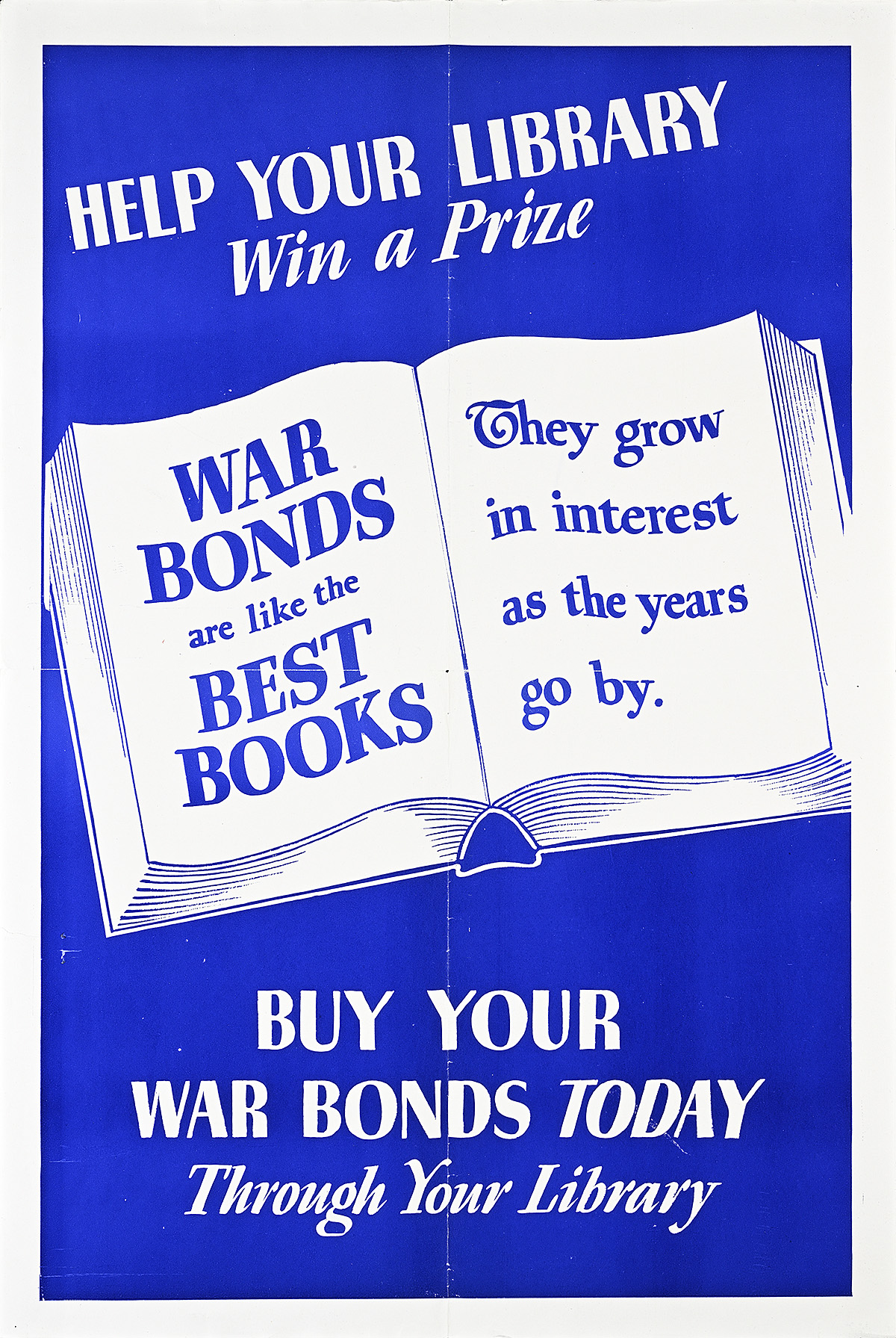
A poster of an open white book with text on the pages on a blue background.

Help Your Library Win a Prize, 1944

Designer Unknown

Private Collection, NYC

  • Librarians and public libraries not only contributed to the war effort by collecting books from civilians for donation to the armed services, but also raised public awareness of other opportunities to support the war effort, like the purchase of war bonds.
  • During annual war bond campaigns, libraries could volunteer to sell war bonds for the government. Those that sold the most could win prizes for their branch, including original book illustrations, inscribed books, and other literary items that the public could then enjoy. Libraries in at least 33 states hosted war bond campaigns during the war.
  • The Victory Book Campaign ended in 1943 but this library war bond campaign provided librarians with an opportunity to contribute once again to the war effort, something that many were eager to do. This poster would have been hung in libraries across the United States and was duplicated in newspapers to advertise a local library’s participation in the war bond drive.

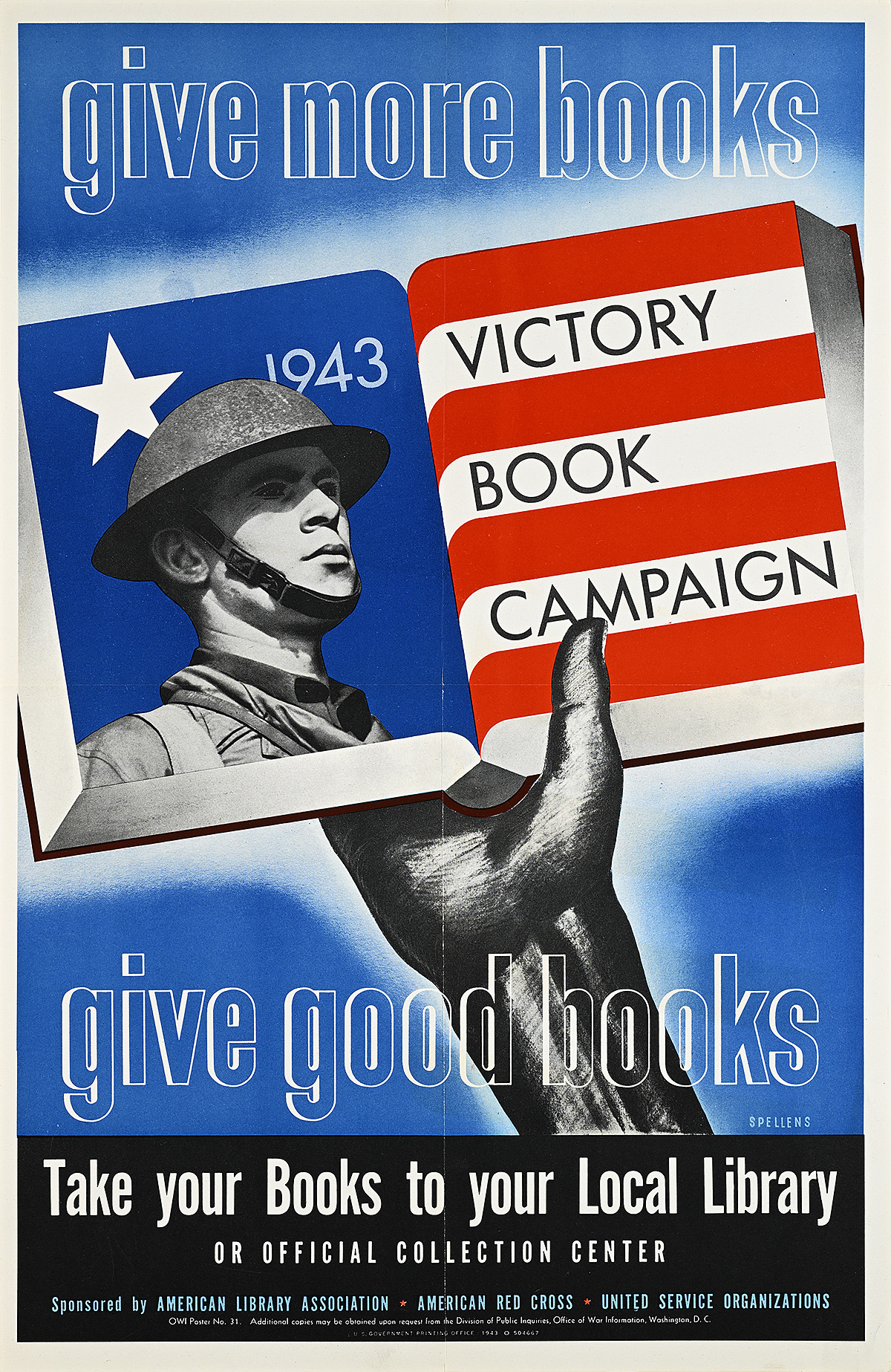
A poster of a hand holding up an open book with a soldier's face on a blue background on the left and red and white stripes on the right.

Give Good Books, 1943

Irving Spellens (Dates Unknown)

Private Collection, NYC

  • When the Victory Book Campaign was renewed in January 1943, a patriotic color scheme was chosen for this poster, with a book standing in for the American flag. Posters like this one persuaded the public to donate more than 8 million books for the armed forces in 1943. 
  • The single white star on the left side of the open book is likely a reference to a common identification symbol for American vehicles across war zones, highlighting the connection between books and the freedom of information that was one of the main values of the Allied forces.
  • The U.S. military distributed more books to its troops than that of any other nation during World War II. When U.S. soldiers served alongside other Allied armies, they were often besieged with requests for books, especially from British and Australian servicemen who shared the same language. The unofficial policy was to read a book and pass it on to the next person who wanted it. As a result, books supplied by the U.S. government helped spread American values such as free speech, personal liberty, free choice, and democracy among the armies of other nations.
  • The poster’s request for “good books” was an attempt to avoid the kind of “attic-cleaning” approach that resulted in donations few soldiers would want to read—books like Equestrianism for Women and Crawford County, Minnesota (both of which were given to the campaign). Since troops inevitably had diverse interests and their educational levels ranged from that of a fourth-grader to a college graduate, the Victory Book Campaign simply asked the public to give their favorite reading material.

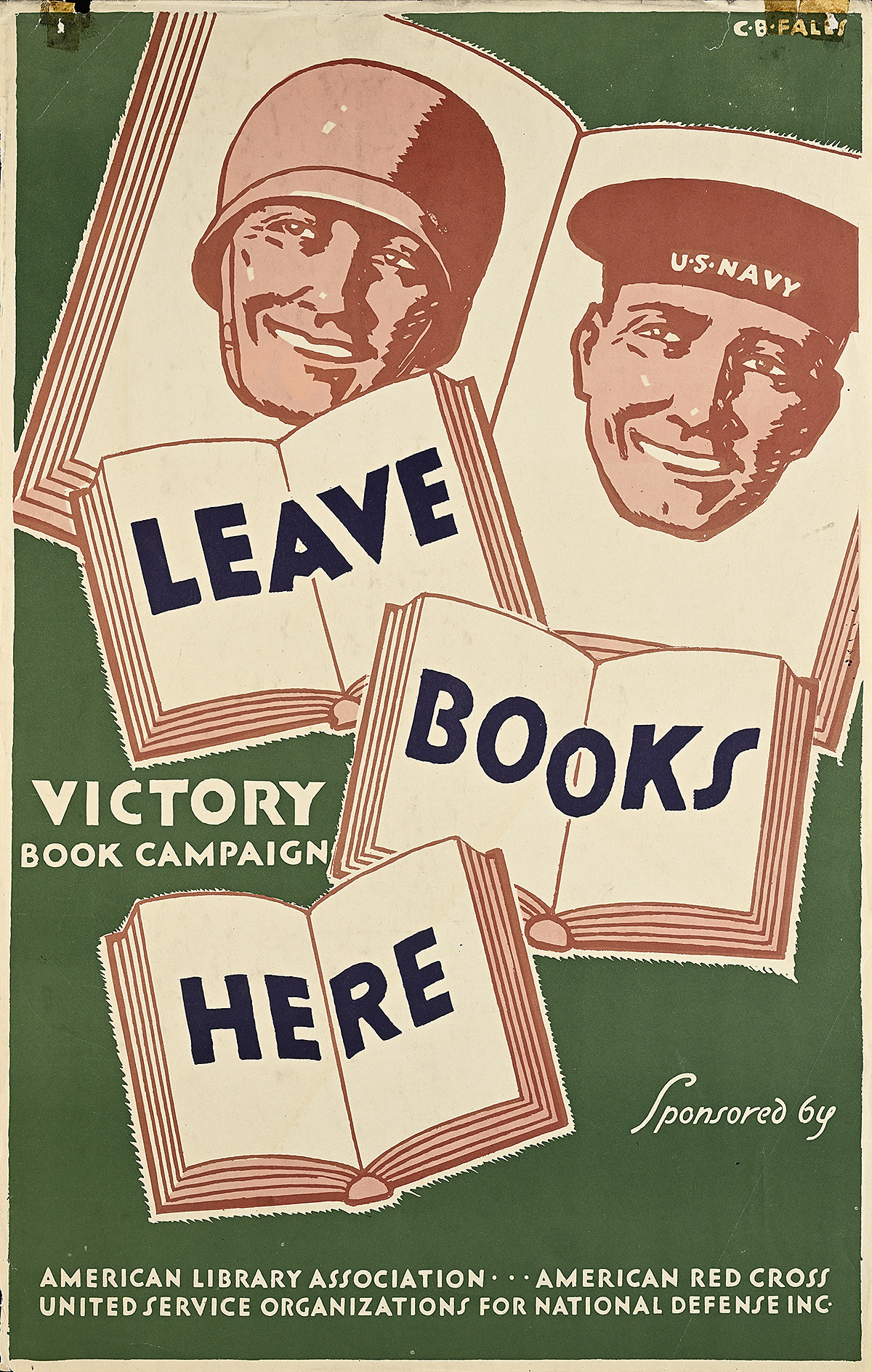
A poster of four white open books with floating faces of uniformed men on them.

Leave Books Here, 1942

Charles Buckles Falls (1874–1960)

Private Collection, NYC

  • In January 1942, librarians across the United States launched the largest book drive in American history: the Victory Book Campaign. Because the U.S. military lacked a sufficient budget to purchase books for troops, civilians were asked to donate their favorite books to fill book shelves in training camps at home.
  • The American Library Association collaborated with the American Red Cross and United Service Organizations to host the Victory Book Campaign, headquartered in the Empire State Building in New York City.
  • Book drops were ubiquitous—they were in grocery stores, department stores, libraries, train stations, offices, movie theaters, buses and trams, and schools. Posters like this one were often displayed near these drop sites to attract attention and emphasize that all branches of the armed services were benefiting from these efforts. 
  • By May 1942, more than 10 million books had been donated by the public and distributed to military training facilities across the United States. At some ports of embarkation, giant crates of books greeted soldiers who were encouraged to grab reading material for their weeks-long journey overseas.

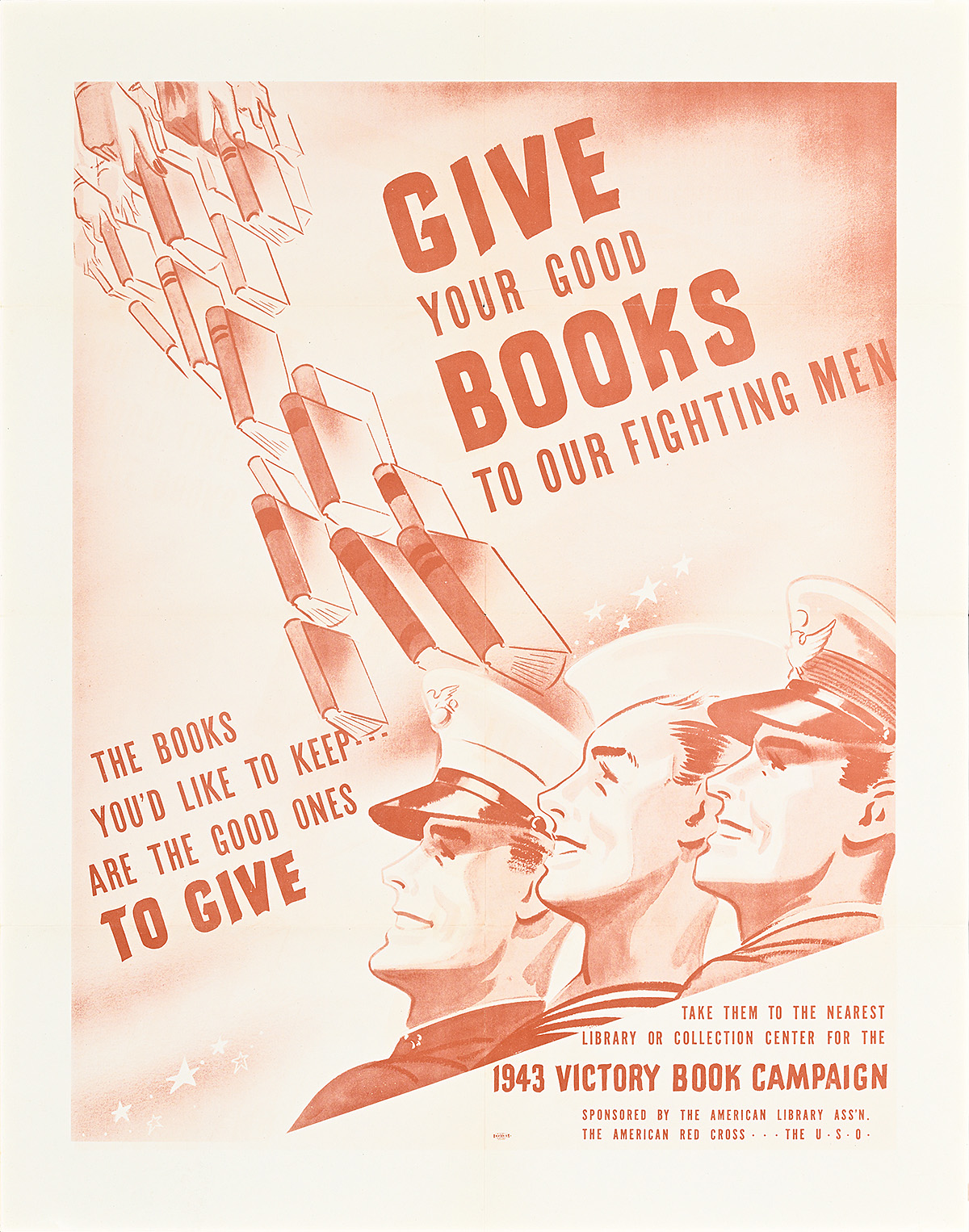
A poster of an illustration of three uniformed men in profile looking to the upper left with a trail of books behind them.

Give Your Good Books to Our Fighting Men, 1943

Designer Unknown

Private Collection, NYC

  • In 1943, an endless barrage of campaigns for resources overwhelmed the American public who were asked to give paper, aluminium, rubber, and other household waste to support the war effort. The call for book donations was lost in the chorus of demands, and supplies ran low. 
  • This poster illustrates how book donations went directly to an audience of young, eager men in the services; a cascade of books is literally falling from the hands of people making donations in the upper-left corner of the image toward an appreciative line-up of servicemen from different branches of the military at the lower right. This poster suggests a direct connection between the action of the book donor and the improvement of the lives of American fighting men.
  • To encourage donations of high-quality and popular books that troops would actually enjoy, this poster advises the viewer that “the books you’d like to keep are the good ones to give.” Unfortunately, book donations continued to be dominated by undesirable titles and the Victory Book Campaign was discontinued at the end of that year.

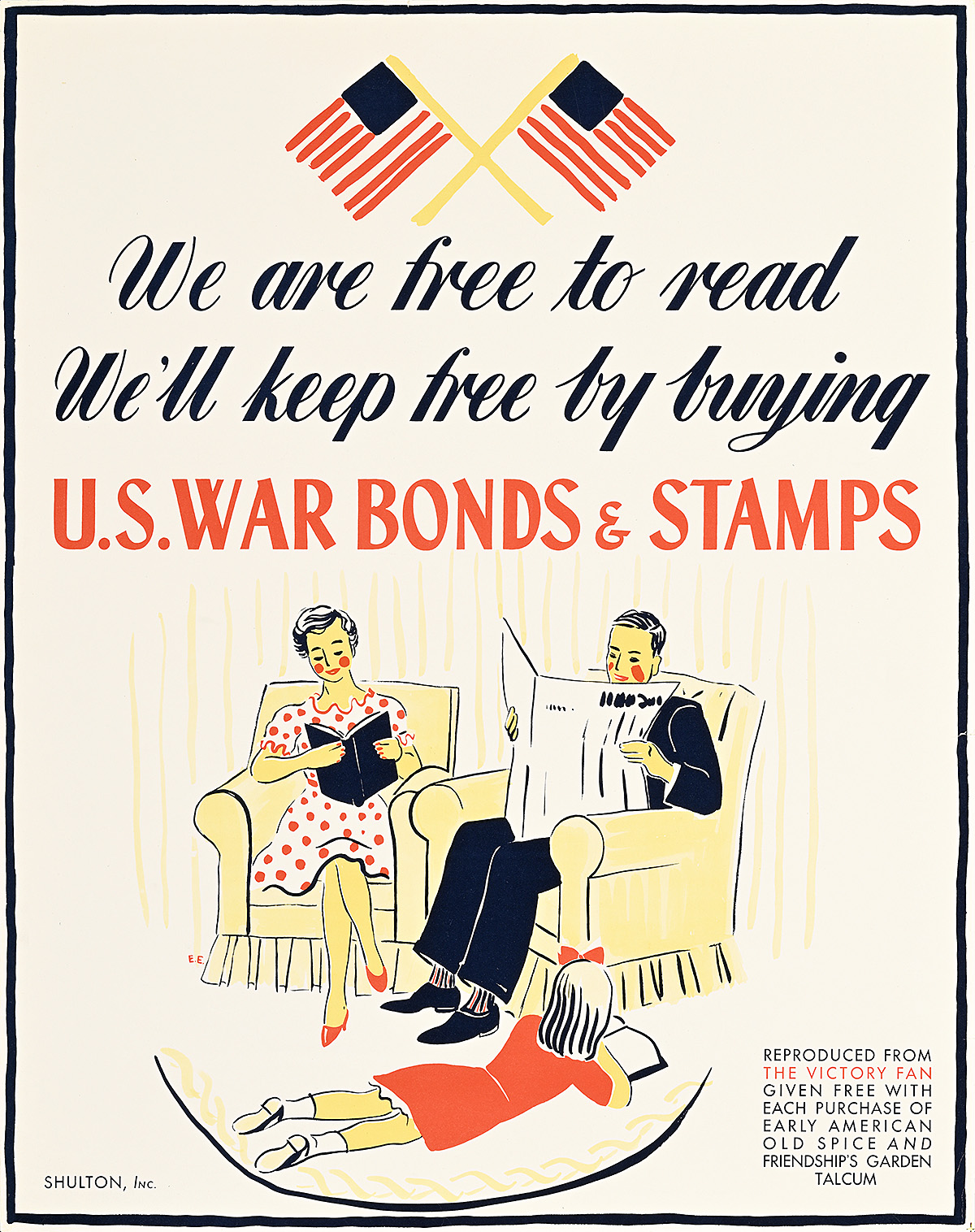
A poster of a man and woman reading in chairs while a child lays on the ground with a book.

U.S. War Bonds & Stamps, 1942

Dorothy Enid Edson (1899–1989)

Private Collection, NYC

  • Best known as the creator of Old Spice, Shulton was a toiletries company that collaborated with the U.S. Treasury Department to produce a series of war bond posters. Here, Shulton’s in-house designer, Dorothy Enid Edson, who usually created the Americana-themed designs for the company’s packaging, depicts the “classic” American family reading at home.  
  • This image was meant to highlight the “outstanding freedom of America” where every man, woman, and child could read what they pleased, in sharp contrast to Nazi-occupied territories where there was no free circulation of information or ideas. 
  • Other posters in this series celebrated the freedom to “raise our children,” worship, and “teach the truth” in schools without the government’s intervention or oversight. These posters would have been displayed in stores across the United States, reminding the public to purchase war bonds and stamps (thereby financially supporting the war effort), and to cherish and practice their democratic freedoms. 
  • The text in the lower-right corner indicates that Edson’s image originated on a Victory Fan that came free with the purchase of some of Shulton’s “Early American” products. Victory Fans were among the many inexpensive but decorative incentives used to entice people to buy something while simultaneously supporting the war effort.

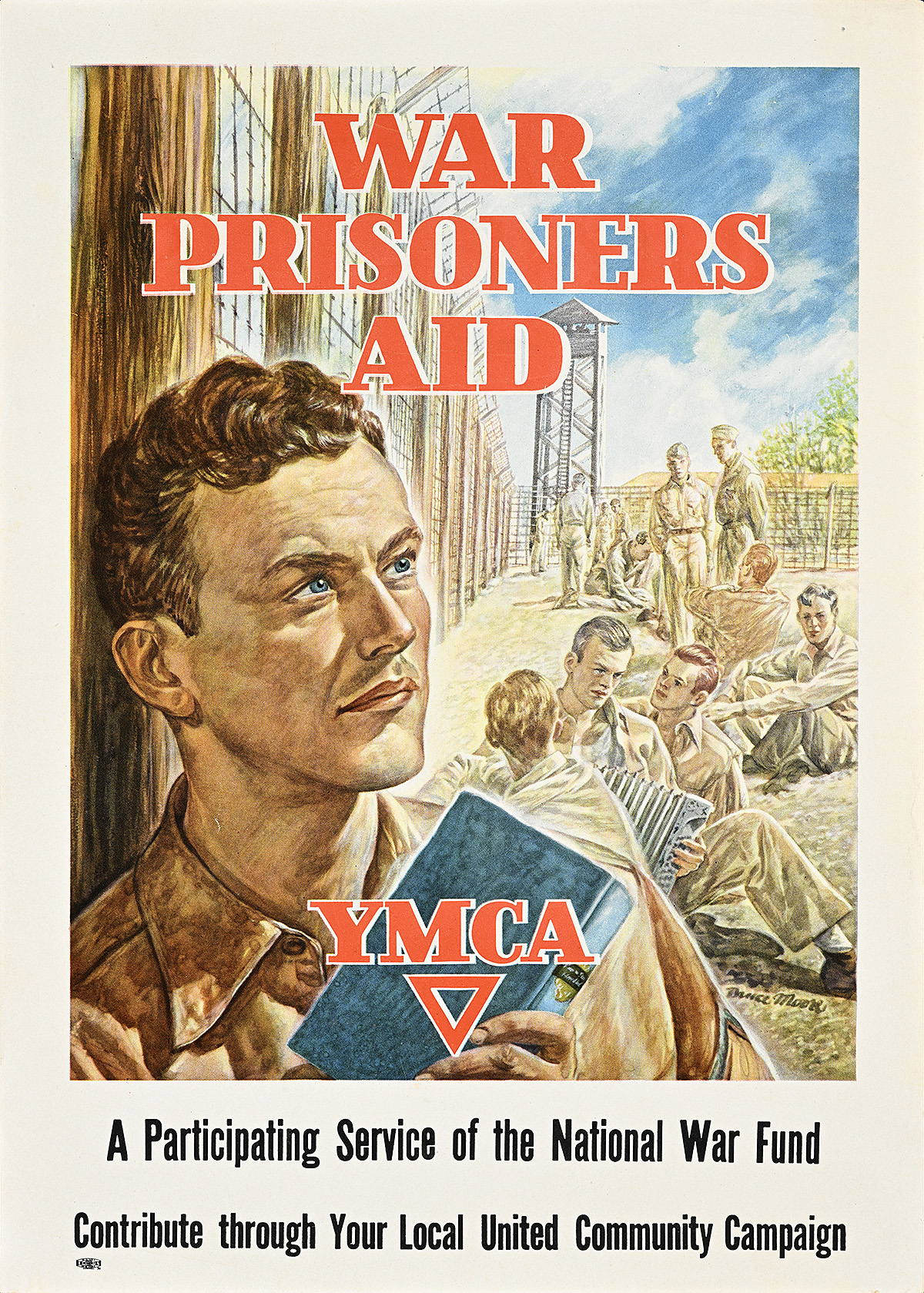
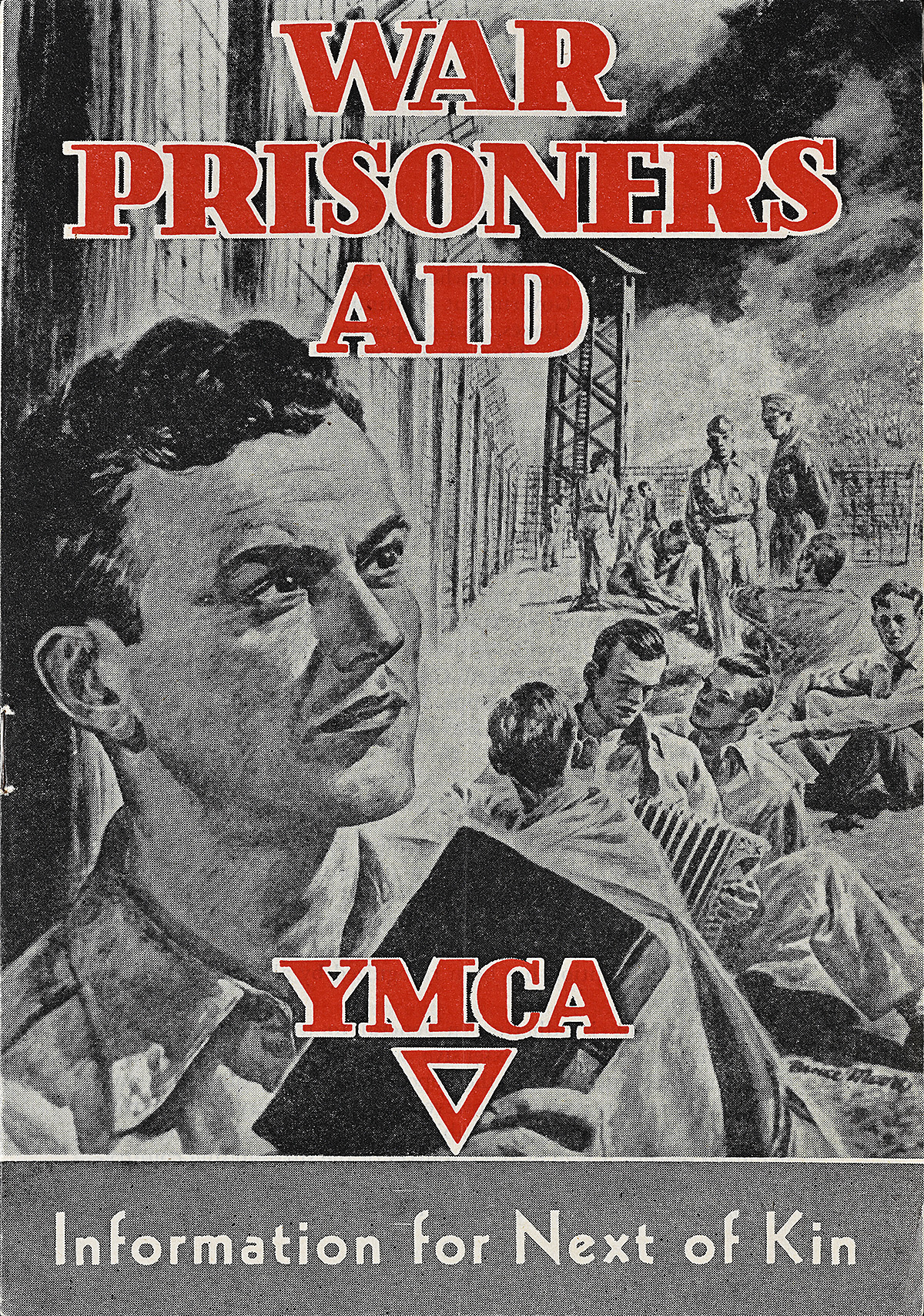
A poster of a painted soldier holding a book with a line of prisoners of war sitting behind him.

War Prisoners Aid, c. 1945

Bruce Moore (1905–80)

Private Collection, NYC

  • During World War II, the YMCA’s international headquarters in Geneva was permitted to distribute books and other recreational items to prisoners of war (POWs) by agreement with several nations, including Germany. Under this arrangement, the YMCA tended to the needs of prisoners of all nations, including German POWs in the United States and American POWs in Germany. Books were cherished by prisoners, as each title provided hours of mental escape from uncertainty and boredom. 
  • As a result of Nazi book bans, books sent to Allied prisoners in German POW camps were subject to severe restrictions. Those that included information about navigation, meteorology, chemistry, geography, the armed forces, radio, inventions, politics, propaganda, or espionage were banned, as were any books by Jewish authors (including Albert Einstein). German guards at POW camps for Allied troops sorted through all YMCA boxes and removed any banned items that had been included by mistake. 
  • Packages entering POW camps were also subject to size and weight restrictions. Whenever possible, the YMCA sent small paperbacks in lieu of bulky hardcovers to maximize the number of books and the hours of entertainment they could provide.

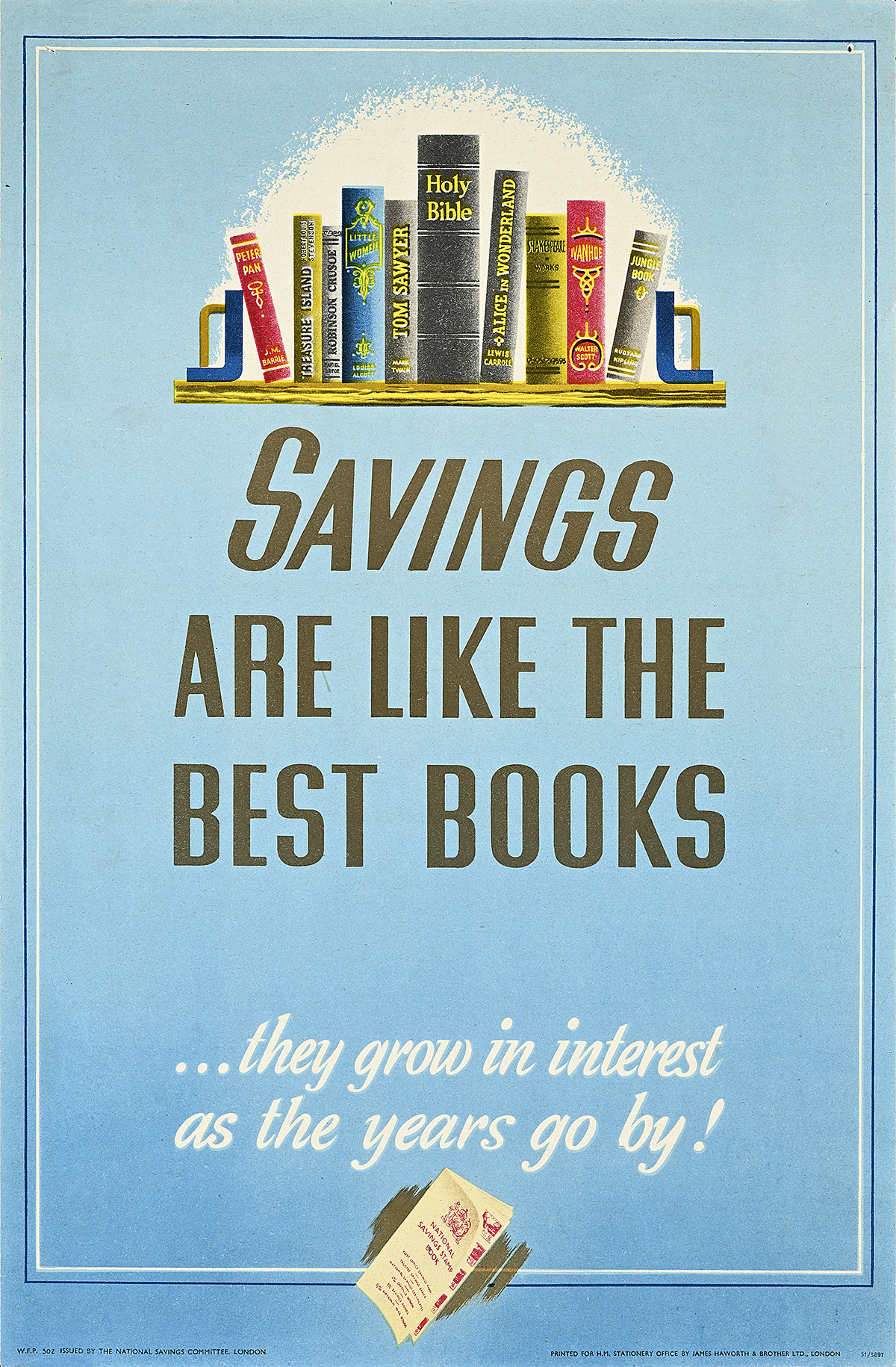
A poster of a small shelf with various books on it and text underneath on a blue background.

Savings Are Like the Best Books, c. 1940

Designer Unknown

Private Collection, NYC

  • Produced by the National Savings Committee in London, this poster uses a literary analogy to encourage British civilians to save their money during the war while rationing was in effect, and to grow their finances by earning interest. A handful of wartime posters in both Britain and the United States similarly compared books to financial gain, noting how money and ideas may gain value over time.
  • The British book industry was dealt a serious blow during the Blitz in 1940, when many printing houses, booksellers, and publishers were bombed and millions of books were destroyed. This loss of infrastructure, in addition to a paper shortage, meant that books suddenly became especially precious.
  • Among the “best books” displayed on this poster are Peter Pan, Tom Sawyer, Little Women, Alice in Wonderland, Shakespeare, The Jungle Book, and the Holy Bible.

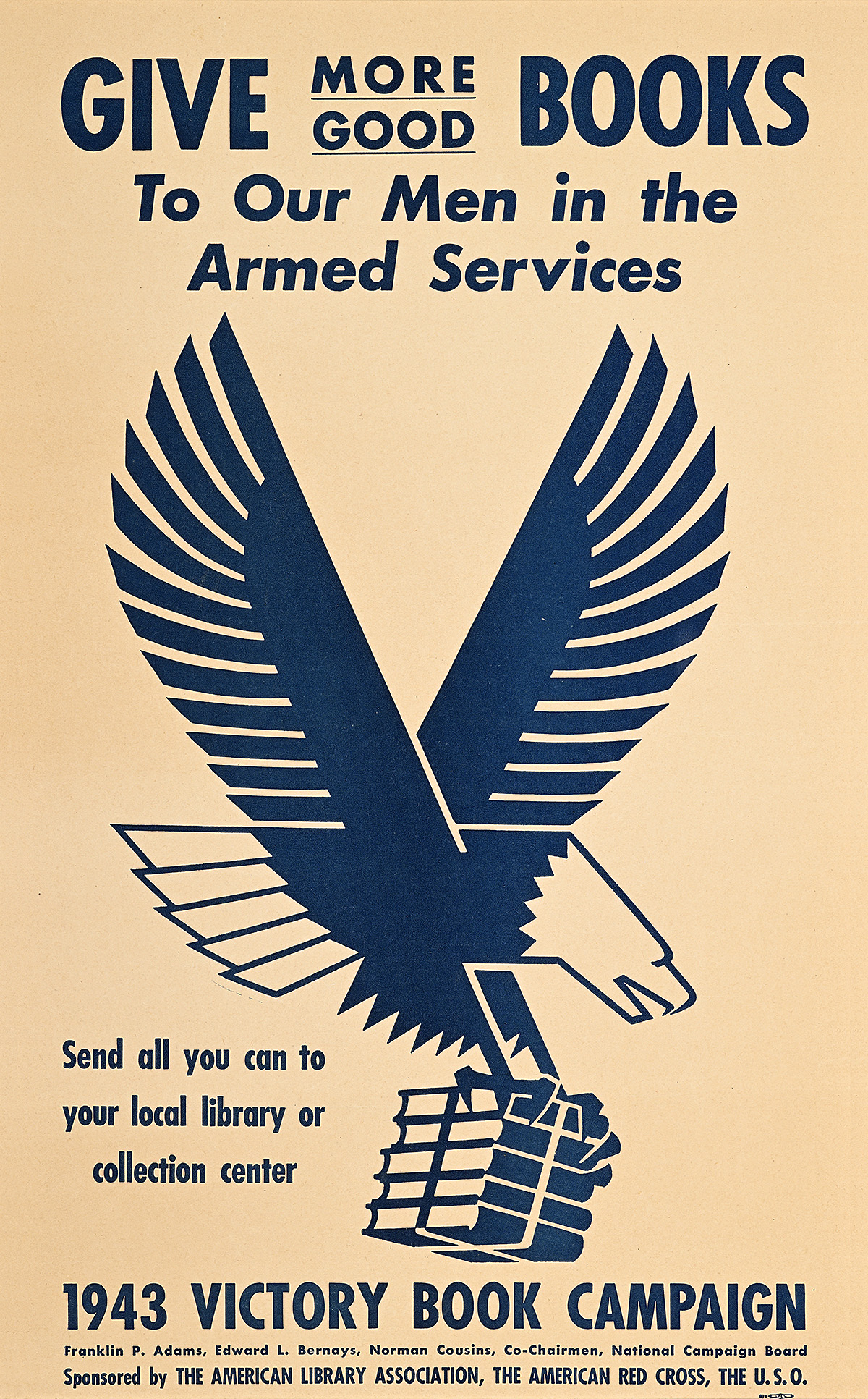
A poster of a geometric navy blue eagle with wings outstretched and a stack of books in its talons.

Give More Good Books, 1943

Designer Unknown

Private Collection, NYC

  • This 1943 Victory Book Campaign poster features a modernist rendering of a bald eagle, the national emblem of America, carrying a bundle of books to soldiers overseas. Its stylized wings are shaped like a “V,” often used in wartime images to denote Victory. 
  • A large number of the donations were in poor condition or unsuitable (like cookbooks or children’s picture books), causing the Victory Book Campaign to be discontinued at the end of 1943. To replace these efforts, American publishers began to produce miniature paperbacks called “Armed Services Editions” (ASEs). Sized to fit the breast or hip pocket of a military uniform, these tiny paperbacks featured popular titles. Every month, millions were shipped to American troops around the world.   
  • While the Victory Book Campaign had rallied civilians and educated them about the importance of books to democracy, it was far easier to control the quality and quantity of books sent to soldiers if the U.S. Army and Navy could simply purchase ASEs. 
  • Publishers sold ASEs to the military at an average price of about five and a half cents (approximately 93 cents today) per book. Since the ASEs were given to the troops without charge, publishers avoided publicizing the program, fearing that American civilians would protest at paying several dollars each for books if they knew that ASEs cost just a few cents to produce and were available to American servicemen for free.

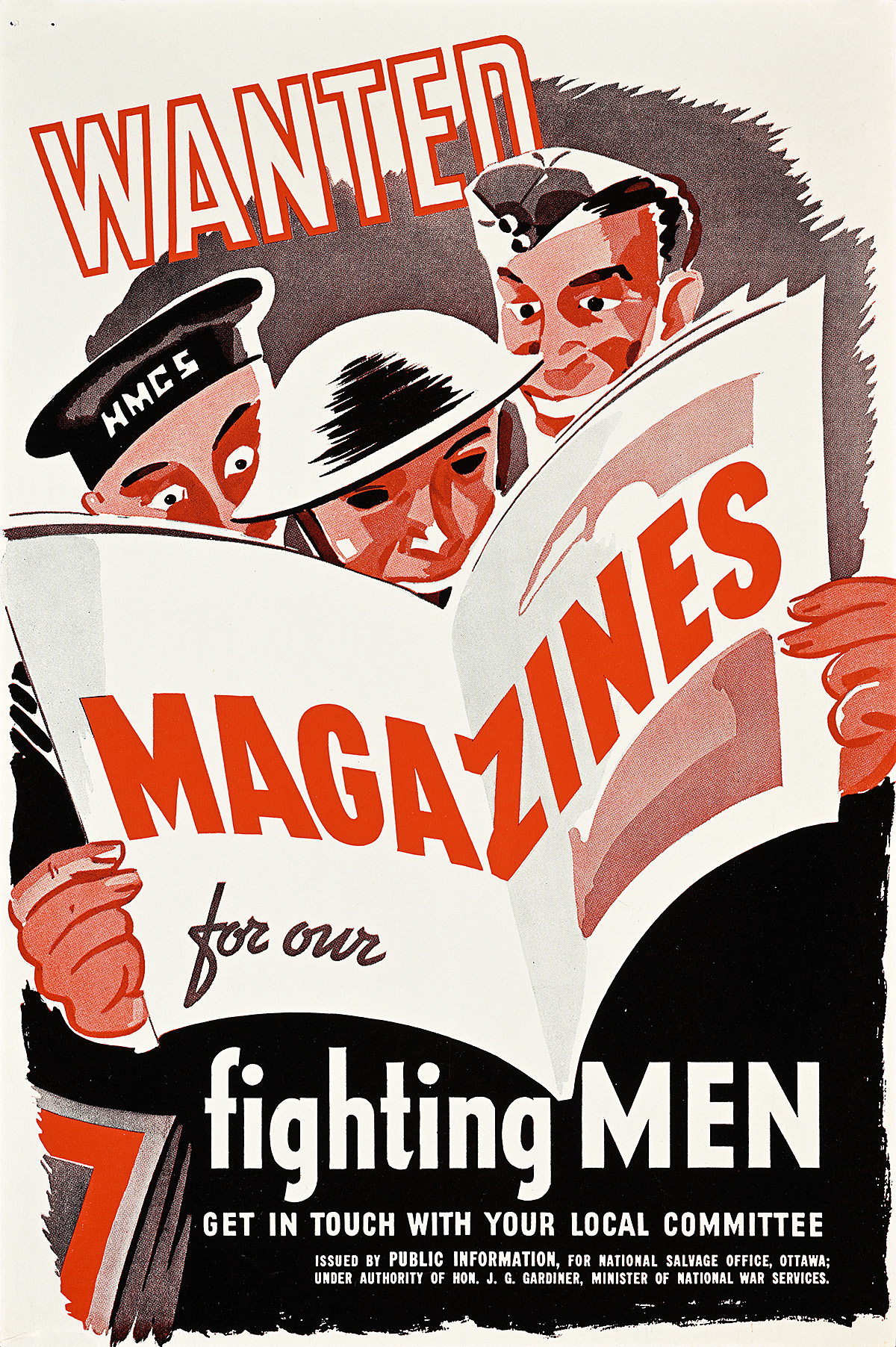
A poster of an illustration of three men standing together reading a large open magazine.

Magazines for Our Fighting Men, c. 1945

Designer Unknown

Private Collection, NYC

  • In Canada, a voluntary organization called the United War Services worked to acquire recreational materials for Canadian troops. It had a Books and Magazines Committee, which asked the Canadian public to donate books, magazines, playing cards, and games.    
  • This poster urges Canadian civilians to give their gently used magazines to Canadian servicemen. In 1943, 100,000 magazines per week were collected for the armed forces in Canada.
  • During World War I, the United States had also collected donated magazines for servicemen overseas, but the slow speed of shipping and the shabby condition of many of the second-hand publications ultimately doomed the program.
  • Aware that most young men had already developed the habit of reading magazines and comic books as civilians, the United States military purchased magazines for troops during World War II rather than encouraging donations.

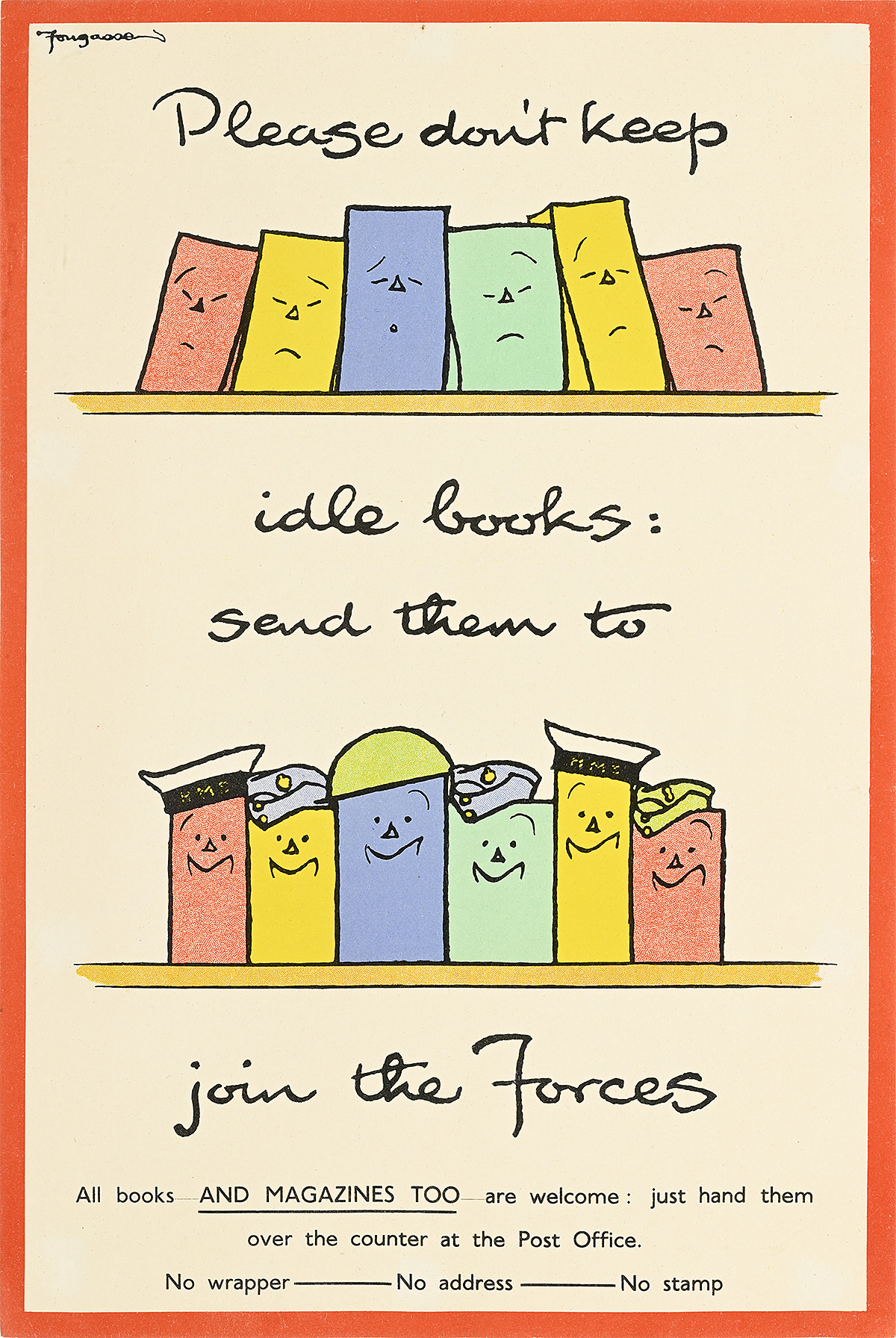
A poster of two shelves holding multicolored books with smiley faces on their spines on a tan background.

Please Don’t Keep Idle Books, c. 1945

Fougasse (Cyril Kenneth Bird, 1887–1965)

Private Collection, NYC

  • Fougasse was a popular cartoonist and illustrator who designed dozens of posters for the British government instructing the public on proper wartime behavior during World War II. He produced several posters for the Royal Naval War Libraries, each requesting monetary donations to buy reading materials as well as donations of actual books and magazines.
  • This poster advertises the need for books in all branches of the British military. While the hardcover books depicted here would have been especially useful in a ship’s library, where sailors would not have had to carry them for miles, foot soldiers preferred paperbacks. A soldier in the field might carry a donated book to read during lulls in action; there was no obligation to return it and books were kept in circulation as servicemen swapped them.
  • This colorful poster asks the British public to donate books and magazines to the armed forces by dropping them off at any post office. These books were periodically collected, sorted, and then distributed according to current needs across the different branches of the military. Posters like this one would have been displayed in post offices throughout the United Kingdom as well as in other government buildings open to the public.

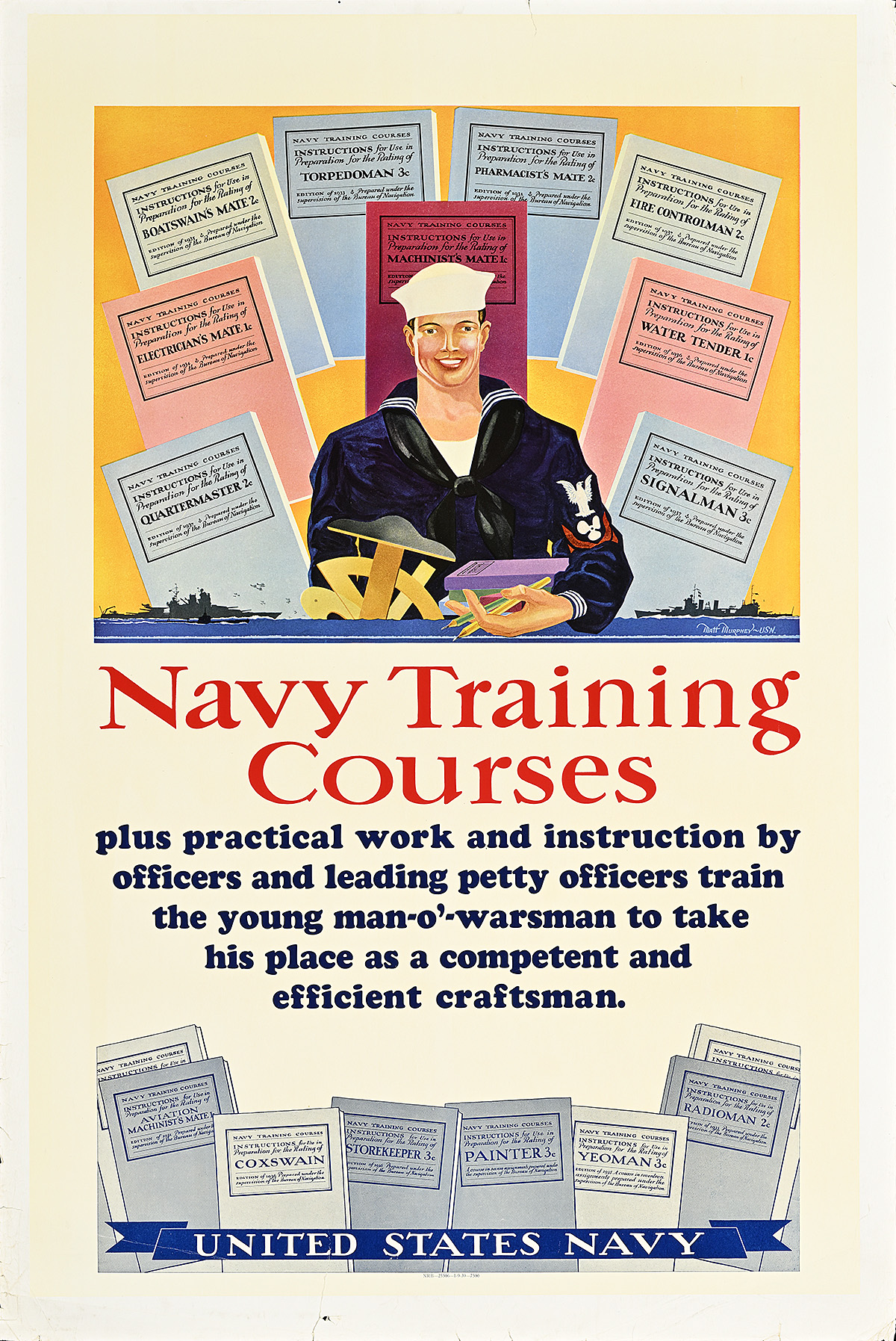
A poster of a smiling sailor in uniform holding books with various multicolored books in the background.

Matthew Murphey (1898–1943)

Private Collection, NYC

  • The United States Navy and Army provided many opportunities for servicemen to gain skills and an education that would advance their rank or improve their employment prospects after the war. This poster highlights some of the specialist training courses offered by the Navy, including how to become a Quartermaster (navigator), a Signalman (who uses flags and lights to communicate), a Yeoman (secretary), and a Machinist’s Mate (engineer). 
  • This is one of several posters designed by Matthew Murphey, who joined the U.S. Navy before World War I and was ultimately transferred to the National Headquarters of the Navy Bureau of Recruitment in New York City. He died while serving in the Navy off the coast of England in 1943.
  • The widespread prevalence of the books and educational opportunities offered to troops during the war partly accounts for the tremendous popularity of the Servicemen’s Readjustment Act of 1944 (better known as the G.I. Bill) and its promise of free vocational training or education for honorably discharged veterans. Before the war, most men did not read books voluntarily (they preferred magazines); however, having gained a reading habit and confidence in learning while at war, 7.8 million veterans pursued education or training under the G.I. Bill after they were discharged, 2.2 million of them at a four-year college or university.

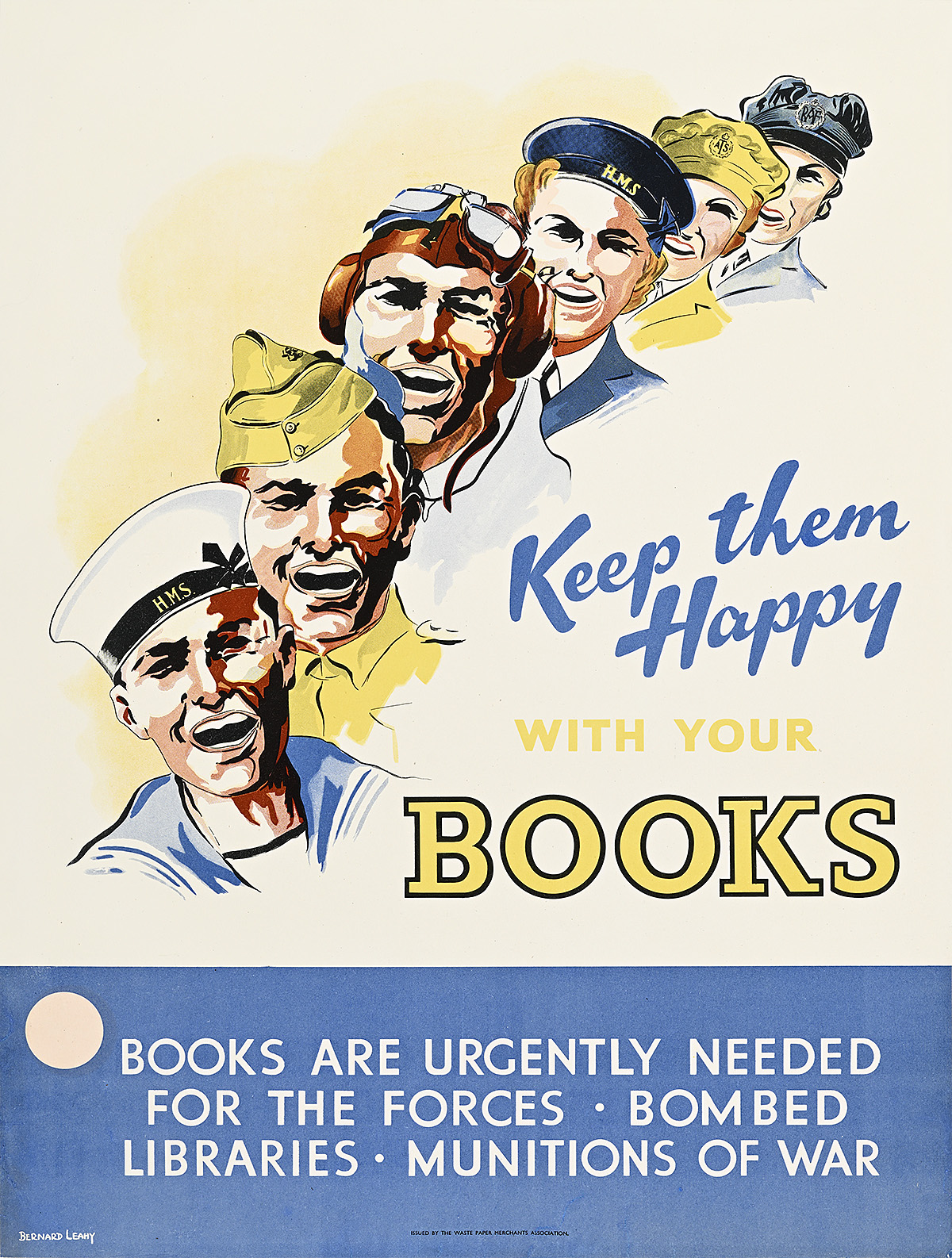
A poster of heads of several smiling uniformed men and women in a line.

Keep Them Happy with Your Books, c. 1945  

Bernard Leahy (Dates Unknown)

Private Collection, NYC

  • This poster, produced by the Waste Paper Merchants Association of England, encourages the donation of books for troops and civilians at a time when paper rationing and wartime conditions made it difficult for publishers to print enough books.
  • In December 1940, Paternoster Row in London, where most of Britain’s publishing industry was situated, was bombed heavily by German planes; millions of books burned and the offices of many publishing houses were leveled. The country’s capacity to produce books was greatly diminished. 
  • Paper rationing remained in effect in Britain until 1949; many British publishers printed the tiniest paperbacks ever sold (measuring as little as 4 by 5.25 inches) to stretch the number of books they could print on a limited paper supply. Some cost only two shillings (approximately 80 cents in 1945; less than a hardcover book in the United States but more than the 25-cent standard cost of a paperback).   
  • The public demand for books in Britain was extremely high, especially given the frequency of air raids in 1940 and 1941. As civilians took refuge in cellars, shelters, and other underground locations, reading provided a distraction from the tension and the terror. 
  • Books were also collected to brighten the off-duty hours of munitions workers, who often worked long, dangerous shifts in factories.

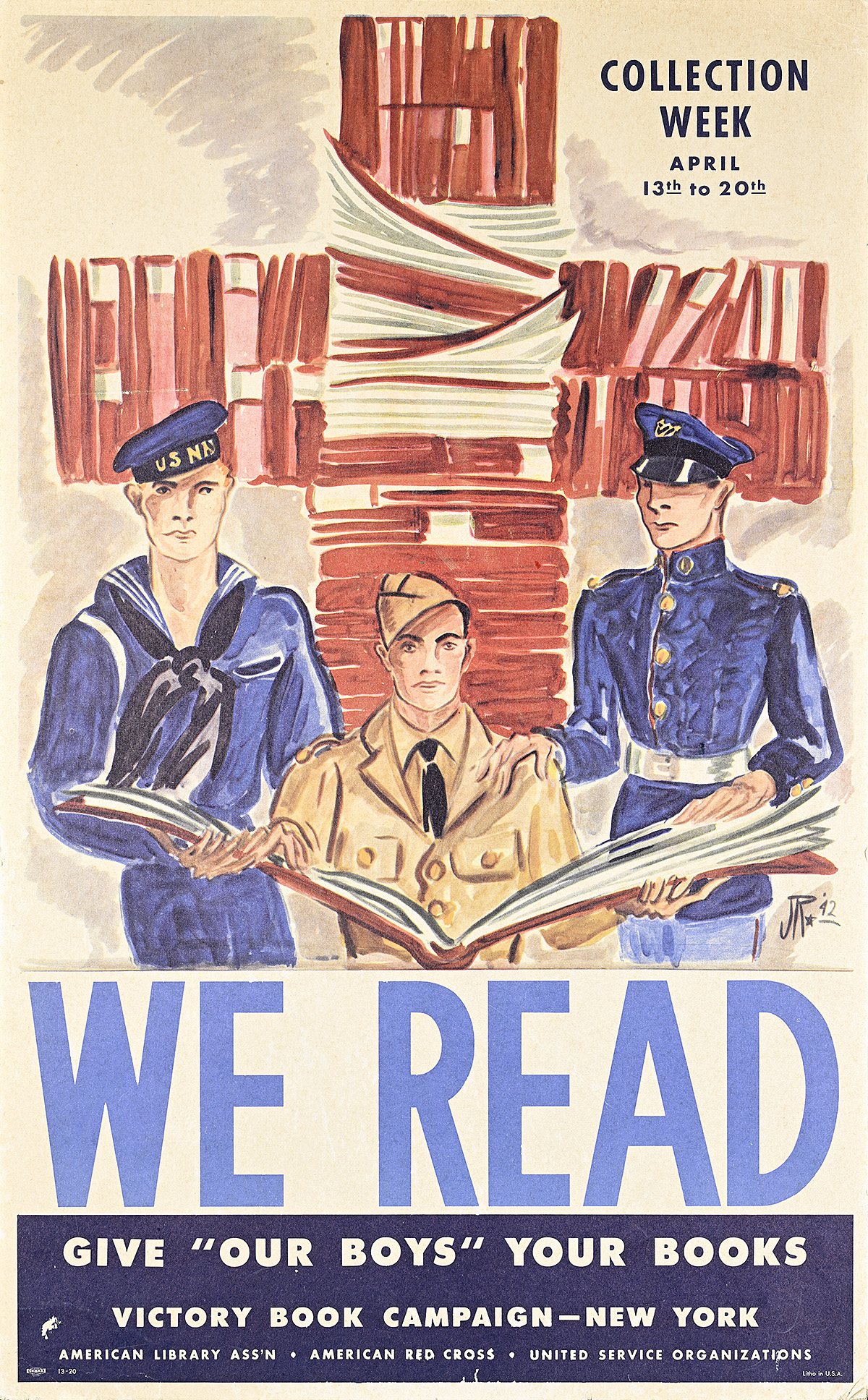
A poster of three uniformed men holding open a very large book with red books in the background forming a cross.

We Read, 1942

J.R. (Dates Unknown)

Private Collection, NYC

  • In an effort to collect 10 million donated books by mid-1942, the Victory Book Campaign announced a special “Collection Week” between April 13 and 20. In support of these efforts, President Roosevelt declared April 17, 1942, “Victory Book Day,” and personally encouraged the American public to donate as many books as possible.
  • This poster was made for the New York branch of the campaign and would have been displayed in public buildings throughout the state. Special attention was given to New York because it had the highest quota for donations—2 million books, or 20 percent of the national goal—and because the Victory Book Campaign was headquartered in the Empire State Building. 
  • This painterly design shows soldiers from three branches of the military standing in front of piles of books stacked to form a red cross, pointing to the assistance of the American Red Cross in the campaign. Books were an important form of recreation for wounded soldiers in hospital.

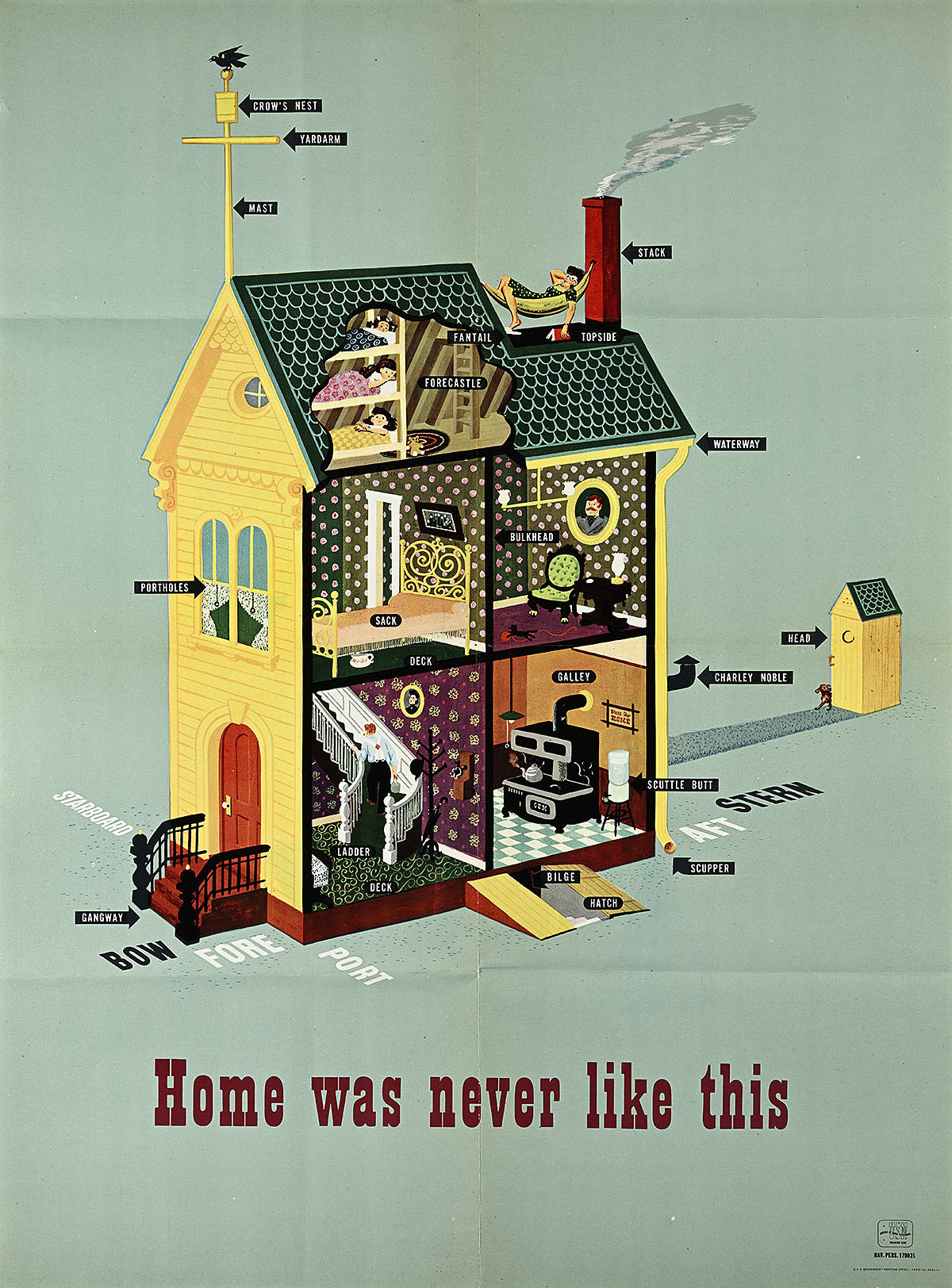
A poster of an illustrated house with a wall removed and a colorful interior of four rooms and an attic.

Home Was Never Like This, 1943

William E. Exton, Jr. (1906–88)

Private Collection, NYC

  • This poster was issued by the Bureau of Naval Personnel to help acquaint new U.S. Navy recruits with the different parts of a ship. The design compares a naval vessel with a traditional American home; the entryway stairs are described as the “gangway,” the windows as “portholes,” the bed as a “sack,” and the kitchen as the “galley.” This image would only have been seen by sailors and was not distributed in public locations.
  • The phrase “home was never like this” appears on a lot of American ephemera created during World War II, from postcards to posters. It was meant as an ironic acknowledgment of the exotic or rough conditions servicemen faced while overseas. Here, it is used to emphasize the similarities between the arrangement of a ship and that of a traditional house.
  • In a humorous vignette, a woman is shown lounging in a hammock “topside,” a book dangling from her hand, referencing the tendency of sailors to relax in the open air on a ship’s top deck and read. Most ships had a permanent library, and the Navy received magazines as well as paperback Armed Services Editions for its men.
  • Reading was especially popular in the Navy. There were often long stretches of time between engagements, and books provided hours of distraction and entertainment.

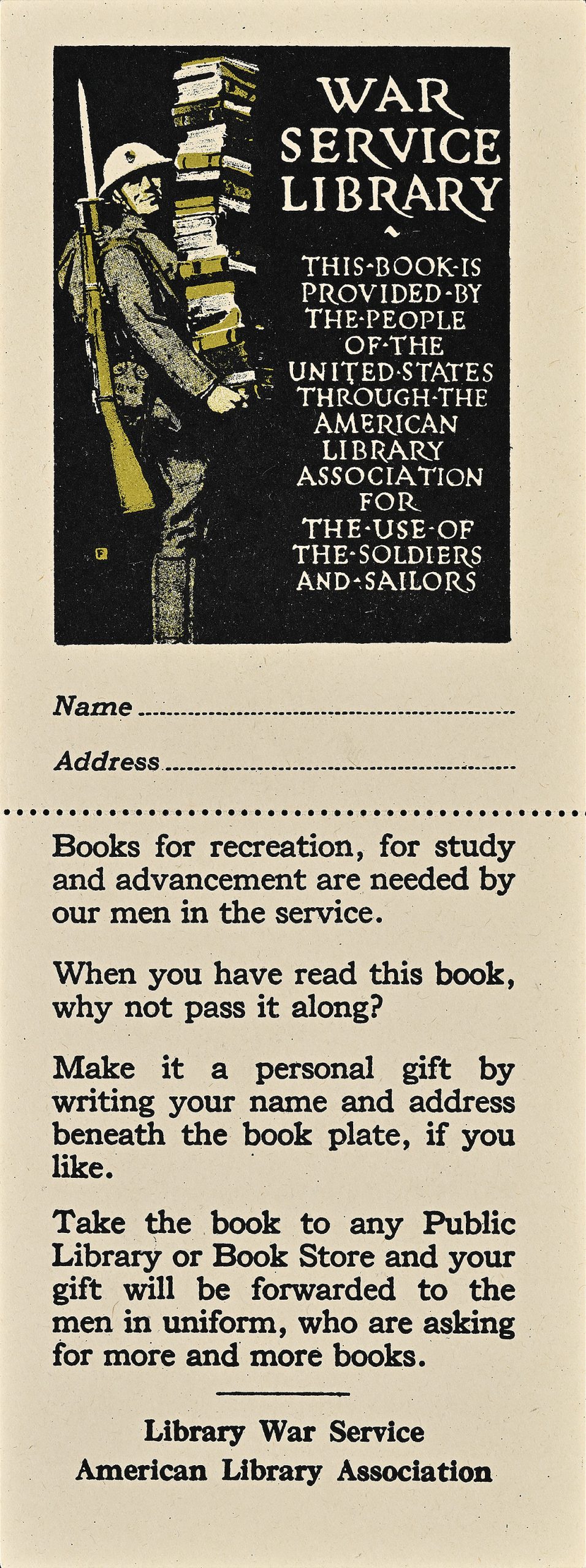
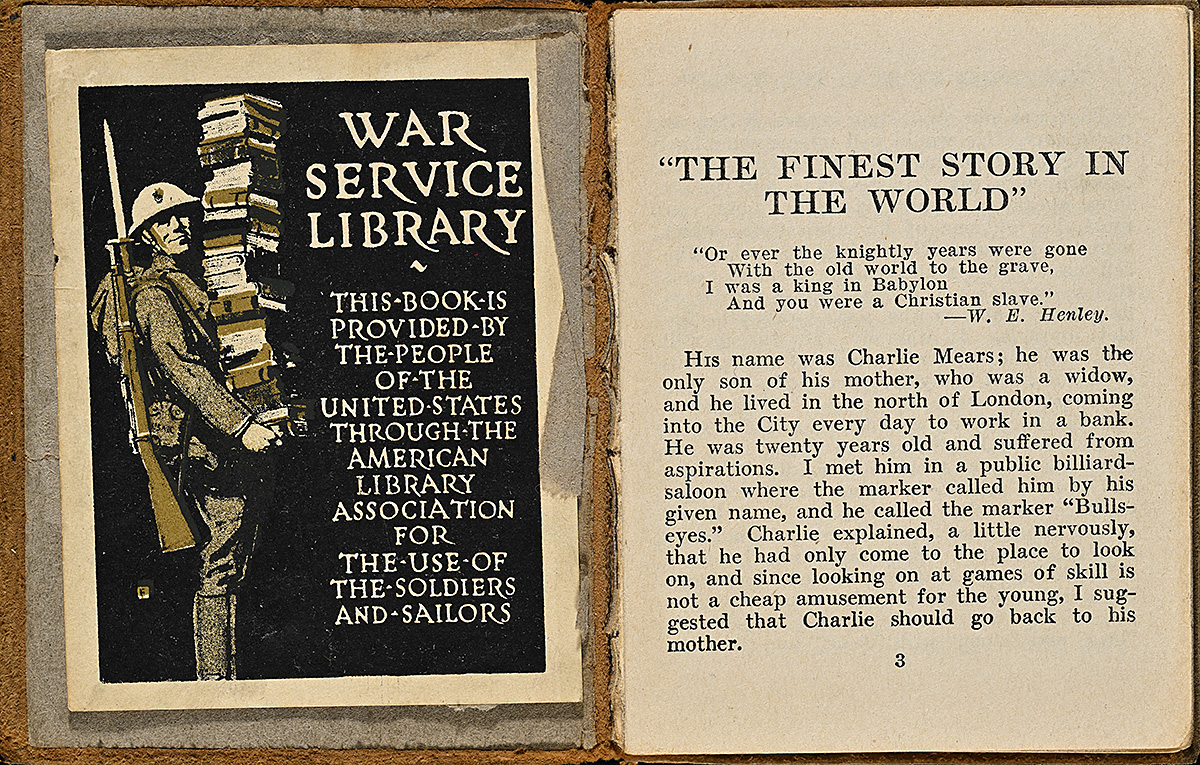
A bookplate with an image of a soldier in uniform holding a tall stack of books in his arms.

Various Ephemera, 1917–45 

Private Collection, NYC

A stamp of a soldier reading a book with German text above and below.

Various Ephemera, 1917–45 

Private Collection, NYC

A brochure of a man holding a book with a line of prisoners of war behind him in black and white with red text.

Various Ephemera, 1917–45 

Private Collection, NYC

A book page with a soldier in uniform standing and holding a tall stack of books in his arms.

Various Ephemera, 1917–45 

Private Collection, NYC

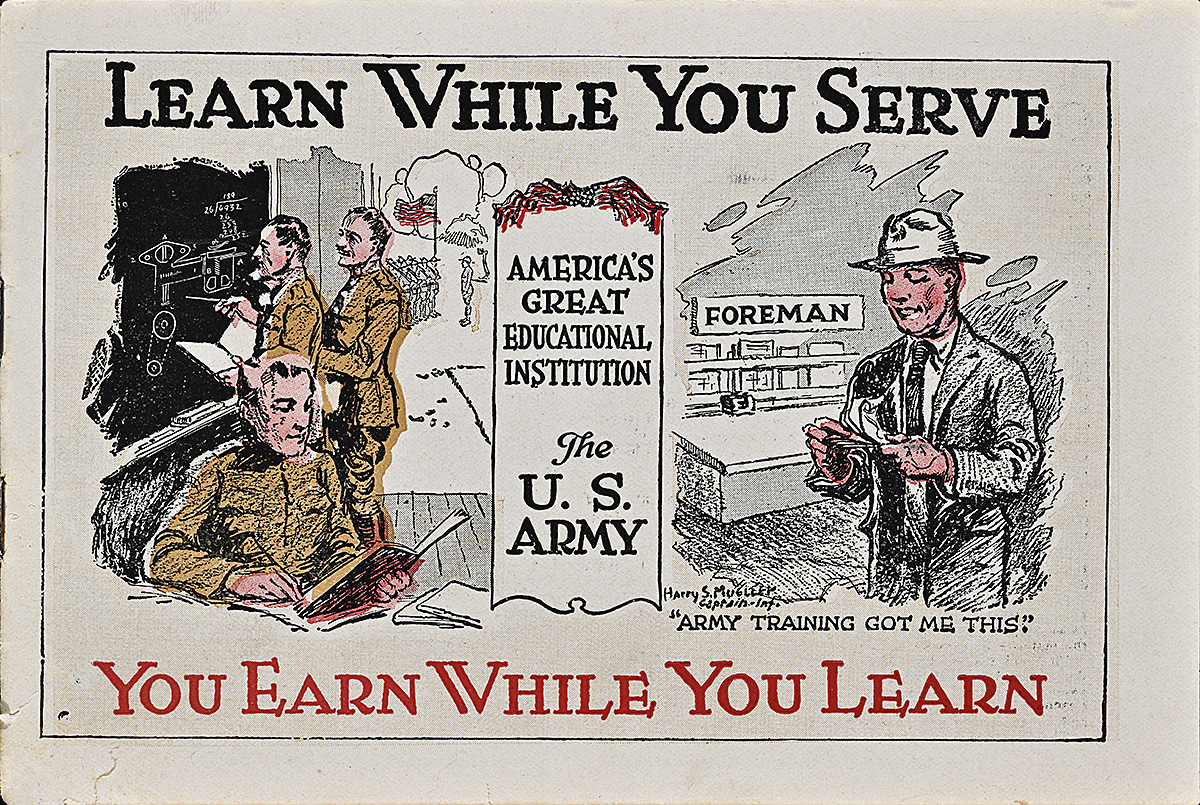
A horizontal brochure with illustrations of soldiers reading and writing on the left and a man in a suit on the right.

Various Ephemera, 1917–45 

Private Collection, NYC

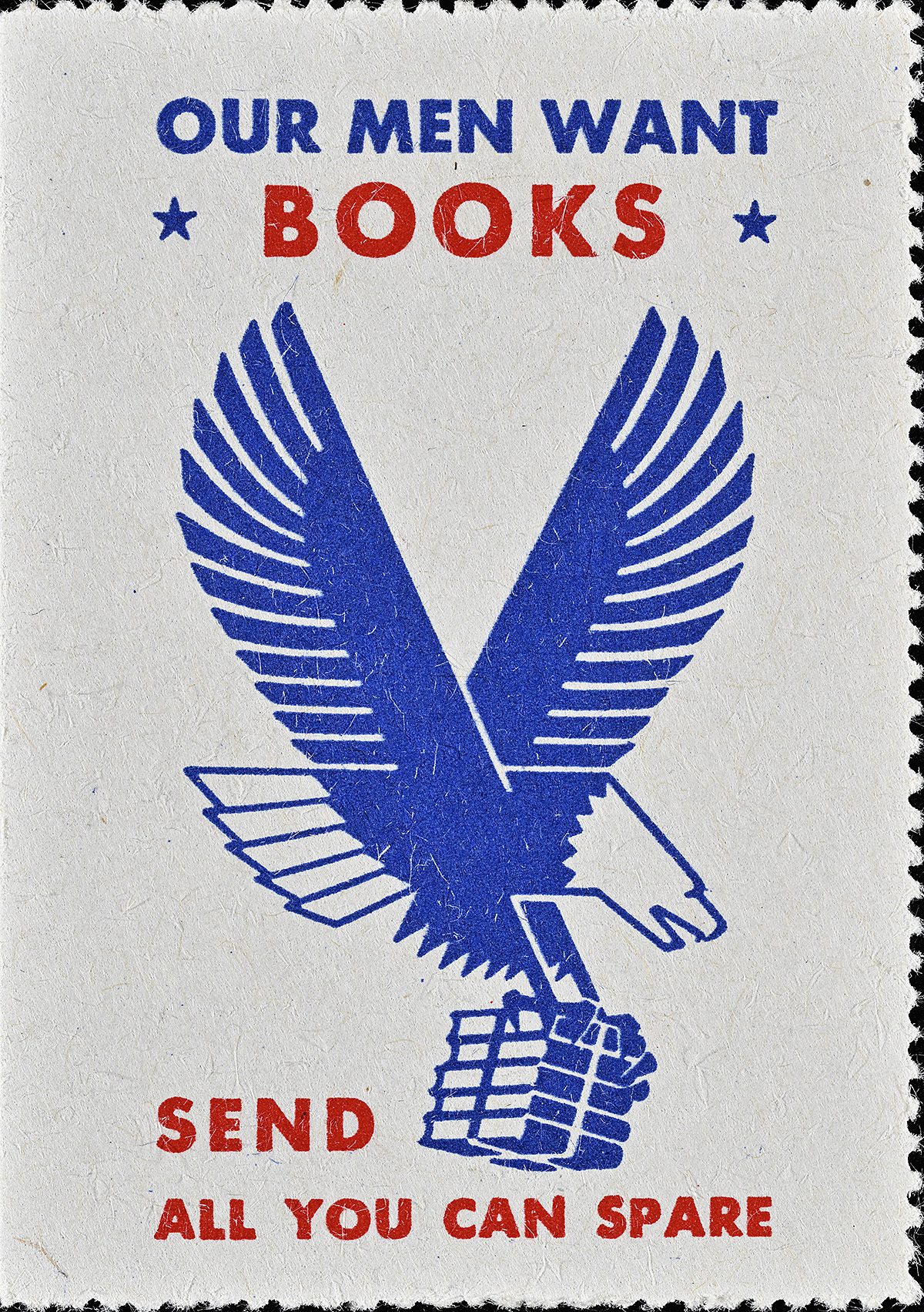
A stamp of a blue eagle with wings outstretched and a short stack of books held in its talons.

Various Ephemera, 1917–45 

Private Collection, NYC

  • Some of the imagery in the nearby posters served double duty and was repurposed on bookplates (decorative labels pasted inside the covers of books), brochures, and collectible stamps. With or without words, these illustrations conveyed the importance of books in wartime. 
  • The War Prisoners Aid brochure provides information to families about the efforts made by the YMCA to supply recreational items to servicemen in prisoner-of-war camps. 
  • The “Earn While You Learn” brochure aimed to increase recruitment by advertising the educational opportunities available in the Army.
  • Some of the images and texts in these objects are identical to those in their corresponding posters. In others, the color schemes or surrounding text have been adapted to a slightly different purpose. Can you match these objects with their related posters?

Curator

Molly Manning


Designer

Ola Baldych


Registrar

Melanie Papathomas


Production

Mihoshi Fukushima Clark


Installation

John F. Lynch


Special Thanks

Andrew Pettegree, University of St Andrews

Christopher P. Loss, historian

Catherine Bindman, editor

Randy Ferreiro, proofreader

Sofía Jarrín, Spanish translator 


PULL QUOTES:

“Give the book that causes a pang at parting, like saying goodbye to an old friend.”—WWI book donation plea

“Books are one of our rare pleasures.”—Anonymous soldier

“We are crying for reading material.”—Anonymous soldier

“We get curious about all books that are banned…who wouldn’t?”—Anonymous soldier

“Whenever we get [books] they are as welcome as a letter from home. They are as popular as pin-up girls….”—Private WRW and the Gang